
Using Perplexity’s Comet AI Browser for SEO
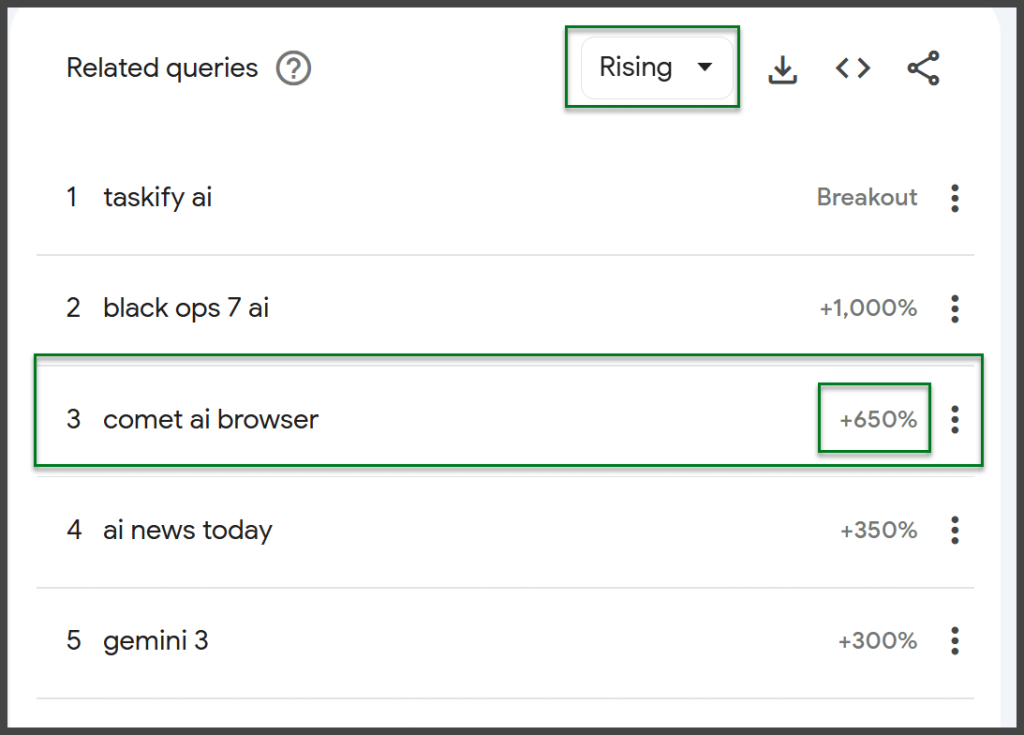
Around 1 month ago in October 2025, Perplexity allowed global and free access to their Comet browser. Since then, related search terms have been rising sharply, with “comet AI browser” being a top AI-related term in the past seven days:
So, what’s all the fuss about? Comet is an AI-powered automation browser produced by Perplexity which can help to transform simple browsing sessions into deep research or automation dives.
Could it be useful for SEO? Let’s explore.
Installing Comet AI Browser
The download an installation process is relatively straightforward. You can download Comet here. It’s currently available for Windows, Mac OS and Android. Once the installer downloads, execute it to install Comet.
Once Comet is installed, a window will open taking you through some basic configuration settings. Comet can pull in your existing Chrome profiles, including all of your Chrome extensions, bookmarks and stuff like that. Since Comet is based on the Chromium browser engine, most of your Chrome extensions and add-ins should be compatible with Comet.
Once Comet finally boots up, you will notice that it looks very Chrome-like. Indeed, many of the settings in the settings menu are identical to Chrome, whilst there are others based around Comet’s use of AI, privacy and automation.
Initiating Comet’s AI Assistant
Simply click on the large “Assistant” button in the top right, to gain access to Comet’s AI-powered assistant panel:
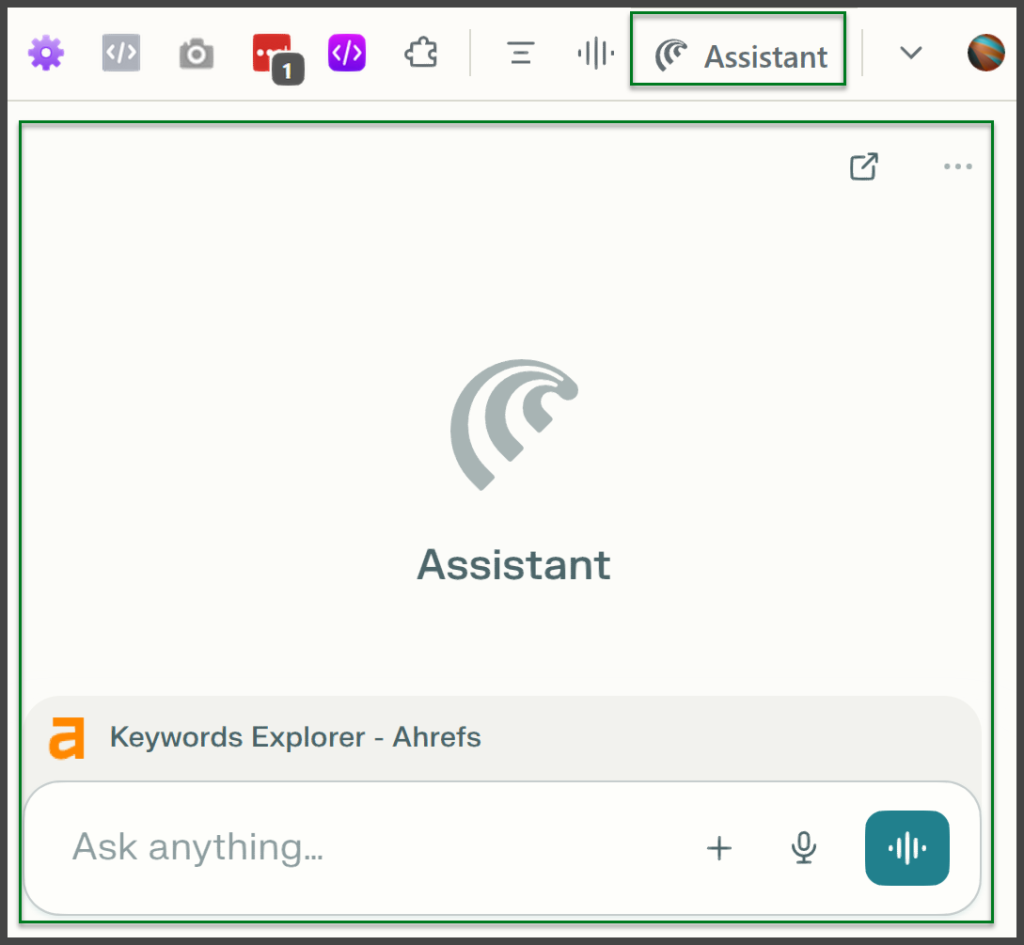
This is where you’ll type prompts in to initiate Comet’s AI functionality and task automation.
Taking Comet for an SEO Test-Spin
Let’s start by performing some keyword research in Ahrefs:
Overall, Comet performed well, browsing and combining data from multiple areas of Ahrefs’ keyword explorer. When I felt Comet had done enough work, I interjected, telling it to stop and report its findings. Comet performed adequately. A human Ahrefs operator may perhaps, have taken a more intelligent approach, rather than browsing all available tabs and sub-menus for additional keywords.
That being said, Comet was able to navigate and harvest data faster than a human operator could. As always with AI, there are both strengths and weaknesses of utilising such technology.
Let’s see how well Comet can navigate performance data in Google Search Console:
Comet was able to navigate the desired report fairly well, so long as thorough instructions were provided. Comet attempted to discard non-brand keywords within its active memory, rather than using Search Console’s in-built filtering options.
A human operator would perhaps have performed the requested operations in more depth, using all available filtering options. However, Comet did a decent job within the specified window of time (a couple of minutes only).
Let’s see how well Comet can navigate page–level data in Google Analytics:
Unfortunately, Comet hits hard limitations in terms of navigating GA4 dashboards and data. Comet has an in-built prevention measure, stopping it from browsing GA4 data. Comet reports:
“I apologize. Unfortunately, the system has security restrictions preventing me from accessing and interacting with Google Analytics URLs. This is a built-in security measure that blocks browser automation tools from accessing analytics data to protect account security and data privacy”.
So, it seems as if Comet is out in terms of, analysing GA4 native dashboard data. That’s a shame, and is a real Achilles heel for any technically competent SEO professional.
Let’s see how well Comet can navigate keyword ranking data within SEO Monitor:
Comet manages to navigate existing data fairly well; however, it doesn’t really filter or re-sort the data to gain the best insights. The output insights would be useable, and may have some SEO-impact, though a human could probably still do a better job.
Final Thoughts and Conclusions
AI SEO services are the future, but in terms of browser navigation and insight determination – the technology isn’t quite there yet. Certainly, this technology shows immense promise. For platforms with which the LLM / AI is more familiar (Ahrefs, Search Console), Comet conducts itself fairly well. For privacy-ringfenced platforms like GA4, Comet fails to perform entirely. For platforms which are accessible, yet which are less represented in the LLM (thus Comet has less navigation expertise, such as SEOMonitor), Comet fails to perform.
It’s not time to ditch your SEO and Analytics experts yet. In the future, such tools may help your analysts to derive insights more quickly. For now, it’s still a mixed bag of results. Where AI has more LLM information about a platform, and where certain platforms aren’t blocked – AI is helpful in those scenarios. Where the LLM knowledge is lacking, or where certain platforms are blocked from AI interactions, a human operator is still fundamentally required.
Here at Anicca, we stay up-to-date on all SEO, search and AI developments. You can check out our SEO services here, or our AI SEO services here. Impressed with our knowledge and coverage of search and AI? Give us a call on 0116 254 7224.