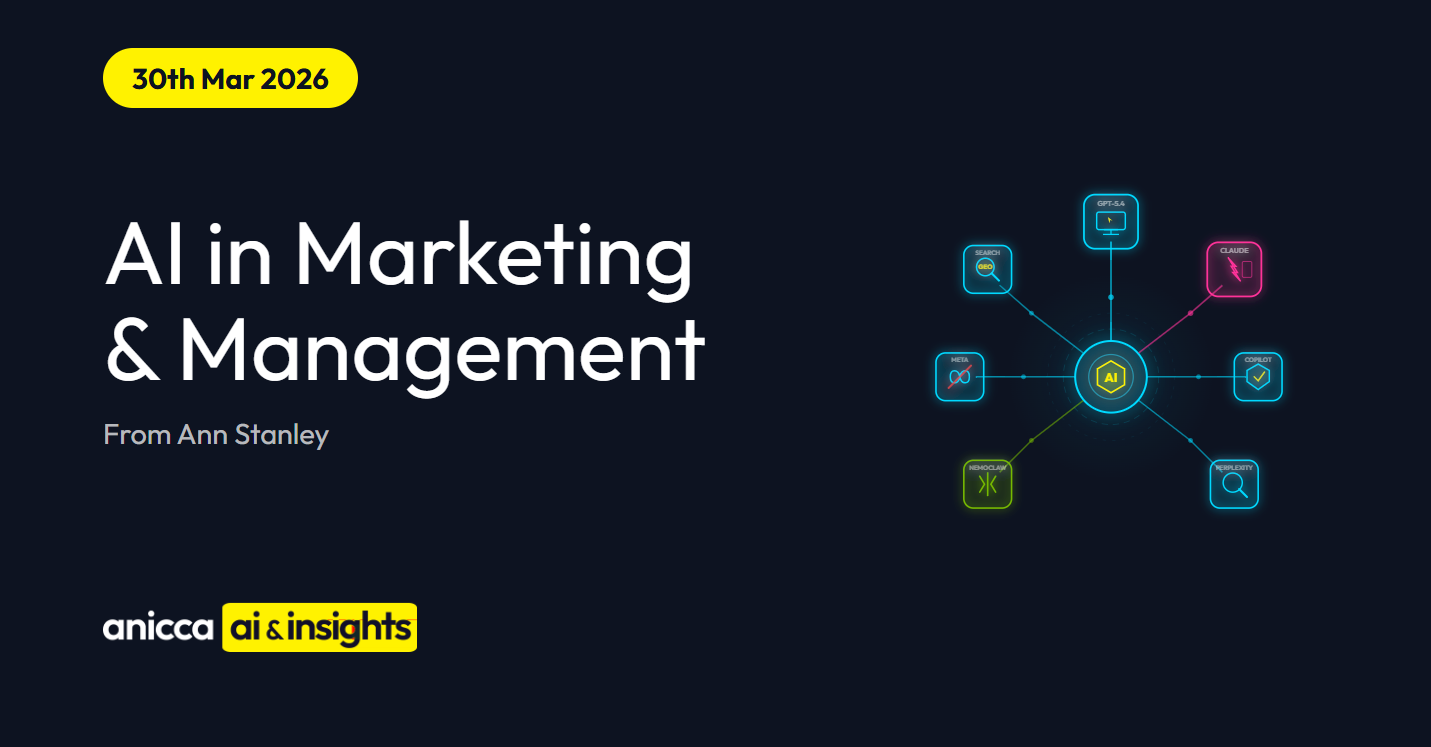
This Week in AI in Marketing & Management (30th Mar 26)
OpenAI Kills Sora, Anthropic Leaks Mythos, China Blocks Manus Deal, and Shopify Opens Agentic Storefronts
A packed week in AI.- OpenAI killed Sora just six months after launch, redirecting compute to coding and reasoning.
- Anthropic’s next-generation Mythos model was leaked, described as a “step change” beyond Claude Opus 4.6.
- China banned the founders of Manus AI from leaving the country over Meta’s $2 billion acquisition.
- Shopify opened Agentic Storefronts so millions of merchants can sell directly inside ChatGPT, Gemini, Copilot, and Google AI Mode.
- Google rolled out its March 2026 core update.
- Harvey raised $200 million at an $11 billion valuation to scale AI legal agents.
- Meanwhile, search budgets are shifting to GEO, and Search Engine Land published the first proper playbook for writing machine-readable content.
Table of Contents
AI News, Tech & Tools- The March 2026 Frontier: GPT-5.4 vs. Gemini 3.1 vs. Claude 4.6
- OpenAI Shuts Down Sora Video App, Pivots Compute to Coding and Reasoning
- Anthropic’s Mythos Model Leaked, Described as “Step Change” in Capabilities
- China Bans Manus AI Founders From Leaving Country Over Meta’s $2B Deal
- Google Gemini Now Imports Chats and Memory from ChatGPT and Claude
- Anthropic Launches Claude Code Auto Mode with AI Safety Classifier
- Google March 2026 Core and Spam Update: What We Know So Far
- Google Search Live Goes Global with Gemini 3.1 Flash Live
- OpenAI Pivots Agentic Shopping Strategy Towards Discovery
- GEO Is Now Stealing Search Budgets
- Wikipedia Bans AI-Generated Content
- How to Write for AI Search: The Machine-Readable Content Playbook
- How AI Agents Will Reshape Every Part of Marketing in 2026
- TikTok Launches Logo Takeover and Prime Time Ad Formats
- IAB Tech Lab Launches AAMP Standards for Agentic Advertising
- Anthropic Economic Index: AI Power Users Are Pulling Ahead
- HBR: AI Is Reshaping White-Collar Work, Not Erasing It
- AI Governance Gap: 53% of Organisations Lack Frameworks
- E-COMMERCE: Shopify Opens Agentic Storefronts to Millions of Merchants
- E-COMMERCE: Shopify Launches Tinker – 100+ AI Tools in One Free App
- E-COMMERCE: Amazon and Walmart Shift the Retail War From Sales to Outcomes
- MARKETPLACES: Amazon and Walmart Shift the Retail War From Sales to Outcomes
- HEALTHCARE: AI Infrastructure Gets $125M as Qualified Health Scales
- LEGAL: Harvey Raises $200M at $11B Valuation to Scale AI Legal Agents
- What are Shopify Agentic Storefronts?
- How is GEO different from traditional SEO?
- Should I worry about Google’s AI-generated title links?
AI News, Tech & Tools
The March 2026 Frontier: GPT-5.4 vs. Gemini 3.1 vs. Claude 4.6
Source: medium.com | Micheal Lanham | March 2026A detailed comparison of the three frontier models available in March 2026 highlights how the competitive landscape has shifted. GPT-5.4 leads on native computer use and agentic capabilities with its 1M token context window. Gemini 3.1 counters with Deep Think and native multimodal processing across Google’s ecosystem. Claude 4.6 brings extended thinking, the 1M context Opus variant, and what many developers consider the strongest coding and reasoning capabilities of the three.The real story here is that the gap between these models has narrowed dramatically. Each excels in different domains, and the choice increasingly depends on your use case rather than any single “best” model. For marketing teams evaluating AI stacks, the platform ecosystem matters more than raw model benchmarks.Why it matters The frontier model race is no longer about one winner. It is about which ecosystem you invest in. OpenAI has the broadest consumer reach, Google has search and enterprise infrastructure, and Anthropic has developer loyalty and safety focus. Marketers should stop asking “which model is best?” and start asking “which platform integrations matter most for our workflows?”OpenAI Shuts Down Sora Video App, Pivots Compute to Coding and Reasoning
Source: cnn.com | variety.com | hollywoodreporter.com | 24 March 2026OpenAI announced it is shutting down Sora, its text-to-video generation app, just six months after launch. The app closes on 26 April 2026, the API on 24 September. Sora shot to the top of the App Store at launch but failed to sustain user interest. OpenAI said it needed to “make trade-offs on products that have high compute costs” and is redirecting those resources towards coding, reasoning, and agentic AI. The Disney licensing deal that allowed Disney characters within Sora is also ending. The Sora research team will pivot to “world simulation research to advance robotics.”Why it matters Here is the thing: OpenAI just killed its most visible consumer product after ChatGPT because the compute economics did not work. Video generation is expensive and the revenue did not justify the GPU spend. This is a signal for the entire AI video space. Expect consolidation. For marketers who built workflows around Sora, the lesson is clear: do not build critical pipelines on single-vendor AI tools without a fallback plan. Google’s VEO 3 (now free in Ads Asset Studio) and Runway remain alternatives.Anthropic’s Mythos Model Leaked, Described as “Step Change” in Capabilities
Source: fortune.com | 26 March 2026Anthropic’s unreleased AI model, codenamed Mythos (also called Capybara internally), was exposed this week after security researchers discovered approximately 3,000 unpublished assets in a public data cache from the company’s content management system. A leaked draft blog post describes Mythos as “by far the most powerful AI model we have ever developed,” representing “a step change” in capabilities over Claude Opus 4.6. An Anthropic spokesperson confirmed the model exists, calling it “a general purpose model with meaningful advances in reasoning, coding, and cybersecurity.” The leaked materials also reveal heightened concerns about misuse, noting the model is “currently far ahead of any other AI model in cyber capabilities.”Why it matters Two stories in one here. First, the model itself: if Mythos genuinely represents a step change over Opus 4.6, the frontier model comparison we covered above is already outdated. Second, the leak: a CMS defaulting to public access is an embarrassing security lapse for a company that prides itself on AI safety. Anthropic plans a cautious rollout starting with early-access customers and cybersecurity organisations, which suggests they know the dual-use risks are real.China Bans Manus AI Founders From Leaving Country Over Meta’s $2B Deal
Source: techweez.com | cnbc.com | 25 March 2026Chinese authorities have imposed exit bans on Manus AI co-founders Xiao Hong and Ji Yichao, preventing them from leaving mainland China while Beijing reviews Meta’s $2 billion acquisition of the agentic AI startup. The investigation centres on what regulators call “Singapore washing”: throughout 2025, Manus wound down its Chinese operations, relocated its headquarters to Singapore, and replaced state-linked investors with US venture capital to present itself as a non-Chinese entity for the deal. The National Development and Reform Commission summoned the founders for questioning about potential violations of foreign direct investment rules. CNBC reports the move has “rattled tech founders and VCs” across Asia who were pursuing similar restructuring strategies.Why it matters This is not just a Meta problem. Beijing is signalling that agentic AI capabilities are now a national security matter, and restructuring your company to avoid Chinese oversight will not go unnoticed. For the broader AI industry, this creates a new risk factor for any cross-border AI acquisition involving Chinese-origin technology or talent. For marketers, the practical impact is that Manus had already started appearing as an embedded assistant inside Meta Ads Manager. If the deal unravels, that integration could stall.Google Gemini Now Imports Chats and Memory from ChatGPT and Claude
Source: winbuzzer.com | Markus Kasanmascheff | 27 March 2026Google launched import tools that let ChatGPT and Claude users migrate their full conversation history and AI-learned preferences to Gemini. Chat history import accepts ZIP files up to 5 GB, with up to five uploads per day. Memory import transfers learned preferences and context. According to recent estimates, Gemini has surpassed 750 million monthly active users, narrowing the gap with ChatGPT’s approximately 810 million. The move comes three weeks after Anthropic launched a similar memory import tool for Claude.Why it matters This is a data portability arms race. Google is making it as frictionless as possible to leave ChatGPT, and Anthropic did the same thing weeks earlier. The winner will be the platform that learns your preferences fastest and delivers the most useful responses. For businesses that have invested months training a particular AI on their workflows and preferences, the switching cost just dropped dramatically.Anthropic Launches Claude Code Auto Mode with AI Safety Classifier
Source: techcrunch.com | winbuzzer.com | 24 March 2026Anthropic’s latest Claude Code release centres on Auto Mode, a new feature that adds an AI safety classifier to review every action before Claude executes it. The classifier approves roughly 93% of routine operations automatically while flagging risky actions like mass file deletion, data exfiltration, or prompt injection attacks embedded in files. If three consecutive actions are blocked, Claude reverts to manual approval mode. Anthropic recommends using Auto Mode in isolated, sandboxed environments rather than production systems. Claude Code has now surpassed $2.5 billion in annualised revenue, up from $1 billion in early January 2026.Why it matters The revenue number is the headline: $2.5 billion annualised, 150% growth in under three months. Auto Mode is the feature that will accelerate this further, removing the biggest friction point for experienced users: constant permission prompts. For businesses deploying Claude Code across teams, the safety classifier approach (approve safe actions, flag risky ones) is a more pragmatic model than either “approve everything” or “approve nothing.”AI in Marketing
Google March 2026 Core and Spam Update: What We Know So Far
Source: seroundtable.com | Barry Schwartz | optimixed.com | numinix.com | 27 March 2026Google’s March 2026 core update began rolling out this week and is expected to take approximately two weeks to complete. Alongside it, the March 2026 spam update was a quick event, finishing within 20 hours. Google also confirmed it is now using AI to generate title links in search results, aiming to improve relevance and presentation. In Google Ads, Performance Max received audience exclusions and updated reporting features, while AI Mode added sponsored store listings and implemented overlay cards that affect click behaviour.Additional developments include Google Merchant centre mandating greyed-out “Buy Now” buttons for out-of-stock items, and Bing rolling out AI-powered reports updates. The combined effect of these changes is a search ecosystem that is becoming more AI-mediated at every touchpoint, from how titles are generated to how ads are served to how out-of-stock inventory is displayed.Why it matters The core update landing alongside AI-generated title links is significant. Google is no longer just ranking your content, it is rewriting how it appears in search results. If your click-through rates change over the next two weeks, it may not be a ranking shift at all. Check whether your title tags are being replaced by AI-generated alternatives before making any content changes.Google Search Live Goes Global with Gemini 3.1 Flash Live
Source: searchenginejournal.com | March 2026Google has made Search Live available in over 200 countries, expanding a feature previously limited to the US. Search Live lets users speak their queries and receive audio responses, then continue the conversation naturally. It also supports camera input via Google Lens, so users can point their phone at a product and ask questions about what it sees. The feature runs on Gemini 3.1 Flash Live, described as Google’s “highest-quality” audio model, which is inherently multilingual and supports conversation threads twice as long as its predecessor.Why it matters Search is becoming a conversation, not a text box. If your content strategy is still built around typed keyword queries, Search Live is the clearest signal yet that you need to think about how your brand sounds in a spoken answer, not just how it ranks in a list of blue links. Voice-optimised content, clear product descriptions, and structured data become essential when the search interface is a dialogue.OpenAI Pivots Agentic Shopping Strategy Towards Discovery
Source: digitalcommerce360.com | Brian Warmoth | 24 March 2026OpenAI has refined its agentic commerce vision, moving away from its initial instant checkout approach and towards product discovery via its Agentic Commerce Protocol (ACP). Target, Sephora, Nordstrom, Lowe’s, Best Buy, The Home Depot, and Wayfair have already integrated ACP for discovery. Walmart’s dedicated ChatGPT app is also taking shape, with newly unveiled details about how the retail giant’s integration will work within the conversational interface.The pivot is telling. OpenAI’s first attempt at in-chat checkout stumbled, and the company is now prioritising the moment before purchase, helping users find and compare products rather than trying to own the transaction itself. This maps to how consumers actually use ChatGPT: they ask for recommendations and research, not one-click buying.Why it matters The real story here is that OpenAI learned what Google learned years ago: owning the discovery layer is more valuable than owning the transaction. If your brand is not optimised for AI-driven product discovery, from structured product data to clear benefit statements, you are invisible to the growing number of consumers who start their shopping journey in a chat window rather than a search bar.GEO Is Now Stealing Search Budgets
Source: proopsconsulting.ca | theaimarketers.ai | Chris Quinn | March 2026Traditional search budgets are quietly shifting to generative engine optimisation (GEO). According to reporting from ProOps Consulting and The AI Marketers, marketers are reallocating search spend as AI-driven search surfaces like ChatGPT, Perplexity, and Google AI Overviews capture an increasing share of user queries. One brand reportedly bumped GEO spending by 10% in Q1 2026 alone. The shift is not about search budgets shrinking, it is about the split inside them changing fast.This trend aligns with what we have been tracking at Anicca. GEO is now the fastest-growing discipline in digital marketing, and the brands that invested early are seeing measurable visibility gains in AI-generated answers. The question is no longer whether to invest in GEO, but how much of your search budget to redirect.Why it matters Do not overlook this: if 10% budget reallocation is happening at brand level in Q1, expect 20-30% by Q4 as measurement frameworks mature and AI search market share grows. Agencies that cannot demonstrate GEO capabilities will lose pitches to those that can. Start auditing your clients’ visibility in AI Overviews, ChatGPT, and Perplexity now, before the budget conversation happens without you.Wikipedia Bans AI-Generated Content
Source: searchenginejournal.com | 27 March 2026Wikipedia has implemented new guidelines prohibiting editors from using LLMs to generate or rewrite article content. The ban stems from conflicts with three core Wikipedia policies: verifiability (LLMs generate text without traceable source citations), no original research (LLMs synthesise information in ways that advance positions not clearly supported by sources), and neutral point of view (LLMs may weight dominant perspectives over minority viewpoints). Two narrow exceptions remain: basic copyediting of your own writing after human review, and translation assistance between language editions.Why it matters Wikipedia is one of the most-cited sources in AI training data and in LLM-generated answers. This ban sends a clear signal: the platforms that care most about information quality are drawing hard lines against AI-generated content. For content marketers, the lesson is that AI-assisted is fine, but AI-generated without human oversight is increasingly unacceptable to the platforms that matter. If Wikipedia will not accept it, expect other high-authority sources to follow.How to Write for AI Search: The Machine-Readable Content Playbook
Source: searchengineland.com | Myriam Jessier | March 2026Search Engine Land published a comprehensive playbook for writing content that LLMs can extract, interpret, and cite in AI-driven search. The core argument: with proposition-based retrieval systems, writing like you are in the business of tricking a crawler into seeing relevance through keyword repetition is no longer viable. LLMs do not seek less information, they seek higher information density. Google’s Gemini operates on a limited “grounding budget” of retrieved information, meaning every sentence needs to carry maximum informational weight.The playbook covers structuring content around clear propositions rather than keyword density, using high-density concept blocks, and ensuring that each section of content can stand alone as a citeable answer. This is a fundamental shift from traditional SEO copywriting, where context was built across paragraphs and pages.Why it matters This is the practical companion to the GEO budget shift story above. If budgets are moving to GEO, content teams need a new writing framework. The key concept is the “grounding budget”: LLMs only retrieve a limited amount of text, so your content needs to deliver complete, self-contained answers in compact blocks. Start rewriting your top-performing pages with this density-first approach.How AI Agents Will Reshape Every Part of Marketing in 2026
Source: martech.org | Constantine von Hoffman | 26 March 2026MarTech’s analysis makes a striking point: AI agents will not just assist customers, they will be the customers. These autonomous agents scan catalogues, compare options, initiate payments, and handle communications in real time. Mark Menell, managing director at a consultancy, describes the shift as moving “from omnichannel to agentic commerce.” The agents do not browse sites or navigate apps as people do. They act, and fast.The article maps this shift across the full marketing stack: discovery, consideration, purchase, and post-sale. At every stage, marketers need to consider that their “customer” may be a software agent making decisions on behalf of a human, with different priorities and evaluation criteria than a human browser would have.Why it matters This connects directly to the Shopify Agentic Storefronts story. The infrastructure is being built now, and the early evidence suggests that product data quality, structured markup, and API accessibility will matter more than visual design or emotional copywriting when the buyer is an algorithm. Marketing teams need a dual strategy: one for human visitors, one for AI agents.TikTok Launches Logo Takeover and Prime Time Ad Formats
Source: techcrunch.com | Sarah Perez | 24 March 2026TikTok introduced two attention-grabbing ad formats this week. Logo Takeover lets brands co-brand with TikTok itself, placing a company logo next to TikTok’s own logo the moment users open the app. Prime Time shows three sequential ads from one advertiser to the same user within a 15-minute window during peak activity, letting brands tell a continuous story rather than relying on a single impression. TikTok also launched Smart+ Test, where its AI creates a second version of your conversion campaign for A/B comparison, and Custom Test for split-testing creative, targeting, or bidding.Why it matters These formats represent TikTok’s bet that attention scarcity requires bolder tactics. Logo Takeover is essentially buying the app’s identity for a moment, and Prime Time turns sequential storytelling into a paid format. For agencies managing paid social, the Smart+ Test feature is worth watching closely. Letting TikTok’s AI auto-generate a challenger campaign could surface creative angles your team would never have tested manually.IAB Tech Lab Launches AAMP Standards for Agentic Advertising
Source: digiday.com | March 2026IAB Tech Lab has launched its Agentic Advertising Management Protocols (AAMP), a standardisation initiative aimed at making AI-driven media buying, measurement, and compliance interoperable across the fragmented ad tech stack. The roadmap includes a collaboration with Kochava, integrating the AAMP Buyer Agent SDK into the StationOne platform as an open-source workspace. Tech Lab members can now work within StationOne to test and implement AAMP-based workflows for programmatic buying.The initiative comes as agentic AI moves rapidly from hype to production. Independent agency Butler Till completed the first real-world test of a programmatic media-buying agent for Geloso Beverage Group, reporting lower media costs and reduced supply-chain waste. Seedtag launched Liz Agent, an agentic platform for faster media strategy and campaign activation.Why it matters Standards are what turn experimental technology into scalable infrastructure. Without AAMP, every ad tech vendor builds agentic tools in isolation, forcing buyers and publishers to manage multiple incompatible systems. The real test is adoption speed. If major DSPs and SSPs implement AAMP within 2026, agentic media buying could become the default workflow by 2027.AI in Management
Anthropic Economic Index: AI Power Users Are Pulling Ahead
Source: anthropic.com | techcrunch.com | fortune.com | March 2026Anthropic published its Economic Index research this month, using privacy-preserving analysis of real Claude usage data to track how AI is affecting the workforce. The findings are nuanced. Claude currently covers only 33% of tasks in observed professional use for computer and maths roles, even though theoretical capability reaches 90% for office and administrative roles. Computer programmers (75% task coverage), customer service representatives, and data entry specialists rank among the most exposed occupations. The real impact so far is not mass layoffs but reduced hiring for junior roles, and a widening gap between AI power users and everyone else.Why it matters The skills gap finding is the one managers need to act on. Power users are pulling dramatically ahead of colleagues who have not adopted AI tools. This is not a future risk, it is happening now. If your team has uneven AI adoption, the productivity gap will widen every month. The most exposed roles are not disappearing overnight, but the hiring pipeline for junior positions in those roles is drying up quietly.HBR: AI Is Reshaping White-Collar Work, Not Erasing It
Source: hbr.org | metlife.com | March 2026Harvard Business Review published new research this month showing that generative AI is reshaping, not uniformly erasing, white-collar work. The findings align with MetLife’s 24th Annual Employee Benefit Trends Study, which found that 80% of employers say AI tools are now part of everyday tasks and 83% say AI is helping employees work faster and more efficiently. But the employee perspective is more anxious: 61% are worried about ethical and safety risks, and 59% fear that AI will make their jobs or skills obsolete faster than new opportunities are created. Workers with AI skills now command wage premiums up to 56% higher than their peers.Why it matters The 56% wage premium for AI-skilled workers is the number that should focus every manager’s attention. This is not about replacing people, it is about the growing gap between those who can use AI effectively and those who cannot. Organisations that invest in AI upskilling now will retain their best people. Those that do not will watch their most capable staff leave for employers who value and reward AI competency.AI Governance Gap: 53% of Organisations Lack Frameworks
Source: agilebrandguide.com | 26 March 2026Stensul’s research of 321 enterprise marketing decision-makers found that 53% of organisations lack comprehensive AI governance for campaign creation, even though AI is the number one organisational mandate for 38% of marketing teams. Nearly half report that AI has increased compliance and brand risk. The damaging cycle: organisations without governance experience more campaign errors, triggering heavier review processes, which erodes the speed advantage AI was supposed to create in the first place.Why it matters The governance finding connects directly to the skills gap story above. If your team is deploying AI without a governance framework, you are not moving faster, you are accumulating risk. The organisations that will scale AI successfully are the ones building guardrails alongside adoption, not after the mistakes start piling up.AI for Sectors & Industries
E-COMMERCE: Shopify Opens Agentic Storefronts to Millions of Merchants
Source: shopify.com | techcrunch.com | theaimarketers.ai | 24 March 2026Shopify launched Agentic Storefronts this week, giving its merchants out-of-the-box access to sell inside ChatGPT, Microsoft Copilot, Google AI Mode, and the Gemini app, all managed centrally from the Shopify Admin. Pricing, checkout, and inventory stay synced automatically. Brands that do not even use Shopify for e-commerce can now join through a new Agentic Plan and list products across the same AI channels. Speaking at the Upfront Summit, Shopify president Harley Finkelstein pointed out that only 18% of U.S. retail purchases happen online, and argued that agentic personal shoppers will become a new front door for e-commerce.Why it matters Here is the thing: Shopify is not just adding another sales channel. It is building the pipes that connect every major AI platform to commerce. If you are an e-commerce brand not thinking about how AI agents discover and recommend your products, you are already behind. The brands that optimise their product feeds, descriptions, and structured data for AI retrieval will be the ones these agents surface first.E-COMMERCE: Shopify Launches Tinker – 100+ AI Tools in One Free App
Source: pymnts.com | 26 March 2026Shopify also launched Tinker on 26 March, a free mobile app that consolidates more than 100 specialised AI tools into a single environment for building brand assets, storefronts, social content, and visual identity from plain-language inputs. Tinker draws on models from OpenAI, Google, and Anthropic, but organises them by output rather than model name. Merchants browse by what they want to create, not by which AI produces it. The core mechanic is prompt abstraction: a brand described in one sentence generates a logo, a product photo becomes a social media video, and multiple creations run simultaneously.Why it matters Tinker signals where the entire AI tools market is heading: away from “choose your model” and towards “describe what you need.” For agencies, this raises an uncomfortable question. If a small business owner can generate a full brand identity, product visuals, and social content from their phone in minutes, the value proposition of creative services shifts from production to strategy and quality control.E-COMMERCE: Amazon and Walmart Shift the Retail War From Sales to Outcomes
Source: pymnts.com | pymnts.com | March 2026The traditional ecommerce funnel ended at checkout. This week’s moves from both retailers suggest the playbook is being rewritten around owning the entire outcome, not just the transaction. Amazon is investing in humanoid and four-legged delivery robots, pushing into one- and three-hour deliveries, and expanding its free returns programme with FedEx. Walmart found that conversion rates were three times lower for products sold directly in ChatGPT than those rerouted to its own website, and is now stepping away from AI-driven checkout experiments to double down on controlling discovery through smart TVs and its Sparky AI assistant integration.Why it matters The Walmart conversion data is the number to remember: 3x lower conversion inside ChatGPT versus their own site. That validates OpenAI’s pivot away from instant checkout (covered above) and suggests that AI chat is better at discovery than closing. For ecommerce brands, the strategic implication is clear: optimise for AI-driven product discovery, but keep the purchase journey on your own site where you control the experience.MARKETPLACES: Amazon and Walmart Shift the Retail War From Sales to Outcomes
Source: pymnts.com | pymnts.com | March 2026The traditional ecommerce funnel ended at checkout. This week’s moves from both retailers suggest the playbook is being rewritten around owning the entire outcome, not just the transaction. Amazon is investing in humanoid and four-legged delivery robots, pushing into one- and three-hour deliveries, and expanding its free returns programme with FedEx. Walmart found that conversion rates were three times lower for products sold directly in ChatGPT than those rerouted to its own website, and is now stepping away from AI-driven checkout experiments to double down on controlling discovery through smart TVs and its Sparky AI assistant integration.Why it matters The Walmart conversion data is the number to remember: 3x lower conversion inside ChatGPT versus their own site. That validates OpenAI’s pivot away from instant checkout (covered above) and suggests that AI chat is better at discovery than closing. For ecommerce brands, the strategic implication is clear: optimise for AI-driven product discovery, but keep the purchase journey on your own site where you control the experience.HEALTHCARE: AI Infrastructure Gets $125M as Qualified Health Scales
Source: statnews.com | 25 March 2026Qualified Health, which helps health systems build and manage AI tools, raised $125 million this week. The company works with hospitals to deploy, monitor, and govern AI across clinical and administrative workflows. The funding reflects growing demand for AI infrastructure in healthcare, where the challenge is not building individual AI tools but managing dozens of them across complex, regulated environments. Health systems face simultaneous pressure from labour shortages, financial strain, and the need to reduce administrative burden, making AI deployment an operational necessity rather than a nice-to-have.Why it matters Healthcare is following the same pattern as legal: the money is flowing not to AI tools themselves, but to the platforms that manage, govern, and integrate them. Harvey for legal, Qualified Health for healthcare. The lesson for marketers watching sector AI trends is that governance and infrastructure are where the real scale happens. Building one AI tool is easy. Managing 50 across a regulated enterprise is the $125 million problem.LEGAL: Harvey Raises $200M at $11B Valuation to Scale AI Legal Agents
Source: theaiinsider.tech | pymnts.com | 27 March 2026Legal AI startup Harvey raised $200 million in a round co-led by GIC and Sequoia, bringing its valuation to $11 billion and total funding past $1 billion. The round closed just months after an $8 billion valuation in December. Harvey’s AI-powered platform now serves more than 100,000 lawyers across 1,300 organisations in 60 countries, including most of the Am Law 100, over 500 in-house legal teams, and 50 asset management firms. More than 25,000 custom AI agents operate on the platform, handling contract analysis, due diligence, compliance, and litigation workflows. Recent customers include NBCUniversal, HSBC, DLA Piper International, and McCann Fitzgerald.Why it matters Harvey’s trajectory is the clearest signal yet that vertical AI agents are not a niche play. An $11 billion valuation for a company that builds AI agents for a single profession tells you where the market is heading: deep, domain-specific AI that replaces workflow steps, not just generates text. For any sector, legal, finance, healthcare, the pattern is the same. The winners will be the platforms that embed AI agents directly into professional workflows, not the ones selling generic chatbots.Key Takeaways
- OpenAI shut down Sora after just six months, redirecting compute to coding, reasoning, and agentic AI – a signal for the entire AI video market
- Anthropic’s Mythos model was accidentally leaked, described as “by far the most powerful” model they have built, with heightened cybersecurity concerns
- China imposed exit bans on Manus AI founders over Meta’s $2B acquisition, treating agentic AI transfer as a national security matter
- Shopify Agentic Storefronts let millions of merchants sell inside ChatGPT, Gemini, Copilot, and Google AI Mode, making AI chat a genuine commerce channel
- Google’s March 2026 core update is rolling out alongside AI-generated title links, meaning Google now rewrites how your pages appear in search results
- OpenAI pivoted away from instant checkout towards product discovery via ACP, with Target, Sephora, Nordstrom, and Walmart already integrated
- Search budgets are shifting to GEO with one brand increasing GEO spend by 10% in Q1 alone, expect this to accelerate through 2026
- IAB Tech Lab’s AAMP standards aim to make agentic AI interoperable across the fragmented ad tech stack
- Google Gemini now imports chat history and memory from ChatGPT and Claude, intensifying the AI platform switching war
- Harvey raised $200M at $11B valuation, with 25,000+ AI agents serving 100,000 lawyers, proving vertical AI agents are big business
- TikTok launched Logo Takeover and Prime Time ad formats plus AI-powered Smart+ campaign testing
- Walmart’s data shows 3x lower conversion inside ChatGPT versus their own site, validating the discovery-not-checkout model
Frequently Asked Questions
What are Shopify Agentic Storefronts?
Agentic Storefronts are Shopify’s new feature that lets merchants sell products directly inside AI platforms including ChatGPT, Microsoft Copilot, Google AI Mode, and the Gemini app. Everything syncs from the Shopify Admin. Brands that do not use Shopify for their main e-commerce can still join through the new Agentic Plan.How is GEO different from traditional SEO?
GEO (Generative Engine Optimisation) focuses on getting your content cited and surfaced in AI-generated answers from platforms like ChatGPT, Perplexity, and Google AI Overviews. Unlike traditional SEO, which optimises for search engine rankings, GEO requires high-density, proposition-based content that LLMs can extract and cite directly.Should I worry about Google’s AI-generated title links?
Yes, but do not panic. Google is now using AI to generate title links in search results, which means the title you set in your HTML may not be what appears. Monitor your Search Console click-through rates over the next two weeks. If CTR drops, check whether your titles have been rewritten before making content changes.Conclusion
This week’s theme is clear: AI is no longer adjacent to marketing, it is becoming the primary channel through which commerce happens. Shopify’s Agentic Storefronts, OpenAI’s discovery pivot, and the GEO budget shift all point in the same direction. The brands and agencies that will win in 2026 are those building dual strategies for human and AI audiences, optimising product data for machine retrieval, and investing in GEO before the budget conversation moves without them.Need help adapting your AI marketing strategy? Contact the Anicca team for expert guidance.This roundup is compiled from publicly available sources using AI-assisted research. While we review every article for accuracy, our analysis reflects our interpretation of the original reporting. We strongly encourage readers to click through to the original sources linked throughout this post for full context and detail. If you spot anything that needs correcting, please let us know.
Thursday AI Club
A hands-on AI club for marketers and managers. Fortnightly 3-hour sessions: Hour 1 is an open Q&A on any AI question; Hours 2-3 split into a workshop track (for newbies) and an advanced track (live demos and deeper questions).
Led by Ann Stanley, James Allen.
Workshop recordings library
Skills and prompts to copy
Private community channel
Secret Agents community access
Full-day hackathon every quarter
Cancel any time
Membership: £40/month or £400/year
Join the Thursday AI Club →