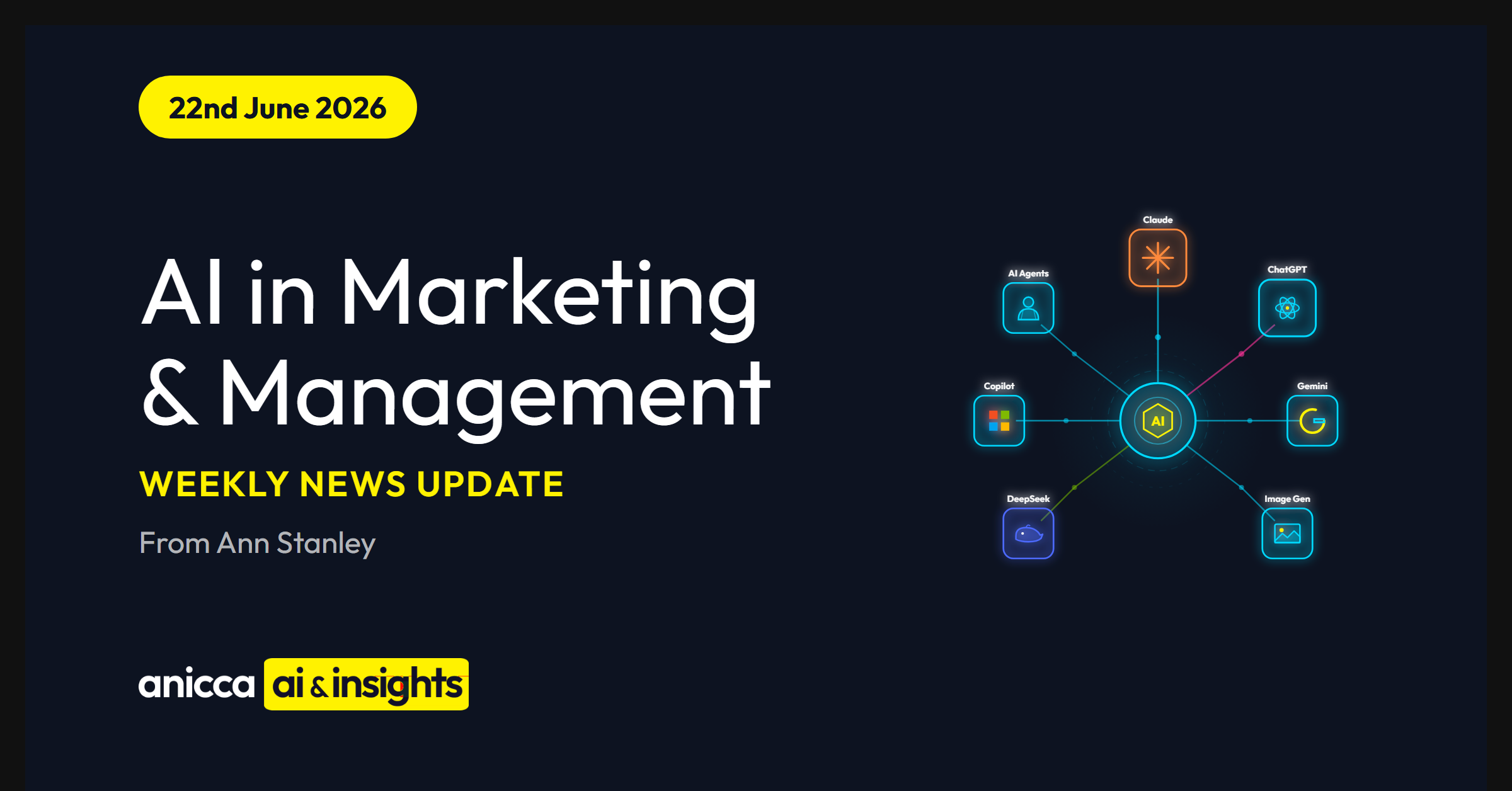
This Week in AI in Marketing & Management (22nd Jun 26)
Agentic Commerce Goes Mainstream, and the C-Suite Confidence Gap Widens
Shopify opened end-to-end agent commerce to every developer, Visa wired payments into ChatGPT, and Adyen, Stripe and Earnix all shipped agent-ready tooling. In marketing, WPP put a number on AI search, forecasting generative search advertising will reach £75bn by 2030, while OpenAI quietly opened its ChatGPT Ads Manager beta to UK advertisers. The management story was less comfortable: fresh research from LinkedIn, CGI and PwC shows leaders talking a confident AI game, while their organisations lag well behind, and the debate over cutting middle management for AI grew sharper. Here is everything that mattered, with our analysis of what to do about it.
Table of Contents
- Anthropic overhauls Claude Design and ships live shared Artifacts for enterprise teams
- Microsoft Copilot Cowork hits general availability and moves to usage-based pricing
- OpenAI’s Codex can now watch you work once and repeat the task forever
- ChatGPT launches a new Scheduled page for managing recurring tasks
- Google launches a Home Speaker built for the Gemini assistant
- Anthropic to meet the White House over an AI tool suspension
- EU AI Act amendment extends deadlines but creates new risks
- WPP forecasts generative search ad revenues to reach £75bn by 2030
- OpenAI opens its ChatGPT Ads Manager beta to UK advertisers
- Keeping your brand visible in AI search, and why generic content gets ignored
- Google softens its guidance on using LLMs.txt for AI SEO, and Adobe builds a GEO practice
- Google Ads ships three bidding and budgeting updates PPC managers need to know
- Google Ads adds AI voiceovers to Performance Max and Demand Gen video campaigns
- Meta tests an MCP server concept for AI-assisted ad workflows
- Adobe launches an AEO tool to track AI search and SGE presence
- LinkedIn launches AI training courses for marketers, and Microsoft expands seniority targeting
- BCG finds a wide gap between claimed and real agentic marketing transformation, and Dentsu revives 360i
- LinkedIn and CGI research finds the C-suite is flying blind on AI
- PwC’s 2026 AI Jobs Barometer links AI to higher productivity, wages and job growth
- As firms cut middle managers for AI, experts warn of a future leadership gap, while new entry-level roles emerge
- Meta’s Zuckerberg admits mistakes in the company’s AI transformation
- BCG says agentic AI turns every team into its own transformation engine, but UK governance lags
AI in E-commerce, Retail and Agentic Commerce
- Shopify opens end-to-end agentic commerce to every developer in its Spring ’26 Edition
- Agentic commerce needs open infrastructure to scale, with a $144bn opportunity by 2030
- Adyen, Stripe and Visa wire payments for agentic commerce
- AI-referred shoppers browse longer and spend more per visit
- AI forces retailers and brands to rethink their product pages
- Pinterest launches an experimental AI shopping app, Ask Pinterest, and THG and Pinterest push conversational retail
- 61% of consumers would let AI pick their pay-later options
AI for Other Sectors and Industries
- MANUFACTURING: Europe pushes AI into factories before its workforce retires
- ENERGY: BCG offers a real-world game plan for AI in renewable energy
- PROFESSIONAL SERVICES: Deloitte and Google Cloud launch a London AI Studio for agentic AI, as Earnix ships insurance-native AI
- HEALTHCARE: UK regulation of AI in healthcare starts to take shape
- PUBLIC OPINION: Pew finds rising AI use but persistently negative sentiment, as France and the UK weigh AI sovereignty
AI News, Tech & Tools
Anthropic overhauls Claude Design and ships live shared Artifacts for enterprise teams
Sources: venturebeat.com | venturebeat.com | 20 June 2026
Anthropic shipped two substantial updates to its Claude platform this week. The first is a major overhaul of Claude Design, adding brand-compliance controls, design-system imports, Claude Code integration and code round-trips, alongside a fix for the token-burning problem that had been driving up the cost of design work. The second is an Artifacts update for Claude Code on Team and Enterprise plans, bringing live, shared dashboards and interactive workspaces that multiple people can view and edit together.
Taken together, the two releases push Claude further from a chat box and towards a collaborative production environment. Brand-compliance controls in particular matter for agencies and in-house teams, because they let you bake a client’s or company’s visual rules into the tool rather than policing output by hand. The lower token usage is not a footnote either, it directly reduces the running cost of doing real work at scale.
Why it matters
For marketing teams, the combination of brand-compliance controls and shared interactive workspaces is the part to watch. It means AI design output can be governed against your brand guidelines automatically, and a campaign dashboard or creative brief can become a live object the whole team works in rather than a static file emailed round. If you have held back from AI design tools because output drifted off-brand, this is the update that starts to close that gap.
Microsoft Copilot Cowork hits general availability and moves to usage-based pricing
Sources: microsoft.com | axios.com | 22 June 2026
Microsoft made Copilot Cowork generally available worldwide this week, bringing secure, AI-powered automation for complex enterprise tasks across Microsoft 365. Cowork is designed to handle multi-step work rather than single prompts, the kind of agentic activity that spans documents, data and apps. Alongside the launch, Microsoft is shifting Cowork to usage-based pricing rather than a flat per-seat fee, and Axios reports the company is even weighing a Microsoft-hosted version of DeepSeek for enterprise customers.
The pricing change is the strategic signal. Usage-based billing tells you Microsoft expects Cowork consumption to vary wildly between light and heavy users, and it wants to capture the value from the heavy ones rather than leave money on the table with a fixed seat price. The DeepSeek consideration, meanwhile, shows even Microsoft is hedging on which underlying models power its enterprise AI.
Why it matters
Usage-based AI pricing is becoming the norm, and it changes how you budget. A flat per-seat cost is predictable, but consumption pricing means a single power user or an automated workflow left running can spike a bill fast. Before rolling Cowork out widely, agree internal guardrails on what gets automated and set spend alerts, or the productivity gains will be eaten by surprise invoices.
OpenAI’s Codex can now watch you work once and repeat the task forever
Source: the-decoder.com | 20 June 2026
OpenAI released Record & Replay for the Codex app on macOS, letting users walk the AI agent through a workflow once and have it repeated automatically afterwards. Rather than describing a task in words, you demonstrate it, and Codex captures the steps and reproduces them. It is a meaningfully different interaction model from prompting, closer to recording a macro than briefing an assistant.
This matters because the hardest part of automating knowledge work is usually the specification, getting the instructions precise enough that an agent does the right thing every time. Demonstration sidesteps that. You do the task properly once, and the agent learns the actual sequence rather than your imperfect description of it.
Why it matters
For marketers drowning in repetitive process work, reporting pulls, campaign setup, data exports, this is the pattern that finally makes automation accessible without technical skill. The teams that benefit first will be the ones that audit their weekly admin now and identify the three or four repeatable workflows worth recording. Start that list before the tools are everywhere, not after.
ChatGPT launches a new Scheduled page for managing recurring tasks
Source: techround.co.uk | 22 June 2026
ChatGPT added a dedicated Scheduled page that makes recurring tasks faster, more reliable and easier to manage in one place. Scheduled tasks let you set ChatGPT to run a prompt on a repeating basis, a daily briefing, a weekly summary, a regular check, and the new page gives that feature a proper home rather than burying it in settings.
It is a small interface change with a bigger implication: OpenAI is steadily turning ChatGPT from a thing you open and ask into a thing that works in the background on a schedule. Surfacing scheduled tasks as a first-class page makes that mode of use obvious to mainstream users who would never have found it otherwise.
Why it matters
Scheduled prompts are an easy, free way to build lightweight automation into a marketing routine, a Monday morning competitor scan, a weekly trend summary, a recurring content-idea generator. The barrier was never capability, it was discoverability. Now the feature has a front door, it is worth spending ten minutes setting up the recurring prompts that would otherwise sit on your to-do list.
Google launches a Home Speaker built for the Gemini assistant
Source: blog.google | 22 June 2026
Google unveiled the Google Home Speaker, the first device built specifically for its Gemini for Home voice assistant. It promises more intuitive help, immersive audio and a stronger privacy posture for everyday household use, positioning Gemini as the conversational layer for the smart home rather than a phone-only assistant.
Hardware built around a specific assistant is how a platform cements a habit. By putting Gemini at the centre of a dedicated speaker, Google is competing for the ambient, always-listening position in the home that shapes which assistant people reach for by default.
Why it matters
Voice and ambient AI are quietly becoming a discovery surface. As Gemini, Alexa and ChatGPT voice modes get better at answering shopping and recommendation questions out loud, the brands that get mentioned in spoken answers win attention that never touches a screen. It is early, but worth tracking how your brand and products are described when an assistant is asked about your category by voice.
Anthropic to meet the White House over an AI tool suspension
Source: bbc.com | 22 June 2026
Senior leaders at Anthropic are set to meet White House officials amid fresh national security concerns over the export of Claude models. The meeting follows tightening scrutiny of where powerful AI models can be used and by whom, with the US government treating model access as a matter of strategic control rather than ordinary commerce.
This is the clearest sign yet that frontier AI has become a geopolitical instrument. When access to a commercial model can be switched off for entire categories of overseas users on national-security grounds, the model stops being a neutral utility and becomes something closer to regulated dual-use technology.
Why it matters
For any UK business building on a US frontier model, this is a real continuity risk, not a distant policy story. Export controls and access restrictions could change which models you are allowed to use, with little notice. The practical response is to avoid hard-wiring your operations to a single provider and keep an eye on which models remain freely available in the UK.
EU AI Act amendment extends deadlines but creates new risks
Source: spglobal.com | 22 June 2026
Proposed changes to the EU AI Act aim to simplify implementation and address practical problems by clarifying rules and extending some timelines. S&P Global notes that while the amendment buys companies more time and removes some ambiguity, it also introduces fresh uncertainty, because shifting deadlines and reworded obligations force organisations to re-read requirements they thought were settled.
Extended deadlines sound like relief, but moving targets are their own kind of cost. Compliance teams that had planned against the original timeline now have to reassess, and any business that paused its preparation on the assumption the rules were fixed may find the goalposts have moved in both directions.
Why it matters
UK businesses trading into the EU are still in scope, and the simplest mistake is to treat a deadline extension as permission to stop preparing. Use the extra time to get your AI inventory and risk classification in order rather than parking it. The companies that stay ready through the changes will move faster than those scrambling when the final dates land.
AI in Marketing
WPP forecasts generative search ad revenues to reach £75bn by 2030
Sources: marketingweek.com | digiday.com | 22 June 2026
WPP Media’s This Year Next Year report forecasts that generative search advertising will reach £75bn globally by 2030, making it the fastest advertising channel ever to hit that milestone. The projection, echoed by parallel forecasts from consultancy Madison & Wall, points to rising search spend within a resilient overall ad economy, with generative search ads pulling budget faster than any previous format.
A forecast this size from a holding company the scale of WPP is a planning signal, not idle speculation. It tells you the agency world expects ads inside AI answer engines, ChatGPT, Gemini, Perplexity and Google AI Mode, to become a mainstream line in media plans within a few years, not a fringe experiment.
Why it matters
If generative search becomes the fastest-growing ad channel in history, the brands that learn it early will own the cheap, uncontested inventory before costs rise. That means watching the ChatGPT Ads Manager and Google’s AI search ad formats now, understanding how placement and measurement work, and building the internal know-how while the channel is still young. Waiting until it is proven means paying mature-market prices.
OpenAI opens its ChatGPT Ads Manager beta to UK advertisers
Source: searchengineland.com | 20 June 2026
OpenAI has opened its ChatGPT Ads Manager beta to UK advertisers, giving them an early chance to learn and prepare for what could become a major new advertising channel. The beta lets UK brands experiment with advertising inside ChatGPT before the format opens up broadly, a rare early-access window into ads placed directly in AI conversations.
The UK getting early access is notable. It puts British advertisers in an unusually strong position to build expertise in a channel that, if WPP’s forecast is right, will be one of the biggest growth stories in advertising this decade. Early betas are where the playbooks get written.
Why it matters
This is a genuine first-mover opportunity for UK brands, and they are rare. Getting into the ChatGPT Ads Manager beta now means learning how conversational ad placement, targeting and measurement actually work before your competitors have even seen the interface. If advertising inside AI chat is part of your category’s future, the time to build the skills is during the beta, not after launch.
Keeping your brand visible in AI search, and why generic content gets ignored
Sources: thedrum.com | cmswire.com | 22 June 2026
As AI reshapes how consumers discover brands, marketers face what The Drum calls a new identity crisis, and increasingly a choice between traditional SEO and AI optimisation. CMSWire sharpens the point with what it calls the mirror problem: AI answer engines only retrieve live web content when they need information they cannot generate from memory, so generic, me-too content that simply restates what every other site says never gets cited. The model already knows that, so it has no reason to fetch your version.
The combined message is uncomfortable but clarifying. Visibility in AI search is not won by producing more content, it is won by producing content distinctive enough that the model cannot reproduce it from its training data, original data, genuine expertise, specific examples and points of view it has not seen a hundred times already.
Why it matters
This reframes the whole content brief. If your blog repeats what is already common knowledge, AI answer engines will ignore it and answer from memory, citing nobody. The route to citation is original research, proprietary data, named experts and genuinely specific advice. Audit your highest-priority pages and ask a blunt question of each: could an AI write this without ever fetching it? If yes, it will not cite you.
Google softens its guidance on using LLMs.txt for AI SEO, and Adobe builds a GEO practice
Sources: searchenginejournal.com | business.adobe.com | 22 June 2026
Google’s updated guidance is now markedly less discouraging about LLMs.txt, special markup and markdown for AI SEO, a notable softening from its earlier scepticism. LLMs.txt is a proposed standard for telling AI crawlers how to find and use a site’s most important content, and Google moving from discouraging to neutral gives the practice more credibility. Adobe, meanwhile, published a guide to building a generative engine optimisation discipline to measure, monitor and optimise brand visibility inside AI search.
The two together mark GEO maturing from buzzword into a defined practice with emerging standards and enterprise tooling. When Google stops warning against a technique and a company like Adobe formalises the discipline, it stops being early-adopter territory and starts becoming standard operating procedure.
Why it matters
Generative engine optimisation is moving from experimental to expected. Adding an LLMs.txt file is now a low-risk step with Google’s tacit blessing, and building a structured way to measure your visibility inside ChatGPT, Perplexity and Google AI Mode is becoming part of the core SEO remit rather than a side project. If GEO is not yet someone’s explicit responsibility on your team, this is the quarter to assign it.
Google Ads ships three bidding and budgeting updates PPC managers need to know
Source: searchenginejournal.com | 22 June 2026
Google Ads is rolling out three changes that affect day-to-day campaign management. It is expanding Smart Bidding Exploration, launching a Promotion mode beta, and updating how it optimises budget-limited campaigns, with the changes beginning on 17 August. Smart Bidding Exploration lets Google’s automation test into queries it would not normally bid on, while the budget-limited optimisation change alters how constrained campaigns spend.
These are the kind of under-the-radar updates that quietly reshape account performance. Expanded Smart Bidding Exploration means Google’s algorithm gets more freedom to spend in new areas, which can find incremental conversions or waste budget depending on how tightly you have set things up.
Why it matters
The 17 August start date is your planning deadline. Before then, review your Smart Bidding targets and budget caps, because giving Google more exploratory freedom without checking your guardrails is how spend drifts. Test the Promotion mode beta on a low-risk campaign first. As automation takes more control, the human job shifts from setting bids to setting the boundaries within which the automation operates.
Google Ads adds AI voiceovers to Performance Max and Demand Gen video campaigns
Source: almcorp.com | 22 June 2026
Google Ads has rolled out AI-powered voiceover generation for Performance Max and Demand Gen video campaigns, letting advertisers add synthetic narration to video assets without a recording studio or voice talent. It is part of Google’s steady expansion of generative creative tools directly inside the ad platform, lowering the cost and time of producing video variations.
Generative creative inside the ad platform is a double-edged development. It dramatically cuts the cost of producing video at scale, which is genuinely useful for testing and localisation, but it also risks a flood of generic, samey video if everyone leans on the same default voices and templates.
Why it matters
AI voiceovers make video testing cheap enough to do properly, multiple variations, different messages, localised versions, without a production budget for each. The opportunity is volume and iteration. The risk is blandness, so use the tool to test more ideas faster, not to replace the distinctive creative that actually makes an ad memorable. The brands that win will treat AI creative as a testing accelerator, not a substitute for a point of view.
Meta tests an MCP server concept for AI-assisted ad workflows
Source: contentgrip.com | 22 June 2026
Meta has published an MCP server example that hints at outside AI agents connecting directly into ad workflows. The Model Context Protocol is the emerging standard that lets AI agents plug into external tools and data, and a Meta Ads MCP server would let an AI agent read campaign data and potentially take actions inside the ad account. ContentGrip notes this raises real questions about oversight, permissions and how fast an agent should be allowed to act.
This is an early but significant signal of where ad management is heading: from humans operating dashboards to agents operating accounts on instruction. An MCP server is the plumbing that makes that possible, and Meta publishing an example is a clear statement of direction.
Why it matters
Agentic ad management is coming, and the governance questions arrive with it. If an AI agent can adjust budgets and pause campaigns through an MCP connection, you need clear rules on what it may do autonomously and what needs a human sign-off. Start thinking now about the permissions and approval steps you would want around an agent with access to your ad spend, because the technology will be ready before most teams’ controls are.
Adobe launches an AEO tool to track AI search and SGE presence
Source: cmswire.com | 22 June 2026
Adobe has launched a new answer engine optimisation tool that pairs Semrush AI data with Adobe’s content tools to track and lift brand presence inside ChatGPT, Copilot, Perplexity and Google AI Mode. The offering gives marketers a way to measure how often and how favourably their brand appears in AI-generated answers, then act on the gaps using connected content tooling.
Measurement is the missing piece that has held AEO back. Until now, knowing whether your brand shows up in AI answers has been largely manual and anecdotal. A tool that quantifies presence across the major answer engines turns AEO from guesswork into something you can set targets against and report on.
Why it matters
You cannot manage what you cannot measure, and AI answer visibility has been almost impossible to measure at scale. Tools like this make it a trackable metric, which means it can finally sit in a marketing dashboard alongside organic rankings and paid performance. As these tools mature, expect AI answer share to become a standard KPI, so it is worth understanding the category now and deciding how you will benchmark your presence.
LinkedIn launches AI training courses for marketers, and Microsoft expands seniority targeting
Sources: socialmediatoday.com | socialmediatoday.com | 22 June 2026
LinkedIn launched a new programme of AI training courses for marketers, created in partnership with Adobe and designed to teach the fundamentals of AI usage to marketing professionals. Separately, Microsoft has extended LinkedIn’s seniority targeting to more ad objectives, giving advertisers more ways to refine promotions based on the seniority of the people they want to reach.
The training launch is a tell. When LinkedIn, one of the largest professional platforms in the world, decides marketers need structured AI fundamentals, it confirms the skills gap is real and broad rather than confined to laggards. The targeting expansion, meanwhile, is a practical upgrade for B2B advertisers who plan by seniority.
Why it matters
The free LinkedIn and Adobe AI courses are a low-cost way to lift baseline AI literacy across a marketing team, which is often the real blocker to adoption rather than the tools themselves. On the targeting side, expanded seniority objectives give B2B advertisers sharper control over reaching decision-makers. Both point to the same theme this week: the platforms are actively trying to pull marketers up the AI maturity curve.
BCG finds a wide gap between claimed and real agentic marketing transformation, and Dentsu revives 360i
Sources: bcg.com | marketingdive.com | 22 June 2026
BCG’s latest research exposes a sizeable gap between the AI transformation progress CMOs claim to have made and the changes they have actually instituted in their systems and workflows. In short, leaders report more transformation than the evidence supports. Against that backdrop, Dentsu is reviving its 360i brand as an agile, social-first team primed for AI, rather than a standalone agency, aimed at marketers investing more in creators and social.
The BCG finding is the more important of the two. A persistent gap between claimed and actual transformation is exactly how AI initiatives quietly stall, the leadership believes the work is done while the operating model underneath has barely moved. Dentsu restructuring around an agile, AI-ready model is one agency’s answer to closing that gap.
Why it matters
If CMOs are systematically overstating their AI progress, the honest question to ask internally is whether your own transformation is real or rhetorical. Real means changed workflows, new roles and measurable output, not a few pilots and a strategy deck. The agencies and in-house teams that win will be the ones that close the gap between the AI story they tell and the way work actually gets done.
AI in Management
LinkedIn and CGI research finds the C-suite is flying blind on AI
Sources: fortune.com | finance.yahoo.com | 22 June 2026
New LinkedIn research says half of C-suite leaders are effectively flying blind on AI, lacking clear visibility into how it is actually being adopted across their organisations. LinkedIn’s Mark Lobosco told Fortune that different parts of an organisation are often less willing to change, especially when jobs feel at risk. CGI’s parallel 2026 global research, based on talks with over 1,800 mostly C-suite executives, finds AI adoption rising but ambition consistently outpacing genuine enterprise readiness.
The two studies tell the same story from different angles: confidence at the top is running ahead of capability on the ground. Leaders see the strategic opportunity clearly, but underestimate the cultural resistance and readiness gaps that determine whether AI actually takes hold below them.
Why it matters
The dangerous version of this is a leadership team that believes its AI strategy is landing while the organisation quietly resists it. The fix is honest measurement of real adoption, who is using what, on which tasks, with what results, rather than relying on dashboards of licences bought. If you suspect a gap between your AI ambition and your organisation’s readiness, closing it starts with finding out the truth on the ground.
PwC’s 2026 AI Jobs Barometer links AI to higher productivity, wages and job growth
Source: pwc.com | 22 June 2026
PwC’s 2026 Global AI Jobs Barometer reports that AI is driving higher productivity, wage and job growth in the companies leading on adoption, while accelerating skill shifts and transforming entry-level roles. The finding pushes back on the simplest doom narrative, the data shows AI-leading firms growing jobs and raising wages, not just cutting headcount, though it confirms the nature of work is changing fast, particularly at entry level.
The nuance here matters. The headline that AI destroys jobs is too crude for what the evidence actually shows, which is a redistribution and a reshaping. Leading adopters are growing and paying more, but the roles themselves are being rebuilt around AI, and the skills premium is shifting accordingly.
Why it matters
For management, the message is that AI adoption and headcount growth are not opposites, the leading firms are doing both. The competitive risk is not over-hiring, it is falling behind on the productivity and skills curve while rivals pull ahead. Invest in reskilling so your people move up the value chain as AI takes the routine work, rather than treating AI purely as a cost-cutting lever.
As firms cut middle managers for AI, experts warn of a future leadership gap, while new entry-level roles emerge
Sources: hr.economictimes.indiatimes.com | cognizant.com | 22 June 2026
As companies cut middle-management layers in the name of AI-driven efficiency, experts warn this risks a future leadership gap, because middle management has traditionally been where future leaders are grown and tested. At the same time, a joint Cognizant and Pearson study, The AI Workforce Pulse, found 94% of HR leaders expect AI to create new entry-level roles rather than eliminate the bottom rung entirely, arguing entry-level work remains essential.
Read together, the two reports describe a workforce being reshaped at both ends. The middle is being thinned for efficiency while the bottom is being reimagined rather than removed. The unanswered question is how organisations develop leaders if they hollow out the layer where leadership has always been learned.
Why it matters
Cutting middle management for short-term efficiency can create a long-term succession problem that does not show up for years. If AI lets you flatten the org, you still need a deliberate plan for how people gain the judgement and people-management experience that the middle layer used to provide. The smartest organisations will redesign career development, not just delete the rungs.
Meta’s Zuckerberg admits mistakes in the company’s AI transformation
Source: hrexecutive.com | 22 June 2026
After a large round of layoffs described as being driven by AI transformation, Meta CEO Mark Zuckerberg has publicly acknowledged the company has made mistakes in how it handled the shift. The admission is notable because it comes from one of the most aggressive corporate adopters of AI, and it concedes that cutting first and reorganising around AI second did not go to plan.
When a leader as bullish on AI as Zuckerberg admits errors in the transformation, it is worth listening. The implicit lesson is that treating AI primarily as a justification for cuts, rather than as a genuine operating-model redesign, tends to backfire, on morale, on capability and on the work itself.
Why it matters
This is a useful cautionary tale for any leadership team tempted to lead its AI transformation with redundancies. The firms getting AI right are redesigning how work is done and bringing people with them, not cutting first and hoping the reorganisation sorts itself out. Sequence matters: change the workflows, prove the gains, then make structural decisions, in that order.
BCG says agentic AI turns every team into its own transformation engine, but UK governance lags
Sources: bcg.com | itbrief.co.uk | 22 June 2026
BCG argues that as organisations adopt agentic AI, transformation shifts from centralised, top-down programmes to team-led workflow redesign, with each team becoming its own transformation engine. The counterpoint comes from IT Brief, which reports many large UK firms still struggling to embed AI into daily operations despite strong demand, with skills and governance lagging even as governance spending rises.
The tension between the two is the real story. BCG’s vision of decentralised, team-led transformation is compelling, but it only works if the underlying skills and governance are in place, which the UK research suggests they often are not. Devolving AI transformation to teams without the right guardrails is how you get inconsistency and risk.
Why it matters
Empowering teams to redesign their own AI-enabled workflows can move far faster than a central programme, but only on a foundation of shared standards, skills and governance. The practical sequence for UK leaders is to get the guardrails and baseline literacy right first, then push autonomy down to teams. Decentralise the doing, but not before you have centralised the rules.
AI in E-commerce, Retail and Agentic Commerce
Shopify opens end-to-end agentic commerce to every developer in its Spring ’26 Edition
Source: shopify.com | 22 June 2026
Shopify’s Spring ’26 Edition makes it possible for anyone to build end-to-end agentic commerce on the platform, alongside a foundational rebuild of the infrastructure underneath every app. In practice, that means developers can now build experiences where AI agents handle the full shopping journey, discovery, selection and checkout, on top of Shopify, rather than stitching together partial workarounds.
This is a platform-level commitment to the agent-led future of shopping, not a bolt-on feature. By rebuilding the foundations and opening agentic capability to every developer, Shopify is betting that a meaningful share of commerce will soon be transacted by AI agents on behalf of shoppers, and positioning itself as the place that gets built on.
Why it matters
For the hundreds of thousands of brands on Shopify, agentic commerce is moving from theory to a capability sitting inside the platform you already use. The brands that prepare their product data, pricing and content to be readable and trustworthy to AI agents will be the ones agents recommend and transact. This is the moment to make sure your store is built to be shopped by machines as well as people.
Agentic commerce needs open infrastructure to scale, with a $144bn opportunity by 2030
Sources: forbes.com | blog.google | 22 June 2026
Forbes argues that OpenAI’s first agentic commerce attempt stumbled not on AI capability but on missing infrastructure, and that closing that gap unlocks a market opportunity Forbes pegs at $144bn by 2030. Reinforcing the point, Google used the Open Source Summit North America to introduce the Universal Commerce Protocol, a set of open rails designed to let agentic commerce work across platforms rather than locking it inside one company’s walled garden.
The theme is that agentic commerce will only reach its potential on shared, open standards, the same way the web and payments did. Google backing an open protocol, rather than a proprietary one, signals an industry recognition that no single player can own the rails if agent-led shopping is to scale.
Why it matters
Open standards for agentic commerce are good news for brands and retailers, because they reduce the risk of being locked into one gatekeeper’s ecosystem. As protocols like UCP mature, the businesses that adopt agent-friendly standards early will plug into the widest set of AI shopping agents. Keep an eye on which standards gain traction, because backing the winning rails will shape how easily agents can find and buy your products.
Adyen, Stripe and Visa wire payments for agentic commerce
Sources: digitaltransactions.net | emarketer.com | exchangewire.com | 22 June 2026
The payments industry moved decisively on agentic commerce this week. Adyen launched Adyen Agentic, Stripe deepened its own agentic infrastructure for merchants, and Visa enabled agent payments inside ChatGPT, letting an AI agent complete a purchase on a shopper’s behalf. eMarketer frames Adyen and Stripe as deepening their involvement in the infrastructure that makes agent-led transactions possible, while the Visa integration shows the card networks are not standing back.
When the payment processors and card networks build for a use case, it stops being speculative. Payments is the hardest part of agentic commerce to get right, trust, fraud, authorisation, and the fact that Adyen, Stripe and Visa are all shipping for it in the same week tells you the rails are being laid in earnest.
Why it matters
Payment is the final barrier to agent-led shopping, and it is being dismantled fast. Once an AI agent can discover, select and pay without a human touching the checkout, the entire funnel changes. Retailers should be talking to their payment providers now about agentic capabilities, and rethinking a checkout experience that may soon be navigated by software rather than people.
AI-referred shoppers browse longer and spend more per visit
Source: reuters.com | 22 June 2026
New data shows US shoppers who use large language models for purchase recommendations linger longer on retailers’ sites and spend more per visit than other visitors. The finding suggests AI-referred traffic is not just incremental but higher quality, arriving with stronger intent because the shopper has already had a recommendation conversation before clicking through.
This is one of the first solid data points showing AI referral is commercially valuable, not just a novelty. If shoppers who arrive via an LLM recommendation are more engaged and spend more, then visibility inside AI answers translates directly into revenue, which changes the business case for investing in it.
Why it matters
This gives the AI-visibility argument a hard commercial number behind it. If AI-referred shoppers spend more, then getting recommended by ChatGPT, Gemini or Perplexity is a revenue channel, not a vanity metric. It strengthens the case for generative engine optimisation and for ensuring your products and content are the ones AI assistants surface when a shopper asks for a recommendation in your category.
AI forces retailers and brands to rethink their product pages
Source: modernretail.co | 22 June 2026
Leaders across e-commerce are rethinking how they design product pages so they are more discoverable to AI agents, according to Modern Retail. The shift is away from pages optimised purely for human browsing and towards pages that AI shopping agents can read, understand and trust, with clear structured data, complete attributes and machine-readable detail.
This is the practical, unglamorous work that agentic commerce actually requires. Before an agent can recommend or buy your product, it has to understand it, and a product page built only for human eyes, with key details buried in images or marketing copy, is invisible to a machine making a recommendation.
Why it matters
Product page optimisation for AI agents is becoming a competitive necessity, and it is squarely within most teams’ control. Structured data, complete and accurate attributes, clear specifications and genuine review content all help agents understand and trust your products. This is concrete work you can start now, and it compounds, because the brands with the cleanest, most machine-readable product data will be the ones agents confidently recommend.
Pinterest launches an experimental AI shopping app, Ask Pinterest, and THG and Pinterest push conversational retail
Sources: techcrunch.com | retailtechinnovationhub.com | 22 June 2026
Pinterest announced Ask Pinterest, an experimental app for exploring a more conversational approach to shopping, letting users ask for ideas and products in natural language rather than browsing pins. In parallel, THG Ingenuity unveiled a new AI shopping assistant built with Google Cloud, acting as a dedicated expert for online shoppers across the sites it powers.
Both moves point to the same destination: shopping as a conversation rather than a search. Whether it is Pinterest exploring conversational discovery or THG embedding an expert assistant into its merchants’ stores, the interface for finding and choosing products is shifting from filters and grids to dialogue.
Why it matters
Conversational shopping is becoming a real channel, and it rewards brands whose product information answers the questions shoppers actually ask. When a customer describes a need to an AI assistant rather than typing keywords, the products that surface are the ones with rich, relevant, well-structured information about use cases and benefits, not just specifications. Think about the questions your customers ask and make sure your content answers them in language an assistant can use.
61% of consumers would let AI pick their pay-later options
Source: pymnts.com | 22 June 2026
PYMNTS Intelligence reports that 61% of consumers would let AI recommend their buy-now-pay-later options, provided it protects their credit, cost and control. The finding shows consumers are increasingly willing to hand financial decisions to AI, not just product choices, as long as the AI is acting in their interest and keeping them informed.
This is a notable extension of trust. Letting an AI choose a jumper is one thing, letting it pick a credit product is a bigger step, and a majority saying yes signals that consumer comfort with AI-mediated decisions is deepening into financial territory faster than many expected.
Why it matters
As AI agents take on more of the purchase decision, including how shoppers pay, retailers need to ensure their checkout and finance options are presented clearly enough for an agent to evaluate and recommend. If a majority of consumers will let AI choose their pay-later option, the brands whose payment choices are transparent, well-structured and genuinely competitive will be the ones agents select. Payment is becoming part of the agent-readable shopping experience too.
AI for Other Sectors and Industries
MANUFACTURING: Europe pushes AI into factories before its workforce retires
Source: bloomberg.com | 22 June 2026
As experienced factory workers retire, Europe’s industries are turning to AI to fill the looming labour gap, according to Bloomberg. The driver is demographic as much as technological: an ageing manufacturing workforce means critical skills and tacit knowledge are walking out the door, and AI is being positioned to capture and replace some of that capacity before it is lost.
This is a clear example of AI adoption pulled by necessity rather than ambition. When the alternative to automation is an unfillable skills shortage, the business case writes itself, and Europe’s manufacturing base is finding that AI is less a choice than a response to a demographic cliff.
Why it matters
The lesson generalises well beyond factories. AI adoption is most compelling where it solves a concrete, pressing problem, here, retiring expertise, rather than being pursued for its own sake. For any organisation, the strongest AI business cases tend to be the ones tied to a real operational pressure. Find where your equivalent of the retirement cliff is, and that is where AI will deliver clearest value.
ENERGY: BCG offers a real-world game plan for AI in renewable energy
Source: bcg.com | 22 June 2026
BCG sets out how renewable energy players can create substantial value from AI by following a structured approach grounded in operational realities rather than hype. The emphasis is on practical, grounded implementation, identifying the specific operational problems AI can solve in renewables and building from there, instead of chasing ambitious but unfocused transformation.
The grounded framing is the takeaway for any sector. BCG’s insistence on starting from operational realities is a useful corrective to the tendency to launch sprawling AI programmes that never connect to a concrete business problem.
Why it matters
The structured, problem-first approach BCG advocates for renewables applies to AI adoption everywhere. Start with the operational realities and the specific problems worth solving, then apply AI to those, rather than starting with the technology and hunting for a use. Grounded, problem-led implementation consistently beats ambitious but unfocused transformation, whatever the industry.
PROFESSIONAL SERVICES: Deloitte and Google Cloud launch a London AI Studio for agentic AI, as Earnix ships insurance-native AI
Sources: deloitte.com | insurancebusinessmag.com | 22 June 2026
Deloitte announced a new AI Studio on its London campus, built with Google Cloud and aimed at spearheading the UK’s transition to agentic AI, a significant expansion of its delivery capability. Separately, Earnix launched AIOS, an AI Orchestration System it describes as the first AI purpose-built for insurance decisioning, designed for high-stakes business decisions where accuracy and governance are critical.
Both stories show agentic AI moving into regulated, high-stakes professional contexts. Deloitte building dedicated UK capability and Earnix building insurance-native AI for consequential decisions reflect a maturing market where AI is being engineered for sectors that cannot tolerate the loose, generic output of a general-purpose model.
Why it matters
The trend towards purpose-built, sector-specific AI is one to watch. General-purpose models are powerful, but high-stakes decisions in insurance, finance and similar fields increasingly demand AI engineered for that context, with the right guardrails, explainability and domain knowledge built in. As this category grows, expect more specialised AI tools tailored to the specific demands and regulations of individual industries.
HEALTHCARE: UK regulation of AI in healthcare starts to take shape
Source: burges-salmon.com | 22 June 2026
A run of recent announcements is giving health-tech companies and the NHS clearer insight into the future regulatory requirements for AI in UK healthcare, according to law firm Burges Salmon. The emerging picture helps organisations developing or deploying healthcare AI understand the compliance landscape they will need to operate within as the rules firm up.
Regulatory clarity, even partial, is what unlocks confident investment in a sensitive sector. Healthcare AI has enormous potential but operates under understandable caution, and a clearer view of the requirements lets organisations build and deploy with less risk of being caught out by rules that arrive later.
Why it matters
The broader lesson is that regulatory clarity drives confident adoption. In healthcare and every other regulated sector, organisations that understand the emerging rules can move decisively while others hesitate. Keeping close to the regulatory developments in your industry is not a compliance chore, it is a competitive advantage, because clarity is what lets you commit while competitors wait.
PUBLIC OPINION: Pew finds rising AI use but persistently negative sentiment, as France and the UK weigh AI sovereignty
Sources: pewresearch.org | theguardian.com | gov.uk | 22 June 2026
Pew Research centre’s latest study finds more Americans using chatbots, AI summaries and smart speakers than ever, yet overall sentiment about AI still tilts negative, a striking gap between rising adoption and persistent unease. On the policy side, France announced it will drop Palantir’s AI data tools in favour of domestic provider ChapsVision to avoid strategic dependencies on US-controlled technology, while the UK government published AI Scenarios 2030 to help policymakers plan for a range of possible AI futures.
The common thread is sovereignty and trust. Citizens are using AI more while trusting it less, and governments are increasingly wary of depending on foreign-controlled AI infrastructure, with France’s move a concrete example of strategic decoupling and the UK’s scenario planning a sign of how seriously the long-term questions are being taken.
Why it matters
The adoption-trust gap is a direct challenge for any business deploying AI with customers. People are using AI more but trusting it less, which means transparency about how and where you use AI, and a clear human fallback, are becoming commercial necessities, not nice-to-haves. The brands that are open about their AI use and give customers genuine control will earn the trust that turns rising usage into lasting loyalty.
Key Takeaways
- Agentic commerce became infrastructure this week: Shopify opened end-to-end agent commerce to every developer, while Adyen, Stripe and Visa all shipped agent-payment capabilities. If you sell online, start making your product data and checkout readable to AI agents now.
- WPP forecasts generative search advertising will reach £75bn by 2030, the fastest channel ever to that milestone, and OpenAI opened its ChatGPT Ads Manager beta to UK advertisers. UK brands have a rare first-mover window, get into the beta and learn the channel early.
- Generic content is invisible in AI search. Answer engines only fetch live content they cannot generate from memory, so original data, expertise and specific points of view are now the price of being cited. Audit whether an AI could write your top pages without ever fetching them.
- The C-suite is overconfident on AI: LinkedIn, CGI and PwC research all show leaders’ ambition outpacing real organisational readiness. Measure actual adoption on real tasks, not licences bought, to find the truth on the ground.
- Cutting middle management for AI risks a future leadership gap, while 94% of HR leaders expect AI to create new entry-level roles. Redesign career development deliberately rather than just deleting the rungs where leaders are grown.
- AI-referred shoppers browse longer and spend more per visit, giving AI visibility a hard commercial number. Generative engine optimisation is a revenue channel, not a vanity metric.
- Google Ads ships three bidding and budgeting changes from 17 August, including expanded Smart Bidding Exploration. Review your targets and budget caps before then, because more automation freedom without guardrails is how spend drifts.
Frequently Asked Questions
How should my brand prepare for agentic commerce now that Shopify and the payment networks have opened it up?
Start with your product data and content, because that is what AI agents read to decide whether to recommend and buy your products. Make sure attributes are complete and accurate, specifications are structured and machine-readable, and your content answers the questions shoppers actually ask rather than just listing features. Then talk to your payment provider about agentic capabilities, since Adyen, Stripe and Visa are all building for agent-led checkout. The brands that are easiest for an agent to understand and transact with will be the ones agents choose.
Should UK marketers get into the ChatGPT Ads Manager beta?
If advertising inside AI conversations could be relevant to your category, yes, the UK early-access window is a genuine first-mover advantage. WPP forecasts generative search advertising will be the fastest-growing channel in advertising history, reaching £75bn by 2030, so learning how conversational ad placement, targeting and measurement work before competitors have even seen the interface is valuable. Treat the beta as a low-cost way to build expertise and internal playbooks while the channel is still cheap and uncontested.
Our content is not showing up in AI search results. What should we change?
The core issue is usually that the content is too generic. AI answer engines only retrieve live web content when they need information they cannot generate from their own training, so content that simply restates common knowledge never gets cited. Shift towards original research, proprietary data, named experts and genuinely specific, experience-based advice. A useful test is to ask of each important page: could an AI write this without ever fetching it? If the answer is yes, it will not cite you.
How do I close the gap between our AI ambition and what our organisation has actually adopted?
Start by measuring reality rather than intent. Research from LinkedIn, CGI and PwC this week showed leaders consistently overestimate their organisation’s AI readiness, so find out who is genuinely using which tools, on which tasks, with what results, instead of relying on the number of licences purchased. Then address the real blockers, usually baseline AI literacy and cultural resistance, with practical training and clear governance. Lead the transformation by redesigning how work is done and bringing people with you, not by cutting first and reorganising later.
Conclusion
This was the week agentic commerce crossed from concept to infrastructure, and the gap between AI ambition and AI reality came into sharp focus. The opportunities are concrete and time-sensitive: a first-mover window in AI advertising, a measurable revenue case for AI search visibility, and a platform-level shift to agent-led shopping that rewards the brands that prepare their data now. The risks are just as concrete: spend that drifts as automation takes control, transformations that exist more in leadership decks than in real workflows, and structural cuts that solve a short-term efficiency problem while creating a long-term leadership one.
Three actions for UK marketing and management leaders this quarter. First, make your product data and content readable to AI agents, because agentic commerce is now built into the platforms you already use. Second, measure your real AI adoption and your AI search visibility honestly, so strategy is grounded in what is actually happening rather than what you hope is. Third, treat AI transformation as an operating-model redesign that brings people with it, not as a cost-cutting exercise dressed up as progress.
Need help turning this week’s AI developments into a practical plan for your business? Contact the Anicca team for expert guidance on AI in marketing and management.


Thursday AI Club
A hands-on AI club for marketers and managers. Fortnightly 3-hour sessions: Hour 1 is an open Q&A on any AI question; Hours 2-3 split into a workshop track (for newbies) and an advanced track (live demos and deeper questions).
Led by Ann Stanley, James Allen.
Membership: £40/month or £400/year
Join the Thursday AI Club →This roundup is compiled from publicly available sources using AI-assisted research. While we review every article for accuracy, our analysis reflects our interpretation of the original reporting. We strongly encourage readers to click through to the original sources linked throughout this post for full context and detail. If you spot anything that needs correcting, please let us know.