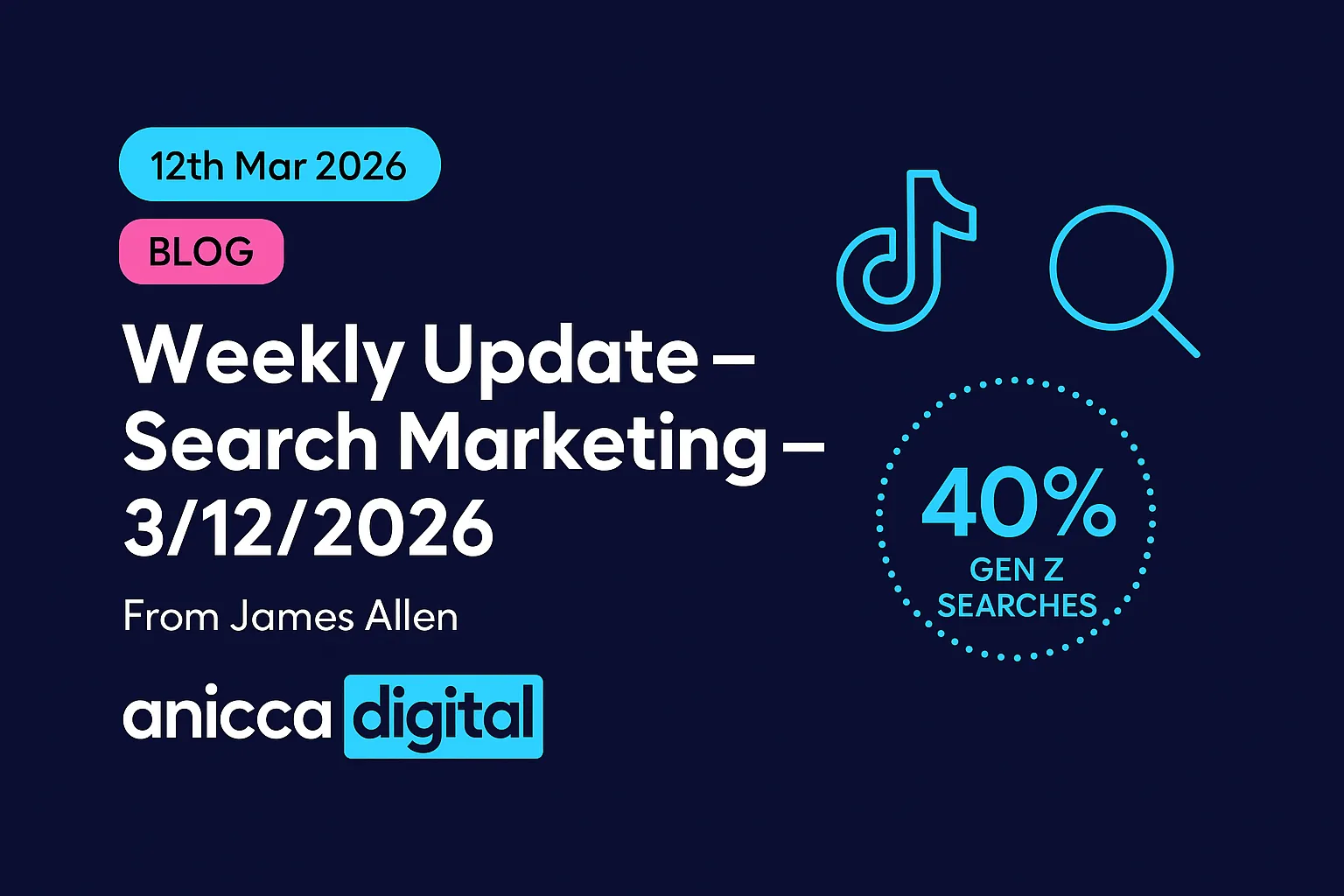
Weekly Update – Search Marketing – March 12th 2026
Estimated reading time: 17 minutes
This week’s SEO news roundup explores a fast-changing search marketing landscape, with AI Overviews shaking up SERPs, new Google tools for agencies, and e-commerce product grids redefining visibility. Discover how AI is influencing both organic and paid strategies, why PPC is more challenging, and what the latest legal and technical updates mean for your campaigns. Stay ahead with practical insights and expert analysis on the most pressing developments in search marketing news.
Table of Contents
Google Tools & Platform Updates
PPC & Paid Media
SEO Volatility & SERP Features
- Google Search Ranking Volatility Still Heated
- Organic Rankings Vs. Product Grids: The New Ecommerce Divide
AI & Innovations
- Gemini 3 Impact on AI Overviews: Nearly Half of Cited Domains Changed, 32% More Sources Per Answer, and Sourceless Bug Fixed
- Update: 38% of AI Overview Citations Pull From Top 10 Pages
- How to Find AI Visibility Gaps with Semrush
- How Agencies Use Semrush for AI Visibility
- WordPress Releases Updated AI Experiments Plugin
- 3 AI Search Changes Every Marketer Needs A Plan For In Q2
- Marketers Report Highest Rates Of AI ‘Brain Fry,’ Report Finds
- How AI Is Reshaping Who Gets Recommended: Marketing In The Eligibility Era
Legal, Compliance & Trust
- B2B Buyers Trust Peers Over AI Chatbots, Report Finds
- Amazon Wins Preliminary Injunction Against Perplexity’s Comet
Technical SEO & Indexing
- Google: You Can Disavow Entire TLDs Like .XYZ With Domain Directive
- Google’s Liz Reid Says LLMs Unlock Audio And Video Indexing
Strategy & Measurement
- A Full-Funnel SEO, PPC & KPI Blueprint for Building Sustainable Revenue Growth
- Strategic Directions: Navigating Search Marketing’s New Era
Summary & Resources
Search Marketing in Flux: AI Overviews, Google Tools, E-commerce SERPs and the New Agency Playbook
This week’s search news paints a vivid picture of a marketing landscape in rapid transition. Google is rolling out powerful new features for agencies and SEOs, while AI-powered search is fundamentally changing how brands are discovered, cited, and recommended. E-commerce SERPs are being reshaped by product grids, and legal battles are beginning to define the boundaries of AI agents in commerce. Meanwhile, marketers are grappling with the operational realities of automation, new reporting frameworks, and even the cognitive toll of AI adoption. For agencies and in-house teams alike, the message is clear: adaptability, integration, and a focus on full-funnel value are now essential for search success.
Branded Queries Filter Rolling Out in Search Console
Google’s full rollout of the branded queries filter in Search Console is a significant upgrade for search professionals. This feature gives marketers the ability to instantly segment branded versus non-branded search traffic, removing the need for manual filtering and guesswork. For agencies managing multiple clients, this is a game-changer for both reporting and strategic planning. It enables teams to clearly attribute performance to brand-driven searches versus broader category or generic queries, which is crucial for understanding the true impact of SEO and paid campaigns.
With this filter, agencies can now provide clients with much more granular insights into how their brand is being discovered and where growth opportunities lie. For example, a spike in non-branded traffic may signal successful content or outreach strategies, while branded query growth often reflects wider brand-building efforts. This distinction is vital for accurate ROI calculations, especially when evaluating the effectiveness of upper-funnel awareness campaigns versus direct response initiatives. Senior stakeholders will appreciate the clarity this brings to performance discussions, as it supports more informed investment decisions across organic and paid channels.
For SEO specialists, the branded queries filter also opens up new avenues for keyword research and competitive analysis. It allows teams to pinpoint which non-branded terms are driving incremental growth and to identify gaps where the brand is underperforming. For PPC managers, understanding the interplay between branded and non-branded search can help optimise bidding strategies and avoid cannibalisation. Agencies should ensure their teams are fully trained on this feature, as it will quickly become a staple of effective search reporting and client communication.
Google Launches Merchant Center For Agencies
Google’s dedicated Merchant Center for Agencies is a major step forward in e-commerce management. The new platform provides a unified dashboard for agencies to oversee multiple client accounts, streamlining everything from onboarding and permissions to diagnostics and reporting. This is a direct response to the growing complexity of e-commerce portfolios, where agencies are often juggling dozens of feeds, product listings, and compliance requirements across different brands and markets.
The single-view interface, consolidated diagnostics, and opportunities tab are particularly valuable for operational efficiency. Agencies can now spot issues (such as out-of-stock products, feed errors, or policy violations) across all clients at a glance, enabling faster response and minimising downtime. The platform’s focus on actionable insights (like identifying low-traffic products or trending brands) helps agencies proactively optimise feeds and campaigns, rather than reacting to problems after the fact. This not only improves campaign performance but also strengthens client relationships by demonstrating a proactive, data-driven approach.
For senior agency leaders, the new Merchant Center reduces operational friction and risk, freeing up teams to focus on strategy and growth rather than troubleshooting. It also supports better collaboration between agency and client teams, with clearer permissions and reporting pathways. As Google Shopping and paid search become ever more competitive, robust feed management is now a core driver of visibility and sales. Agencies should review their internal processes and ensure they’re making full use of these new tools to deliver maximum value for their e-commerce clients.
Survey Says: PPC is Harder Than It Was 2 Years Ago
The latest State of PPC survey reveals a stark reality: over half of PPC practitioners believe paid search management is now significantly more challenging than it was two years ago. The main culprits are increased automation, shrinking keyword-level visibility, rising competition, and evolving privacy regulations. For agencies, this means maintaining performance and demonstrating ROI has never been tougher, especially as platforms like Google Ads automate more decision-making and restrict access to granular data.
The survey highlights the growing need for advanced strategies, ongoing education, and a shift towards holistic, cross-channel approaches. Agencies can no longer rely on the same tactics and must invest in automation expertise, first-party data strategies, and creative testing to stay ahead. Transparent communication with clients is also vital, as many may not fully grasp how industry changes are impacting campaign performance. Proactive account management (benchmarking challenges, refining service offerings, and setting realistic expectations) will be key to retaining client trust in this volatile environment.
For senior decision-makers, the findings are a call to action: invest in upskilling teams, embrace new tools, and foster a culture of experimentation. The old playbook is no longer enough. Agencies that can adapt quickly, leverage automation intelligently, and provide clear, business-focused reporting will be best positioned to thrive as the PPC landscape continues to evolve.
Google Search Ranking Volatility Still Heated
Search professionals are facing an extended period of ranking volatility in Google’s organic results, with no official confirmation of a core update. This ongoing instability is causing significant fluctuations in traffic and campaign performance across multiple verticals. For agencies, this means regular SERP tracking and the ability to respond rapidly to changes have become critical survival skills.
During these periods of uncertainty, foundational SEO best practices become even more important. Agencies must maintain open communication with clients, providing context for ranking shifts and reassurance that volatility is industry-wide, not just an isolated issue. Documenting observed changes and being ready to pivot strategies quickly is essential, especially if Google eventually confirms an update or signals a new direction.
For senior leaders, the lesson is clear: agility and resilience are now core competencies in search marketing. Investing in robust monitoring systems, flexible optimisation plans, and strong client communication protocols will help agencies weather the storm and capitalise on new opportunities as they emerge. Staying informed and maintaining a cool head will separate the winners from those left behind in this ever-shifting landscape.
Gemini 3 Impact on AI Overviews: Nearly Half of Cited Domains Changed, 32% More Sources Per Answer, and Sourceless Bug Fixed
SE Ranking’s deep-dive into Google’s Gemini 3 update reveals a seismic shift in how AI Overviews source and cite content. Nearly 50% of previously cited domains have been replaced, and the average number of sources per answer has jumped by 32%. The critical bug that left 1 in 10 AI Overviews without attribution has also been resolved, but the baseline rate of sourceless answers remains higher than before. For SEOs and agencies, this means the AI-driven SERP is now drawing from a far broader and more dynamic set of domains, making authority signals and entity optimisation more important than ever.
The data shows that while top domains have largely retained their positions, the long tail of citations is in constant flux. This creates both risk and opportunity: established brands enjoy more stable visibility, but smaller sites face increased volatility and must work harder to maintain their presence. The expansion of AI Overviews into more competitive and high-difficulty keywords also means that brands can no longer rely solely on traditional SEO tactics to secure visibility. Structured data, clear entity signals, and content that is easily citable by AI systems are now essential for inclusion.
For agency leaders, this underscores the urgency of auditing clients’ AI Overview presence and adapting content strategies to the new reality. Monitoring AI-driven SERP features, prioritising structured data, and tracking citation trends over time are now critical components of a future-proof SEO strategy. The growing influence of AI on search visibility demands continuous adaptation and a willingness to embrace new optimisation techniques.
Update: 38% of AI Overview Citations Pull From Top 10 Pages
Ahrefs’ latest research reveals that only 38% of Google’s AI Overview citations are drawn from the top 10 organic results, highlighting a growing divergence between traditional rankings and AI-generated answers. This trend means that high organic rankings no longer guarantee AI visibility, while lower-ranking or niche content can unexpectedly gain exposure through AI Overviews. For search marketers, this is both a challenge and an opportunity: the strategies that win in classic SEO are no longer sufficient for AI-driven search.
To increase the likelihood of being cited in AI Overviews, agencies must focus on entity relevance, comprehensive topical coverage, and robust structured data. Monitoring both organic and AI-driven SERP features is now essential for a holistic SEO approach. The findings also reinforce the need for diversified content strategies and the cultivation of authority signals that go beyond traditional ranking factors. For clients, it’s important to understand that AI visibility is a separate metric from organic rankings and requires its own set of optimisation tactics.
Senior marketing leaders should adjust reporting frameworks to reflect this new reality, ensuring that both organic and AI-driven visibility are tracked and communicated. Educating clients about the evolving relationship between rankings and AI features will help set expectations and demonstrate the value of a forward-thinking SEO strategy.
How to Find AI Visibility Gaps with Semrush
Semrush’s guide to identifying and closing AI visibility gaps offers a practical roadmap for agencies seeking to future-proof their organic search efforts. By using the AI Visibility Toolkit, marketers can pinpoint where competitors are cited in AI answers but their own brand is not. This approach enables proactive optimisation for AI-driven SERP features, ensuring clients maintain or grow their presence as Google and other platforms expand AI-powered answers.
The guide recommends auditing current content for citable information, enhancing structured data, and tracking AI citation trends over time. For agencies, this means shifting from a reactive to a proactive stance. It’s critical to identify gaps before they become lost opportunities. The ability to benchmark against competitors and prioritise high-impact topics or sources is especially valuable in a landscape where AI-driven visibility can change rapidly.
For agency leaders, integrating AI visibility analysis into regular SEO workflows is now a must. This not only helps demonstrate value to clients but also positions the agency as a forward-thinking partner capable of navigating the complexities of modern search. As AI becomes an increasingly dominant force in search, the ability to close visibility gaps will be a key differentiator for agencies and brands alike.
How Agencies Use Semrush for AI Visibility
This Semrush case study showcases how four agencies have leveraged AI Visibility tools to drive substantial increases in AI referral traffic and conversions. By tracking AI citations, benchmarking against competitors, and integrating AI visibility metrics into reporting, these agencies have positioned themselves at the forefront of the AI-driven search revolution. The results demonstrate the tangible business impact of proactive AI visibility management.
For SEO and PPC professionals, the key takeaway is that AI visibility is not a separate discipline but an evolution of existing best practices. Agencies which treat AI optimisation as an extension of traditional SEO (focusing on content quality, entity signals, and structured data) are seeing the best results. The case study also highlights the importance of educating clients about AI-driven search and expanding reporting frameworks to include AI citation data.
For senior agency leaders, integrating AI visibility into core service offerings is now essential for future-proofing client campaigns and maintaining a competitive edge. Agencies that can demonstrate measurable outcomes from AI-focused strategies will stand out in an increasingly crowded marketplace and build stronger, more resilient client relationships.
B2B Buyers Trust Peers Over AI Chatbots, Report Finds
A new survey of B2B decision-makers reveals that peer recommendations are trusted nearly twice as much as AI chatbots, with real-user testimonials ranking highest for perceived value. White papers, once a staple of B2B content marketing, now rank lowest. For search marketers, this underscores the importance of building authentic brand advocacy and leveraging user-generated content in both SEO and paid campaigns.
Agencies should prioritise strategies that encourage customer reviews, testimonials, and peer-driven case studies to enhance trust signals and conversion rates. While AI-powered tools can boost efficiency, the human element remains critical in the B2B buyer journey. Marketers need to balance automation with genuine engagement, integrating peer insights into content and outreach strategies to build credibility and trust.
For senior leaders, the findings highlight a shift in content strategy: original research, user testimonials, and community discussions are now more effective than polished, vendor-controlled materials. Agencies that help clients foster authentic peer advocacy and surface real experiences will be better positioned to drive high-quality leads and build long-term relationships in an AI-influenced digital landscape.
Amazon Wins Preliminary Injunction Against Perplexity’s Comet
A federal judge’s preliminary injunction against Perplexity’s Comet AI agent marks a pivotal moment for AI-powered shopping tools and e-commerce platforms. The ruling bars Comet from accessing Amazon accounts and orders the destruction of previously collected data, signalling increased regulatory scrutiny of AI agents that interact with major platforms. For search marketers, this case highlights the potential for legal and compliance risks when deploying AI-driven product discovery tools and shopping assistants.
Agencies managing e-commerce or retail clients must stay informed about evolving legal frameworks that could impact AI integrations, automated account access, and data privacy. Platforms may respond by tightening security protocols and restricting third-party AI access, which could affect both organic and paid search strategies. Marketers should proactively assess their use of AI tools, ensuring alignment with platform policies to mitigate risk and maintain trust with clients and consumers.
For senior decision-makers, this case is a reminder that innovation must be balanced with compliance. Agencies should work closely with legal teams to evaluate the risks of AI-driven automation and be prepared to adapt strategies as the regulatory landscape evolves. Staying ahead of these developments will be crucial for maintaining competitive advantage and safeguarding client interests.
A Full-Funnel SEO, PPC & KPI Blueprint for Building Sustainable Revenue Growth
Search Engine Journal’s blueprint for integrating SEO, PPC, and KPIs offers a timely roadmap for agencies and brands seeking sustainable revenue growth. The article argues that lead volume alone is no longer a sufficient metric; marketers must focus on lead quality, pipeline velocity, and alignment between organic and paid channels. Unified tracking, robust attribution models, and regular campaign audits are essential for identifying and eliminating wasted spend.
The blueprint provides actionable steps for mapping buyer journeys, optimising content for each stage, and setting KPIs that reflect true business impact. For agencies, adopting this holistic framework can improve client retention, drive more predictable results, and demonstrate clear ROI. The emphasis on operational alignment is especially relevant in today’s volatile market.
For senior leaders, the takeaway is that sustainable growth requires moving beyond siloed tactics and vanity metrics. Agencies that can deliver integrated, full-funnel strategies will be better positioned to support long-term client success and adapt to the changing demands of the digital marketplace.
Organic Rankings Vs. Product Grids: The New Ecommerce Divide
The divide between traditional organic rankings and product grid features in Google’s e-commerce SERPs is now too significant to ignore. Product grids are dominating prime real estate, often attracting higher click-through rates than classic search results. This shift means that ranking first organically may no longer guarantee maximum visibility or traffic, especially for retailers competing in crowded categories.
Search marketers must now optimise for both organic and product grid placements, which requires a dual approach: classic ranking tactics for organic results and technical enhancements for product feeds. Feed quality, structured data, and Merchant Center integration are now as important as on-page SEO and link building. Agencies should audit client SERPs to identify grid opportunities and ensure products are eligible for prominent placements.
For agency leaders, the message is clear: e-commerce SEO is now a multidisciplinary challenge, blending technical, creative, and operational skills. Educating clients about these changes and adapting reporting to reflect the new landscape will be crucial for maintaining trust and demonstrating value. Continuous monitoring of SERP features and a willingness to innovate across both organic and paid channels will separate the leaders from the laggards in e-commerce search.
WordPress Releases Updated AI Experiments Plugin
WordPress’s updated AI Experiments plugin is opening new doors for content creation and site management. With features like automated content and image generation, as well as AI-assisted editorial review, agencies and marketers can streamline production workflows and experiment with advanced AI capabilities directly within the WordPress environment. This is particularly valuable for agencies managing multiple client sites, as it enables faster turnaround times and more scalable content strategies.
The plugin’s ability to generate review notes on accessibility, grammar, readability, spelling, and SEO brings a new level of quality control to the editorial process. Agencies can use these tools to ensure consistency and adherence to brand guidelines, while also freeing up time for higher-value creative and strategic work. As AI capabilities continue to expand, staying current with platform innovations will be key to maintaining a competitive edge.
For agency leaders, the challenge is to balance the benefits of automation with the need for quality control and brand consistency. Structured onboarding, regular training, and a culture of experimentation will help teams make the most of these new tools without sacrificing quality or creativity. Monitoring plugin updates and participating in beta programmes can also provide early access to cutting-edge features and influence future development.
3 AI Search Changes Every Marketer Needs A Plan For In Q2
This article highlights three critical AI search changes that marketers must address in the coming quarter: the expansion of AI Overviews, evolving citation patterns, and the growing divergence between organic rankings and AI-driven answers. The recommendations are clear: audit content for AI citation readiness, optimise for entity and topical relevance, and track AI Overview appearances alongside traditional rankings.
Agencies are encouraged to develop new reporting frameworks that reflect both organic and AI-driven visibility, ensuring clients understand the full impact of search changes. Continuous education and adaptation are essential, as AI continues to reshape the search landscape at a rapid pace. Proactive monitoring, investment in tools that track AI features, and close collaboration with clients will be key to future-proofing strategies.
For senior marketers, the takeaway is that AI-driven search is no longer a future concern, it’s a present reality. Agencies that can anticipate and adapt to these changes will be best positioned to maintain visibility and drive results in an increasingly AI-centric environment.
Marketers Report Highest Rates Of AI ‘Brain Fry,’ Report Finds
A recent study finds that 26% of marketing professionals are experiencing “brain fry” due to AI overuse – the highest rate among all surveyed industries. The pressure to rapidly adopt new AI tools and workflows, often without adequate training or support, is leading to mental fatigue, decision fatigue, and increased error rates. For agencies, this is a clear signal that innovation must be balanced with employee well-being and sustainable adoption practices.
Structured onboarding for new technologies, regular breaks, and a culture of experimentation without burnout are essential for maintaining creativity and productivity. Agencies should advocate for realistic timelines and resource allocation when integrating AI into client campaigns, ensuring that teams are not overwhelmed by the pace of change.
For senior leaders, prioritising team health and sustainable adoption will help maintain long-term success as AI continues to transform the marketing landscape. Investing in ongoing education and support, and recognising the limits of cognitive capacity, will be key to retaining top talent and delivering consistent results in an increasingly automated world.
How AI Is Reshaping Who Gets Recommended: Marketing In The Eligibility Era
AI-driven eligibility criteria are fundamentally changing which brands get recommended in digital advertising and search. Platforms are moving from visibility-based models to decision interfaces, where AI systems determine eligibility for ad placements and organic features based on structured clarity, reputation, authority, trust, and decision-enabling content. For marketers, this means that building robust entity signals and trust indicators is now as important as classic ranking factors.
Agencies are advised to audit client assets for eligibility compliance, enhance brand authority, and monitor platform updates that affect recommendation algorithms. The shift to eligibility-based marketing requires a proactive approach to technical SEO, reputation management, and cross-channel consistency. Educating clients about these changes and adjusting strategies to align with evolving AI standards will be critical for maintaining visibility and competitiveness.
For senior decision-makers, the eligibility era demands a cross-functional approach, bringing together content strategy, product marketing, documentation, PR, and engineering. Success now depends on being the obvious choice for both humans and machines. A spot on the shortlist must be earned through demonstrable credibility and structured, decision-grade information.
Google: You Can Disavow Entire TLDs Like .XYZ With Domain Directive
Google’s confirmation that site owners can use the Disavow File Domain Directive to disavow entire top-level domains (TLDs) like .xyz is a powerful, but potentially risky, tool for agencies. This capability allows for rapid response to large-scale spam or toxic link issues originating from specific TLDs. However, Google cautions against broad application, as misuse could inadvertently harm legitimate link equity and organic performance.
For SEO professionals, careful auditing of backlink profiles is essential before deploying domain-level disavows. Targeted removals should be prioritised over blanket actions, and all decisions should align with Google’s guidelines to avoid unintended consequences. Educating clients on the risks and benefits of domain-level disavows is also important for managing expectations and maintaining trust.
For agency leaders, this announcement highlights the ongoing importance of proactive link management and nuanced strategies in addressing negative SEO. Staying vigilant against spam while protecting valuable links will be critical for maintaining search visibility and site health in an increasingly complex digital environment.
Google’s Liz Reid Says LLMs Unlock Audio And Video Indexing
Google’s head of Search, Liz Reid, has announced that large language models (LLMs) are enabling Google to better understand and index audio and video content. This marks a significant shift in how non-textual content is surfaced in search results, offering new opportunities for brands to expand their visibility. For agencies, optimising audio and video assets with clear metadata, transcripts, and structured data is now more important than ever.
Marketers should audit existing multimedia content, ensure accessibility, and leverage schema markup to enhance discoverability. The move towards multimodal indexing will impact both organic and paid strategies, requiring a holistic approach to content optimisation. Agencies should educate clients on the benefits of investing in high-quality audio and video and monitor ongoing developments in LLM-powered search.
For senior leaders, staying proactive and investing in multimedia optimisation will help brands capitalise on emerging opportunities in the evolving search landscape. As Google continues to expand its indexing capabilities, agencies that can deliver comprehensive, accessible, and well-structured content across all formats will be best positioned for future success.
Strategic Directions: Navigating Search Marketing’s New Era
The search marketing landscape is undergoing a period of unprecedented change, driven by advances in AI, evolving SERP features, and shifting user expectations. Agencies and in-house teams must embrace a more integrated, full-funnel approach. An approach which combines technical excellence, creative strategy, operational alignment, and a relentless focus on trust and eligibility. Reporting frameworks must evolve to capture both traditional and AI-driven visibility, and teams must be supported with the training, tools, and well-being initiatives needed to thrive in a fast-moving environment.
For senior leaders, the imperative is clear: invest in agility, foster cross-functional collaboration, and prioritise strategies that build long-term brand authority and trust. The winners in this new era will be those who can adapt quickly, leverage new technologies intelligently, and deliver measurable business outcomes across the entire customer journey. As search continues to evolve, agencies which lead with insight, innovation, and integrity will be best positioned to guide clients through the challenges of an AI-powered future.
Key Takeaways
- AI Overviews are now drawing from a broader range of sources, so optimising for structured data and entity signals is crucial for both SEO and PPC professionals.
- Google’s new branded queries filter and Merchant Center for Agencies offer more granular reporting and streamlined e-commerce management, helping agencies deliver clearer insights and faster responses.
- PPC is becoming more complex, with automation and reduced keyword visibility requiring agencies to invest in advanced strategies and transparent client communication.
- Product grids are dominating e-commerce SERPs, making it essential to optimise both organic listings and product feeds for maximum visibility.
- Legal and compliance risks are rising as AI agents interact with major platforms, so agencies must stay informed and ensure all tools and strategies align with evolving regulations.
- Marketers should prioritise authentic peer advocacy and user-generated content, as B2B buyers trust real testimonials far more than AI chatbots or traditional white papers.
- Agency leaders must support their teams with training and well-being initiatives to avoid burnout from rapid AI adoption and maintain creativity in a changing landscape.
Frequently Asked Questions
How should I adjust my SEO strategy for AI Overviews?
Focus on optimising your content for entity relevance, structured data, and clear topical authority. Make sure your site provides easily citable information and monitor AI citation trends to identify and close visibility gaps.
What changes should I make to my Google Ads campaigns in light of increased automation?
Embrace automation but stay proactive with creative testing, first-party data strategies, and transparent reporting. Regularly review campaign performance and communicate openly with clients about the impact of automation on results.
How do I optimise for product grids in e-commerce SERPs?
Ensure your product feeds are high quality, use structured data, and integrate with Google Merchant Center. Audit your SERPs to identify opportunities for grid placements and keep feeds updated for eligibility.
What are the risks of using the Disavow File Domain Directive for entire TLDs?
Disavowing whole TLDs can quickly address large-scale spam, but it may also remove valuable links and harm your site’s authority. Always audit your backlink profile carefully and prioritise targeted removals over blanket actions.
How can agencies avoid team burnout as AI adoption accelerates?
Provide structured onboarding for new tools, encourage regular breaks, and foster a culture of experimentation without excessive pressure. Support ongoing education and monitor workloads to maintain team well-being and creativity.
Conclusion
The search marketing world is evolving at a rapid pace, with AI, automation, and new SERP features reshaping the way brands compete for visibility. Agencies and marketers need to stay agile, invest in ongoing learning, and adapt strategies to embrace both technical innovation and human trust signals. As regulations tighten and competition intensifies, those who blend creativity, compliance, and data-driven decision-making will lead the way. Stay tuned for more updates as the landscape continues to shift, and make sure your team is ready for what’s next.
Need help adapting your search strategy for AI-driven search? Contact the Anicca team for expert guidance on SEO and PPC in the AI era.