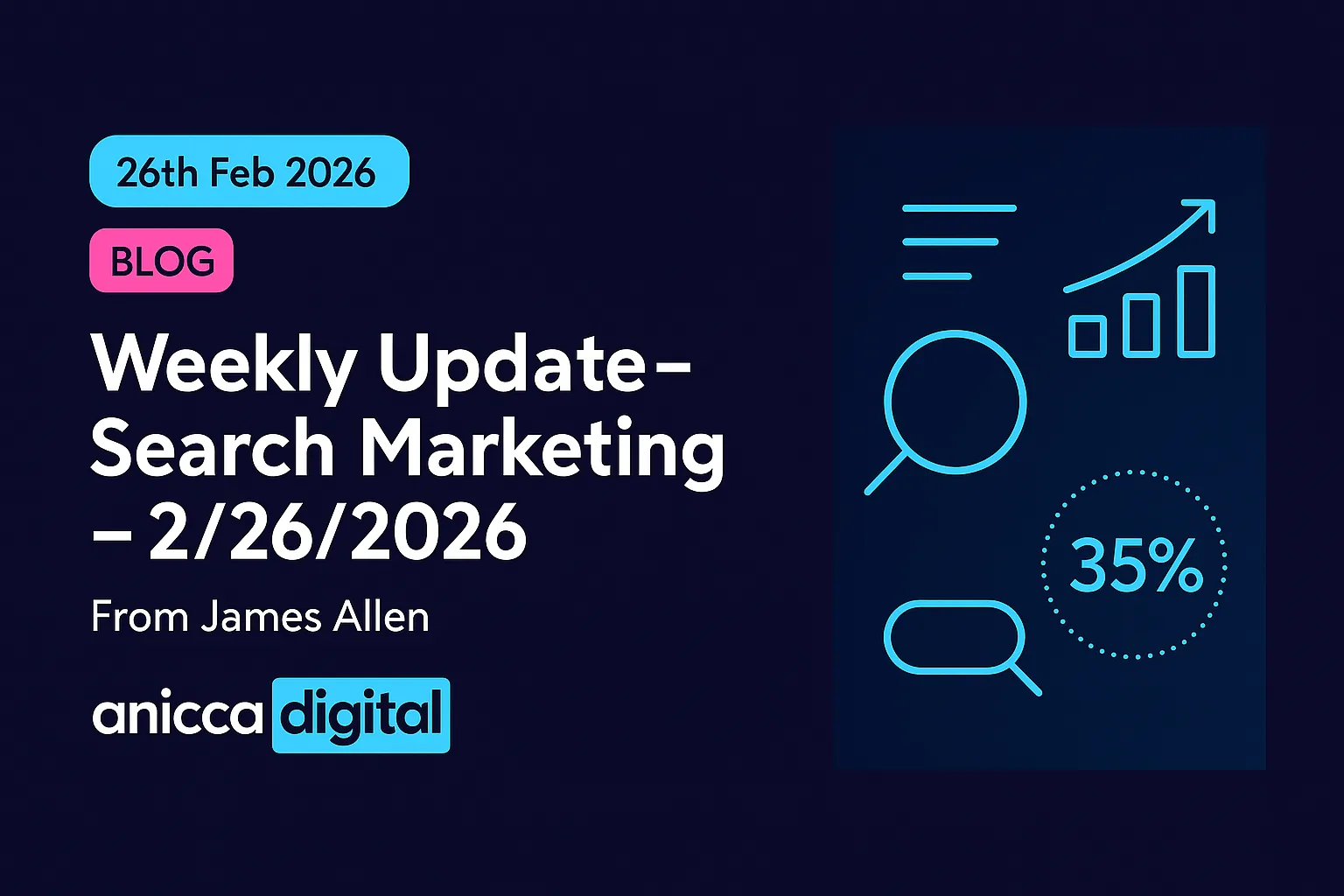
Weekly Update – Search Marketing – February 26th 2026
Estimated reading time: 22 minutes
This week’s search marketing news brings a wave of updates and insights for SEO and PPC professionals. Discover how AI-driven optimisation is reshaping the industry, why Google’s latest changes to Ads support and reporting matter, and what new legal battles could mean for data access. From local SEO best practices to the evolving role of CMS plugins and the impact of Google Discover updates, there’s plenty to keep you ahead of the curve. Dive in for actionable strategies, expert analysis, and the latest developments you need to know.
Table of Contents
AI & Search Evolution
- AAO: Why Assistive Agent Optimisation is the Next Evolution of SEO
- AI-SEO is a Change Management Problem
- Agentic Commerce Optimisation: A Technical Guide to Prepare for Google’s UCP
- Microsoft: ‘Summarise With AI’ Buttons Used to Poison AI Recommendations
SEO & Local Optimisation
- The Perfect Local Business Contact Page Built for Google and Conversions
- Content Scoring Tools Work, but Only for the First Gate in Google’s Pipeline
- Local GEO & AI Search: A 90-Day Plan to Make Every Location AI-Ready
- Web Almanac Data Reveals CMS Plugins Are Setting Technical SEO Standards (Not SEOs)
- SEO Fundamental: Google Explains Why It May Not Use a Sitemap
- 4 Sites That Recovered from Google’s December 2025 Core Update – What They Changed
PPC & Paid Media
- How to Write Paid Search Ads That Outperform Your Competitors
- Google Ads Support Now Requires Account Change Authorisation
- What it Takes to Make Demand Gen Work for B2B and Ecommerce
- How to Turn Google’s Performance Max into an Ecommerce Growth Engine
- 2026 Google Ads Playbook: 5 Strategies Behind Profitable Ad Spend
- Google Ads Surfaces PMax Search Partner Domains in Placement Report
Analytics & Reporting
- The SEO’s Guide to Google Search Console
- Google Search Console Page Indexing Report Missing Data Prior to December 15
Legal & Industry Trends
- SerpApi Moves to Dismiss Google Scraping Lawsuit
- SerpApi Challenges Google’s Right to Sue Over SERP Scraping
- Google Discover Update: Early Data Shows Fewer Domains in US
- Strategic Directions for Search Marketing: Navigating the AI-First Era
Summary & Support
Search Marketing News: AI-Driven SEO, Local Optimisation, Paid Search Innovation & Legal Shifts
This week’s search marketing news is packed with developments that signal a rapidly evolving landscape for SEO and PPC professionals. From the rise of Assistive Agent Optimisation (AAO) and the changing role of content scoring tools, to new Google Ads support policies and the increasing influence of CMS plugins on technical SEO, the industry is being reshaped by AI, automation, and legal challenges. Local SEO, paid search creative, and ecommerce campaign structures also feature heavily, highlighting the need for both technical excellence and strategic agility. As AI agents, new protocols, and platform updates redefine how brands are discovered and chosen, staying ahead means not just following best practices, but actively influencing them.
AAO: Why Assistive Agent Optimisation is the Next Evolution of SEO
The concept of Assistive Agent Optimisation (AAO) marks a significant shift in how brands must approach SEO in an AI-driven world. Unlike traditional SEO, which focused on being found by search engines, or even AEO (Answer Engine Optimisation), AAO is about being the preferred choice when AI agents make decisions for users. This means that the digital presence of a brand must be crystal clear, consistent, and easily digestible by AI systems that rely on knowledge graphs and large language models.
For SEO professionals, this shift requires a renewed focus on structured data, entity clarity, and the strategic use of knowledge panels. Technical SEO is no longer just about crawlability and indexation; it’s about ensuring that every data point about your brand is accurate and reinforced across the web. The article highlights that AI agents now act as the new funnel, evaluating and selecting brands internally before a user ever sees a list of options. This puts a premium on brand authority, trust signals, and the ability to feed structured information directly to AI systems through protocols like IndexNow.
For senior marketers and decision-makers, AAO is a call to treat the website as the anchor for all brand information and to invest in digital branding that is both human- and machine-readable. The days of relying on Google’s generous crawling and JavaScript rendering are fading; AI agents often don’t render JavaScript and expect clean, structured data. The competitive advantage will go to those who adapt early, ensuring their brand is the one AI agents trust and select. This evolution isn’t just technical. it’s a strategic evolution, requiring cross-functional alignment between brand, content, and technical teams.
The Perfect Local Business Contact Page Built for Google and Conversions
Local SEO continues to be a battleground, and the humble contact page is now a frontline asset. Google’s algorithms increasingly scrutinise contact pages to verify business legitimacy, making it vital to include comprehensive NAP (Name, Address, Phone) details, trust signals, and local content. The article outlines a blueprint for contact pages that not only serve users but also satisfy both traditional and AI-driven search engines. Embedding Google Maps, listing accepted payments, and showcasing reviews and testimonials are now must-haves.
For SEO practitioners, aligning contact page details with the Google Business Profile is essential for consistency and credibility. Conversion tracking, strong calls to action, and location-specific content further boost both visibility and lead generation. Amenities and unique local attributes can help a business stand out in conversational AI queries, such as “cafés in London with free WiFi and outdoor seating.” This is particularly important as search becomes more conversational and AI-driven.
From a senior stakeholder perspective, treating the contact page as a strategic asset can yield measurable improvements in local rankings and conversion rates. It’s no longer just a formality; it’s a trust-building, conversion-driving touchpoint that feeds both human and machine decision-making. Agencies should audit client contact pages, implement these best practices, and educate clients on the growing importance of local SEO readiness in an AI-first world.
How to Write Paid Search Ads That Outperform Your Competitors
Paid search is more competitive than ever, and writing standout ad copy is a critical differentiator. This article provides a tactical guide for crafting ads that not only catch the eye but also convert. Key recommendations include reviewing ads in the context of competitor messaging, focusing on unique value propositions, and using AI tools as a starting point. Never a replacement for the human touch. The advice is clear: don’t obsess over ad strength metrics; instead, prioritise clarity, compliance, and compelling offers.
For PPC specialists, the message is to continually review and revise ad copy, back up claims with data, and highlight ease of use and location-specific relevance. Turning off automated assets and ensuring messaging accuracy are crucial for compliance and brand integrity. The article also stresses the importance of regularly updating numbers and offers, as well as using dynamic location insertion for regional campaigns.
For agencies and senior marketers, the takeaway is to embed a process of ongoing creative testing and competitor analysis. Ad copy should be regularly benchmarked against the competition, with a focus on what truly differentiates the brand. This approach not only improves click-through and conversion rates but also ensures that paid search investments deliver maximum ROI in an increasingly automated and crowded SERP environment.
Google Ads Support Now Requires Account Change Authorisation
Google Ads support has introduced a new policy requiring explicit advertiser authorisation before support specialists can make changes within an account. This means that when submitting a support request, advertisers must now check an authorisation box, granting Google permission to troubleshoot by making direct adjustments. However, the responsibility for campaign outcomes remains firmly with the advertiser, as Google does not guarantee results.
For PPC professionals, this policy shift increases the need for careful oversight and risk management. While faster support can be beneficial, there’s a real risk of unintended changes impacting live campaigns. Agencies must update their internal protocols, ensure all changes are reviewed and documented, and educate clients about the implications of granting access. This is especially important as automation and AI further reduce manual control over campaigns.
For senior leaders, the change underscores the importance of governance, transparency, and accountability in paid media management. Granting access for troubleshooting should be a considered decision, with clear communication between agency and client. The policy is a reminder that, even as platforms become more automated, the ultimate responsibility for campaign performance remains with the advertiser.
What it Takes to Make Demand Gen Work for B2B and Ecommerce
Google’s Demand Gen campaigns represent a shift from traditional search tactics to a social advertising mindset, especially for B2B and ecommerce brands. The article highlights that success in Demand Gen depends on interruption-based creative, precise audience segmentation, and aligning offers with the customer journey stage. Common pitfalls include misaligned offers, generic creative, and insufficient conversion data.
For PPC teams, the message is clear: creative is the new keyword. Campaigns must capture attention within seconds, speak directly to pain points, and use bold, problem-focused messaging. Structuring campaigns for mid- and upper-funnel conversions, leveraging custom audience segments, and budgeting for sufficient conversion data are all critical. The article also recommends continuous creative testing and post-click optimisation to maximise results.
For agency leaders and CMOs, Demand Gen offers a viable channel for growth, but only if approached with the right mindset and resources. It’s not about replicating search tactics; it’s about embracing a more dynamic, data-driven approach that prioritises creative, targeting, and offer alignment. Agencies should guide clients through this transition, setting realistic expectations and focusing on measurable outcomes such as MQL and SQL generation.
Content Scoring Tools Work, but Only for the First Gate in Google’s Pipeline
Content scoring tools like Surfer SEO and Clearscope have become staples in many SEO toolkits, but their value is often misunderstood. This article clarifies that these tools are most effective at helping content pass Google’s first-stage retrieval, which is still based largely on word matching and BM25 algorithms. While they can identify vocabulary gaps and ensure topical coverage, their correlation with rankings is modest, as later ranking stages depend more on authority, engagement, and other signals.
For SEO practitioners, the key is to use these tools to identify zero-usage terms and ensure comprehensive topical coverage during the research phase. Don’t chase perfect scores during drafting. Analysing competitor content selectively and focusing on audience-aligned content are more valuable than blindly following tool recommendations. Entity coverage and semantic relationships are still areas where current tools fall short, so original research and value-add content remain essential for differentiation.
For agencies and content leads, it’s important to set client expectations around what content scoring tools can and cannot achieve. They are a useful baseline for retrieval, but true ranking success requires a holistic approach that includes authority building, engagement, and unique insights. Use these tools as a starting point, but always aim to go beyond the competitive baseline to create content that stands out.
SerpApi Moves to Dismiss Google Scraping Lawsuit
The legal battle between SerpApi and Google over scraping public search results has far-reaching implications for the SEO and digital marketing industry. SerpApi argues that Google is misusing the DMCA to restrict access to public data, aiming to protect ad revenue rather than genuine copyrights. The case centres on whether scraping publicly visible SERPs constitutes copyright infringement or anti-competitive behaviour.
For SEO platforms, AI tools, and agencies that rely on third-party SERP data for optimisation and reporting, the outcome of this case could be game-changing. If Google prevails, access to essential search data could become more restricted, making it harder to conduct competitive analysis, monitor rankings, or train AI models. Conversely, a win for SerpApi could reinforce the principle of open access to public data, supporting the continued development of data-driven marketing strategies.
Senior leaders should monitor this case closely, as it could reshape industry practices and the availability of competitive intelligence. Agencies may need to prepare contingency plans for data access and reporting, ensuring transparency with clients about potential changes in data collection and analysis capabilities.
The SEO’s Guide to Google Search Console
Google Search Console (GSC) remains an indispensable tool for SEO professionals, and this comprehensive guide explores its full capabilities – from setup and property management to advanced performance analysis and troubleshooting. Recent updates, including AI-powered configuration, branded query filters, and social channel integration, have expanded GSC’s utility for both technical and strategic reporting.
For practitioners, GSC offers granular insights into site health, indexing issues, and Core Web Vitals. Custom annotations, weekly/monthly views, and the URL inspection API enable detailed monitoring and troubleshooting. The evolving role of GSC in the AI era is particularly noteworthy, as it transitions from a technical reporting tool to a visibility intelligence platform, helping marketers track performance across both traditional and AI-driven search surfaces.
For agencies and senior marketers, ensuring clients are fully leveraging GSC is critical for technical audits, content optimisation, and strategic decision-making. As search journeys become more complex and non-linear, GSC’s trend analysis and topic cluster reporting provide valuable context for aligning SEO strategies with broader marketing objectives.
Google Search Console Page Indexing Report Missing Data Prior to December 15th
A widespread reporting bug in Google Search Console’s page indexing report has resulted in missing data prior to December 15, affecting all users. Google has yet to issue an official statement, but the issue appears to be linked to latency problems from early December. This disruption is a timely reminder of the fragility of third-party reporting platforms.
For SEO professionals and agencies, the immediate impact is on historical analysis and client reporting. It’s advisable to communicate the situation to clients, delay critical reporting if possible, and monitor for updates from Google. Maintaining local backups of key data is now more important than ever, ensuring continuity in the face of platform disruptions.
For senior stakeholders, this incident highlights the need for robust data governance and contingency planning. Agencies should review their data retention policies and invest in tools or processes that safeguard historical data, minimising the impact of future disruptions on reporting and strategic decision-making.
How to Turn Google’s Performance Max into an Ecommerce Growth Engine
Performance Max (PMax) campaigns have changed the ecommerce advertising landscape, but many brands struggle with limited visibility into spend distribution and performance drivers. This article offers a practical framework for regaining control of PMax campaigns, focusing on product segmentation, feed optimisation, and campaign structure.
For PPC specialists, the key is to segment products based on actual performance. Create dynamic groupings for star products, underperformers, and new arrivals. Set clear performance thresholds, shortening analysis windows, and automating product movement between segments are all recommended to maximise budget efficiency and ROAS. Feed management and automation tools can help streamline these processes across thousands of SKUs and multiple channels.
For agency leaders and ecommerce managers, the message is that PMax doesn’t have to mean flying blind. With the right segmentation and data-driven decision-making, it’s possible to uncover overlooked opportunities, reduce wasted spend, and drive higher profitability. Agencies should guide clients through this transition, ensuring campaigns are structured for both control and scale.
AI-SEO is a Change Management Problem
Implementing AI-driven SEO strategies is as much an organisational challenge as a technical one. This article argues that success with AI-SEO depends on alignment across leadership, clear ownership, and updated success metrics. Siloed initiatives and lack of executive buy-in are common pitfalls that can undermine even the most technically sound projects.
For SEO and marketing leaders, the takeaway is to establish cross-functional teams, set measurable goals, and foster a culture of experimentation. Educating stakeholders about AI’s capabilities and limitations is essential for integrating AI-SEO into broader marketing objectives. This approach increases the likelihood of sustainable, scalable results from AI-powered search initiatives.
For agencies, it’s important to position themselves as change agents, helping clients navigate the organisational shifts required for AI-SEO success. This includes facilitating executive sponsorship, aligning incentives, and ensuring that AI-SEO efforts are not just technical add-ons but integral to the brand’s overall strategy.
Local GEO & AI Search: A 90-Day Plan to Make Every Location AI-Ready
AI is transforming how consumers discover and choose local brands, making it essential for multi-location businesses to be AI-ready. This guide presents a 90-day action plan for boosting local search visibility, focusing on structured data, Google Business Profile updates, and local citation building.
For local SEO practitioners, the plan emphasises review management, local content creation, and consistency across all platforms. Monitoring AI search results and adjusting strategies based on emerging trends are also crucial. The framework is actionable and measurable, making it suitable for rapid implementation across large location footprints.
For agencies and enterprise marketers, this plan offers a blueprint for future-proofing multi-location clients. Ensuring that each location is discoverable in both traditional and AI-powered search environments will be key to maintaining visibility and driving growth as AI agents become the new gatekeepers of local discovery.
Web Almanac Data Reveals CMS Plugins Are Setting Technical SEO Standards (Not SEOs)
A new analysis of the 2025 HTTP Archive Web Almanac reveals that technical SEO best practices are increasingly dictated by CMS and plugin defaults rather than individual site decisions. With over 50% of the web running on CMS platforms, their defaults and feature rollouts are quietly defining what “normal” looks like at scale.
For SEO professionals, this standardisation can be a double-edged sword. While it raises the baseline for technical SEO, it can also lead to missed opportunities for differentiation and advanced customisation. The article encourages practitioners to audit plugin configurations, identify gaps, and implement enhancements beyond default settings.
For agencies and senior marketers, it’s important to educate clients about the limitations of relying solely on CMS tools. Competitive advantage increasingly comes from tailored technical strategies, advanced configuration, and proactive influence on plugin development. Agencies should position themselves as partners who go beyond the basics to deliver real value.
2026 Google Ads Playbook: 5 Strategies Behind Profitable Ad Spend
Maximising profitability in Google Ads campaigns requires a blend of automation, smart bidding, and data-driven segmentation. This article outlines five key strategies for 2026, including Performance Max optimisation, robust conversion tracking, and regular performance audits.
For PPC practitioners, the focus should be on leveraging audience insights, testing creative assets, and eliminating wasted spend. Automation is delivering on its promise, but only when campaigns are structured for profit (not just scale). Continuous optimisation and data-driven decision-making are essential for achieving higher ROAS and lower CAC.
For agency leaders, the playbook offers a clear framework for scaling campaigns efficiently and staying ahead of evolving platform features. The actionable insights provided can help clients achieve sustainable growth and maintain a competitive edge in paid search.
Google Discover Update: Early Data Shows Fewer Domains in US
Early data from the February Google Discover core update indicates a reduction in the diversity of domains appearing in US user feeds. The update aims to prioritise locally relevant and authoritative content, resulting in fewer sites being surfaced. This shift underscores the importance of expertise, trustworthiness, and local relevance in content strategy.
For SEO professionals, monitoring Discover traffic and analysing which content types are still performing well is essential. Agencies should audit client content for alignment with these signals and adjust publishing calendars accordingly. The trend towards favouring specialised, authoritative sites over generalists is likely to continue.
For senior marketers, staying informed about Discover algorithm changes is critical for maintaining visibility and engagement in this evolving channel. Investing in local content and building topic expertise will be key to capturing and retaining Discover traffic.
SerpApi Challenges Google’s Right to Sue Over SERP Scraping
SerpApi’s motion to dismiss Google’s DMCA lawsuit challenges the search giant’s right to claim copyright over publicly visible search results. The case could set a precedent for the legality of scraping SERPs for SEO, analytics, and AI training purposes. SerpApi argues that accessing public data is not circumvention under current law and references key legal decisions supporting open access.
For SEO platforms, competitive intelligence tools, and data-driven marketing strategies, the outcome of this case will be pivotal. A ruling in Google’s favour could restrict access to essential search data, while a win for SerpApi would reinforce the principle of open data and support continued innovation in the industry.
Agencies should follow this case closely and be prepared to adapt their data collection and reporting practices based on the outcome. Transparency with clients about the potential impact on optimisation and analytics capabilities is essential.
4 Sites That Recovered from Google’s December 2025 Core Update – What They Changed
This case study examines four websites that successfully recovered from the December 2025 Google core update. Key recovery factors included improving content quality, enhancing E-E-A-T signals, and addressing technical SEO issues. Specific changes ranged from updating outdated content and consolidating thin pages to strengthening author profiles and improving user experience.
For SEO professionals, the findings reinforce the importance of comprehensive site audits, prioritising user experience, and monitoring algorithmic trends. Recovery is rarely about technical fixes alone; it requires a holistic, quality-focused approach that addresses both content and trust signals.
For agencies, these insights provide a roadmap for guiding clients through recovery strategies. Emphasising ongoing optimisation and adaptability to Google’s evolving ranking criteria is key to long-term success. The value of original, in-depth content and strong brand trust cannot be overstated.
Agentic Commerce Optimisation: A Technical Guide to Prepare for Google’s UCP
Google’s Universal Commerce Protocol (UCP) and the rise of agentic commerce are set to redefine ecommerce optimisation. The article emphasises the need for complete and accurate schema markup, high-quality product feeds, and third-party validation to ensure visibility in AI-driven shopping experiences. Best practices include integrating with AI agents, optimising for on-platform transactions, and maintaining data consistency across channels.
For ecommerce marketers and technical SEO specialists, auditing ecommerce infrastructure and prioritising structured data are now essential. UCP’s schema-based approach means that product data must be both comprehensive and machine-readable, supporting AI agents in making informed selections. Third-party reviews and social proof remain critical for building trust and consensus.
For agencies, educating clients about the implications of agentic commerce and developing strategies to future-proof online stores is a strategic imperative. As AI-powered discovery and conversion become the norm, brands that prepare early will be best positioned to capture market share.
SEO Fundamental: Google Explains Why It May Not Use a Sitemap
Google’s John Mueller has clarified that the presence of a sitemap does not guarantee its use for indexing if the site lacks new or important content. Search Console errors related to sitemaps often stem from insufficiently valuable pages or outdated information. The focus should be on content quality and ensuring sitemaps accurately reflect site structure and updates.
For SEO professionals, this insight reinforces the need for ongoing technical SEO maintenance and alignment with Google’s evolving indexing criteria. Auditing sitemaps, removing low-value URLs, and prioritising pages with strong user and search intent are now best practices for maximising crawl efficiency and visibility.
For agencies, it’s important to communicate to clients that technical SEO is not a one-time task. Regular reviews and updates to sitemaps and site content are essential for maintaining search performance and avoiding indexing issues.
Microsoft: ‘Summarise With AI’ Buttons Used to Poison AI Recommendations
Microsoft has identified 31 companies exploiting “Summarise with AI” buttons to inject prompts designed to bias AI assistant recommendations. These prompt injection attacks aim to manipulate AI outputs in future conversations, posing risks to search integrity and user trust. Microsoft has implemented new mitigations in Copilot to counteract these tactics.
For marketers, the potential for AI manipulation highlights the importance of transparent, high-quality content to maintain credibility. Agencies should monitor AI-driven traffic and review how their content is summarised by third-party tools, ensuring that brand reputation and search performance are not compromised by malicious prompt injections.
For senior stakeholders, staying informed about AI security developments is essential for safeguarding brand reputation and maintaining trust with users. Proactive monitoring and collaboration with platform providers can help mitigate risks and ensure that marketing efforts are not undermined by unethical practices.
Google Ads Surfaces PMax Search Partner Domains in Placement Report
Google Ads has expanded Placement Reports for Performance Max (PMax) campaigns to include Search Partner domains and impression counts. This enhancement provides advertisers with greater transparency into where ads are being served, enabling more informed brand safety reviews and optimisation decisions.
For PPC professionals, the ability to identify underperforming or irrelevant placements and adjust exclusions accordingly is a significant step forward. While the report focuses on impressions rather than clicks or conversions, it still offers valuable insights for refining targeting and improving campaign efficiency.
For agencies, leveraging this data to communicate results more effectively to clients and make data-driven optimisation decisions is now easier. The update reflects Google’s ongoing efforts to increase accountability and control within automated campaign types, supporting better outcomes for paid search investments.
Strategic Directions for Search Marketing: Navigating the AI-First Era
The search marketing landscape is undergoing a profound transformation, driven by advances in AI, automation, and evolving user behaviours. SEO and PPC professionals must adapt to new optimisation paradigms. This is true whether such optimisations are being chosen by AI agents, leveraging structured data for agentic commerce, or navigating the standardisation of technical SEO through CMS plugins. The importance of brand trust, content quality, and data integrity has never been greater, as AI systems increasingly act as gatekeepers and decision-makers.
For agencies and senior marketers, the strategic imperative is to move beyond best practices and actively shape the standards that define visibility and success. This means investing in technical excellence, organisational alignment, and proactive adaptation to legal, platform, and algorithmic changes. The winners in this new era will be those who combine deep technical expertise with strategic foresight, ensuring their brands are not just found (but chosen) by both humans and machines.
Key Takeaways
- AI-driven optimisation is now a core focus, with Assistive Agent Optimisation (AAO) and agentic commerce requiring brands to prioritise structured data and machine-readable content.
- Google Ads’ new support authorisation policy and expanded Placement Reports mean agencies must update internal processes and increase transparency with clients.
- Local SEO remains crucial, with enhanced contact pages and consistent local signals directly impacting rankings and conversions.
- Content scoring tools are useful for initial optimisation but should not be relied on exclusively; authority, engagement, and originality are key for ranking success.
- Legal cases around SERP data scraping could reshape access to vital SEO and analytics data. Agencies should monitor developments and prepare contingency plans.
- Performance Max and Demand Gen campaigns require data-driven segmentation, creative testing, and ongoing optimisation for profitable results in ecommerce and B2B.
- Technical SEO standards are increasingly set by CMS plugins, so auditing and customising plugin settings is essential for competitive advantage.
Frequently Asked Questions
How should I adapt my SEO strategy for AI-driven search and Assistive Agent Optimisation?
Focus on structured data, entity clarity, and ensuring your brand information is consistent and easily digestible by AI agents. Prioritise building trust signals and authority, as AI systems are increasingly making choices on behalf of users.
What changes should I make to my Google Ads campaigns following the latest updates?
Review internal processes to ensure all account changes via Google support are properly authorised and documented. Use the new Placement Reports to monitor ad placements and refine exclusions for better brand safety and campaign efficiency.
How do I make my local business more visible in AI-powered and local search?
Optimise your contact page with complete NAP details, trust signals, and local content. Keep your Google Business Profile up to date and ensure consistency across all platforms to improve both AI and human-driven discovery.
Are content scoring tools enough to guarantee top rankings?
No, while they help ensure your content covers key topics and terms, true ranking success depends on authority, user engagement, and providing unique value. Use these tools as a starting point, but focus on quality and originality.
What impact could the SerpApi vs. Google legal cases have on my marketing data?
Depending on the outcome, access to SERP data for analytics and reporting could become more restricted. Stay informed about legal developments and consider diversifying your data sources and backup strategies to maintain reporting continuity.
Conclusion
The pace of change in search marketing is accelerating, with AI, automation, and legal shifts driving new challenges and opportunities for SEO and PPC professionals. Brands that invest in structured data, creative testing, and robust governance will be best placed to thrive as AI agents and new protocols shape the future of discovery. Stay proactive by monitoring industry developments, adapting your strategies, and prioritising both technical excellence and strategic foresight.
Need help adapting your search strategy for AI-driven search? Contact the Anicca team for expert guidance on SEO and PPC in the AI era.