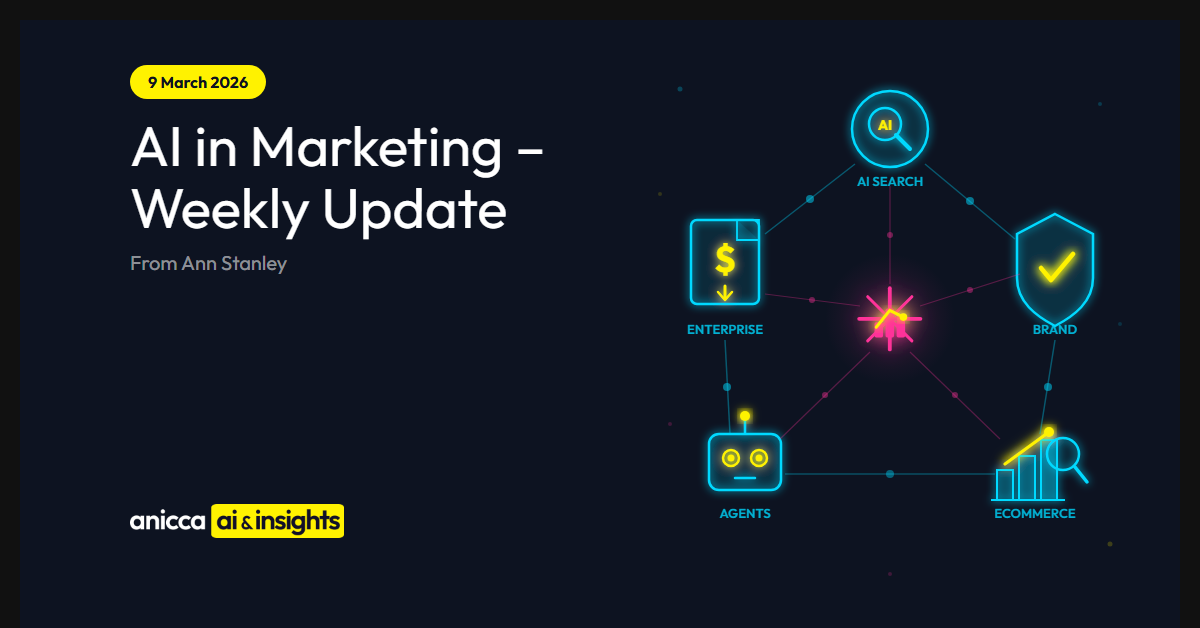
This Week in AI Marketing (9th Mar 26)
By Ann Stanley | 9 March 2026 | 29 min read
AI Max Revenue vs CPA, Google’s Patent Play & Anthropic Integrates Microsoft Office
This week brought hard data on Google’s AI Max performance (13% more revenue, but at what cost?), a patent filing that reveals Google’s plans for AI-generated shopping landing pages, and Anthropic embedding Claude directly into PowerPoint, Excel, and Word.
Meanwhile, the walls between paid and organic search continue to crumble as agencies merge their teams around shared objectives. Six GEO startups are reshaping how consumers shop through AI, Adobe has launched its agentic marketing platform, and content teams are producing 42% more output but losing their brand voice in the process.
From Criteo joining ChatGPT’s ad pilot to the Pentagon ban that accidentally made Claude the number one app, this week’s news makes one thing clear: AI is no longer changing marketing — it is marketing.
Table of Contents
- As Brands Respond to AI Search, Paid and Organic Are Merging
- Google’s AI Generated Landing Page Patent Is Limited to Shopping and Ads
- How Brands Should Craft Their AI Strategies — GEO and AEO Tips
- AI Search Impacting Budgets for Content Marketers
- Stagwell and Emberos Launch Agentic GEO Tool
- Content Marketing in an AI Era: From SEO Volume to Brand Fame
- Elastic Marketing: Scaling AI Content Without Losing Brand Voice
- AI Max Brand Controls Expand, VRC Non-Skip Ads Go Global
- Criteo Joins ChatGPT’s Ad Pilot
- AI Max Increases Revenue 13% But Drives Higher CPA
- 6 Hot GEO Startups Are Shaping the Future of AI Shopping
- Amazon Seller Central AI Remakes Data Analysis
- Goddiva’s Head of Ecommerce on AI and the Future of Fashion Retail
- AI Layoffs: Companies Cutting Staff While Smart Agencies Retrain
- Adobe Launches Agentic AI for Marketing
- Anthropic Embeds Claude into PowerPoint, Excel, and Word — Plus Managed Skills and Analytics API
- Claude Hits #1 on App Store as Pentagon Ban Drives Consumer Support
- Anthropic’s Research on AI Labour Market Impacts
- Should I enable Google AI Max for my Search campaigns?
- How should I prepare for GEO as a marketing channel?
- Is Claude still safe to use for business after the Pentagon ban?
- How do I stop AI content from sounding generic?
AI Search & SEO
As Brands Respond to AI Search, Paid and Organic Are Merging
Source: digiday.com | March 2026
For the best part of 20 years, paid search and SEO have operated as separate disciplines with separate teams, separate budgets, and often separate agencies. That era is ending. At Digiday’s Media Buying Summit, Elena MacGurn, SVP of Search at Digitas (Publicis Groupe), confirmed the agency has begun merging organic and paid teams around shared client objectives. “Unless you have that shared goal, your strategies are going to be at odds,” she said — a remarkably direct admission from one of the world’s largest agency networks.
The catalyst is Google’s AI Overviews. Since launching in May 2024, brands have watched organic traffic patterns shift as queries become “significantly larger and much more contextual,” according to HelloFresh CMO Patrick Stal. AI Overviews are compressing the traditional SERP, pushing both organic results and ads into less visible positions. The response from forward-thinking agencies is to use organic search expertise to identify overlooked keyword opportunities and then deliberately bid against queries that might trigger AI Overview summaries — treating paid and organic as complementary weapons rather than parallel tracks.
Why it matters
Here’s the thing: if your paid and organic teams still sit in separate silos with separate KPIs, you are already behind. The most effective search strategies in 2026 will come from unified teams that can see the full picture — where organic visibility is declining, where paid needs to compensate, and where AI Overviews create opportunities that neither team would spot alone. This is not a future trend. Digitas, one of the largest search agencies in the world, is doing it now.
Google’s AI Generated Landing Page Patent Is Limited to Shopping and Ads
Source: searchenginejournal.com | March 2026
There has been considerable drama about Google’s patent for AI-generated landing pages. The fear was that Google would replace publisher websites entirely with its own AI-created pages. The reality is more targeted: the patent, titled “AI-generated content page tailored to a specific user,” applies specifically to low-converting shopping results, product feeds, and advertisements — not organic search results. Google is essentially creating better landing experiences for merchants whose existing product pages are poor enough to lose the sale.
The patent describes a system that would generate a landing page dynamically when a user clicks on a shopping ad or product listing, pulling information from the merchant’s product feed and combining it with AI-generated content tailored to the searcher’s intent. This only triggers when Google determines the merchant’s own page would result in a poor user experience. Glenn Gabe’s analysis on LinkedIn sparked much of the initial panic, but Search Engine Journal’s closer reading of the patent text confirms the scope is narrower than feared.
Why it matters
This is actually good news for most marketers. It means Google is solving a problem at the bottom of the funnel — bad product pages that waste ad spend — rather than cutting publishers out of the loop entirely. But if you are running Shopping campaigns with weak landing pages, take notice: Google may soon replace them with its own AI-generated versions, and you will lose control of the customer experience. The fix is straightforward — invest in your product pages now, before Google decides they need replacing.
How Brands Should Craft Their AI Strategies — GEO and AEO Tips
Source: adage.com | Garett Sloane | 5 March 2026
Ad Age published a practical breakdown of the GEO landscape, featuring Profound’s technical analysis dashboard that measures brand presence across AI platforms. The article notes a critical finding: good GEO relies heavily on traditional SEO, since LLMs often run conventional search queries on behalf of consumers behind the scenes. This means the fundamentals — clean URL structures, proper schema markup, fast-loading pages — still matter as much as ever, even in the age of AI search.
Two data points stand out. First, LLMs prioritise content less than 13 weeks old, which means quarterly content refresh cycles are no longer sufficient — you need content that is continuously updated. Second, brands are now talking to AI agents with their digital content as much as they are talking to people. Product feeds, structured data, and machine-readable content formats are becoming as important as the human-readable copy on your website. The article features multiple examples of brands adapting their content strategies for both audiences simultaneously.
Why it matters
Here is the real story: if your content strategy still revolves around annual audits and static service pages, you are becoming invisible to LLMs. The brands winning in GEO are treating content freshness as a competitive weapon, updating key pages monthly rather than yearly. At Anicca, we have been building GEO audit tools using Claude Code to help our clients understand exactly where they stand across AI platforms — because you cannot optimise what you cannot measure.
AI Search Impacting Budgets for Content Marketers
Source: demandgenreport.com | March 2026
Clutch’s 2026 State of Content Report, produced in partnership with Conductor, reveals that 81% of content marketers feel positive about the state of content marketing — but investment is accelerating, not because of confidence but because the playing field has expanded. SEO now includes AI search and LLM visibility, which means content teams are effectively optimising for multiple audiences: Google’s traditional algorithm, AI Overviews, ChatGPT, Perplexity, Gemini, and Claude.
The most striking shift in the report is directional: budgets are not being cut because of AI — they are growing because there are now more surfaces to optimise for. Content teams are treating LLMs as a first-class audience alongside human readers, investing in structured content, authoritative citations, and entity-based strategies that perform well across both traditional and AI-powered search.
Why it matters
Don’t overlook the strategic implication here. If you are only optimising for Google’s traditional SERP, you are missing an expanding universe of discovery channels. The content marketing teams that grow their budgets now — specifically to address AI search surfaces — will build a visibility advantage that compounds over time. Those that wait will find themselves playing catch-up against competitors who started earlier.
Stagwell and Emberos Launch Agentic GEO Tool
Source: adweek.com | March 2026
Stagwell, the $3 billion marketing services company led by Mark Penn, has launched an agentic AI tool in partnership with Emberos, specifically designed to help brands navigate AI search. The tool monitors brand mentions across AI platforms — including ChatGPT, Gemini, Perplexity, and Google’s AI Overviews — and provides actionable recommendations for improving GEO performance. This is one of the first enterprise-grade agentic solutions focused specifically on GEO rather than general marketing automation.
The partnership is notable because Stagwell is not a niche startup — it is one of the world’s largest marketing services companies, with clients including Procter & Gamble, PepsiCo, and Johnson & Johnson. When a holding company of this scale builds dedicated GEO tools, it signals that GEO has moved from experimental to essential. The agentic element means the tool does not just report on AI visibility — it actively recommends and can execute optimisation changes, closing the loop between insight and action.
Why it matters
The fact that major holding companies are building dedicated GEO tools tells you where the industry is heading. GEO is not a niche concern for early adopters — it is becoming a core discipline alongside SEO and PPC. At Anicca, we have been building our own GEO audit tools using Claude Code, producing 25+ reports for our outreach programme. The market is validating what we have been saying for months: brands need to understand and optimise their visibility across AI platforms, not just Google.
Content Marketing in an AI Era: From SEO Volume to Brand Fame
Source: searchengineland.com | March 2026
Search Engine Land argues that content marketing is undergoing a fundamental shift from “produce more, rank higher” to “be memorable, build brand.” In the AI era, where LLMs can generate unlimited content at near-zero marginal cost, the competitive advantage is no longer volume — it is distinctiveness. The article makes the case that brands investing in original research, unique perspectives, and genuine expertise will win, while those churning out generic AI-generated content will fade into an increasingly noisy background.
The argument is supported by the market data: AI content tools have made it trivially easy to produce blog posts, social media copy, and email sequences at scale. But when every competitor has the same capability, more content becomes the baseline, not the differentiator. The brands that stand out are those producing content that AI cannot easily replicate — proprietary data, original research, expert opinion, and perspectives rooted in real-world experience rather than training data.
Why it matters
This is a message worth repeating to every marketing team: more content is not the answer. Better, more distinctive content is. If your content strategy is “use AI to produce 10x more blog posts,” you are solving the wrong problem. The winners in 2026 will be the brands that use AI to accelerate the production of genuinely original content, not the ones that use it to flood the internet with more of the same.
Elastic Marketing: Scaling AI Content Without Losing Brand Voice
Source: marketingprofs.com | March 2026
MarketingProfs tackles the growing problem of “AI sameness” — the phenomenon where teams produce dramatically more content using AI tools but lose their unique brand voice in the process. The numbers are stark: according to Ahrefs data, marketing teams are producing approximately 42% more content per month since adopting AI tools. But what they gain in volume, they are losing in distinctiveness. Readers can increasingly recognise — and ignore — the generic, over-polished tone that characterises AI-generated content.
The article introduces the concept of “elastic marketing”: scaling content production with AI while maintaining brand distinctiveness through human oversight, editorial standards, and style governance. The key insight is that AI sameness is not just a creative problem — it is a strategic threat to brand differentiation. When your content sounds identical to every competitor’s AI-generated output, engagement drops, brand equity erodes, and you end up spending more on paid distribution to compensate for declining organic reach.
Why it matters
The 42% stat is telling. Teams are producing more, but if it all sounds the same, you are not gaining market share — you are just adding to the noise. The solution is not less AI, but better AI governance: train your AI tools on your brand voice, set editorial standards that require human review before publishing, and invest in the original thinking that AI cannot yet replicate. Generic content does not just underperform — it actively damages your brand.
Advertising Platforms
AI Max Brand Controls Expand, VRC Non-Skip Ads Go Global
Source: searchenginejournal.com | blog.google | March 2026
Two significant Google Ads updates this week. First, AI Max text guidelines are now more widely accessible in beta, giving advertisers greater control over how AI generates ad copy across Search and Performance Max campaigns. The feature lets advertisers define rules in natural language — such as “don’t imply our products are cheap” or “don’t use the word ‘only’” — which Google’s AI then follows when generating headlines and descriptions. This is the brand safety layer that AI-generated ad copy has been missing.
Second, VRC Non-Skip ads have reached general availability globally in Google Ads and Display & Video 360. These are 30-second, CTV-only non-skippable ads that let brands reach YouTube’s living room audience — and YouTube has been the number one streamer in the US for three consecutive years according to Nielsen’s Gauge Report. The format targets the growing audience watching YouTube on connected TVs, where viewer behaviour is closer to traditional television than mobile browsing.
Why it matters
The VRC format is particularly interesting for brand advertisers who have struggled with skip rates on YouTube. Non-skippable, living room placement, on the platform with the largest streaming audience — this is Google making a serious play for TV-style brand budgets. If you are running brand awareness campaigns, test VRC Non-Skip alongside your existing YouTube formats. And if you have not explored AI Max text guidelines yet, now is the time — the ability to steer AI-generated copy with natural-language brand rules is essential as automation becomes the default in paid search.
Criteo Joins ChatGPT’s Ad Pilot
Source: adexchanger.com | March 2026
Criteo has joined OpenAI’s ChatGPT advertising pilot as its first ad tech partner, bringing retail media expertise to conversational AI. This is not banner advertising inside a chat window — it is commerce-focused advertising woven into the conversation when users are actively researching purchases. Criteo posted double-digit-percent growth following the announcement, while subscription software and martech stocks continue to struggle, underscoring the market’s conviction that conversational AI is a genuine new ad surface.
The mechanics matter here. Unlike traditional display or search advertising, ads inside ChatGPT reach users at the precise moment of intent expression — when someone is actively asking about products, comparing options, or researching a purchase decision. This is fundamentally different from interruption-based advertising. The user has explicitly described what they want, and the ad is served as a relevant recommendation within that context. For ecommerce brands with strong product data, this is as close to perfect targeting as digital advertising gets.
Why it matters
For ecommerce brands and retailers, this is an early-mover opportunity worth watching closely. Criteo’s integration signals that the retail media giants see conversational AI as more than a gimmick — they are building infrastructure for it. By the time ChatGPT advertising is generally available, the early testers will have the data advantage. If you work with Criteo or manage retail media, ask about pilot access now.
AI Max Increases Revenue 13% But Drives Higher CPA
Source: searchengineland.com | March 2026
Google’s AI Max for Search campaigns is delivering 13% more revenue — but it comes with a catch. Cost per acquisition is climbing alongside those gains, raising a familiar tension in Google’s AI-driven automation: the platform optimises for volume, not efficiency. The study highlights what many PPC managers have suspected since AI Max launched — that Google’s algorithm will happily spend more of your budget to hit revenue targets, regardless of whether the economics work for your business.
The revenue-CPA trade-off is not new in paid search, but AI Max amplifies it because advertisers have less visibility into how the system makes decisions. Unlike traditional Search campaigns where you control match types and bids at keyword level, AI Max operates as a black box that expands queries, generates ad copy, and adjusts bids autonomously. The 13% revenue lift sounds attractive in a board presentation, but if your CPA rises 20% to achieve it, the net margin impact could be negative — particularly for lead generation businesses where cost per qualified lead matters more than raw conversion volume.
Why it matters
For PPC managers, this is a trade-off that demands weekly monitoring, not a set-and-forget deployment. Set clear CPA floors before enabling AI Max. Test it on campaigns where your margins can absorb cost increases, and compare blended performance (revenue per pound spent) rather than looking at revenue and CPA in isolation. The brands that win with AI Max will be those that treat it as a tool to be governed, not an autopilot to be trusted.
Ecommerce & Retail AI
6 Hot GEO Startups Are Shaping the Future of AI Shopping
Source: adweek.com | Lauren Johnson | March 2026
Adweek profiles six startups — including Adthena and Profound — that are building the tools brands need to compete in AI-driven shopping. The article notes that while agentic commerce (where AI agents buy products on behalf of consumers) is not happening at scale yet, the infrastructure is being built now. Between August 2025 and January 2026, AI answer engines drove 49.5 million visitors to the ecommerce sites of five big retailers — Amazon, Walmart, Target, Temu, and eBay — according to Similarweb, with Amazon grabbing 28% of that traffic followed by Walmart at 27%.
That is a growing but still fractional amount of total ecommerce traffic. The startups profiled are building measurement, optimisation, and visibility tools specifically for AI shopping surfaces — essentially creating the equivalent of early SEO tools for a new channel. Profound’s dashboard, for example, provides technical analysis of a brand’s presence across AI platforms, while others focus on product feed optimisation for LLM consumption and conversion tracking across AI-driven shopping journeys.
Why it matters
The real story here is the investment pattern. Multiple startups building dedicated GEO tools for ecommerce tells you where the smart money thinks shopping is heading. This is the equivalent of the early SEO tools era — the brands that invest in understanding their AI shopping visibility now will dominate when the volume arrives. The 49.5 million visitors figure is small compared to total ecommerce traffic, but the growth trajectory is steep, and early movers will have a structural advantage.
Amazon Seller Central AI Remakes Data Analysis
Source: practicalecommerce.com | March 2026
Amazon has overhauled Seller Central’s analytics with AI-powered data analysis, making it dramatically easier for sellers to understand performance trends, identify issues, and spot opportunities. Instead of manually crunching spreadsheets and navigating Amazon’s notoriously complex reporting interface, sellers can now ask natural language questions about their data and receive instant analysis with actionable recommendations.
The upgrade represents Amazon’s broader push to embed AI across its seller tools, lowering the barrier to data-driven decision making. For mid-market sellers who lack dedicated analytics teams, this is a significant equaliser — the kind of insight that previously required expensive third-party tools or specialist consultants is now built directly into the platform. Amazon is effectively giving every seller access to an AI-powered business analyst.
Why it matters
If you sell on Amazon or manage Amazon accounts for clients, this is worth exploring immediately. Better data analysis means faster reactions to market changes, pricing shifts, and inventory issues. The Amazon sellers who adopt these tools early will have a genuine competitive edge over those still relying on manual reporting. And for agencies managing multiple Amazon accounts, this could fundamentally change how you deliver client insights.
Goddiva’s Head of Ecommerce on AI and the Future of Fashion Retail
Source: retailtechinnovationhub.com | Amber Domenech | 3 March 2026
Published for International Women’s Day, this interview with Goddiva’s Head of Ecommerce Amber Domenech and Lead Product Developer Akshi Shah Joshi offers a refreshingly practical take on AI in fashion ecommerce. “AI is not replacing the role of the designer, it is strengthening it,” says Shah Joshi. The conversation moves past the fear narrative — Will AI replace us? Will creativity lose its human touch? — and into practical adoption stories from a brand that is using AI daily.
Shah Joshi describes how her team uses AI as a creative partner rather than a competitor, testing ideas, exploring variations, and refining concepts before committing to physical samples. The approach reduces waste, speeds up the design process, and lets the team experiment more freely — all while keeping human judgment at the centre of final creative decisions. Domenech adds that fashion ecommerce sits at the centre of AI’s transformation, with implications for everything from product photography to customer service.
Why it matters
The broader lesson applies across sectors: AI works best when it augments human creativity and judgment rather than replacing it. The brands getting this right are using AI for data analysis, rapid prototyping, and product development while keeping human decision-making at the centre of brand and creative choices. If your team is still debating whether to use AI, Goddiva’s practical approach is a useful template — start with the tasks where AI adds speed without removing judgment.
Agentic AI & Automation
AI Layoffs: Companies Cutting Staff While Smart Agencies Retrain
Source: martech.org | March 2026
MarTech’s weekly roundup leads with a pointed observation: Block became the latest company to blame AI for layoffs, with CEO Jack Dorsey claiming AI has “changed what it means to build and run a company. A significantly smaller team, using the tools we’re building, can do more and do it better. And intelligence tool capabilities are compounding faster every week.” Articles in The Wall Street Journal and The Guardian both suggested this was likely an excuse rather than a genuine strategic shift — blaming AI makes layoffs look visionary rather than cost-cutting.
MarTech’s take cuts deeper: if AI can truly replace workers at the scale these executives claim, then why not start with the executives making those decisions? The question is deliberately provocative, but it highlights a real tension in how AI is being used as corporate cover. The companies making genuine AI-driven productivity gains are typically retraining and redeploying staff, not laying them off with a press release about the future of work.
Why it matters
This matters for marketers because the “AI replacing jobs” narrative directly affects team budgets and hiring decisions. The reality is more nuanced: AI is displacing some tasks while creating entirely new roles that did not exist 18 months ago — GEO specialists, AI prompt engineers, automation architects, agent governance managers. Smart agencies are retraining, not firing. If your leadership team is using AI as a reason to cut headcount rather than reinvest in capabilities, the long-term cost will be far higher than the short-term savings.
Adobe Launches Agentic AI for Marketing
Source: business.adobe.com | March 2026
Adobe has unveiled its agentic AI platform for marketing, designed to reimagine end-to-end customer experiences. The platform integrates across Adobe’s existing suite — Experience Cloud, Creative Cloud, and Document Cloud — to create AI agents that can autonomously manage campaign workflows, personalisation, and content delivery. Key products include Experience Platform Agent Orchestrator, Brand Concierge (an AI-powered conversation agent), and LLM Optimiser (which shapes how brands appear in AI search).
The product line-up reveals Adobe’s strategy: rather than building standalone AI tools, they are embedding agentic capabilities directly into the platform that thousands of enterprise marketing teams already use daily. The LLM Optimiser product is particularly notable — it is Adobe’s entry into the GEO tools market, offering enterprise clients a way to manage their visibility across AI search platforms from within their existing Adobe ecosystem. This puts Adobe in direct competition with the GEO startups profiled by Adweek this week.
Why it matters
Adobe’s entry into agentic marketing is significant because of the installed base. If enterprise marketing teams can deploy AI agents without switching platforms, adoption will be fast — and potentially disruptive for agencies and consultants who currently provide the services these agents are designed to automate. For agencies, the question is urgent: are you building AI agent capabilities yourself, or waiting for your clients’ existing platforms to make you redundant?
Social Media & Content
How to Drive Real ROI with AI in B2B Marketing
Source: martech.org | March 2026
A whopping 91% of marketing teams now have some AI in their stack, according to Jasper’s State of AI in Marketing Report. But ROI confidence is slipping. Only 41% of marketers say they can prove the return on their AI investment — down from higher figures in earlier surveys when the novelty factor was still driving enthusiasm. The novelty has faded and the hard question remains: where is the actual business impact?
MarTech argues the problem is not technology — it is maturity. The teams seeing genuine results are those that have moved beyond “we saved time on content creation” and started connecting AI to pipeline metrics, deal velocity, and revenue growth. The article outlines a maturity model: from experimentation (using AI for drafting and ideation), through integration (embedding AI into workflows), to transformation (AI driving measurable business outcomes). Most teams, the data suggests, are stuck between stages one and two.
Why it matters
Don’t overlook this: 91% adoption means AI is no longer a competitive advantage in itself. The advantage now comes from how well you connect AI tools to business outcomes. If your AI usage report reads “we saved time on content creation” or “we generated more social posts,” you are measuring the wrong thing. The teams pulling ahead are measuring AI’s impact on qualified leads, conversion rates, and revenue — not productivity metrics that do not connect to the bottom line.
Instagram Introduces Thumbnail Post Editing for Grids
Source: socialmediatoday.com | March 2026
Instagram now lets users edit thumbnail images for grid posts after publishing. It is a small but welcome update for brands and creators who obsess over grid aesthetics — no more deleting and reposting just because the auto-generated thumbnail cropped badly. The feature applies to all post types, including Reels and carousels.
AI Tools & Models
Anthropic Embeds Claude into PowerPoint, Excel, and Word — Plus Managed Skills and Analytics API
Anthropic had a busy week on the product side. Claude is now available as an add-in for PowerPoint, and Claude in Excel has been upgraded to use the latest Opus 4.6 model with support for native Excel operations including pivot table editing and conditional formatting. The company also launched Anthropic-managed Skills — pre-built capabilities for working with Office documents and PDFs — plus a Custom Skills API that lets organisations build their own integrations.
On the enterprise side, Anthropic released the Claude Code Analytics API, enabling organisations to programmatically track daily aggregated usage metrics across their teams. Claude Code access is now included with every Team plan standard seat, while Enterprise plans can be purchased directly online without a sales conversation. These are not flashy announcements, but they remove friction — the kind of practical infrastructure changes that drive real adoption. When your AI assistant lives inside the tools you already use every day, the adoption barrier drops to almost zero.
Here is the real story: Anthropic is not just building better AI models — it is embedding Claude directly into the tools that marketers, analysts, and managers use every day. PowerPoint, Excel, Word. These are the applications where most business work actually happens, not in AI-specific interfaces that require switching context. This is the “AI everywhere” strategy playing out in real time, and it is likely to accelerate Claude’s adoption faster than any model improvement. For marketing teams already using Office 365, the question is no longer whether to try Claude — it is whether your competitors are already using it.
Claude Hits #1 on App Store as Pentagon Ban Drives Consumer Support
Source: businessinsider.com | March 2026
In a twist that nobody predicted, the US government’s decision to ban Anthropic from federal use — over the company’s ethical stance on surveillance and autonomous weapons — drove Claude to the number one position on the App Store. Users defected from ChatGPT in a show of support for Anthropic’s principles, a consumer backlash against government overreach that turned a policy punishment into a marketing triumph. Microsoft, Google, and Amazon have all confirmed that Claude remains fully available for commercial and non-defence customers.
The story is remarkable for what it reveals about brand values in the AI era. Anthropic did not launch a marketing campaign — it took an ethical position that cost it government revenue, and consumers rewarded it with downloads and subscriptions. The parallel with brands like Patagonia is clear: companies that demonstrate genuine values, even when it costs them, can build loyalty that no advertising budget can buy. eMarketer’s analysis described it as a “political flashpoint” that exposed the tension between AI safety principles and government defence interests.
Why it matters
For marketers, the practical takeaway is simple: Claude is not going anywhere for business users. If anything, the controversy has boosted its profile and consumer trust. The broader lesson is that brand values matter — even (perhaps especially) in AI. And for the Pentagon ban itself: it applies only to US federal government and defence contractors. For non-government businesses worldwide, nothing has changed. Claude remains fully available on AWS, Google Cloud, and Azure.
Anthropic’s Research on AI Labour Market Impacts
Source: anthropic.com | 5 March 2026
Anthropic published new research introducing “observed exposure” — a novel measure that combines theoretical AI capability with real-world usage data, weighted toward task automation rather than augmentation. Unlike previous measures that estimated what AI could theoretically do, observed exposure tracks what AI is actually doing in practice. The key finding: AI is far from reaching its theoretical capability, with actual coverage remaining a fraction of what is feasible. The gap between potential and reality is wider than most predictions suggest.
However, the data reveals important demographic patterns. Occupations with higher observed exposure are projected to grow less through 2034, and the most exposed workers tend to be older, female, more educated, and higher-paid. This challenges the common narrative that AI primarily threatens low-skill jobs — the data shows that knowledge workers, including those in marketing, analytics, and content roles, face the highest displacement risk. The research explicitly notes that the effect is not yet dramatic, but the directional signal is clear.
Why it matters
This research matters for agencies and consultancies planning their workforce strategy. The data suggests AI displacement will hit knowledge workers harder than manual roles — which means marketing, analytics, and content teams need to be thinking about reskilling now, not in three years. The practical response is not to panic, but to invest in skills that AI cannot easily replicate: strategic thinking, client relationships, creative direction, and the kind of nuanced judgment that comes from real-world experience. The teams that start this transition now will be far better positioned than those that wait for the disruption to arrive.
Key Takeaways
- Google AI Max delivers 13% more revenue but at higher CPAs — set CPA floors and monitor weekly before scaling across your account
- Paid and organic search teams are merging at major agencies like Digitas — if yours are still siloed, you are falling behind the industry
- Google’s AI landing page patent is limited to Shopping and Ads, not organic results — but poor product pages may get replaced by Google’s own AI versions
- Anthropic has embedded Claude into PowerPoint, Excel, and Word — AI is now inside the tools marketers use every day, not just in separate AI interfaces
- Criteo joining ChatGPT’s ad pilot signals conversational AI is becoming a genuine advertising surface — early testers will have the data advantage
- Content teams are producing 42% more with AI but brand voice is being lost — quality governance and editorial standards are now essential, not optional
- 91% of marketing teams have AI in their stack, but only 41% can prove ROI — the competitive advantage has shifted from adoption to effective integration
Frequently Asked Questions
Should I enable Google AI Max for my Search campaigns?
It depends on your margin tolerance. AI Max drives more revenue but at higher CPAs — the study shows a 13% revenue increase but with corresponding cost increases. Test it on campaigns where you can absorb cost increases, set clear CPA floors, and monitor weekly. Do not roll it out across your entire account without testing first. Compare blended performance (revenue per pound spent) rather than looking at revenue and CPA in isolation.
How should I prepare for GEO as a marketing channel?
Start by ensuring your content is fresh (less than 13 weeks old), well-structured with proper URLs, and answers specific questions rather than targeting broad keywords. LLMs favour content that reads naturally and provides authoritative, cited answers. Traditional SEO hygiene — schema markup, internal linking, fast load times — still matters because LLMs often run conventional search queries behind the scenes. Treat LLMs as a first-class audience alongside human readers.
Is Claude still safe to use for business after the Pentagon ban?
Yes. The ban applies only to US federal government and defence contractors. Microsoft, Google, and Amazon have all confirmed Claude remains fully available for commercial customers on their cloud platforms. For non-government businesses worldwide, nothing has changed. If anything, the controversy boosted Claude’s consumer profile — it hit number one on the App Store after the ban was announced.
How do I stop AI content from sounding generic?
Train your AI tools on your brand’s style guide and past content. Set editorial standards that require human review before publishing. Invest in original research, proprietary data, and expert perspectives that AI cannot replicate from its training data. Use AI for speed and scale, but keep brand voice, opinion, and creative direction firmly human. The 42% content production increase from AI tools is meaningless if it all sounds the same as your competitors’ output.
Conclusion
This week’s news reinforces a pattern that is becoming impossible to ignore: AI is not just changing individual marketing tactics — it is restructuring how the entire industry operates. From agencies merging their paid and organic teams to Adobe launching enterprise-grade agentic AI, from Google’s AI Max raising revenue-at-any-cost questions to Anthropic embedding Claude into the Office suite, the pace of structural change is accelerating.
Three things to do this week: first, review your AI Max CPA trends and set performance floors before the algorithm’s appetite for spend outpaces your margins. Second, audit your content freshness for GEO readiness — anything older than 13 weeks is becoming invisible to LLMs that prioritise recent material. Third, explore Claude’s new Office integrations if your team lives in PowerPoint and Excel — the barrier to adoption has never been lower, and your competitors may already be using it.
Work With Us
Want to stay ahead of AI marketing changes? Anicca Digital helps brands and agencies navigate AI Search, GEO, Google Ads automation, and agentic AI strategy. Whether you need a GEO audit, an AI-ready paid media review, or a full digital strategy overhaul — talk to our team and let’s build your plan.
Subscribe to the AI in Marketing newsletter on LinkedIn for a weekly digest straight to your feed. And if you want to go deeper, we’re launching the Thursday AI Club after Easter — a paid membership with fortnightly live sessions where we discuss what’s actually working in AI marketing. Existing clients and recent course attendees get free access. More details coming soon.
About This Roundup
This weekly roundup is compiled from publicly available sources using AI-assisted research and analysis. While every article is reviewed for accuracy, our commentary reflects our interpretation of the original reporting. We strongly encourage readers to click through to the original sources linked throughout this post for full context and detail. If you spot anything that needs correcting, please let us know.

Thursday AI Club
A hands-on AI club for marketers and managers. Fortnightly 3-hour sessions: Hour 1 is an open Q&A on any AI question; Hours 2-3 split into a workshop track (for newbies) and an advanced track (live demos and deeper questions).
Led by Ann Stanley, James Allen.
Membership: £40/month or £400/year
Join the Thursday AI Club →