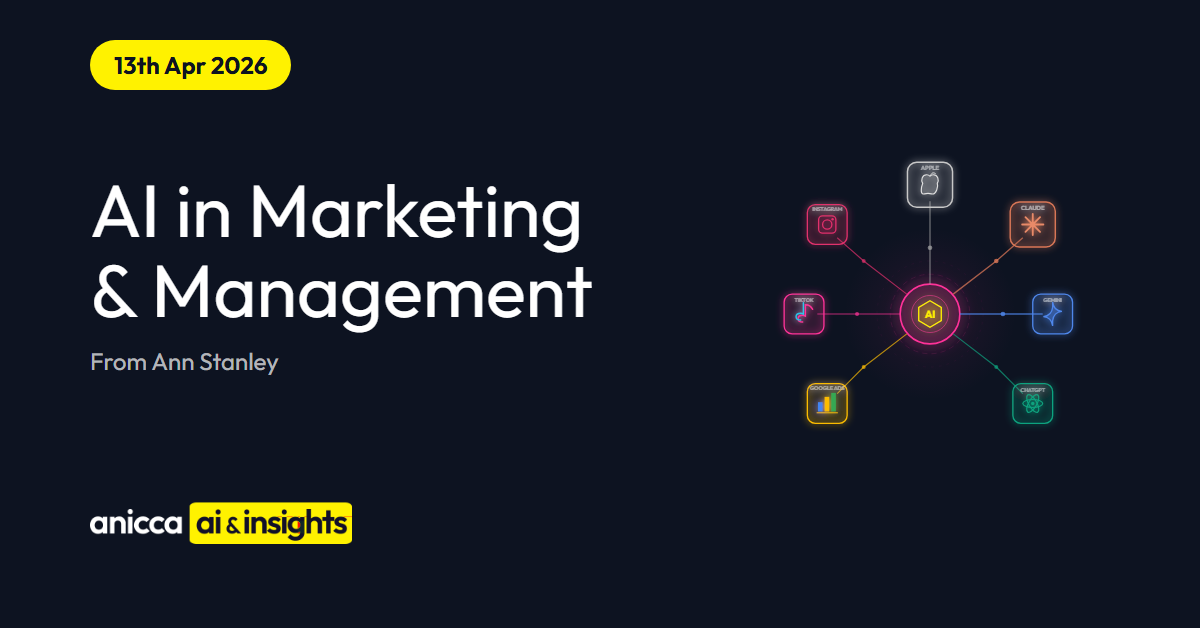
This Week in AI in Marketing & Management (13th Apr 26)
Apple Picks Gemini, Anthropic Pulls Mythos, Google Ads Claims 80% Sales Lift
Four stories have dominated the AI marketing and management conversation this week. Apple has picked Google Gemini over OpenAI to power the new Siri. Anthropic cancelled the launch of Claude Mythos after safety concerns, with the European Union publicly welcoming the decision. Google is telling advertisers that AI-powered ads are lifting online sales by up to 80% for some brands. And Block has joined Oracle, Meta and Amazon in openly cutting headcount as AI takes on work previously done by humans. Alongside these headlines, the week brought fresh developments in agentic commerce, SEO versus AI search strategy, and sector-specific AI adoption from banking to retail.Table of Contents
AI News, Tech and Tools- Apple picks Google Gemini over ChatGPT to power the new AI Siri
- Anthropic pulls Claude Mythos launch after safety concerns, EU welcomes the delay
- OpenAI takes on Anthropic with a 100 dollar per month ChatGPT Pro plan
- Anthropic launches Managed Agents to handle the hard part of building AI agents
- Anthropic expands compute deal with Google and Broadcom
- Gemini for Google Home launches in 16 more countries
- The New Yorker profiles Sam Altman: can he be trusted with our future?
- Google says AI-powered ads are lifting online sales by up to 80%
- Google Ads lets marketers reuse AI text rules across campaigns
- A practical guide to the new AI creative tools in Google Ads
- Google AI Overviews: 90% accurate, yet millions of errors remain
- The Verge: inside the growing industry trying to influence AI responses
- A framework for prioritising SEO versus AI search investment
- Tubi becomes the first streamer to launch a native app inside ChatGPT
- TikTok launches new Wix and HubSpot integrations
- Sprout Social: 20 Instagram trends defining success in 2026
- Block bets on AI-driven teams as 50-55% of jobs face transformation
- IMD: bosses, stop telling staff that AI will not take their jobs
- Fortune: AI is transforming work and talent strategy must keep up
- Decision Marketing: bosses feel the heat too as AI puts all heads on the block
- Finance: Fifth Third says AI will help banks out-code their vendors
- NVIDIA State of AI in Financial Services 2026: 96% now using AI
- Travel: hotels book directly through ChatGPT as Mirai and EaseMyTrip go native
- Automotive: carmakers accelerate AI applications after CES 2026
- Education: Pearson and TCS partner to bring AI into learning and assessments
- B2B SaaS: AI agents force a rethink of SaaS pricing models
- Retail and CPG: NVIDIA finds 9 in 10 retailers will raise AI budgets in 2026
- Retail: Frasers Group launches AI shopping assistant
- Should my brand be on ChatGPT Apps like Tubi, Mirai and EaseMyTrip?
- Is the Google Ads 80% sales lift figure real, and should I believe it?
- Do I need to shift all my budget from SEO to GEO now?
AI News, Tech and Tools
Apple picks Google Gemini over ChatGPT to power the new AI Siri
Source: mashable.com | April 2026Apple has chosen Google Gemini, not ChatGPT, as the large language model powering the new AI-overhauled Siri. The decision follows more than a year of head-to-head testing. Apple will run a customised Gemini on its own private cloud rather than routing queries through Google servers, and the integration ships with the next major iOS release.Why it matters For marketers, this is the moment Siri becomes a genuine AI surface worth planning for. Voice-activated product discovery, agentic booking and app-to-app handoffs on iPhone will now run through Gemini’s reasoning layer, which is the same layer behind Google AI Overviews and AI Mode. Brands that have been optimising for Google’s generative search results will find those same optimisations carrying over to Siri, while anything built purely for ChatGPT as a consumer interface has just lost the largest possible distribution pipe.Anthropic pulls Claude Mythos launch after safety concerns, EU welcomes the delay
Sources: spiceworks.com, theguardian.com, politico.eu | April 2026Anthropic has cancelled the public launch of Claude Mythos after internal red-teaming found the model could accelerate cyber attacks and help design biological threats. The company will do a staged rollout to trusted enterprise customers instead. The European Union publicly welcomed the decision, calling it a model for how frontier AI developers should behave under the EU AI Act.Why it matters Anthropic is building its brand on being the safety-first alternative, and the EU is actively rewarding that positioning. Expect more enterprises in regulated sectors, particularly banking, healthcare and legal, to use the Mythos decision as justification for defaulting to Claude over ChatGPT. It also puts pressure on OpenAI and Google to demonstrate equivalent voluntary slowdowns, or risk being framed as the reckless option in procurement decks.OpenAI takes on Anthropic with a 100 dollar per month ChatGPT Pro plan
Source: cnbc.com | 9 April 2026OpenAI has launched a 100 dollar per month ChatGPT Pro tier aimed at professional developers and power users, in direct response to Claude Code and Claude Cowork. Pro includes unlimited advanced reasoning, higher coding rate limits, and new agentic tools that run tasks across files and desktop. OpenAI is deliberately pricing to undercut the combined cost of GitHub Copilot, Claude Code and Cursor.Why it matters The premium tier of generative AI is now a two-horse race between ChatGPT Pro and Claude, both at 100 dollars per month and both bundling agentic features. If you are buying AI tools for your team, this is the week to stop using free-tier ChatGPT in production workflows. It also means agency pricing conversations with clients are about to get easier: the cost of the tools is rising, so the cost of the expertise to use them should rise with it.Anthropic launches Managed Agents to handle the hard part of building AI agents
Source: wired.com | April 2026Anthropic has launched Claude Managed Agents, a product that takes over the infrastructure, memory, tool use and recovery logic that developers previously had to build themselves. WIRED describes it as the “missing middle layer” between a raw API call and a custom agent framework. Early customers include Palantir, Rakuten and several large law firms. Pricing is usage-based, not per-seat.Why it matters Managed Agents answers the biggest complaint from enterprise buyers: that AI agents sound good in demos and fall apart in production. By taking on the infrastructure headache, Anthropic makes it realistic for mid-sized teams to ship agentic workflows without hiring specialist AI engineers. For agencies and in-house marketing teams, this lowers the cost of shipping an agent that actually does something useful, whether that is lead qualification, brief generation from transcripts, or support triage.Anthropic expands compute deal with Google and Broadcom
Source: anthropic.com | April 2026Anthropic has expanded its compute partnership with Google and Broadcom, securing multiple gigawatts of extra capacity on Google Cloud TPUs and on Broadcom’s custom silicon. The deal gives Anthropic a second source of advanced chips beyond its Amazon Trainium commitments and is aimed at preventing the capacity wobbles Claude users have seen in recent weeks.Why it matters For marketing teams building on top of Claude, this is the fix for the reliability issues many users have seen recently. If you were considering moving production workflows off Claude because of capacity queues, it is worth waiting until the new compute comes online. It also reinforces how tightly Google, Anthropic and Amazon are now intertwined at the infrastructure layer, even while they compete fiercely at the application layer.Gemini for Google Home launches in 16 more countries
Source: techadvisor.com | April 2026Google has rolled out Gemini for Home to 16 more countries including the UK, replacing the older Google Assistant on Nest speakers and Nest Hubs. Gemini for Home handles multi-step household tasks, remembers context across conversations and controls smart devices more naturally. Users have to opt in through the Google Home app to switch.Why it matters Voice is back on the agenda. Amazon is upgrading Alexa to Alexa Plus, Apple is rebuilding Siri on Gemini, and now Google is replacing its own Assistant with Gemini on home devices. For brands with recipes, products, services or local presence, the voice layer is becoming a genuine discovery surface again after five years of being treated as a gimmick. Any brand doing local SEO or GEO should start thinking about how it surfaces in household voice queries.The New Yorker profiles Sam Altman: can he be trusted with our future?
Source: newyorker.com | April 2026The New Yorker has published a long-read profile of Sam Altman, built around whether the person running the company most likely to build AGI should be trusted with the responsibility. It reports new detail on the November 2023 board firing, Altman’s relationship with Microsoft, and documents episodes where Altman reportedly told different stakeholders different stories about the same events.Why it matters This is the kind of long-form journalism that shapes boardroom and regulatory attitudes for the next twelve months. If you are advising clients on AI vendor selection, expect the Altman trust question to come up. It is already the main reason Anthropic is winning deals in regulated sectors. The piece also gives marketing and comms teams a template for how to write about AI leadership responsibly, combining admiration for the technology with scepticism about the people in control of it.AI in Marketing
Google says AI-powered ads are lifting online sales by up to 80%
Sources: emarketer.com, modernretail.co | April 2026Google has released performance data claiming brands using its full AI-powered ad stack are seeing online sales lifts of up to 80% compared to older match types and manual bidding. The 80% is the top decile of performers; the median across all advertisers in the Google-commissioned study was closer to 25%, with a 32% reduction in cost per acquisition for brands that let Google’s AI drive targeting, creative and placement together.Why it matters The 80% number will dominate client conversations for the next fortnight. The honest read is that the median lift of 25% is still material, and the brands who saw 80% were the ones who fed Google’s AI high-quality first-party data, a strong feed and diverse creative. If you are resisting full automation because you want to preserve manual levers, this is Google’s answer to you. Do not ignore the data, run your own test with robust holdouts so you know the lift in your account, not in Google’s press release.Google Ads lets marketers reuse AI text rules across campaigns
Source: searchengineland.com | April 2026Google Ads now lets advertisers define AI text rules once and reuse them across campaigns. The rules govern how Google’s generative models rewrite headlines and descriptions in RSAs and Performance Max, covering brand voice, banned words, required phrases and compliance disclaimers. Exclusion lists stop the AI from rewriting specific headlines approved by legal or brand teams.Why it matters For agencies and in-house teams running Google Ads at scale, this is a genuine time saver. It also reduces the single biggest complaint enterprise clients have with AI-generated copy: that it goes off-brand the moment you stop watching. Set the rules once at account level, lock down the sensitive phrases, and you can let Performance Max run creative variations without the weekly audit. This is the kind of boring but important platform change that compounds into real productivity gains.A practical guide to the new AI creative tools in Google Ads
Source: practicalecommerce.com | April 2026Practical Ecommerce has published a walkthrough of the AI creative tools in Google Ads, covering image generation, product background editing, video trimming and asset scoring. The most useful finding is that Google’s image generator is noticeably better for lifestyle backgrounds than for the product itself. The right workflow is to generate a background and composite the original product photograph on top, rather than letting the AI draw the product from scratch.Why it matters Most advertisers are still using AI creative tools wrong: they ask the model to generate the whole ad rather than treating it as a co-pilot on specific creative tasks. The Practical Ecommerce playbook of “generate the background, keep the product photo real” is one of the most useful operational tips we have seen in months. Agencies should write this into their Performance Max onboarding checklist this week.Google AI Overviews: 90% accurate, yet millions of errors remain
Source: searchengineland.com | April 2026A new analysis of more than 5,000 queries found Google AI Overviews are now accurate about 90% of the time, up from 70% in 2024. They now appear on around 60% of all Google searches, which means even a 10% error rate translates to millions of wrong answers every day. Accuracy is lowest on medical, financial, product comparison and anything involving dates, distances or prices.Why it matters For brands, the honest read is that AI Overviews are now accurate enough to drive real traffic shifts and inaccurate enough to misrepresent your product or service regularly. You need a monitoring workflow that checks what AI Overviews are saying about your brand and your top category queries, catches the factual errors, and submits them through Google’s correction process. Treat it like an SEO audit but for generative answers. This is the bread and butter of GEO work for 2026.The Verge: inside the growing industry trying to influence AI responses
Source: theverge.com | April 2026The Verge has profiled the emerging generative engine optimisation industry and the specialist agencies and tool vendors, including Profound, Otterly, AthenaHQ and Goodie, that are trying to influence what ChatGPT, Gemini, Claude and Perplexity say about brands. Techniques include structured data markup, authoritative content placement, brand mention seeding on Reddit and Quora, and automated monitoring of how brand entities appear in AI responses.Why it matters GEO is now a recognised category in mainstream tech press, not just in the SEO echo chamber, which means client budgets for GEO work will start showing up in RFPs over the next two quarters. The Verge’s scepticism is healthy because it gives you the language to push back when clients ask for guaranteed AI ranking improvements. The honest pitch is that GEO work builds the entity authority and mention footprint that gives your brand the best chance of being cited, not a guaranteed position.A framework for prioritising SEO versus AI search investment
Source: searchenginejournal.com | April 2026Search Engine Journal has published a framework to help marketers decide how much to invest in SEO versus GEO. It pushes back against the idea that every brand needs to pivot immediately, and offers four diagnostic questions: share of category traffic from classic blue links, percentage of top queries triggering AI Overviews, how often your brand is mentioned in AI responses, and how much revenue depends on converting queries that AI answers could intercept.Why it matters This is the most grown-up SEO versus GEO piece we have seen in months, and the four-question framework is genuinely useful for prioritising work. If you are having the “do I need to do GEO” conversation with a client, this is the article to send them. It gives both sides a shared vocabulary and stops the conversation becoming a binary pivot-or-die choice.Tubi becomes the first streamer to launch a native app inside ChatGPT
Source: techcrunch.com | 8 April 2026Fox-owned streamer Tubi has launched the first native streaming app inside ChatGPT, using OpenAI’s ChatGPT Apps framework. Users can ask ChatGPT to find and play Tubi content directly in the chat interface, with playback handed off to the Tubi app for full viewing. Tubi says a growing share of its weekly active users are now discovering new titles through AI chat rather than the Tubi homepage.Why it matters ChatGPT Apps is turning into a real distribution surface. Tubi follows Mirai and EaseMyTrip going native inside ChatGPT this month. If your brand has a discovery or transaction use case that works well in conversation, it is time to get on the ChatGPT Apps waitlist, because the early movers are capturing the best positioning. For content brands in particular, the parallel is the arrival of Apple TV apps in 2015: the platforms that launched first became defaults.TikTok launches new Wix and HubSpot integrations
Sources: socialmediatoday.com, socialmediatoday.com | April 2026TikTok has shipped two integrations this week. Wix store owners can now install a TikTok pixel, sync product catalogues and publish TikTok ads directly from the Wix dashboard, with TikTok Shop supported for eligible merchants. The HubSpot integration imports TikTok lead gen form data straight into HubSpot CRM and triggers workflows on TikTok ad leads.Why it matters If you have been holding off TikTok Ads because of the tracking and attribution headache, these integrations close the gap. HubSpot CRM integration in particular removes one of the most common objections from B2B clients experimenting with TikTok for lead gen, and the Wix integration makes TikTok a one-click add for hundreds of thousands of small stores that previously found the platform too fiddly.Sprout Social: 20 Instagram trends defining success in 2026
Source: sproutsocial.com | April 2026Sprout Social’s 2026 Instagram trends report finds Reels engagement now outperforms Stories for the first time, carousel posts drive the highest saves-per-impression, and AI-generated content is being penalised in reach unless clearly labelled. More than half of Gen Z users now start product research in Instagram search rather than Google.Why it matters The single most actionable finding is the algorithm penalty for unlabelled AI-generated content. If you are using Midjourney, Seedream or Nano Banana for Instagram creative, label the output and lean into AI as a creative style rather than hiding it. The second most important finding is Instagram as a search surface for young audiences, which has implications for product naming and keyword use in captions.AI in Management
Block bets on AI-driven teams as 50-55% of jobs face transformation
Source: bitget.com | April 2026Jack Dorsey’s Block is restructuring around AI-driven teams, with layoffs affecting roughly 40% of employees across several business units, on top of cuts at Oracle, Amazon and Meta. Fresh BCG and Microsoft research lands in the same week estimating 50-55% of jobs will be significantly transformed by AI within two to three years, with job titles and salaries staying the same but expectations shifting dramatically.Why it matters Block is the first large, public tech company to tie a 40% headcount cut explicitly to AI efficiency gains rather than to macro conditions. That is a significant framing shift, and it gives other chief executives political cover to do the same. For marketing and agency leaders, the Block announcement sets the tone for how boards will start asking about AI productivity in Q2 budget conversations. The real question is what workflows in your team have been redesigned around AI in the last 90 days.IMD: bosses, stop telling staff that AI will not take their jobs
Source: imd.org | April 2026Lausanne business school IMD argues corporate leaders need to stop reassuring staff that AI will not replace them, because the reassurance is dishonest and counterproductive. IMD recommends leaders commit publicly to three things: a timeline for AI introduction, a clear statement of which roles are most at risk, and a retraining commitment with real budget behind it.Why it matters This is the bluntest mainstream article on leadership communication around AI that we have seen this year. If you are running an agency or a team, use the IMD framework this month. Write the memo that says which workflows are being automated, which roles will change, what the retraining budget is, and what the timeline looks like. Your team already knows something is coming, and the trust dividend from naming it honestly is larger than the short-term morale hit.Fortune: AI is transforming work and talent strategy must keep up
Source: fortune.com | 7 April 2026Fortune interviewed senior CHROs including from IBM on how AI is reshaping talent strategy. The consensus is that annual headcount planning and job descriptions are breaking down, replaced by skills-based models where roles are decomposed into skills, skills are mapped to AI-augmented workflows, and teams are rebuilt around judgement, client relationships and cross-functional facilitation. Middle management is the layer most exposed.Why it matters Skills audits are becoming a real thing, not an HR fad. If you want to know which roles in your team are most exposed, the question to ask is not “what is your job title” but “what skills do you use in a typical week, and which of those could be done by an AI tool.” Run that exercise on yourself first, then cascade it. The results are uncomfortable but genuinely useful for planning.Decision Marketing: bosses feel the heat too as AI puts all heads on the block
Source: decisionmarketing.co.uk | April 2026New UK research finds senior marketing leaders and agency bosses are just as worried about their own jobs as junior staff. More than 40% of UK marketing directors expect their role to be reshaped by AI within two years, and nearly a quarter are actively considering career changes. Agency founders are being squeezed as clients expect fee reductions matching AI productivity gains.Why it matters This is the first UK-specific piece that frames senior marketing leaders as being in the firing line. The honest read is that agencies that invest early in AI tooling and train their teams will grow into the space vacated by slower competitors. The ones that do not will find their clients asking uncomfortable questions about fees by the end of the year.AI for Sectors and Industries
Finance: Fifth Third says AI will help banks out-code their vendors
Source: americanbanker.com | April 2026Jay Plum, head of consumer lending at Fifth Third Bank, says AI coding tools now let the bank build things in-house that it used to buy, including risk scoring models, exam preparation tooling and internal workflow automation. The bank now asks whether AI could build a vendor’s capability internally for less before renewing any contract.Why it matters A decade of bank tech budgets flowing to SaaS vendors may be about to reverse. For agencies and marketers targeting financial services clients, this shift changes who holds the budget: if banks build more software in-house, the buying conversation moves away from IT procurement and towards business-line leaders who control their own tools. Marketing content aimed at banks should start speaking to “build versus buy” decision criteria, not just vendor capability.NVIDIA State of AI in Financial Services 2026: 96% now using AI
Source: blogs.nvidia.com | April 2026NVIDIA’s 2026 Financial Services survey (1,000+ respondents across 11 markets) finds 96% of financial institutions are actively using AI or planning implementation, up from 91% in 2025. The fastest-growing area is agentic workflows for operations staff. More than half of respondents now run at least one production workload on open-source models like Llama, Mistral or Qwen.Why it matters Financial services is now the sector with the highest AI adoption rate in the world, ahead of tech and retail. If you are marketing AI services into banks, insurers or wealth managers, the pitch has moved on from “should you use AI” to “how do you move from pilot to production.” The open-source finding is also significant, because it contradicts the assumption that regulated sectors only buy from named commercial vendors.Travel: hotels book directly through ChatGPT as Mirai and EaseMyTrip go native
Sources: travelandtourworld.com, traveltrade.today | April 2026Spanish hotel tech company Mirai has launched conversational booking that lets travellers book stays directly through WhatsApp, ChatGPT, Claude and Gemini, without visiting a hotel website. Indian travel giant EaseMyTrip has become the first Indian travel company with a native app inside ChatGPT Apps, offering its full booking flow in-conversation.Why it matters Travel is the first sector where conversational commerce has broken out of pilot and into production at scale. If your clients are in travel, accommodation or experiences, the priority this month is making sure their product data is machine-readable, their availability is API-accessible, and their brand is mentioned in the right review and content sources that LLMs cite. The playbook from Mirai, EaseMyTrip and Tubi will repeat in retail, property and food delivery over the next two quarters.Automotive: carmakers accelerate AI applications after CES 2026
Source: autovista24.autovistagroup.com | April 2026BMW, Mercedes-Benz and Volkswagen are all deepening generative AI integration in their infotainment systems, with BMW partnering with Alexa Plus, Mercedes on a custom LLM, and Volkswagen rolling out ChatGPT access across Europe. Manufacturers are also investing in physical AI (humanoid robots, AI quality inspection) to close the development-cycle gap with Chinese rivals.Why it matters Automotive is where the AI story stops being about content and starts being about physical production. For marketers working with automotive brands, the takeaway is that AI is no longer just a feature in the car, it is a feature in the factory and in the design process. That changes the stories worth telling about innovation, speed to market and manufacturing capability.Education: Pearson and TCS partner to bring AI into learning and assessments
Source: consultancy.uk | April 2026Pearson and Tata Consultancy Services have announced a partnership to embed AI across Pearson’s learning and assessment products, covering personalised learning journeys, AI-assisted essay marking, automated assessment generation and an AI tutoring layer. First products launch in the 2026-27 academic year in the UK and US.Why it matters Education is often an underrated AI market because sales cycles are slow and buyers are conservative. The Pearson-TCS deal shows the big incumbents are now moving quickly to protect their core product lines. For marketers in education or edtech, expect the next twelve months to bring a wave of AI-branded product launches, and expect institutional buyers to start demanding AI features as standard in RFPs.B2B SaaS: AI agents force a rethink of SaaS pricing models
Source: martechseries.com | April 2026Automation Anywhere data shows AI agents are resolving more than 80% of employee service requests in enterprise IT service management, cutting per-seat licence costs by up to 50% in some accounts. Traditional per-seat SaaS licensing no longer reflects the work being done, forcing vendors toward outcome-based, usage-based or agent-based pricing.Why it matters This is the most important commercial story in B2B SaaS right now. If you sell software or services into enterprise buyers, the pricing conversation is about to change fundamentally. Start preparing now: identify the outcomes your product delivers, work out how to measure them, and build pricing tied to those outcomes rather than to seat counts. Agencies face the same pressure as clients ask why they should pay for hours when AI is doing the work in minutes.Retail and CPG: NVIDIA finds 9 in 10 retailers will raise AI budgets in 2026
Source: blogs.nvidia.com | April 2026NVIDIA’s 2026 Retail and CPG survey finds nine in ten retailers will raise AI budgets this year and AI agents will power 40% of enterprise retail applications. 66% of CPG companies have implemented or are scaling generative AI, with customer service the most common use case. Nearly 60% are bringing generative AI creative and retail media planning in-house rather than outsourcing.Why it matters The “bringing it in-house” finding is the one agencies should worry about. Retail and CPG clients are rebuilding their own creative and retail media capabilities using generative AI, which means the traditional “we will run your creative” agency offer is under pressure. The response is to focus on strategy, measurement and the parts of creative work that still need human judgement, and to price accordingly.Retail: Frasers Group launches AI shopping assistant
Source: drapersonline.com | April 2026Frasers Group, owner of Sports Direct, House of Fraser, Flannels and Jack Wills, has launched an AI shopping assistant across its group sites. The assistant handles discovery, size and fit advice, outfit recommendations and returns queries across multiple brands, trained on product catalogues, reviews and brand guidelines, and integrated with the loyalty programme.Why it matters Frasers is the first major UK multi-brand retailer to ship a cross-brand AI shopping assistant at scale. For UK retail clients, this is the proof point that the conversational shopping experience is now a credible competitive feature, not just a Silicon Valley demo. If you work with retailers in the UK and they have been holding off, the question to ask in the next planning meeting is “what would it take to ship our version by Q4.”Key Takeaways
- Apple has chosen Google Gemini over OpenAI to power the new Siri, which turns Gemini into the most widely distributed AI model on consumer devices and makes Google-centric GEO work even more valuable.
- Anthropic cancelled Claude Mythos citing cyber and biosecurity concerns, and the EU publicly endorsed the decision, creating a clearer commercial advantage for Claude in regulated enterprise sales.
- Google’s own data says AI-powered ad stacks deliver median online sales lifts of 25%, with top performers at 80%. Run your own controlled tests with holdouts before presenting these numbers to clients.
- SaaS per-seat pricing is starting to break as AI agents resolve 80% of enterprise IT tickets, with some accounts already cutting licence costs by 50%. Agencies face the same pressure on hourly billing.
- Block’s 40% AI-driven layoff is the first big public tech example of framing headcount cuts as efficiency gains rather than macro pain, and it will shape Q2 board conversations on AI productivity.
- Financial services leads all sectors on AI adoption at 96%, and mid-sized banks are starting to build software in-house rather than buy from SaaS vendors. Build-versus-buy is the new pitch angle.
- Conversational commerce has arrived in travel with Mirai, EaseMyTrip and Tubi all going native inside ChatGPT Apps this month. The same playbook will hit retail, property and food delivery next.
Frequently Asked Questions
Should my brand be on ChatGPT Apps like Tubi, Mirai and EaseMyTrip?
If your brand has a discovery or transactional use case that works well in conversation, yes. Early movers are capturing the best positioning in the new ChatGPT Apps surface, and the pattern from previous platform launches suggests that the first credible app in each category becomes the default. Start by joining the waitlist, then work out which of your existing flows could be condensed into a conversational experience.Is the Google Ads 80% sales lift figure real, and should I believe it?
The 80% number is real but it represents the top decile of advertisers in a Google-commissioned study. The median lift across all advertisers was closer to 25%, which is still meaningful but much less dramatic. The brands that achieved the biggest lifts were the ones that gave Google’s AI the most freedom on targeting, creative and placement. Run your own controlled test with a proper holdout group before quoting Google’s headline figure to clients.Do I need to shift all my budget from SEO to GEO now?
No. Use the Search Engine Journal framework: check what share of your category traffic still comes from classic blue links, what percentage of your top queries trigger an AI Overview, how often your brand is mentioned in ChatGPT or Gemini responses, and how commercial your top converting queries are. Brands with highly transactional top queries should keep investing in traditional SEO and layer GEO on top. Brands whose queries are mostly informational and already AI-dominated should shift more budget into GEO.Conclusion
The week of 6-12 April has made it clear that the big AI platforms are fighting on every front: consumer devices (Apple choosing Gemini), developer tools (ChatGPT Pro versus Claude Code), safety positioning (Mythos cancellation), and distribution through conversational apps (Tubi, Mirai, EaseMyTrip). For marketers and business leaders, three actions matter most this week. First, audit how your brand appears inside AI Overviews, ChatGPT and Gemini, and build a monitoring workflow for the errors that now affect millions of queries every day. Second, plan at least one conversational commerce experiment this quarter. Third, sit down with your team and write the honest memo about which workflows AI is changing, what the retraining plan is, and what the new measurement model looks like. The leaders getting ahead right now are the ones being specific about change, not the ones waiting for more clarity.Need help turning the week’s AI news into a practical plan for your business? Get in touch with Anicca Digital for expert guidance on AI-powered marketing, GEO, Google Ads and agentic commerce strategy.This roundup is compiled from publicly available sources using AI-assisted research. While we review every article for accuracy, our analysis reflects our interpretation of the original reporting. We strongly encourage readers to click through to the original sources linked throughout this post for full context and detail. If you spot anything that needs correcting, please let us know.
Thursday AI Club
A hands-on AI club for marketers and managers. Fortnightly 3-hour sessions: Hour 1 is an open Q&A on any AI question; Hours 2-3 split into a workshop track (for newbies) and an advanced track (live demos and deeper questions).
Led by Ann Stanley, James Allen.
Workshop recordings library
Skills and prompts to copy
Private community channel
Secret Agents community access
Full-day hackathon every quarter
Cancel any time
Membership: £40/month or £400/year
Join the Thursday AI Club →