This Week in AI in Marketing & Management (20th Apr 26)
Google Retires Dynamic Search Ads for AI Max, Anthropic’s Four-Launch Week, UK Lands £500m Sovereign AI Fund
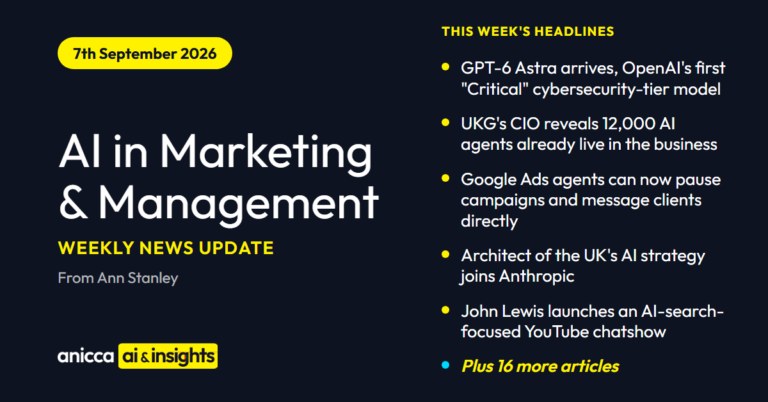
Six stories have dominated the AI marketing and management conversation this week.
Google has announced the end of Dynamic Search Ads, with every campaign migrating to AI Max before the end of 2026.
Anthropic shipped four product launches in four days: a redesigned Claude Code desktop app, the new Routines scheduled-task feature, Claude Opus 4.7, and Claude Design for rapid visual prototyping.
OpenAI responded on three fronts: a Codex update that The Verge called “a direct shot at Claude Code”, GPT-Rosalind for drug discovery, and a $400 billion expansion of the Stargate data centre programme.
Netflix is rebuilding its mobile app around a TikTok-style vertical feed and AI-powered recommendations.
The UK government had its biggest AI-policy week in a decade: a £500 million Sovereign AI Fund, plus permanent London offices confirmed by both OpenAI and Anthropic.
And Snap cut 1,000 jobs (16% of its workforce) citing AI efficiency, the first major US tech layoff of 2026 where the CEO has framed AI as the direct cause in the internal memo.
Alongside these headlines, the week brought fresh developments in local AI search, agentic engine optimisation, AI search adoption splits, the workforce future, and sector-specific AI adoption across healthcare, education, retail, and the public sector. We go deeper on all four Anthropic announcements in our companion post, Claude Desktop Redesign, Claude Routines, Opus 4.7 and Claude Design: What Marketers and Managers Need to Know.
Table of Contents
- Anthropic ships Claude Opus 4.7 with stronger coding and agent performance
- Anthropic redesigns the Claude Code desktop app and adds Routines
- Claude Design launches for rapid visual prototyping
- OpenAI’s Codex update goes straight at Claude Code
- Google brings the Gemini app to Mac, plus Gemini for Home to 16 more countries
- Microsoft confirms work on its own OpenClaw-like agent
- OpenAI expands Stargate with five new US data centre sites
- Google retires Dynamic Search Ads in favour of AI Max
- Your website is now the source of truth in local AI search
- Google AI director outlines agentic engine optimisation playbook
- AI search adoption splits along income lines
- Performance Max channel performance report gets an “over time” view
- Netflix launches TikTok-style vertical feed with AI-powered recommendations
- Snap cuts 1,000 jobs as Spiegel bets on AI to replace them
- Will AI lead to 20% unemployment, or just make employees superhuman?
- Twin to win: the rise of AI digital doppelgangers in the workforce
- AI is quietly making it harder for young workers to get ahead
- Building AI-ready government: David Rai on talent, data debt, and human oversight
- E-COMMERCE: How Etsy is using AI across search, seller tools, and discovery
- RETAIL: Adobe finds AI traffic surging, but most retail sites are not machine-readable
- RETAIL MEDIA: AI will not kill retail media, but it is eyeing the path to purchase
- HEALTHCARE: OpenAI launches GPT-Rosalind for life sciences and drug discovery
- HEALTHCARE: Amazon launches Bio Discovery agentic AI to accelerate drug development
- EDUCATION: Google rolls out new AI tools for learners and educators
- PUBLIC SECTOR: UK launches £500m Sovereign AI Fund as OpenAI and Anthropic both confirm London expansions
AI News, Tech & Tools
Anthropic ships Claude Opus 4.7 with stronger coding and agent performance
Source: anthropic.com | Anthropic | 16 April 2026
Anthropic released Claude Opus 4.7 on 16 April, positioning it as a notable improvement on Opus 4.6 in advanced software engineering, agentic tool use, and long-horizon task completion. The model is generally available to API customers and paid Claude subscribers, and it powers the redesigned Claude Code desktop app released alongside it. Anthropic is pricing Opus 4.7 in line with 4.6 and has made it the default for the Max tier, so most existing customers will see the upgrade without having to pick a new model in the model selector.
The headline gain is reliability on multi-step tasks. Anthropic’s internal evaluations show Opus 4.7 finishing longer agent workflows without losing context, which matters more for marketers than raw benchmark scores because it is what lets Claude run a reporting pipeline, a content repurposing chain, or a competitor sweep end to end without the human having to step in every few minutes. The 1M token context window remains, so the use cases that rely on dumping an entire GA4 export or a full ebook into the model continue to work.
Why it matters
If you have been running Claude Opus 4.6 inside an n8n workflow, a custom agent, or Claude Code itself, Opus 4.7 is a drop-in upgrade that should improve the success rate on anything multi-step. For a detailed walkthrough of how the new model slots in with Routines and the redesigned desktop app, see our companion piece: Claude Desktop Redesign, Claude Routines, Opus 4.7 and Claude Design.
Anthropic redesigns the Claude Code desktop app and adds Routines
Source: venturebeat.com | VentureBeat | 16 April 2026
On 14 April, Anthropic released a complete redesign of the Claude Code desktop app for Mac and Windows alongside a new “Routines” feature. The redesign introduces three explicit modes. Chat is the familiar conversational interface. Cowork is a side-by-side view where Claude works on a task while you keep typing. Code is a developer-style terminal view for anyone comfortable with a command-line flow. VentureBeat’s testing highlighted that the mode switch addresses the single biggest blocker to broader enterprise adoption: people outside engineering teams could not work out where to start.
Routines are the more significant change for non-developers. A Routine is a saved Claude Code instruction that runs on a schedule, pulls in the files or data sources it needs, and produces an output such as a report, a draft, or an email. Think scheduled PPC account check at 07:00, a Monday content brief built from last week’s analytics, or a Friday competitor pricing sweep. You write the Routine once in plain English, then leave it to run.
Why it matters
This is the first Anthropic release aimed squarely at marketers and operators, not engineers. The three-mode split means non-coders can use Chat and Cowork while their more technical colleagues stay in Code, all inside the same app. And Routines finally give marketing teams a way to schedule repetitive Claude work without standing up a separate automation stack. Full walkthrough and screenshots in our deeper companion post.
Claude Design launches for rapid visual prototyping
Source: techcrunch.com and anthropic.com | 17 April 2026
Anthropic rounded out its week with Claude Design, a standalone visual prototyping workspace at claude.ai/design. The product lets users generate marketing visuals, product mockups, loading animations, particle effects, and other front-end design artefacts from a prompt, then edit the result in a Figma-style canvas. It is Anthropic’s first dedicated design product and sits inside its new Anthropic Labs umbrella.
The launch lineup includes starter templates for hero sections, CTAs, loading states, and small interactive widgets. Everything is exportable as code or as static visual assets. In our internal testing, Claude Design produced usable first-draft hero sections in under a minute, though the outputs still need a proper designer’s eye before they go anywhere near a real site.
Why it matters
Claude Design collapses the gap between “I have a rough idea for a landing page” and “I have something the designer can critique”. For small marketing teams without a permanent designer on staff, that is a meaningful productivity win. For agencies, it raises an uncomfortable question about which deliverables clients will continue paying external specialists to produce. We cover the design workflow in detail in our Claude companion post.
OpenAI’s Codex update goes straight at Claude Code
Sources: theverge.com and techcrunch.com | 16 April 2026
OpenAI used the same week to ship a major Codex update that The Verge described as “a direct shot at Claude Code”. The new Codex can read from and write to files anywhere on a Mac, run shell commands, launch applications, and operate across multiple desktop apps in a single task. In practice, that means OpenAI has matched most of the capabilities that made Claude Code the go-to choice for enterprise developer workflows over the last six months, and then added a few of its own.
TechCrunch’s coverage flagged that the update is available on ChatGPT Pro and Enterprise plans and is being bundled with expanded agent features that let Codex complete multi-step tasks without supervision. The strategic context is plain: Anthropic has been winning the developer share war inside Fortune 500 companies for most of 2026, and Codex is how OpenAI intends to pull some of that ground back.
Why it matters
For marketers, a two-horse race in the agentic coding space is good news. It drives capability and price forward faster than a monopoly would. For engineering leads choosing a primary tool, the decision is no longer obvious. Routines plus the Claude desktop redesign give Anthropic a better non-developer story, while Codex’s OS-level reach and its integration with ChatGPT’s existing Team and Enterprise seats give OpenAI a distribution advantage. Expect evaluation cycles to lengthen through Q2.
Google brings the Gemini app to Mac, plus Gemini for Home to 16 more countries
Sources: blog.google, theverge.com, and techadvisor.com | 16 April 2026
Google rolled out a native Gemini app for macOS this week. The desktop app lets users invoke Gemini from anywhere on the system, share specific windows for context, and run long-running tasks in the background while other work continues. The launch closes an awkward gap: Gemini has had a Windows desktop presence via Copilot-style integrations, but Mac users have been stuck using it inside Chrome. The new app also supports Gemini Live voice conversations.
Google also extended Gemini for Home, its replacement for Google Assistant, to 16 new countries including the UK, Australia, and most of Europe. The Gemini-powered speaker experience handles multi-step voice requests that old Assistant could not manage, and it ties into the Home app for visual continuation of a task started by voice.
Why it matters
Google is quietly making Gemini ambient, which matters for marketers thinking about discovery and assistance beyond the search box. Voice queries inside a home environment do not route through Google.com. Over time, a meaningful slice of “how do I…” questions will resolve at the kitchen counter, not on a SERP. That has consequences for how brands show up in Google Business Profile, structured data, and increasingly in Gemini’s knowledge graph as a trusted source.
Microsoft confirms work on its own OpenClaw-like agent
Source: techcrunch.com | TechCrunch | 13 April 2026
Microsoft confirmed this week that it is building a browser-based agent along the same lines as OpenClaw, the open source browsing agent that has become a de facto standard for “let an AI use a website on my behalf” workflows. The Microsoft agent will sit inside Edge and Copilot and will be able to book meetings, fill forms, compare prices, and complete basic ecommerce transactions without the user touching the mouse or keyboard after the initial instruction.
Microsoft is the third hyperscaler in the browsing agent space after OpenAI’s Operator and Google’s forthcoming Gemini agent features. The common capability set is converging quickly: all three can now handle multi-step shopping tasks, light research workflows, and simple form-filling. What is different is how each company plans to distribute the agent. Microsoft’s bet is on Edge market share plus Copilot seat penetration in large enterprises.
Why it matters
For marketers, every new browsing agent is another potential visitor to your site that does not see your design, does not care about your hero video, and judges everything on structured data and copy clarity. The Adobe retail data later in this roundup shows exactly how badly most sites are currently set up for this audience. The time to fix that is now, before these agents become the default interface for commerce-intent queries.
OpenAI expands Stargate with five new US data centre sites
Source: openai.com | OpenAI, Oracle, SoftBank | 13 April 2026
OpenAI, Oracle, and SoftBank announced on 13 April that they are adding five new sites to the Stargate AI data centre programme, taking total committed capacity to nearly 7 gigawatts and total capital commitment to over $400 billion across the next three years. The new sites include locations in Lordstown, Ohio (a former General Motors assembly plant) and Milam County, Texas, both selected for proximity to existing high-voltage transmission infrastructure. Construction at the first new site will begin within 90 days.
The Stargate scale is now hard to overstate. 7GW of dedicated AI compute is roughly the entire electrical demand of a mid-sized European country. The combined investment puts the project on the same financial footing as the largest infrastructure projects in modern US history. Worth noting in context: OpenAI confirmed last week that it has paused its planned UK Stargate site, citing high energy costs and regulatory constraints, which is part of why the UK Sovereign AI Fund (covered in the Sectors section below) has landed the way it has.
Why it matters
For marketers, the practical implication is that AI compute is no longer a constraint on what these models can do, but power and water supply increasingly are. The bigger Stargate gets, the harder it becomes for European businesses to access compute at the same price-performance level as US competitors. If your AI strategy depends on inference cost dropping further, that drop is now more dependent on grid expansion than on chip improvements.
AI in Marketing
Google retires Dynamic Search Ads in favour of AI Max
Sources: blog.google, searchengineland.com, searchenginejournal.com, and adweek.com | 15 April 2026
Google announced on 15 April that Dynamic Search Ads will be retired and every existing DSA campaign will be automatically upgraded to AI Max for Search before the end of 2026. The migration will also cover automatically created assets and campaign-level broad match, both of which will be folded into AI Max rather than continuing as standalone features. Advertisers will be able to opt in to early migration from May, with the forced migration starting in Q3.
AI Max was introduced in 2025 as Google’s answer to the question “what replaces keywords when most queries are AI-generated?”. It uses Gemini to decide which queries an ad should compete on, which landing page to send the user to, and which creative to assemble, based on broader signals than a keyword list could ever capture. Early tests show AI Max campaigns delivering 8% to 14% more conversions than the DSA-equivalent setup on the same budget, according to the Adweek coverage, though the conversion volume lift comes with a drop in advertiser control over match type.
Why it matters
This is the most consequential Google Ads change of 2026 so far. DSA has been a staple of ecommerce and long-tail search strategies for over a decade, and its retirement formally ends the era of keyword-list-driven search advertising. Advertisers who have been sitting out AI Max should run a controlled test in the next 60 days, before the forced migration removes the ability to set a baseline. And anyone relying on DSA for brand bleed or competitor capture needs a new negative strategy, because AI Max expands query coverage by default.
Your website is now the source of truth in local AI search
Source: searchengineland.com | Search Engine Land | 17 April 2026
Search Engine Land published a strong piece this week arguing that for local AI search, the website has overtaken Google Business Profile as the primary source of truth. The reason is structural: when Gemini, ChatGPT or Perplexity answers a local query (“best sourdough in Leicester”, “solicitor who specialises in probate near me”), they increasingly cite and link to the business’s own domain rather than the GBP listing. The GBP is still where the phone number and opening hours come from, but the narrative, the reviews snippets, and the distinguishing detail all come from the site.
The practical implication is a new priority list for local SEO. Schema.org markup on every service page, a proper FAQ section on the homepage, and structured data on reviews have become table stakes. The article also argues that every local business now needs an “About us” page that reads well to a language model, not just to a human scanner, because LLMs pick up much more content from these pages than Google historically did.
Why it matters
If you have been treating GBP as the primary local marketing channel and the website as a brochure, that model is inverted now. Audit the top 20 pages on your site for schema, FAQ blocks, and location-specific content this quarter. Make sure every page answers the “what, where, who for, and how” questions a language model would need to cite you confidently.
Google AI director outlines agentic engine optimisation playbook
Source: searchengineland.com | Search Engine Land | 16 April 2026
Google’s director of AI search, Liz Reid, spoke at a Search Engine Land event this week and sketched out what she called “agentic engine optimisation”. The core idea is that optimising for a human reading a SERP and optimising for an AI agent fetching your page on a user’s behalf require different content patterns. Agents prefer clean, structured, unambiguous answers. They reward pages that state a fact, cite it, and move on. They penalise pages that bury the answer behind three paragraphs of “ever-evolving landscape” preamble.
Reid’s five-point playbook: write pages that resolve a specific intent, use structured data liberally, maintain answer currency with dated updates, avoid contradictions between sections of the same page, and make sure the canonical URL serves clean HTML that can be parsed without JavaScript execution. None of these points are new on their own, but their combination signals Google’s view of what the next generation of on-page SEO looks like.
Why it matters
This is Google telling SEOs what it wants them to do, which is always worth listening to. The practical change for most marketing teams is a content audit that separates “pages humans land on to browse” from “pages agents need to resolve an intent”. The second list is usually much shorter and much more fixable than a site owner expects.
AI search adoption splits along income lines
Source: martech.org | MarTech | 14 April 2026
New Pew Research data published this week shows that AI search adoption is heavily skewed by household income and by education. Among US adults with a household income above $150,000, 48% now use a generative AI tool for at least some search queries every week. Among those under $30,000, the figure is 11%. The split is even sharper on degree status, with 52% of postgraduate degree holders using AI search weekly compared to 9% of those with a high school qualification only.
The MarTech analysis makes the point that this is not a straightforward digital divide story. Lower-income users are not absent from AI tools overall. They are heavy users of voice assistants and of AI-assisted social media features. But they are not yet treating ChatGPT, Perplexity, or Gemini as a primary way to find information. The segment of the population that researches, compares, and evaluates before buying has moved fastest into AI-first search, while the segment that acts on recommendations from trusted platforms has not.
Why it matters
If your ICP sits at the top of the income pyramid, AI search visibility is already a near-term revenue issue, not a 2027 problem. If your ICP is mass market, traditional SERP visibility is still paying the bills, but the direction of travel is clear. Plan a 24-month transition: hold Google spend steady, invest now in the structured content that LLMs cite, and measure referral traffic from ChatGPT and Perplexity as a leading indicator.
Performance Max channel performance report gets an “over time” view
Source: seroundtable.com | Search Engine Roundtable | Barry Schwartz | 16 April 2026
Search Engine Roundtable spotted a quiet but welcome Google Ads UI change this week. The Performance Max channel performance report now supports an “over time” view, letting advertisers see how their PMax spend has shifted across Shopping, YouTube, Display, Search, Discover, Gmail, and Maps week by week. Until now, the channel breakdown was a single snapshot of the last chosen date range, which made it very hard to spot a gradual drift from one surface to another.
The update is small, but it closes a long-standing transparency complaint. One of the biggest criticisms of PMax has been that advertisers cannot see where their money is going, and therefore cannot manage the mix. The “over time” view does not give control back, but it does give visibility, which is the first step to pressuring Google for more reporting granularity.
Why it matters
Run this report on every PMax campaign this week. If you see a meaningful drift from Shopping to Display or YouTube without a matching conversion lift, you have a data point to take to your Google account manager. For agencies, this is the kind of small UI change that client-facing reporting dashboards need to start surfacing.
Netflix launches TikTok-style vertical feed with AI-powered recommendations
Source: techcrunch.com | TechCrunch | 17 April 2026
Netflix confirmed in its Q1 2026 earnings update and via a TechCrunch report on 17 April that its mobile app is being redesigned around a TikTok-style vertical video discovery feed, paired with a new generation of AI-powered recommendations. The vertical feed, which rolls out by the end of April, replaces the long-standing horizontal thumbnail grid on the mobile discovery tab. Users swipe up through full-screen short-form clips and trailers rather than scrolling sideways through artwork tiles.
The shift mirrors what Disney+ launched as “Verts” earlier in 2026 and what Peacock is testing as “News Reels”. All three streamers are responding to the same pressure: younger audiences spend less time browsing and more time being served. The AI layer underneath the new feed is doing the heavy lifting, picking each clip based on watch history, dwell time on previews, and increasingly explicit signals about content tone. Netflix has also flagged that it will use AI more broadly for content creation and personalisation through the rest of 2026.
Why it matters
For brand marketers, this is a content format shift, not just a UI change. The most effective brand storytelling on Netflix-class platforms over the next 12 months will be vertical, short, and front-loaded with the hook in the first 1.5 seconds. For agencies, the implications spread across paid social, in-stream advertising, and the influencer creative briefs that brands have spent the last two years optimising for horizontal landing pages. Audit your content library now: how much of it is portrait-ready?
AI in Management
Snap cuts 1,000 jobs as Spiegel bets on AI to replace them
Source: thenextweb.com | The Next Web | 16 April 2026
Snap announced on 16 April that it is cutting roughly 1,000 jobs, or 16% of its full-time workforce. CEO Evan Spiegel framed the cuts explicitly in AI terms, arguing that Snap’s remaining 5,200 staff, supported by AI tools, will be able to ship more than the previous 6,200 could. The layoffs are targeting around $500 million in annualised cost savings and follow a public campaign from activist investor Irenic Capital Management, which had explicitly recommended eliminating about 1,000 roles.
The market reaction was unambiguous. SNAP stock jumped roughly 8% on the news, though it remains down 31% year to date. This is the first major US tech layoff of 2026 where the CEO has framed AI as the direct cause in the internal memo rather than dressing it up as “realigning to priorities”. Spiegel’s internal note, reported by The Next Web, said that “AI makes it possible for a smaller team to build more, faster, and to higher quality”, and that this “changes what a modern workforce looks like”.
Why it matters
This is the Snap CEO saying in public what several other CEOs have been saying to investors in private since Q4 2025. Expect more explicit “AI caused this layoff” announcements in Q2 and Q3. For marketing leaders, the immediate implication is that agency pitches and vendor proposals that quietly assume your team headcount will hold steady through 2026 are now high-risk. Budget and delivery models need to flex for both headcount up and headcount down outcomes.
Will AI lead to 20% unemployment, or just make employees superhuman?
Source: insurancebusinessmag.com | Insurance Business | 15 April 2026
Insurance Business published a careful look at the running disagreement between the people actually building AI. Anthropic CEO Dario Amodei has publicly warned of white-collar unemployment rates hitting 20% within five years. OpenAI CEO Sam Altman has argued the opposite, that the net effect will be higher employment at higher productivity, with AI absorbing the drudgery and freeing humans for higher-value work. Both are looking at the same technology. Neither can produce uncontested data to back their position.
The piece pulls together three independent research strands that try to settle the question empirically. MIT’s recent “state of AI at work” study found 71% of knowledge workers are using AI tools daily but the productivity lift is concentrated in the top quartile of adopters. McKinsey’s 2025 “superagency” research estimated a 30% to 40% productivity gain for roles that can be fully reconfigured around AI. And ILO data shows no measurable aggregate job displacement yet, but rising churn inside roles that have been redefined around AI-assisted workflows.
Why it matters
The honest answer to the headline question is “we do not know yet, and the answer will be different for different industries”. For marketing specifically, the evidence is consistent: AI makes the top-performing 25% of marketers significantly more productive and has little effect on everyone else. That is a leadership problem, not a technology problem. The work for 2026 is getting every marketer into that top quartile, not waiting to see which CEO’s prediction wins.
Twin to win: the rise of AI digital doppelgangers in the workforce
Source: hrmagazine.co.uk | HR Magazine | Hannah Davenport | 13 April 2026
HR Magazine’s feature explores “digital doppelgangers”, Gartner’s term for AI-generated replicas of specific employees, trained on that person’s writing, meeting notes, and decisions. Gartner has listed digital doppelgangers as one of its Future of Work Trends for 2026, and the piece documents early enterprise deployments at Salesforce, KPMG, and several UK law firms. The use cases range from “a replica of the CEO that can field internal questions out of hours” to “a junior analyst twin that can draft a first pass of client deliverables overnight”.
The ethical questions are real. Who owns the twin when the employee leaves? Can a twin be used in a performance review of the underlying person? Does the twin have access to the same secure systems as the employee? The researchers quoted argue that organisations need to update AI governance policies before the technology arrives inside the building, not after. UK employment law gives the employee significant rights over their own likeness and voice, and those rights do not automatically transfer to the employer just because the twin was trained on work-produced content.
Why it matters
If you have any client-facing staff whose writing style is a defining part of the service, expect the digital doppelganger question to come up in the next 12 months. Get ahead of it with an explicit policy on whether the business will or will not train twins, who owns the output if it does, and what happens when someone leaves. This is also a brand question: how much of your agency’s value is the specific person, and how much is the process?
AI is quietly making it harder for young workers to get ahead
Source: okoone.com | Okoone | 17 April 2026
Okoone’s analysis draws on US Bureau of Labor Statistics data and a Stanford Digital Economy Lab working paper to argue that AI is quietly hollowing out the entry-level work that junior employees used to learn on. The tasks most exposed to generative AI, first-pass research, summarising meeting notes, drafting basic client communications, formatting slides, are the same tasks that 22 to 28 year olds used to do for their first three years in professional services. Those tasks have not disappeared, but the volume per senior has dropped, which means fewer junior headcount needed per partner or director.
The data the piece cites is striking. US graduate hiring in consulting, law, and accounting is down 18% year on year, while partner-to-associate ratios have widened from 1:6 to 1:4 in the top 20 firms. Senior hires are up. Mid-level hires are flat. Junior hires are down hard. The Stanford paper argues that this is not a cyclical downturn but a structural shift: the entry-level tier of white-collar work has been disproportionately absorbed by AI.
Why it matters
For agency and professional services leaders, this is a medium-term pipeline problem. If the industry stops training the 22 year olds, where do the 32 year old project leads come from in ten years? Some firms are responding by redesigning the junior role around AI supervision rather than AI substitution, so juniors learn to QC AI output rather than do the work by hand. That is a better answer than simply cutting the junior intake, but it requires a real rethink of what a training programme now looks like.
Building AI-ready government: David Rai on talent, data debt, and human oversight
Source: thinkdigitalpartners.com | THINK Digital Partners | Christine Horton | 16 April 2026
THINK Digital Partners ran a Q&A with Sparta Global CEO David Rai on the state of AI readiness across UK central government. Rai’s three-part argument: public sector AI adoption is being held back by a shortage of AI-native talent inside the civil service, by unresolved “data debt” from decades of siloed IT procurement, and by the absence of a coherent human oversight framework for AI decisions that affect citizens. Until all three are tackled together, individual AI pilots will not scale.
The talent piece is where Sparta has built its business. The company runs intensive training academies that take career changers and convert them into data and AI practitioners, then places them into client organisations, including multiple UK departments. Rai’s view is that “AI-ready” is mostly a people and process question, not a procurement question, and that the current pattern of commissioning one big AI project per department is the opposite of what good adoption looks like.
Why it matters
For marketers in regulated sectors or in firms that sell to government, the “data debt” framing is useful. It reframes the conversation from “buy an AI tool” to “clean up the data the AI will need”, which is usually where the real value sits. The Sparta story also models what a good internal training programme for AI can look like if you are considering building one inside your agency.
AI for Sectors & Industries
E-COMMERCE: How Etsy is using AI across search, seller tools, and discovery
Source: digitalcommerce360.com | Digital Commerce 360 | 16 April 2026
Digital Commerce 360 unpacked Etsy’s internal AI programme this week. The marketplace is running AI in three distinct layers. Layer one is search relevance: Etsy now matches queries to listings using semantic understanding rather than keyword overlap, which is why a search for “cottagecore wedding” now surfaces listings that never used the phrase. Layer two is seller tooling: Etsy provides sellers with AI-generated title suggestions, photography improvement prompts, and pricing guidance based on comparable listings. Layer three is discovery: AI-curated category pages that change daily based on trending aesthetics and seasonal demand.
The commercial results are measurable. Etsy reported that AI-powered search is driving 6% higher conversion rates on the queries where it is fully live, and that sellers using the AI-generated titles are seeing a 12% lift in impressions on new listings. The piece also notes that Etsy is using AI internally to flag suspected drop-shipped or mass-manufactured listings that violate its handmade policy, which is a non-commercial use case but a brand-critical one.
Why it matters
Etsy’s pattern, AI for the consumer, AI for the seller, and AI for trust and safety, is a useful template for any marketplace business. The seller-tooling layer is the most interesting for agencies to study, because it shows how AI can be packaged as a service to the people who actually create the inventory, not just to the end buyer. If your agency serves marketplace operators, there is a pitch in here.
RETAIL: Adobe finds AI traffic surging, but most retail sites are not machine-readable
Source: business.adobe.com | Adobe | Vivek Pandya | 16 April 2026
Adobe’s Analytics team published new data this week showing that AI-driven traffic to US retail websites has grown roughly 1,200% year on year, measured as visits originating from large language model platforms or AI browsers. But the uplift is heavily uneven. Retailers with machine-readable product data, comprehensive schema markup, and clean canonical URLs are capturing most of the traffic. Retailers without those basics are seeing their share of AI-referred visits drop in absolute terms, even as the overall pool grows.
The report also breaks down conversion behaviour. AI-referred visitors spend 8% more per order and are 23% more likely to convert than search-referred visitors, according to Adobe’s data. That skew matters because AI referrals are currently under 5% of total retail traffic, but they are disproportionately high-intent. Retailers who are invisible to AI agents are missing the highest-value incoming segment, not just a new channel.
Why it matters
This is the “Adobe data” version of the schema argument. If you run or audit an ecommerce site, the work list is short and concrete: schema on every product page, schema on every category page, canonical URLs that serve clean HTML without JavaScript execution, and a robots.txt that explicitly allows the major LLM and agent crawlers (GPTBot, ClaudeBot, Google-Extended, PerplexityBot). Anyone not ticking all four is leaving money on the table.
RETAIL MEDIA: AI will not kill retail media, but it is eyeing the path to purchase
Source: thedrum.com | The Drum | Editorial | 15 April 2026
The Drum convened a set of retail media industry leaders to debate whether agentic shopping, where an AI agent does the buying on the consumer’s behalf, will eat retail media networks (Amazon Ads, Walmart Connect, Tesco Media, and others). The split was three ways. One camp argued that agentic shopping is overhyped and that most consumers will not delegate purchase decisions to an agent for the foreseeable future. A second camp argued it is inevitable and that retail media networks need a completely different ad product for agent audiences. A third camp argued it is simply another layer in an already messy funnel, and that retail media will absorb it the way it absorbed on-site search ads.
The interesting data point in the piece is that Amazon already reports between 3% and 5% of sessions where the user is clearly being mediated by an agent rather than browsing directly. Amazon has started building agent-specific creative slots in its internal ad console, though they are not yet available to external advertisers. Walmart Connect is still in “watch and wait” mode. The UK grocers, including Tesco and Sainsbury’s, have not publicly commented.
Why it matters
For any brand running retail media, the next 12 months is about pilot budget. Ring-fence 5% of your retail media spend for agent-specific creative and measurement as soon as Amazon makes it available externally. Meanwhile, make sure the product feed your retail media campaigns depend on is clean, because that same feed is what the agents consume when deciding what to recommend. Bad feed, no recommendation, no sale.
HEALTHCARE: OpenAI launches GPT-Rosalind for life sciences and drug discovery
Source: openai.com | OpenAI | 17 April 2026
OpenAI launched GPT-Rosalind on 17 April, its first purpose-built domain-specific model designed entirely around the workflows of life sciences research. The model, named after British X-ray crystallographer Rosalind Franklin, is built for biochemistry, genomics, protein engineering, and translational medicine. It is evaluated on tasks such as evidence synthesis, hypothesis generation, experimental planning, sequence-to-function prediction, molecular cloning design, and literature retrieval. GPT-Rosalind scored above the 95th percentile of human experts on RNA prediction and took the top spot on BixBench, a benchmark for life sciences AI models.
OpenAI is partnering with Amgen, Moderna, the Allen Institute, and Thermo Fisher Scientific to embed GPT-Rosalind into research and discovery workflows. Access is restricted to US enterprise customers who pass a qualification and safety review, which makes this a deliberately constrained rollout. The model can query specialised databases, parse scientific literature, interact with computational tools, and suggest new experimental pathways through an orchestrated multi-step workflow.
Why it matters
This is the first of what will be many domain-specific frontier models. Expect equivalents for legal research, financial analysis, materials science, and clinical practice within 12 to 18 months. For agencies serving life sciences clients, GPT-Rosalind plus Amazon Bio Discovery (next story) is a one-week step-change in what AI can do for early-stage drug discovery, and the marketing implications, from MSL enablement to KOL engagement strategies, are starting now.
HEALTHCARE: Amazon launches Bio Discovery agentic AI to accelerate drug development
Sources: genengnews.com, pharmaphorum.com, and emjreviews.com | 14-15 April 2026
AWS launched Amazon Bio Discovery, an agentic AI platform built specifically for drug development workflows, in mid-April. The platform connects multiple specialised foundation models for tasks like protein structure prediction, molecule generation, and ADMET property estimation, then orchestrates them through an agent layer that can plan and execute multi-step research workflows on behalf of a scientist. AWS positions Bio Discovery as a direct competitor to Google’s Isomorphic Labs and to standalone biotech AI startups.
The commercial pitch is clear. Pharma R&D teams already use AWS for compute, and Bio Discovery lets them stay inside that infrastructure rather than shopping models from third parties. Amazon is initially targeting late-discovery and early-translational use cases, where the savings from AI-assisted hypothesis generation are most measurable. Several Tier 1 pharma companies are reportedly already in pilot, though Amazon has not named them publicly.
Why it matters
The arrival of GPT-Rosalind and Amazon Bio Discovery in the same week confirms that the hyperscalers are now competing directly for the life sciences AI workload, not leaving it to specialists. For pharmaceutical marketing teams, this changes the cycle: drug discovery accelerating from “decades” toward “years” reshapes when and how brands enter the planning conversation. For agencies pitching pharma, an AI-fluency story is now a baseline expectation, not a differentiator.
EDUCATION: Google rolls out new AI tools for learners and educators
Source: blog.google | Google | 14 April 2026
Google announced a new suite of AI tools for the education sector this week, spanning test preparation, study planning, language learning, and assessment. The release includes guided study modes inside the Gemini app, a new “exam coach” feature that generates personalised practice papers from a student’s recent work, AI-assisted essay feedback for educators (with surfaced “this looks AI-generated” indicators), and integrations with Google Classroom for teacher-side workflow automation. The tools are free for verified students and educators.
The release matters because Google is also extending its no-cost AI tier for higher education globally, which raises the bar significantly for what universities can offer their students at no extra cost. Combined with OpenAI’s existing free ChatGPT for students programme and Anthropic’s recent Claude for Education pilots, the major AI labs are now actively competing to be the default tool inside university workflows.
Why it matters
For ed-tech marketing, the implication is that “AI features” are no longer a differentiator: they are table stakes. The product positioning conversation has moved on to “how does our AI integrate with the curriculum, the assessment process, and academic integrity policy”. For universities and training providers, this is a procurement opportunity, free Google AI tools may displace existing paid edtech subscriptions in the next budget cycle.
PUBLIC SECTOR: UK launches £500m Sovereign AI Fund as OpenAI and Anthropic both confirm London expansions
Sources: sovereignai.gov.uk, wired.com, cnbc.com (OpenAI), and cnbc.com (Anthropic) | 13-16 April 2026
The UK had a remarkable week for AI policy and inward investment. Technology Secretary Liz Kendall launched the Sovereign AI Fund at Wayve on 16 April, a £500 million ($675 million) hybrid state-backed venture capital and scaling support unit aimed at British AI startups capable of becoming globally competitive. The first equity investment is in AI infrastructure startup Callosum. Six further startups, including Prima Mente, Cosine, Cursive, Doubleword, Twig Bio, and Odyssey, get fully funded access to the UK’s largest supercomputers. The Unit also offers super-priority visas (decided within one working day) and up to 10 cost-free R&D talent visas per company.
The same week, OpenAI announced its first permanent London office, an 88,500 sq ft space at Regent Quarter, King’s Cross, with capacity for 544 staff (vs the current 200), opening in 2027. Three days later, Anthropic confirmed plans to expand its London team to 800 staff, becoming one of the largest single AI employers in the UK capital. Both arrivals come despite OpenAI pausing its planned UK Stargate data centre site, citing energy costs and grid constraints, an awkward backdrop that the Sovereign AI Fund’s compute-access provision is partly designed to compensate for.
Why it matters
For UK marketers, the talent and partnership market for AI specialists is about to tighten significantly. OpenAI and Anthropic both hiring at this scale will pull AI engineers and applied researchers out of the UK enterprise market and into the labs. For agencies serving public sector clients, the Sovereign AI Fund’s procurement preferences will start to shape what UK government departments will and will not buy. And for any UK SME building AI products, this is the most generous policy environment for accessing compute and talent visas in the past decade.
Key Takeaways
- Dynamic Search Ads are being retired. Run a controlled AI Max test in the next 60 days before the forced Q3 migration removes your baseline.
- Anthropic shipped four major products in four days (Claude Code desktop redesign, Routines, Opus 4.7, and Claude Design). OpenAI responded with a Codex update aimed squarely at Claude Code. Expect a fast capability race for the rest of Q2.
- Local AI search has overtaken Google Business Profile as the primary source of truth. Audit your top 20 pages for schema, FAQ blocks, and location-specific content this quarter.
- AI search adoption is splitting by income and education. If your ICP earns over $150k, treat AI search visibility as a near-term revenue issue, not a 2027 concern.
- Snap cut 1,000 jobs and explicitly blamed AI in the internal memo. Expect more “AI caused this layoff” announcements in Q2 and Q3. Budget and vendor models need to flex.
- US graduate hiring in consulting, law, and accounting is down 18%. Entry-level work has been disproportionately absorbed by AI. Firms need to redesign junior roles around AI supervision, not cut the intake.
- Adobe data shows AI-referred traffic is growing 1,200% year on year and converts 23% better than search traffic. Schema, clean canonical URLs, and LLM-friendly robots.txt are now commercially critical.
- The UK had its biggest AI policy week in a decade: a £500m Sovereign AI Fund plus permanent London offices from both OpenAI (544 staff) and Anthropic (800 staff). Expect AI talent to tighten in the UK enterprise market.
- Hyperscalers are now competing directly for life sciences AI workloads. OpenAI’s GPT-Rosalind and Amazon Bio Discovery launched in the same week, marking the start of domain-specific frontier models. Expect equivalents for legal, financial, and materials within 18 months.
- Netflix is rebuilding mobile discovery around a TikTok-style vertical feed plus AI recommendations. Brand storytelling on streaming platforms over the next 12 months needs to be vertical, short, and front-loaded with the hook in 1.5 seconds.
Frequently Asked Questions
When exactly does Google retire Dynamic Search Ads?
Google has announced optional migration starting May 2026 and forced migration beginning Q3 2026, with all DSA campaigns moved to AI Max by the end of 2026. Automatically created assets and campaign-level broad match will also be folded into AI Max rather than continuing as standalone features.
Should I start using AI Max now or wait for the forced migration?
Start now. Run a controlled test with one or two campaigns before Q3 so you have a baseline of how AI Max performs against your existing DSA and broad match setup. Once forced migration happens, you lose the ability to compare. Early testers also get Google account support that will not be available at the volume once the whole base is migrating at once.
What is the practical difference between Claude Code’s Routines and a traditional scheduled task?
A Routine is a plain-English Claude instruction that runs on a schedule, pulls in the files or data sources it needs, and produces an output such as a report, a draft, or an email. You write it once in natural language, and Claude handles the interpretation each time. That makes it practical for non-developers in a way that cron jobs, Windows Task Scheduler, or n8n workflows are not. We cover Routines in depth in our Claude companion post.
How do I know if my website is “machine-readable” for AI agents?
Three quick checks. First, test whether your key pages render without JavaScript execution (view source, not inspect element, should contain the content you expect to rank for). Second, run the Google Rich Results Test on a product or service page to confirm your schema is present and valid. Third, check your robots.txt explicitly allows GPTBot, ClaudeBot, Google-Extended, and PerplexityBot. If any of these fail, you are leaving high-intent AI traffic on the table.
Conclusion
This week concentrated a lot of structural change into seven days. Dynamic Search Ads, one of the longest-running Google Ads products, is being retired. Anthropic shipped four products aimed at marketers and managers, not just engineers. OpenAI responded with a Codex update that escalates the agentic coding race. And Snap’s layoffs made explicit what plenty of CEOs have been saying privately: AI is now a direct cause of headcount decisions, not a background trend.
The practical priorities for marketing leaders are clear. Test AI Max before the forced migration. Audit your site for schema and clean canonical URLs so AI agents can read you. Rethink what a junior role looks like when first-pass research and drafting is already automated. And stress-test your 2026 budget against both “team expands” and “team contracts” scenarios, because AI-driven headcount moves are going to cut both ways this year.
Three Ways to Go Deeper
1. Read the Claude Code C-Suite Guide
This week was Anthropic’s biggest release week of 2026. If you want the marketer-and-manager view of Claude Code, the Desktop redesign, Routines, Opus 4.7 and Claude Design (with screenshots and step-by-step setup), see our companion post: Claude Desktop Redesign, Claude Routines, Opus 4.7 and Claude Design: What Marketers and Managers Need to Know.
2. Join Thursday AI Club
Free weekly sessions hosted by the Anicca team for marketers and business leaders adopting AI. Two-hour live formats: Q&A then Workshop, or Show-and-Tell with member demos. Join Thursday AI Club to become a member.
3. Get help with your AI marketing strategy
If your team needs a hand with AI Max migration, schema readiness for AI agents, agentic SEO, or rethinking your 2026 plan in light of this week’s news, the Anicca team can help. Contact Anicca Digital for a no-obligation chat.
This roundup is compiled from publicly available sources using AI-assisted research. While we review every article for accuracy, our analysis reflects our interpretation of the original reporting. We strongly encourage readers to click through to the original sources linked throughout this post for full context and detail. If you spot anything that needs correcting, please let us know.

Thursday AI Club
A hands-on AI club for marketers and managers. Fortnightly 3-hour sessions: Hour 1 is an open Q&A on any AI question; Hours 2-3 split into a workshop track (for newbies) and an advanced track (live demos and deeper questions).
Led by Ann Stanley, James Allen.
Membership: £40/month or £400/year
Join the Thursday AI Club →