Is AI killing traditional search? Are marketers right to panic about zero-click results? And should you abandon your blog because traffic is down?These were just some of the questions tackled in the Datos “Pulse of the Web” webinar broadcast on 11th February 2026, featuring Rand Fishkin (CEO and Co-founder of SparkToro) and Eli Goodman (President and Co-founder of Datos, a Semrush company). Their Q4 2025 State of Search report is packed with data that challenges some popular narratives — and reinforces others. This blog post is based on a transcription and notes from the live webinar. For the complete data and analysis, we recommend downloading the full report.Here are the key findings every marketer needs to know.
Note: this data is based on desktop searches only and some data will be very different on mobiles.
1. AI Is Not Killing Traditional Search
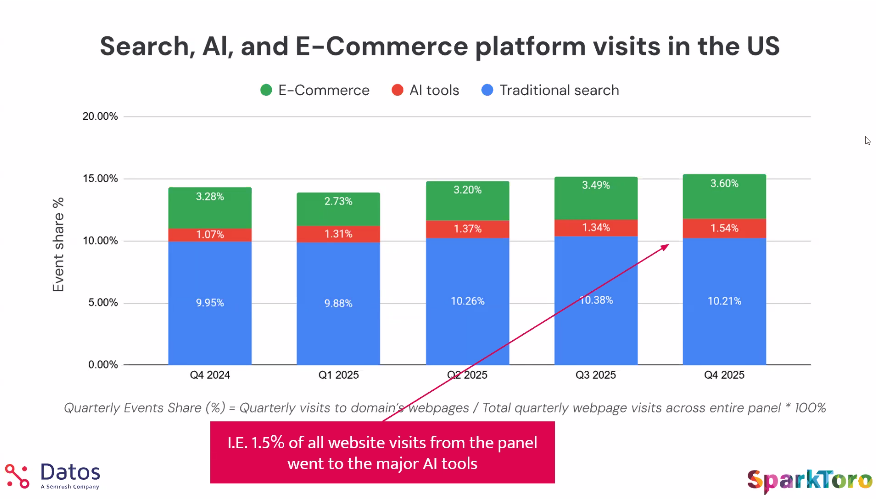
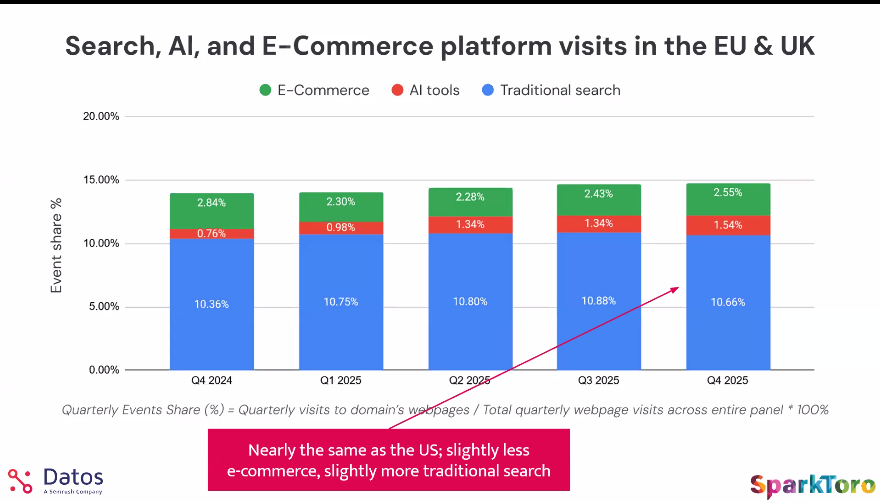
Let’s start with the headline finding. Despite all the “search is dead” narrative, the data tells a different story.AI tool visits (ChatGPT, Gemini, Perplexity, Claude and others) grew by what Rand Fishkin described as almost 50% year-over-year, now accounting for 0.77% of all US desktop activity by December 2025 across Datos’ panel of over 20 million anonymised users. That’s significant growth.But here’s the thing: traditional search engine visits also grew. Google, Bing, Yahoo, and DuckDuckGo all saw a higher percentage of visits compared to the previous year.Search, AI, and e-commerce platform visits in the US (Source: Datos/SparkToro Q4 2025)EU and UK trends mirror the US closely (Source: Datos/SparkToro Q4 2025)
Why this matters:
AI is additive, not substitutive. People aren’t replacing Google with ChatGPT — they’re using both for different purposes. Combined, e-commerce, AI tools, and traditional search make up approximately 15% of all internet visits in the United States.The EU and UK show very similar patterns, with slightly lower e-commerce visits but comparable search and AI usage.
2. Google’s Continued Dominance
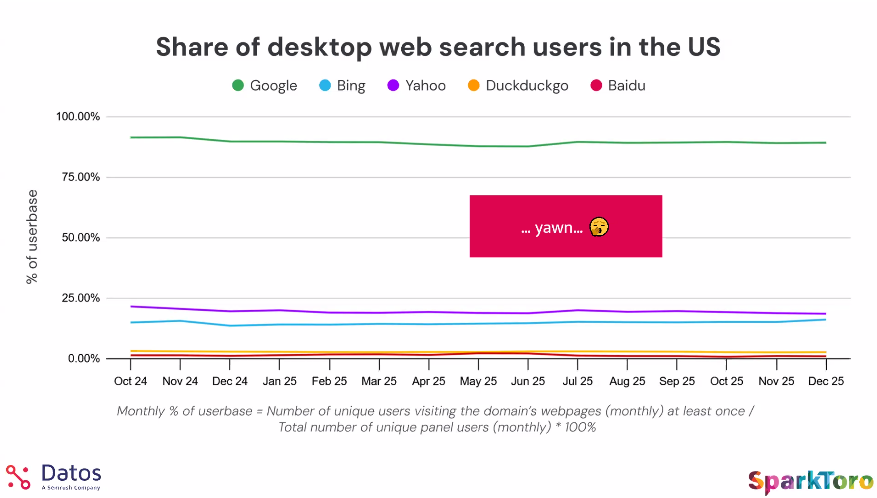
If you were hoping for a dramatic shift in search engine market share, you’ll be disappointed.Google consistently holds over 90% of desktop search market share in both the US and EU/UK.
Bing sits around 20% of the userbase, with Yahoo, DuckDuckGo, and Baidu barely registering.Google continues to dominate desktop search with over 90% market share (Source: Datos/SparkToro Q4 2025)
As Eli Goodman put it, behavioural pathways are very difficult to change. People have deeply ingrained habits — they Google things. New technologies like AI are primarily adding to existing behaviours rather than replacing them.
Searches per user are normalising
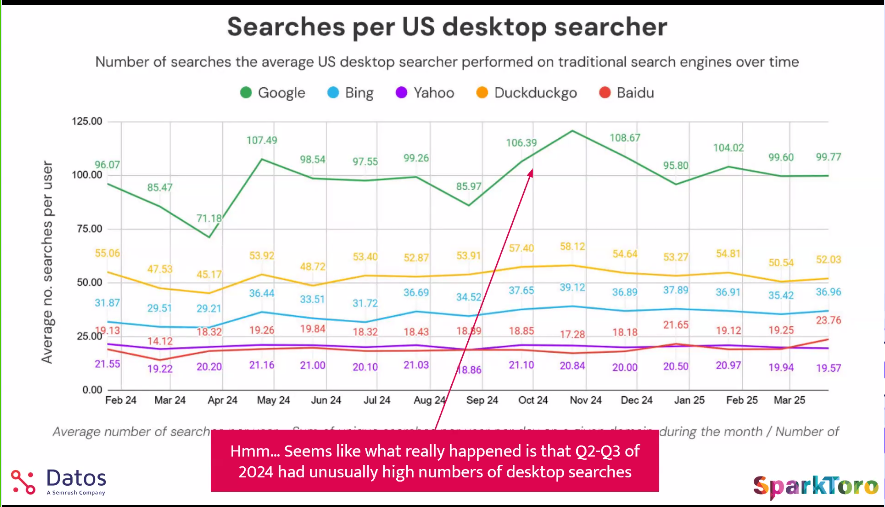
The average Google desktop searcher performed 103 searches in October 2025, down from 120.74 in October 2024. That sounds alarming, but there’s a straightforward explanation: the Q2-Q3 2024 spike was likely driven by the highly consequential US election, which drove unusually high search volumes among certain demographics. Searches have simply reverted to historically normal levels of around 100 per user per month.The Q2-Q3 2024 spike in searches per user has normalised (Source: Datos/SparkToro Q4 2025)
Why this matters:
Google’s dominance is deeply entrenched. Marketers should continue to prioritise Google SEO and paid search as the primary search channel, while recognising that search volume fluctuations are often driven by external events rather than structural shifts.
3. The Zero-Click Problem Is Getting Worse
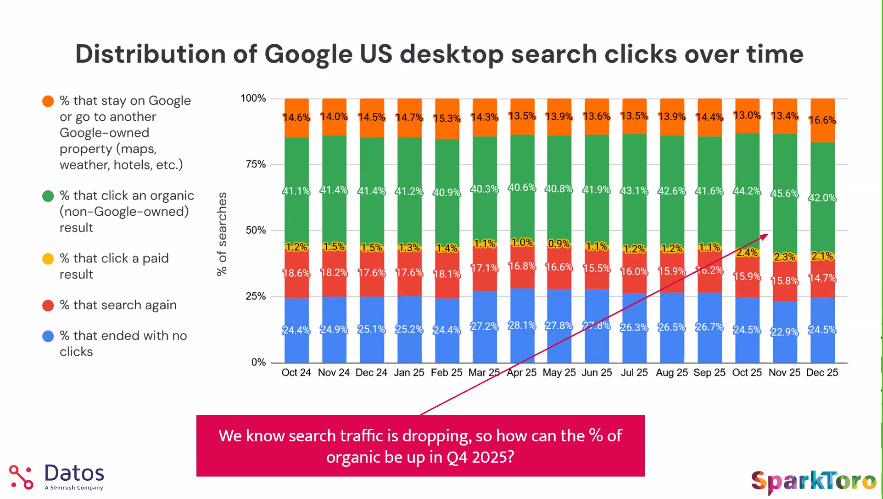
This is where the data gets concerning for marketers relying on organic traffic.56% of Google desktop searches result in a “zero-click” outcome (combining clicks that stay within Google properties and searches that lead to no click at all) — the user stays on Google, clicks nothing, or searches again.Zero-click searches account for 56% of Google desktop searches (Source: Datos/SparkToro Q4 2025)Google drives clicks (paid and organic) for just 44% of searches, a significant decline from over 60% a decade ago. And remember: mobile search, which accounts for two-thirds of all Google searches, has even higher zero-click rates.Perhaps more importantly, Rand Fishkin highlighted that the top destinations — YouTube, Reddit, Facebook, LinkedIn — are receiving an ever-increasing share of Google’s outbound traffic. This means the “long tail” of smaller websites is being squeezed from both sides: fewer clicks overall, and a larger proportion of those clicks going to major platforms.Why this matters:
With over half of searches generating no clicks, relying solely on organic traffic is increasingly risky. Marketers need to optimise for visibility within search results (featured snippets, AI Overviews) and diversify traffic sources beyond Google.
4. Google Ads and AI Overviews: A 394% Surge
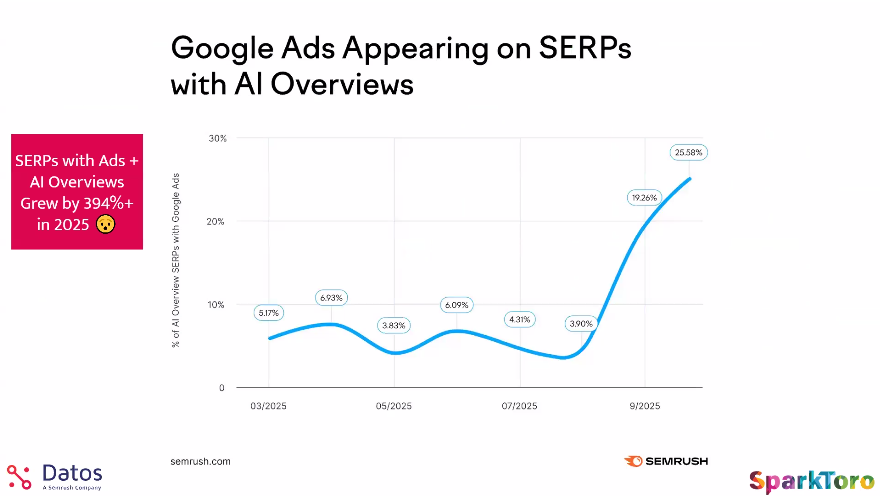
One of the most striking data points from Semrush’s research: SERPs with ads appearing within AI Overviews grew by 394% in 2025.SERPs with ads and AI Overviews grew by 394% in 2025 (Source: Semrush)The percentage of AI Overview SERPs displaying Google Ads jumped from around 5% early in 2025 to over 25.58% by September 2025. Rand Fishkin predicted this trend will only accelerate as Google pushes to meet revenue targets, driving paid search costs upwards.Eli Goodman offered a counterpoint: Google’s $120+ billion profit in 2025 gives them the luxury of extensive A/B testing before implementing changes. They “measure twice, cut once” — ensuring both profitability and user experience are maintained before rolling out features at scale.
Why this matters:
As Google integrates ads into AI Overviews, paid search costs are likely to rise. Marketers should monitor CPCs closely and consider how AI Overview placements may affect both paid and organic strategies.
5. Google AI Mode: Tiny Share, Rapid Growth
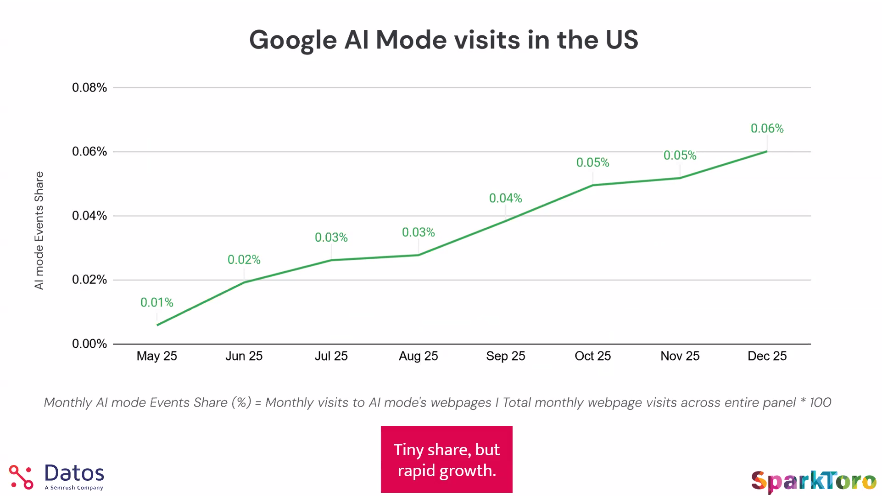
Google AI Mode is still very small as a proportion of total web visits — just 0.06% in December 2025 in the US. But the growth trajectory is unmistakable, rising from 0.01% in May 2025.Google AI Mode: tiny share but rapid growth trajectory (Source: Datos/SparkToro Q4 2025)The EU and UK saw a later start (launching around August 2025) but have matched the US trajectory, also reaching 0.06% by December.Why this matters:
Eli Goodman attributed Gemini’s rapid rise to Google’s unparalleled distribution advantage — it’s embedded in Android devices, Apple’s default search, Google Home, and corporate accounts worldwide. This dramatically reduces friction for user adoption.
6. Where Do Clicks Actually Go After Search?
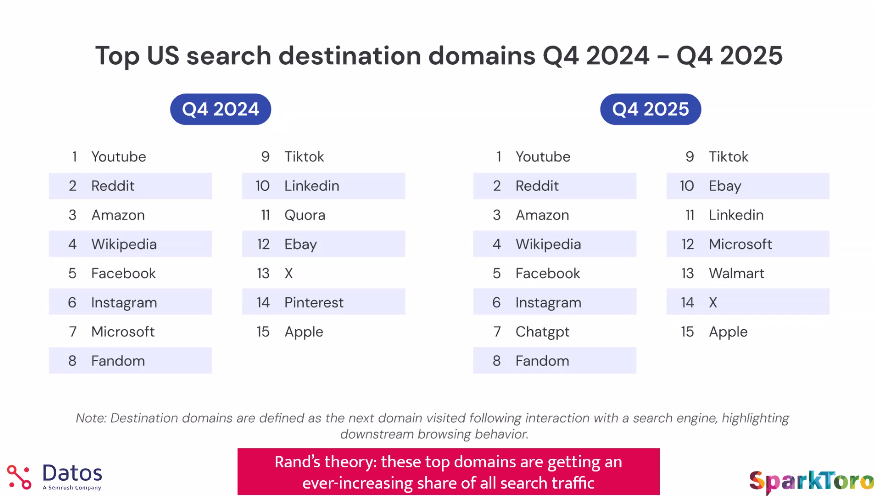
The top US search destination domains shifted notably between Q4 2024 and Q4 2025.ChatGPT entered the top search destinations at #7 (Source: Datos/SparkToro Q4 2025)Where users go after prompting AI tools (Source: Datos/SparkToro Q4 2025)The standout here is ChatGPT entering the top search destinations at #7, climbing from #9 in Q3 2025. Quora exited the top 15, while eBay showed slight improvement.
Where do people go after using AI tools?
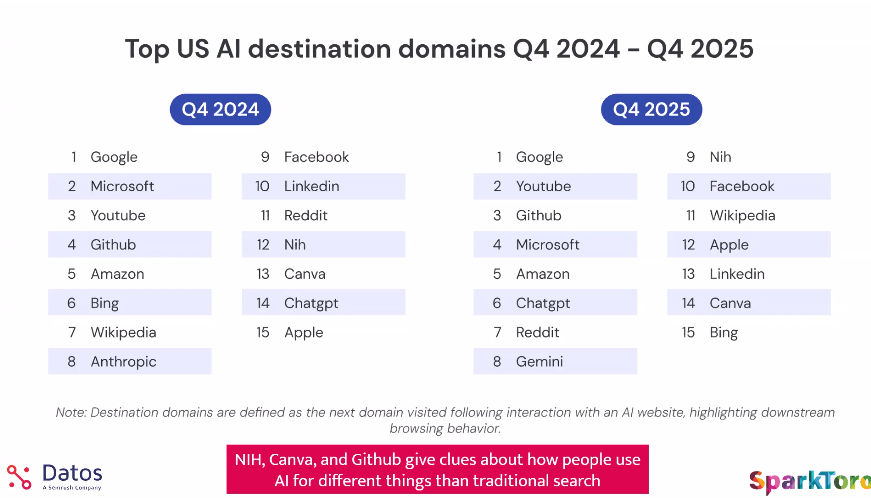
Post-AI-prompt destinations tell a different story. The top sites people visit after using an AI tool include Google (still #1), YouTube, GitHub, Microsoft, and Amazon. Notably, NIH (National Institutes of Health) appears at #9 for health-related queries, and Canva features prominently for image/visual tasks.This reinforces Eli Goodman’s point: users switch between LLMs and Google for different purposes — AI for education and modelling data, Google for execution and citations. The customer journey is complex and multifaceted.Why this matters:
Users are moving fluidly between AI tools and traditional search. Understanding your audience’s post-search and post-AI destinations helps you position content where they actually end up, not just where they start.
7. ChatGPT Has Plateaued — and Gemini Is Coming
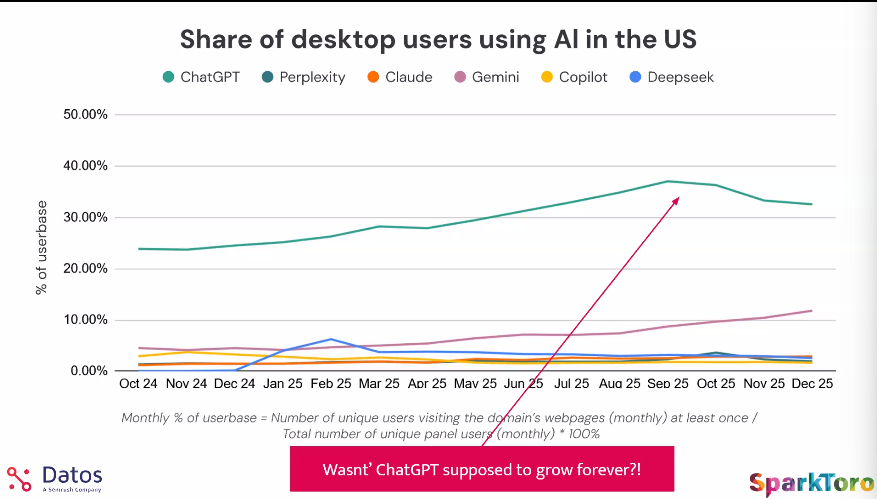
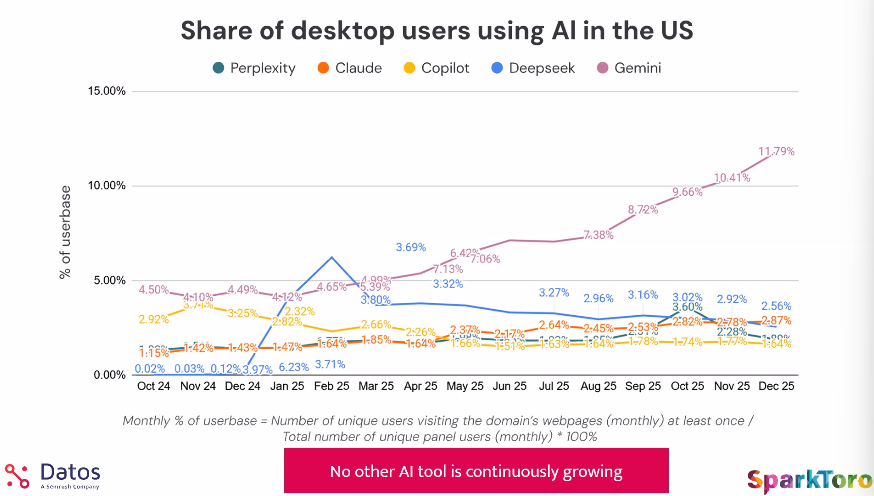
For the first time, ChatGPT has plateaued or shown a slight decline in its share of desktop users, peaking around 37% in September 2025 before dipping to 32.58% in December.Meanwhile, Google Gemini has been on a relentless climb — growing from 4.50% of desktop users in October 2024 to 11.79% by December 2025. No other AI tool shows this kind of continuous growth trajectory.ChatGPT plateaued while Gemini shows continuous growth (Source: Datos/SparkToro Q4 2025)Gemini is the only AI tool showing continuous growth (Source: Datos/SparkToro Q4 2025)Other notable movements in the AI tool landscape:
Claude has more than doubled its market share (1.15% to 2.87%), primarily attracting more advanced, technical, and B2B users
Perplexity has held relatively steady around 2.5-3%
Copilot remains in the 2-3% range
DeepSeek appeared as a new entrant in late 2025
Eli Goodman’s insight: The “value creation” phase of AI must eventually transition to “wealth creation” (profitability). This will influence company strategies and market dynamics — expect consolidation and pricing changes across AI tools.Why this matters:
The AI landscape is not a one-horse race. Gemini’s rapid growth via Google’s distribution means marketers need to consider visibility across multiple AI platforms, not just ChatGPT.
8. AI Answers Are Wildly Inconsistent
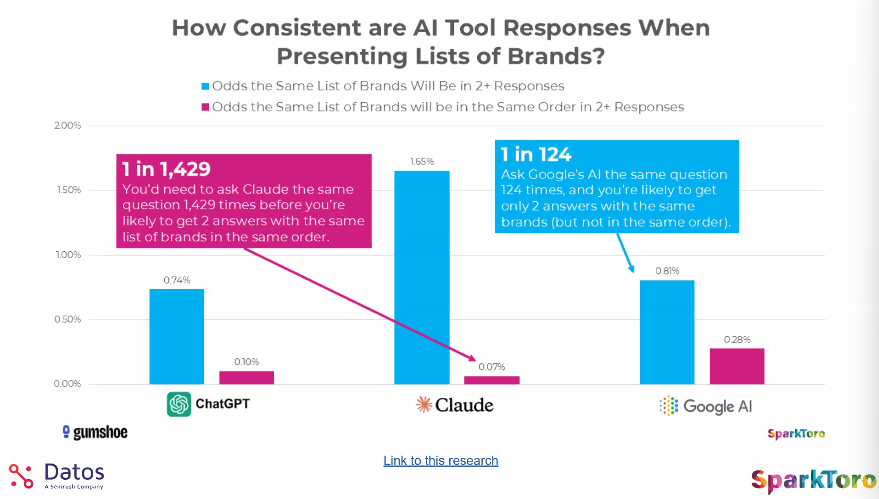
This finding should give every marketer pause. Research by Datos, SparkToro, and Gumshoe found that AI answers are highly volatile and inconsistent.AI answers are wildly inconsistent across all tools (Source: Datos/SparkToro/Gumshoe)
Ask Google’s AI mode the same question 124 times, and you’re likely to get only 2 answers with the same list of brands (and not even in the same order)
With Claude, you’d need to ask the same question 1,429 times before getting 2 answers with the same list of brands in the same order
ChatGPT showed slightly better consistency, but still extremely variable
Why this matters:
Marketers should exercise extreme caution when using AI measurement tools and interpreting AI-generated answers. A single snapshot of an AI response is essentially meaningless as a benchmark.
9. E-Commerce: Remarkably Stable
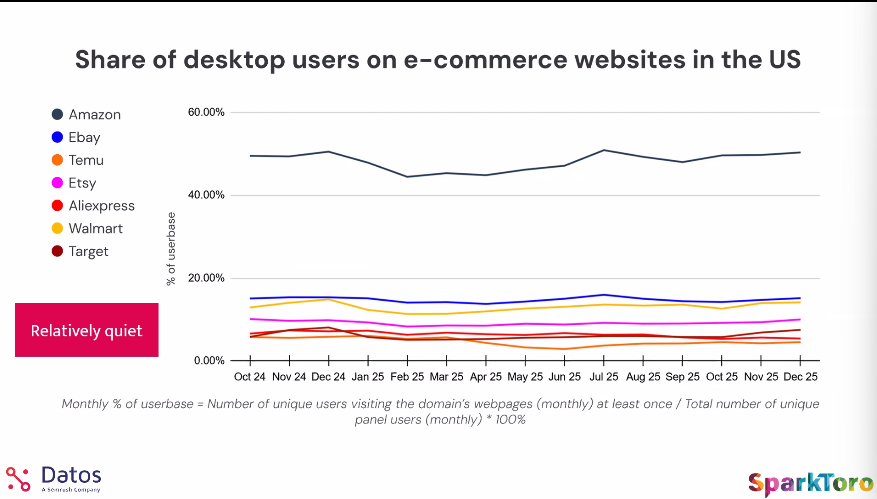
Desktop e-commerce usage remains remarkably stable, with normal seasonal fluctuations. Amazon dominates at around 50% of desktop e-commerce users in the US, with eBay, Temu, Etsy, and others far behind.E-commerce desktop usage remains remarkably stable (Source: Datos/SparkToro Q4 2025)In the EU and UK, Amazon also leads (around 40-45%), with eBay and AliExpress as notable competitors, plus regional players like Allegro and Zalando.Rand Fishkin offered an interesting perspective on agentic commerce (AI-driven purchasing): he believes its impact may be smaller than anticipated, working primarily for simple reorders rather than complex buying decisions where consumers want to research, compare, and deliberate.Why this matters:
E-commerce behaviour on desktop is stable and predictable. Amazon remains dominant, and AI-driven purchasing is unlikely to disrupt considered buying decisions. Focus on product visibility and reviews rather than worrying about AI replacing e-commerce browsing.
10. Content Platforms and the Rise of Pinterest & TikTok Search
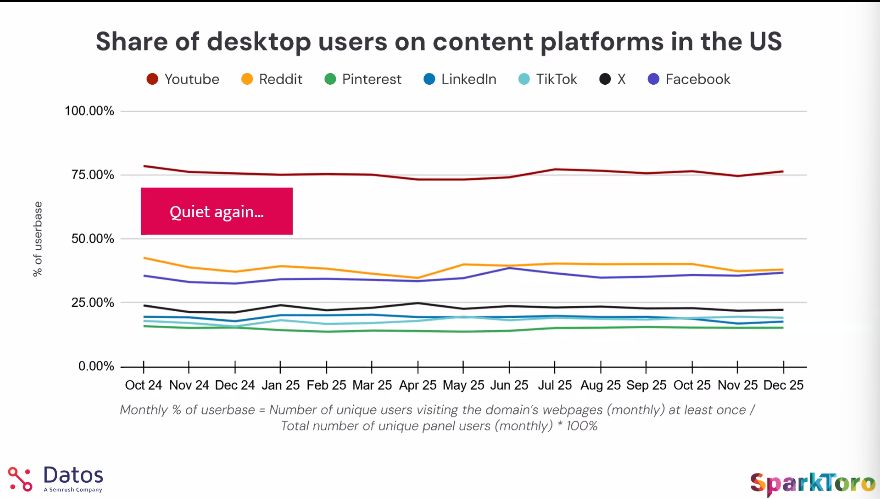
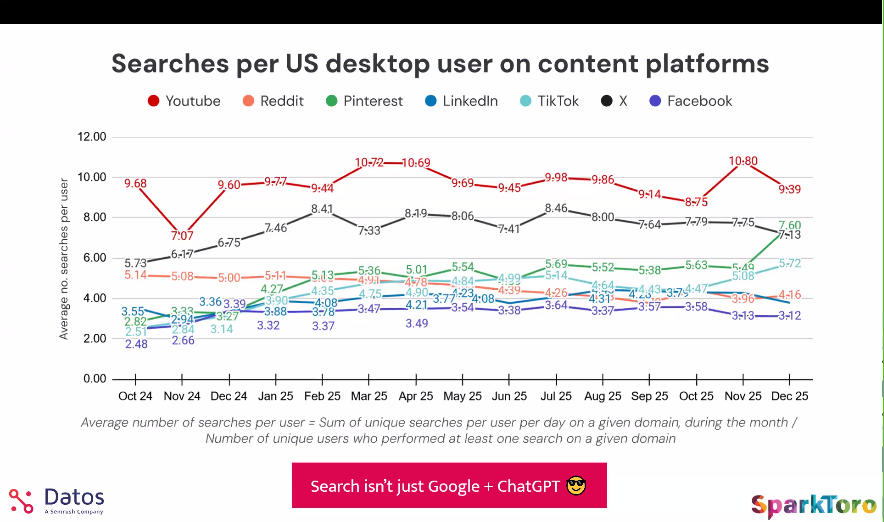
Usage of major content platforms (YouTube, Reddit, Pinterest, LinkedIn, Facebook) on desktop is largely flat and mature. YouTube dominates at around 75% of desktop users, with Facebook and Reddit in the 25-40% range.Content platform usage is largely flat and mature on desktop (Source: Datos/SparkToro Q4 2025)Pinterest shows extraordinary growth in searches per user (Source: Datos/SparkToro Q4 2025)But there’s a hidden gem in the data: Pinterest has shown extraordinary growth in “searches per searcher”, reaching approximately 10.80 searches per user by December 2025, up from around 7.50 a year earlier. TikTok has also seen significant growth as an internal search platform, with users increasingly turning to it for discovery and product searches. This indicates significantly increased engagement and internal search activity on these platforms.The broader point is crucial: search extends far beyond Google and ChatGPT. People search within YouTube, Instagram, LinkedIn, Reddit, Facebook, TikTok, and Pinterest — all of which are highly influential in their respective niches.The data also revealed that on desktop, Reddit has overtaken Facebook in the US in terms of domain users, and Reddit’s growth in the EU/UK has been described as “remarkable”.Why this matters:
Pinterest and TikTok are emerging as significant internal search engines. Marketers should optimise content for platform-specific search within these channels, especially for visual and product-related queries where these platforms are gaining ground.
11. What Should Marketers Actually Do?
Rand Fishkin’s advice was characteristically direct: “Go where your audience goes.”Rather than chasing general trends, focus on understanding your specific audience’s behaviour on the internet. Use tools like SparkToro and Datos’ data services to analyse audience journeys and identify key influence points.
Practical steps for marketers
Don’t abandon your blog. Despite reduced direct traffic in the zero-click world, blog posts still influence Google and AI answers. They serve as valuable repositories for engaged audiences and play a role in nurturing customer relationships.
Get mentioned in lists on other websites. Rand referenced research showing that gaining mentions in reputable publications (New York Times, Wall Street Journal, Reddit, YouTube) directly influences what AI tools recommend.
Break content into smaller chunks. Content chunking — breaking information into digestible, smaller pieces — makes it easier for AI models to parse and use in generating answers.
Be cautious with AI measurement. Given the extreme volatility of AI answers, don’t rely on single snapshots or anecdotal AI responses to guide strategy.
Diversify your search strategy. Think beyond Google. Your audience is searching on YouTube, Reddit, LinkedIn, Pinterest, Instagram, and TikTok. Understand which platforms matter most for your specific audience.
Watch Google AI Mode and Gemini closely. These are still tiny in absolute terms, but the growth trajectory suggests they’ll become increasingly important. Google’s distribution advantage makes Gemini a serious contender.
Key Findings at a Glance
Finding
What It Means
AI tool usage grew ~50% YoY (per Rand Fishkin)
Now 0.77% of US desktop activity; significant but slowing from 200-300%+ previous growth rates
Google desktop search spiked in 2024
Likely US election-driven; now normalised to ~100 searches/user/month
ChatGPT plateaued in Q4 2025
First time ever; Gemini gaining fast due to Google’s distribution
56% zero-click rate on desktop
Even worse on mobile; long-tail websites most affected
AI Overviews with ads up 394%
Expect paid search costs to continue rising
AI answers are wildly inconsistent
Don’t trust single AI snapshots for measurement
E-commerce and content platforms stable
Despite AI disruption, core internet behaviours haven’t shifted
Final Thoughts
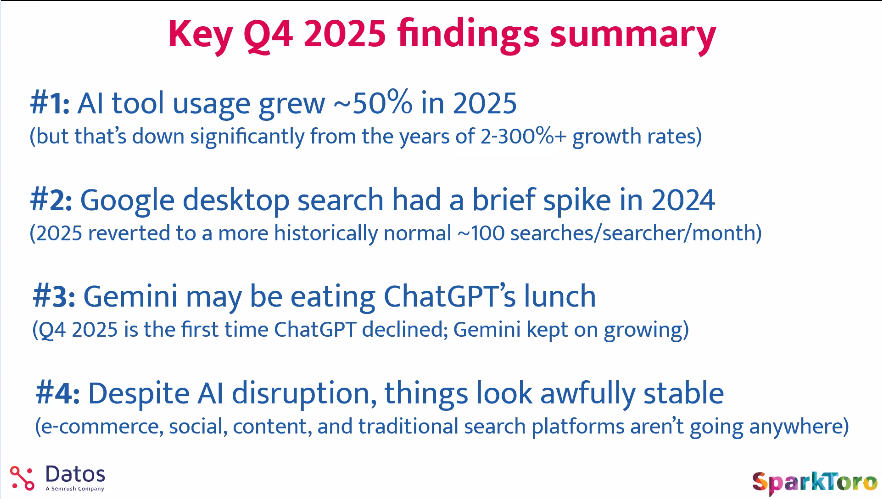
Key Q4 2025 findings summary (Source: Datos/SparkToro)The overarching message from the Datos and SparkToro Q4 2025 report is one of nuance. Yes, AI is growing rapidly. Yes, zero-click is a real problem. But traditional search isn’t dying, e-commerce is stable, and the biggest shifts are happening in how people use multiple platforms together, not in wholesale replacement of one tool with another.The smartest marketers will resist the urge to react to headlines and instead dig into the data that matters for their specific audience. As Rand Fishkin reminded us: the internet is a big place, and your customers are using more of it than just Google.
Download the Full Report
This blog summarises the key findings from the Datos and SparkToro webinar. For the complete data, methodology, and detailed analysis, download the full report:
A hands-on AI club for marketers and managers. Fortnightly 3-hour sessions: Hour 1 is an open Q&A on any AI question; Hours 2-3 split into a workshop track (for newbies) and an advanced track (live demos and deeper questions).
A week that reshaped the AI landscape on three fronts at once. Google launched Gemini 4 Argon with a one million token output limit, OpenAI unveiled Dots agents and the GPT-6 Sol and Luna models while apologising to the Australian government for AI agents that breached public sector systems, and Shopify, Mastercard, JPMorgan and Cloudflare all moved agentic commerce from theory to live infrastructure. Here is what UK marketers and managers need to know for the week of 29 September to 5 October 2026.
Frontier model prices fell 40-50% in a single week, Meta’s Muse agent hit 2.5 million downloads and triggered the first agentic commerce standoff, GEO became the search skill every brand wants, and Microsoft rebuilt Copilot around usage-based pricing. Here is everything that mattered in AI for marketing and management this week.
This week in AI marketing: AI News, Tech & Tools, AI in Marketing, AI in Management, AI in E-commerce, Retail and Agentic Commerce and more. Expert analysis from Anicca Digital.
Anthropic, OpenAI and xAI’s chiefs call to slow AI’s pace as King Charles hosts a Dumfries House safety summit. Plus GPT-6 Astra, AI Overviews and more. Expert analysis from Anicca Digital.
New Edition 3 (May 26) of The Claude Code Guide - For Marketers & Managers
Download our latest 88-page practical guide to use agentic AI to improve your productivity & profit.
Ann Stanley is not a developer, but she has been using Claude Code every day since Jan 26.
She has written this guide so you can use Claude Code on your desktop, without the steep learning curve.
It covers setup, Skills, voice commands, team rollout, version control, house-keeping and a new chapter on AI departmental agents and AI operating systems (AIOS).