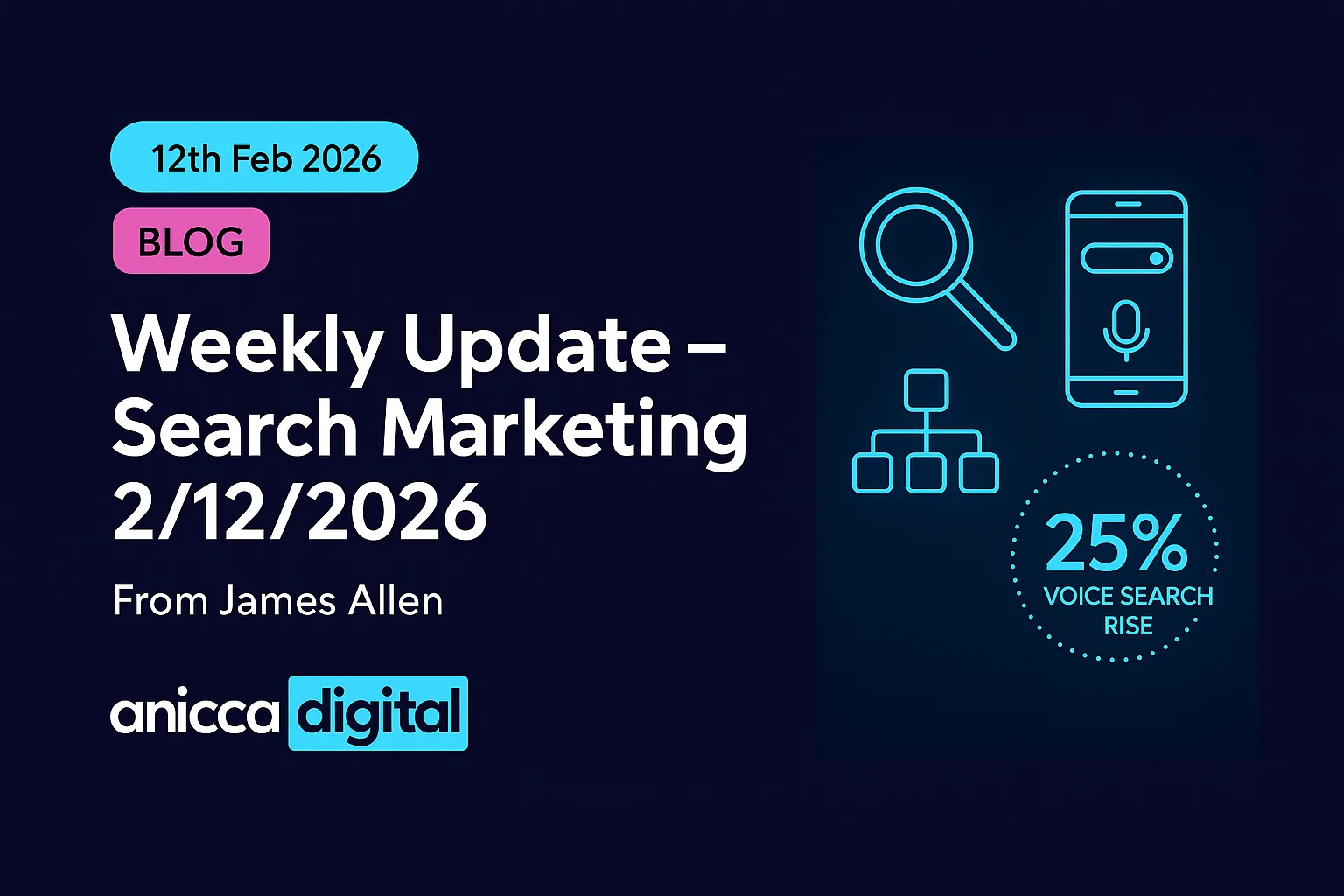
Weekly Update – Search Marketing – 12th February 2026
Estimated reading time: 17 minutes
This week’s SEO news explores a rapidly changing digital marketing landscape, with AI-powered search and advertising taking centre stage. We cover how Microsoft and Google are advancing AI search tools, the impact of Google’s Gemini 3 model on brand visibility, and why PPC measurement is evolving in response to privacy changes. From new AI citation metrics to actionable tips for boosting Google Ads conversion rates, here’s what search marketers need to know to stay ahead.
Table of Contents
AI & Search Innovations
- Bing Webmaster Tools Adds AI Performance Report
- Google Pushes AI Max Tool with In-App Ads
- How to Make Automation Work for Lead Gen PPC
- Why Governance Maturity is a Competitive Advantage for SEO
- Why PPC Measurement Feels Broken (and Why It Isn’t)
- How SEO Leaders Can Explain Agentic AI to Ecommerce Executives
- What Repeated ChatGPT Runs Reveal About Brand Visibility
- Reddit Says 80 Million People Now Use Its Search Weekly
- OpenAI Starts Testing ChatGPT Ads
- Google AI Mode Doesn’t Favour Above-the-Fold Content: Study
- Gemini 3 Wiped Out 46% of Cited Domains and Left 1 in 10 AI Overviews Without Any Sources
- ChatGPT Has 12% of Google’s Search Volume but Google Sends 190x More Traffic to Websites
- Anonymised Queries Make Up Nearly Half of Google Search Console Traffic
- E-E-A-T Audit: 220+ Markers That Measure Experience, Expertise, Authority, and Trust
PPC & Paid Media
- Google’s Ads Chief Details UCP Expansion, New AI Mode Ads
- 15 Fixes to Improve Low Conversion Rates in Google Ads
SEO, Local & Technical
- What the Data Shows About Local Rankings in 2026 [Webinar]
- Hidden HTTP Page Can Cause Site Name Problems in Google
Content & Video
Strategy & Future Directions
Summary & Guidance
AI Search, PPC Measurement, and New Visibility Benchmarks: What Search Marketers Need to Know
This week’s search marketing news signals a period of rapid transformation for both SEO and PPC professionals. Microsoft and Google are doubling down on AI-powered search and advertising, with new tools to track AI citations and promote automation. Meanwhile, studies reveal how AI models are reshaping brand visibility, with Google’s Gemini 3 model consolidating AI Overview sources and ChatGPT now handling a significant share of global search queries. And yet, AI chat platforms are sending far less traffic to websites than Google. PPC measurement continues to evolve amid privacy restrictions, and local SEO is being redefined by reputation signals and AI-driven discovery. Marketers and agencies must now balance classic SEO and PPC tactics with new strategies for AI eligibility, governance, and content formats to maintain their competitive edge.
Below, we break down the most significant developments and what they mean for your search marketing strategy.
Bing Webmaster Tools Adds AI Performance Report
Microsoft has rolled out the AI Performance report in Bing Webmaster Tools, offering a new lens into how your content is cited across Microsoft Copilot, Bing’s AI summaries, and partner integrations. This dashboard tracks metrics such as total citations, average cited pages, grounding queries, and page-level citation activity, providing a timeline view of your AI-driven visibility. Unlike classic search analytics, the focus here is on citation frequency; showing which of your pages are being used to ground AI-generated answers, rather than just clicks or rankings.
For SEO professionals, this is a step-change in how visibility is measured. The report enables you to see which content is consistently referenced by AI, helping you identify both your strongest and weakest topics. While it doesn’t yet connect citations to actual traffic or conversions, it’s a vital tool for confirming your AI footprint and refining content structure, clarity, and entity representation. The emphasis is now on Generative Engine Optimization (GEO) – optimising not just for SERPs, but for inclusion in AI-driven answers.
For agency leaders and senior marketers, this signals Microsoft’s intent to make AI visibility a core metric, not just an experimental add-on. The lack of click data means you’ll need to pair these insights with broader analytics, but the direction is clear: future-proofing your search strategy now means understanding and improving your AI eligibility. Expect further enhancements to inclusion and attribution across both search and AI experiences, and prepare to integrate AI citation metrics into your regular reporting and content planning.
Google Pushes AI Max Tool with In-App Ads
Google is now actively promoting its AI Max feature directly inside Google Ads campaign settings, marking a more assertive push to drive adoption of its AI-powered automation tools. Advertisers are seeing notifications for AI Max within Search campaigns, moving Google’s AI features from optional rollouts to a more central part of the campaign management workflow.
For PPC managers, this means increased exposure to AI-driven automation options, which can deliver efficiency gains but also require careful oversight. The integration of promotional messaging within the platform blurs the line between guidance and self-promotion, so it’s crucial for agencies to remain vigilant and ensure that automation aligns with each client’s unique business goals (rather than simply defaulting to Google’s recommendations).
From a senior perspective, this shift reflects Google’s strategic intent to accelerate AI adoption at scale, potentially influencing how campaigns are set up and optimised. Agencies should proactively educate clients about the benefits and trade-offs of AI Max, monitor the impact of these in-app promotions on campaign performance, and be prepared to justify automation choices with clear, data-driven rationale. Expect this approach to expand to other Google Ads features, making platform literacy and critical evaluation more important than ever.
How to Make Automation Work for Lead Gen PPC
B2B lead generation campaigns have traditionally struggled to benefit from automation due to lower conversion volumes and longer sales cycles, but new strategies are making AI-powered tools more effective. Key recommendations include integrating offline conversions from CRM platforms, assigning values to micro-conversions, and using campaign-specific goals to optimise for different funnel stages. Portfolio bidding is highlighted as a way to aggregate conversion data, helping automation reach performance thresholds faster.
For PPC specialists, this means embracing a more nuanced approach to automation. Connecting your CRM to ad platforms is now non-negotiable, as is leveraging first-party audience data to improve targeting. The use of AI for competitor research, negative keyword review, and ad copy generation can free up valuable time for strategic work. Regular testing of bid strategies, match types, and landing pages through experiments is encouraged, with automation serving as a complement to (rather than a replacement for) human oversight.
Senior marketers should note that automation, when paired with the right signals and audience data, can drive significant improvements in both efficiency and lead quality. Agencies must adopt these best practices to remain competitive, ensuring that automation is not just a buzzword but a genuine driver of business outcomes. The key is to design systems that provide the right signals, leverage first-party data, and use AI to support, not supplant, strategic decision-making.
Why Governance Maturity is a Competitive Advantage for SEO
As AI-driven search features and platform redesigns add complexity, SEO teams are facing greater risks from weak organisational governance. The Visibility Governance Maturity Model (VGMM) offers a framework for assessing and improving SEO processes across ownership, documentation, and cross-functional collaboration. Mature governance is now essential for protecting SEO investments from being undermined by uncoordinated product launches, content changes, or technical updates.
For SEO professionals, VGMM provides actionable steps to document standards, establish review checkpoints, and secure stakeholder buy-in. The model outlines five maturity levels, from unmanaged to sustained, and encourages teams to move from reactive firefighting to proactive prevention. Improved governance leads to fewer traffic drops, more stable AI citations, and better resource allocation. Such improved governance allows SEOs to focus on growth rather than crisis management.
For agency leaders and digital directors, the message is clear: SEO is no longer just a technical or content discipline, but a strategic function that requires robust organisational support. Using VGMM to identify process gaps and reduce operational risk positions your agency or in-house team as a sustainable, high-value partner. In an AI-first landscape, the ability to maintain search visibility depends as much on governance as on technical execution.
Why PPC Measurement Feels Broken (and Why It Isn’t)
PPC measurement is becoming increasingly challenging as browser restrictions and privacy regulations limit the persistence of identifiers like GCLIDs and cookies. Deterministic click-to-conversion tracking is less reliable, requiring marketers to adapt to environments where some data is always missing. The solution lies in combining client-side pixels with server-side offline conversion imports, and embracing modeled conversions as a standard input.
For PPC professionals, this means designing measurement systems for redundancy and inference, rather than perfect observability. Tools like Google Tag Gateway and Enhanced Conversions can help recover lost signals, but agencies must also accept that modeled conversions and aggregate attribution are the new normal. Educating clients on the realities of partial data is essential, as is focusing on data quality and consistency across platforms.
For senior stakeholders, the strategic takeaway is that measurement is now a more nuanced, strategic discipline. Agencies should focus on building systems that remain useful when signals are missing, delayed, or inferred, and use both immediate and delayed conversion signals for optimisation. The era of perfect tracking is over; adaptability, redundancy, and human judgement are now the hallmarks of effective PPC measurement.
How SEO Leaders Can Explain Agentic AI to Ecommerce Executives
Agentic AI (where software agents act on behalf of users) is reshaping ecommerce and executive conversations. SEO leaders must clarify that agentic systems add a new decision-maker (the AI agent) rather than replacing customers. The focus for SEO is shifting from rankings to eligibility: ensuring that product data is clear, consistent, and trustworthy so agents can confidently select a brand.
For SEO teams, this means working closely with technical, operational, and data teams to ensure reliability and machine-readability. Discovery and consideration stages are becoming more conversational and personalised, making generic content less effective. Measurement will rely more on directional signals than precise attribution, so marketers should prioritise improving product data quality, reducing inconsistencies, and strengthening brand trust signals.
For ecommerce executives and agency leaders, the actionable message is to invest in foundational improvements, rather than overreacting to AI hype. The winners in agent-led journeys will be those who adapt their SEO strategies to earn eligibility, not just traditional rankings, and who build cross-functional teams capable of supporting machine-driven selection.
What Repeated ChatGPT Runs Reveal About Brand Visibility
A recent study analysing 1,200 ChatGPT prompts has revealed that AI brand recommendations are highly inconsistent, with only a handful of brands consistently mentioned across repeated queries. Dominant brands in competitive categories are mentioned over 80% of the time, while most others languish in the long tail. In niche categories, there are more opportunities for consistent AI mentions.
For marketers and SEOs, this means that AI visibility tracking tools relying on single prompt checks are unreliable. To gauge true AI visibility, you should run key prompts multiple times and focus on building brand authority in specific niches. Differentiated positioning is more important than ever, and over-reliance on AI visibility metrics can be misleading.
Agencies should advise clients to track AI brand mentions statistically and prioritise strategies which enhance brand recognition and trust. This is especially true within AI-driven search environments where consistency is difficult to achieve. The findings highlight the need for a statistical, rather than anecdotal, approach to AI visibility, and the importance of niche authority for emerging brands.
Reddit Says 80 Million People Now Use Its Search Weekly
Reddit has reported that 80 million users now engage with its search function weekly, following the integration of AI-powered Reddit Answers. This positions Reddit as a full-fledged discovery engine, where users start and complete their research journeys within the platform. The unified search and AI Q&A experience is driving significant growth, with Answers queries rising from 1 million to 15 million in a year.
For search marketers, Reddit’s growing influence means brand visibility within Reddit communities is as crucial as ranking in traditional or AI search. The platform’s partnerships with Google and OpenAI have made Reddit content a leading source for AI-generated answers, amplifying its impact on search behaviour. Agencies should now consider Reddit a key channel for organic visibility, community engagement, and reputation management.
The shift also signals a broader trend: user discovery is increasingly happening outside traditional search engines, and platforms like Reddit are becoming essential sources for both user research and AI training data. Marketers should adapt strategies to leverage both standard and AI-driven search experiences on Reddit, ensuring their brands are visible and credible within relevant communities.
OpenAI Starts Testing ChatGPT Ads
OpenAI has begun testing ads within ChatGPT, marking its first step towards monetising conversational AI. The ads appear in a clearly labelled section below the chat interface for select users on the free and Go subscription tiers, while paid tiers remain ad-free. Ads are tailored based on conversation topics and prior interactions, but do not influence ChatGPT’s responses or access user conversations.
For marketers, this development opens a new channel to reach highly engaged AI users at scale. Agencies should monitor ad performance, targeting options, and user adoption as OpenAI refines its monetisation strategy. The emergence of conversational AI as a viable advertising platform will require brands to adapt their creative and targeting approaches for AI-driven environments, focusing on relevance and user context.
From a strategic perspective, this move signals the growing convergence of search, conversation, and advertising. Brands that experiment early with ChatGPT ads will be better positioned to understand user behaviour in conversational contexts and to shape their messaging for this new discovery environment.
Google AI Mode Doesn’t Favour Above-the-Fold Content: Study
A new study by SALT.agency finds that Google’s AI Mode does not prioritise above-the-fold content when citing sources in AI-generated answers. After analysing over 2,300 URLs, researchers found no correlation between the vertical position of text on a page and its likelihood of being cited. Instead, AI Mode pulls citations from anywhere on the page, with subheadings and the following sentences frequently highlighted.
For SEO professionals, this debunks the myth that AI Mode favours certain page positions or rigid templates. The actionable takeaway is to focus on well-structured, authoritative content with clear subheadings, rather than chasing AI-specific layouts. Content quality and organisation remain the most important factors for AI search visibility.
Agencies should prioritise content clarity and relevance over superficial design tweaks for AI optimisation. The findings reinforce the importance of robust content structure and descriptive headings, ensuring your content is easily understood and cited by AI systems (regardless of where it appears on the page).
Gemini 3 Wiped Out 46% of Cited Domains and Left 1 in 10 AI Overviews Without Any Sources
A new analysis reveals that the rollout of Google’s Gemini 3 AI model led to a dramatic reduction in the diversity of sources cited in AI Overviews. Nearly 46% of previously cited domains disappeared, and 10% of AI Overviews now appear without any source attribution. This consolidation raises concerns about the visibility of smaller publishers and the transparency of AI-generated answers.
For search marketers, the findings highlight the need to strengthen brand authority and topical relevance to remain eligible for AI citations. Agencies should monitor changes in AI Overview sourcing, diversify content strategies, and prioritise high-quality, authoritative content to improve the likelihood of being cited. The shift underscores the importance of adapting to evolving AI algorithms and reinforces the need for robust entity optimisation and off-site signals.
The trend towards concentration at the top means that established brands and platforms like YouTube and Reddit are capturing a larger share of citations, while smaller publishers risk losing visibility entirely. Marketers must now compete not just for rankings, but for inclusion in AI-generated answers – a challenge which requires both technical optimisation and strategic brand building.
ChatGPT Has 12% of Google’s Search Volume but Google Sends 190x More Traffic to Websites
Ahrefs’ latest research shows that while ChatGPT now handles 12% of Google’s global search volume, Google still drives 190 times more traffic to websites. The study highlights a critical distinction: ChatGPT’s responses often satisfy user intent within the platform, resulting in minimal outbound clicks, whereas Google’s search results are designed to send users to external sites.
For marketers, this means that while optimising for AI visibility is important, traditional SEO remains the primary driver of traffic and conversions. Agencies should balance efforts between AI search optimisation and classic SEO, ensuring content is structured for both AI inclusion and SERP rankings. The findings also suggest that brands must monitor how AI platforms reference their content and adapt strategies to capture value from both direct and AI-mediated search experiences.
From a senior perspective, the research underscores the need for a dual-track approach: invest in AI search eligibility and brand authority, but do not neglect the fundamentals of organic search that continue to deliver the lion’s share of website traffic.
Anonymised Queries Make Up Nearly Half of Google Search Console Traffic
Ahrefs reports that nearly 50% of clicks and impressions in Google Search Console (GSC) are now attributed to anonymised queries, meaning the actual search terms are not disclosed to site owners. This trend complicates keyword analysis and performance tracking, making it harder for marketers to optimise for specific queries.
For SEO professionals, the shift requires a move towards broader topic and entity optimisation, leveraging available data to identify content gaps and performance trends. Alternative analytics methods (such as landing page analysis and third-party tools) are becoming essential to supplement missing query data. Agencies must adapt reporting to focus on holistic performance, rather than granular keyword insights.
For senior marketers, this is a reminder that data privacy and transparency are shaping the future of SEO measurement. Embracing adaptable reporting and a holistic approach to strategy will be key to maintaining visibility and demonstrating value in an era of increasing data privacy.
E-E-A-T Audit: 220+ Markers That Measure Experience, Expertise, Authority, and Trust
Ahrefs has published a comprehensive E-E-A-T audit framework featuring over 220 markers to assess a website’s Experience, Expertise, Authority, and Trust. This resource enables marketers to systematically evaluate and improve signals that influence both traditional search rankings and AI-driven visibility.
For SEO teams, the audit covers content quality, author credentials, external validation, technical security, and user trust factors. Such auditing provides a practical checklist for identifying gaps and prioritising enhancements. As Google and AI platforms increasingly rely on these signals to determine content eligibility and ranking, a robust E-E-A-T profile is essential for maintaining and growing search visibility.
Agencies and senior marketers should integrate E-E-A-T audits into regular SEO workflows, using the findings to communicate the value of trust-building improvements to clients and stakeholders. The framework provides a clear roadmap for strengthening brand authority, ensuring that content and site reputation align with evolving search engine and AI expectations.
Google’s Ads Chief Details UCP Expansion, New AI Mode Ads
Google’s Ads Chief has announced the expansion of the Universal Commerce Protocol (UCP), an open-source standard designed to streamline AI-driven e-commerce transactions. UCP enables AI platforms to seamlessly discover products, checkout flows, and payment options, reducing integration complexity for retailers. Google is also rolling out new ad formats in AI Mode, integrating sponsored content directly into AI-powered search results.
For marketers, these developments signal a shift towards agentic commerce, where AI agents play a central role in the purchase journey. Agencies should prepare clients by optimising product data for machine-readability, ensuring compatibility with emerging protocols, and adapting ad strategies for AI-driven environments. Staying ahead of these changes will be critical for maintaining visibility and competitiveness as AI transforms search and shopping behaviours.
From a leadership perspective, the expansion of UCP and AI Mode ad formats represents a new era of commerce where seamless integration and machine eligibility are as important as traditional marketing. Brands that invest early in AI-ready product data and creative assets will be best positioned to capture value in this evolving landscape.
15 Fixes to Improve Low Conversion Rates in Google Ads
This actionable guide outlines 15 proven strategies to boost low conversion rates in Google Ads campaigns. Recommendations include refining keyword targeting, optimising ad copy, leveraging audience segmentation, and implementing advanced bidding strategies. The article emphasises the importance of tracking micro-conversions, improving landing page relevance, and using negative keywords to filter out unqualified traffic.
For PPC managers, these tactics provide a practical checklist for ongoing account management. Testing new ad formats, utilising automated rules, and regularly reviewing search term reports are highlighted as ways to enhance campaign efficiency and increase lead quality. Agencies should adopt a data-driven approach, continuously monitoring performance metrics and adjusting tactics to maximise ROI.
For senior marketers, the guide reinforces the value of systematic, incremental improvements over wholesale account rebuilds. Conversion rate optimisation should become a habit, with regular reviews and refinements ensuring that PPC investments deliver measurable business outcomes.
What the Data Shows About Local Rankings in 2026
A recent webinar analysed the latest data on local search rankings for 2026, revealing key trends and actionable insights for marketers. The discussion highlighted the growing impact of reviews, proximity, and business profile optimisation on local pack visibility. Consistent NAP (Name, Address, Phone) information, high-quality photos, and active engagement with customer feedback were emphasised as critical factors.
The data also showed that AI-driven features and user-generated content are increasingly influencing local rankings. Agencies should prioritise comprehensive business profile management, encourage authentic reviews, and leverage new AI tools to monitor and enhance local search performance.
For local SEO specialists and digital leaders, the message is clear: reputation signals now matter more than ever, and AI is changing how local visibility is earned. Staying updated on these trends is essential for maintaining competitive advantage in local SEO, especially as search algorithms and user behaviours continue to evolve.
Google has identified that hidden HTTP versions of a website can cause issues with site name display in search results, even if the primary site uses HTTPS. This technical oversight can lead to branding inconsistencies and confusion for users.
For technical SEOs, the advice is to audit site configurations, ensure proper redirects from HTTP to HTTPS, and eliminate duplicate content across protocols. Addressing these issues helps maintain a consistent brand presence in SERPs and supports better indexing.
Agencies should include protocol checks in their technical SEO audits and educate clients on the importance of secure, canonical URLs. Proactive management of site versions is essential for preserving brand integrity and optimising search visibility in both traditional and AI-driven search environments.
From Article to Short-Form Video That Holds Attention
This article explores strategies for transforming written content into engaging short-form videos, a format increasingly favoured by search platforms and social media algorithms. Key recommendations include repurposing high-performing articles, focusing on concise messaging, and leveraging visual storytelling techniques.
For content marketers and SEOs, using AI-powered video creation tools can streamline production and maintain brand consistency. Optimising videos for mobile consumption and incorporating clear calls to action are highlighted as best practices. Agencies should integrate video repurposing into content strategies to expand reach, improve engagement, and capitalise on evolving search and discovery trends.
Embracing short-form video can enhance visibility across multiple platforms, including AI-driven search experiences. For senior marketers, this is an opportunity to future-proof content strategies and ensure your brand remains relevant as user preferences and discovery channels evolve.
Strategic Directions: Search Marketing in an AI-First Era
The landscape of search marketing is undergoing a profound transformation. AI-driven discovery, automation, and privacy constraints are reshaping how visibility, measurement, and engagement are achieved. For SEO and PPC professionals, the challenge is to balance the fundamentals with new imperatives: AI eligibility, entity optimisation, and multi-channel visibility.
Senior marketers and agency leaders must champion a culture of adaptability, investing in data quality, cross-functional collaboration, and continuous learning. The winners in this new era will be those who combine strategic foresight with operational excellence, ensuring their brands are not just present, but prominent, in both traditional and AI-powered search environments.
Now is the time to audit your readiness for AI-driven search, strengthen your brand’s authority signals, and experiment with emerging channels and formats. The future of search belongs to those who can navigate complexity with clarity and turn disruption into opportunity.
Key Takeaways
- AI-powered search and advertising are rapidly changing the landscape, with new tools from Microsoft and Google making AI visibility a critical metric for SEO and PPC professionals.
- Google’s Gemini 3 model has significantly reduced the diversity of sources in AI Overviews, highlighting the importance of building brand authority and topical relevance to stay visible.
- PPC measurement is evolving due to privacy regulations, making it essential to combine client-side and server-side tracking and embrace modelled conversions for accurate reporting.
- Reddit’s surge as a discovery engine and OpenAI’s move to introduce ads in ChatGPT present fresh opportunities for brand visibility beyond traditional search engines.
- Effective local SEO now depends more on reputation signals and AI-driven features, while technical SEO must address issues like HTTP/HTTPS consistency to maintain brand presence.
- Adopting robust governance models and regular E-E-A-T audits can help organisations future-proof their SEO and content strategies for both classic and AI-driven search.
- Short-form video and multi-channel content repurposing are increasingly important for standing out in evolving search and discovery environments.
Frequently Asked Questions
How will AI Mode affect my SEO strategy?
AI Mode in Google does not favour above-the-fold content, so the focus should be on well-structured, authoritative content with clear subheadings throughout your pages. Prioritise content clarity and robust organisation to improve your chances of being cited in AI-generated answers.
What changes should I make to my Google Ads campaigns?
With Google pushing AI Max and other automation tools, it’s important to test these features while maintaining close oversight. Ensure automation aligns with your business goals and regularly review campaign performance to avoid relying solely on platform recommendations.
How do I optimise for AI Overviews?
To increase your eligibility for AI Overviews, focus on building strong brand authority, topical relevance, and high-quality, well-structured content. Monitor changes in AI sourcing and diversify your content strategy to adapt to evolving algorithms.
What should I do about anonymised queries in Google Search Console?
Since nearly half of GSC traffic now comes from anonymised queries, shift your approach towards broader topic and entity optimisation. Use alternative analytics methods like landing page analysis and third-party tools to supplement missing query data.
How can I improve my PPC measurement in a privacy-first world?
Combine client-side pixels with server-side offline conversion imports and accept modelled conversions as part of your measurement strategy. Focus on data quality, redundancy, and educating stakeholders about the realities of partial data and aggregate attribution.
Conclusion
This week’s updates underline just how quickly search marketing is evolving, with AI, automation, and privacy shaping every aspect of SEO and PPC. Marketers must now balance technical best practice with new strategies for AI eligibility, brand authority, and multi-channel content. Staying ahead means investing in governance, robust measurement, and creative content formats that resonate across both traditional and AI-powered platforms. As the landscape continues to shift, those who adapt early will secure their competitive edge.
Need help adapting your search strategy for AI-driven search? Contact the Anicca team for expert guidance on SEO and PPC in the AI era.