
Google AI Mode launches in the UK: What it means for your SEO and website traffic
After what seems like forever, Google’s highly anticipated AI Mode officially launched in the UK on 29th July 2025. This is going to create a major shift in how users interact with Search. As part of Google’s continued investment in AI-driven search experiences, this rollout introduces a more conversational, multimodal interface—one designed to help users complete more complex tasks and get answers faster.
As detailed in Google’s UK announcement, AI Mode now appears as a tab in mobile and desktop search, and is fully integrated into the Google app. UK users can submit queries via text, voice or image and receive AI-generated summaries with supporting links, often without scrolling down the results page. Although this is officially ‘live’, many users won’t see this instantly and it expected to be a staggered rollout to users.
For digital marketers and SEO professionals, this update has real implications, especially for websites that rely heavily on organic traffic from informational content. And if you’ve not seen the ‘search like never before’ advert on TV already, Google is already promoting searchers to expand their search queries.
More Queries Are Answered Within Search
AI Mode leverages Google’s Gemini model to interpret complex or multi-part queries. Using a process called query fan-out. This process looks at different aspects of a search and brings together results into a coherent summary.
From a user perspective, this is useful.
From a marketing standpoint, it means Google is increasingly answering questions directly within Search, particularly for informational or research-based queries. That means fewer clicks through to individual websites, even for content that ranks well.
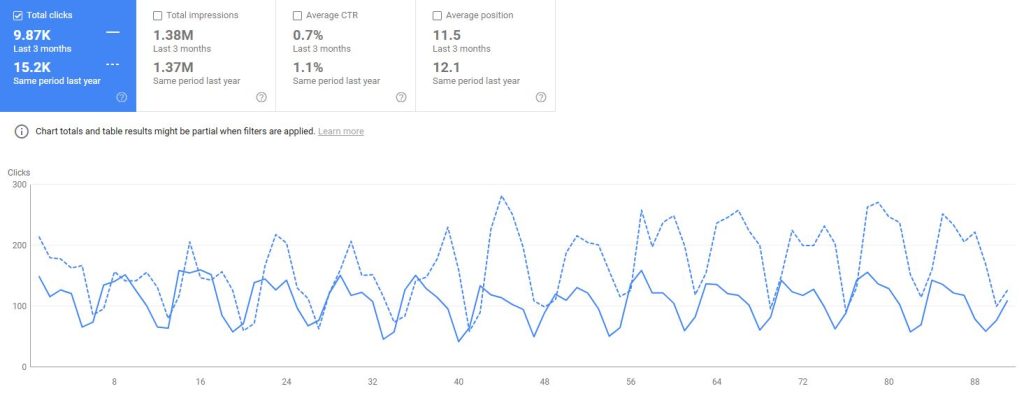
Below is an example of how much AI Overviews already affects informational pages. This page still ranks number 1 for core informational keywords, and is cited 1st in the AI Overviews, but clicks are down compared to last year. This is what marketers are going to need to compete with.
Why You Might See Traffic Drops—Even If Rankings Improve
If you’ve noticed a drop in organic traffic to your how-to articles, guides or blog posts, AI Mode / AI Overviews could be the cause. These types of informational pages are exactly what AI Mode is trained to summarise.
Even if your ranking hasn’t changed, and even if demand for a topic has grown, users may now find the answer they need without ever clicking through. This makes it more important than ever to create content that earns its place in the AI-generated summaries—or offers something the AI response can’t.
Search Is Becoming More Long Tail. Go Deeper!
One key trend behind AI Mode is the rise of more complex, long-tail search queries. Users are now asking richer, multi-faceted questions like:
• “Best eco-friendly garden products for families with young children”
• “What’s the best CRM for B2B sales teams with under 10 staff?”
• “How do I switch broadband providers without a service gap?”
These queries require layered answers—and that means your content strategy needs to go beyond surface-level copy.
To stay relevant, your content should:
• Target detailed, specific queries, not just broad topics
• Go deeper into user intent—answer follow-up questions and variations
• Use subheadings, FAQs and supporting content to create comprehensive coverage
• Anticipate what users will want next and guide them towards it
In essence, Google still needs your content—it just needs it to be more complete, better structured and more helpful than ever before.
Key Actions: What You Should Be Doing Now
1. Create Structured Content That Answers the Full Query
Make sure your content directly answers the kind of long-form, multi-part questions users are now asking. Include:
• Clear headings and subheadings
• Step-by-step instructions or summaries
• Internal links to supporting pages
• Helpful extras like downloads, videos or interactive tools
This makes your content more likely to be used as a source in AI Mode—and more valuable to users who do click through.
2. Implement and Test Schema Markup Properly
Structured data helps Google—and its AI systems—understand your content. It’s now essential to ensure:
- FAQ, HowTo, Product and Review schema are present where relevant
- All schema passes validation using Google’s Rich Results Test
- You’re following the latest best practices in formatting, nesting and coverage
The better Google understands your content, the more likely it is to include it as a citation or surface it in related searches.
3. Understand What Gets Cited in AI Mode
Keep a close eye on what types of websites and content are being cited within AI Mode summaries for your target search terms.
Ask:
- Are competitors appearing?
- Are publishers dominating?
- What format are those pages using?
Use that intelligence to optimise your own content structure, improve on what’s out there, and fill any gaps.
4. Revisit Your Conversion Pages (PLPs, PDPs, Service Pages)
As Google answers more queries directly, it’s critical that your traffic has somewhere valuable to go. Strengthen your:
- Product Listing Pages (PLPs) – Ensure filters, CTAs and product copy support conversion
- Product Detail Pages (PDPs) – Focus on benefits, FAQs, reviews and trust signals
- Service Pages – Make these landing pages work harder with detailed content and clear next steps
If you previously relied on blog traffic to generate leads or sales, it’s time to make your money pages do more of the heavy lifting.
5. Integrate Blog Content Into the Wider Journey
Blog content still has a role—but you need to work harder to integrate it into your overall marketing strategy. That means:
- Linking clearly from blog articles to commercial pages
- Embedding lead-gen tools, email sign-ups or downloads
- Using blog posts to educate, but always with a next step in mind
You want to give users a reason to go beyond the summary in AI Mode—and continue their journey on your website.
6. Monitor LLM Results and Referral Traffic
If you regularly monitor your referral traffic, you’re likely seeing sharp increases in referrals from LLM’s such as ChatGPT and Perplexity. These LLMs should absolutely be a part of your SEO strategy moving forward
- Monitor traffic and conversions from LLMs
- Get links and mentions from websites being used as sources within LLMs
- Fact check what AI knows about your business and put right whatever is wrong
- Get ready for purchases made directly within LLM interfaces
As well as increasing your visibility within LLMs, it’s worth noting that ChatGPT recently agreed a deal with Shopify, likely to mean that users will be able to purchase products within the ChatGPT interface. Something like this would rival Google’s shopping experience and many people will begin to buy products without even visiting your website.
SEO in the AI Mode Era
The UK launch of Google AI Mode marks a fundamental change in how search works. With Google now capable of summarising and answering a growing range of questions directly within Search, businesses must rethink how they structure and position content online. And whilst many people will continue to claim ‘SEO is Dead’, it is clear that SEO is still needed more than ever, and this is a vital time to look at your SEO strategy and plan for the future. Failing to do so could mean you’re left behind.
To succeed in this new landscape, your content must:
- Go deeper into long-tail queries
- Use structured data effectively
- Offer unique value that AI summaries can’t replicate
- Strengthen the user journey from blog to conversion
AI Mode doesn’t mean the end of SEO—but it does require a more strategic, user-first approach to content creation.
Need help adapting your SEO strategy for AI Mode?
Anicca’s SEO team is already working with clients to futureproof their content strategies, schema implementation, and conversion optimisation. Get in touch for support.