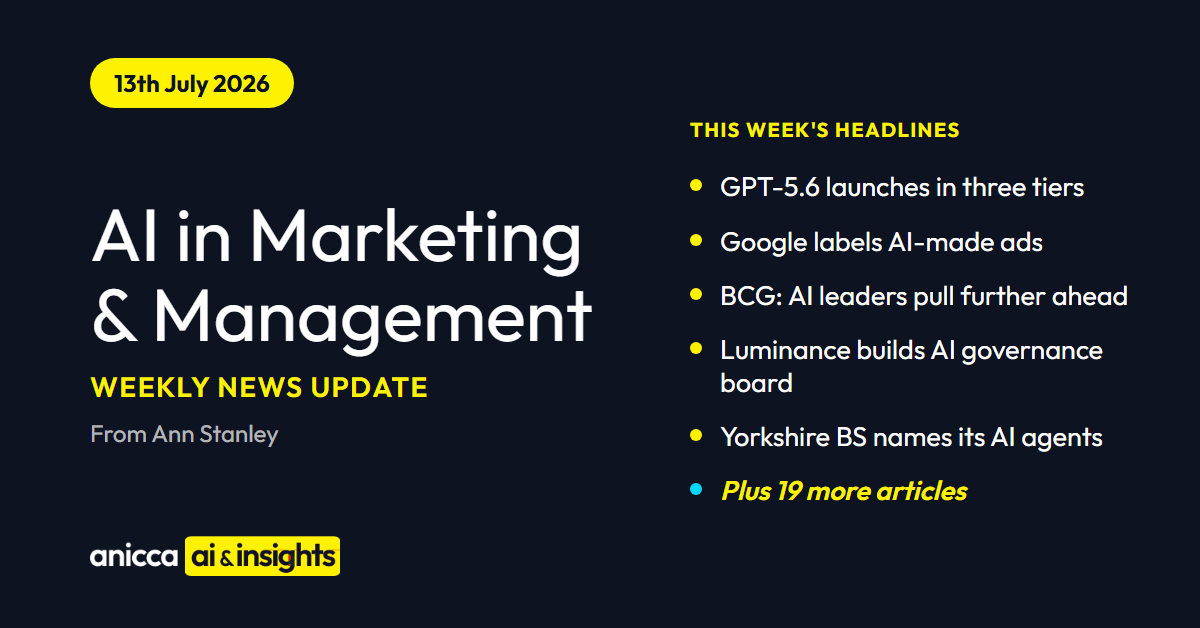
This Week in AI in Marketing & Management (13th Jul 26)
This Week in AI in Marketing & Management: GPT-5.6 Lands, AI Search Rewrites Visibility
This week’s biggest story: OpenAI released GPT-5.6 to the public after a White House cybersecurity delay, introducing three tiers (Sol, Terra, Luna) alongside a new ChatGPT Work agent that can run projects across apps for hours. In marketing, Google launched AI transparency labels for ads and rolled out AI Max FAQs, while the SEO industry grappled with a growing question: does SEO still own GEO outcomes? On the management side, Luminance assembled a heavyweight AI governance advisory board, and Yorkshire Building Society shared real-world results from three named AI agents. Meanwhile, Scotland is threatening to freeze datacentre projects, putting the UK’s AI growth zones under pressure.
Table of Contents
- OpenAI releases GPT-5.6 (Sol, Terra, Luna) after White House cybersecurity delay
- ChatGPT Work: OpenAI’s agent that stays on a project for hours
- Anthropic’s new Claude “Reflect” feature quietly makes the case for AI
- Scotland could freeze new datacentre projects, threatening UK’s AI strategy
- Jamf and AWS Bedrock team up to govern AI apps on managed Macs
- AI search is exposing SEO’s risk of losing ownership of GEO outcomes
- Why AI search makes trust your most important visibility signal
- Google introduces “How this ad was made” AI transparency labels
- ActiveCampaign links Google Ads to first-party data for AI campaign building
- Google Ads AI Max: new FAQs clarify positioning versus Performance Max
- Humanised AI content: why it now dominates SEO performance
- Luminance launches heavyweight advisory board for AI governance
- CIO: business processes, not IT, are holding AI back
- KPMG: AI adoption is a people transformation, not a technology one
- Yorkshire Building Society reports customer service gains from AI agents Penelope, Sam and Alf
- CROSS-SECTOR: BCG on how AI leaders create competitive advantage
AI in E-commerce, Retail and Agentic Commerce
- Practical Ecommerce: AI marketing looks familiar, because it is
- Digital Commerce 360 and ReFiBuy launch first AI commerce rankings
- Ecommpay launches podcast covering agentic commerce and AI in payments
- Salling Group and Google launch AI-driven commerce partnership
- Envirofone’s AI-driven trade-in relaunch debuts on eBay Live
AI for Other Sectors and Industries
- FINANCE: IndusInd Bank CHRO on leadership, AI and decisiveness
- HR: Flexible working has not disappeared, it has matured
- PUBLIC SECTOR: What are Britain’s AI growth zones, and are they feasible?
AI News, Tech & Tools
OpenAI releases GPT-5.6 (Sol, Terra, Luna) after White House cybersecurity delay
Source: openai.com | cnbc.com | theguardian.com | 8-9 July 2026
OpenAI moved GPT-5.6 to general availability on 9 July, launching three variants: Sol as the flagship, Terra as a balanced everyday model, and Luna as the cost-efficient tier. The release followed a month-long restriction imposed by the Trump administration, which had limited access to government-approved users while the centre for AI Standards and Innovation completed additional testing. OpenAI describes Sol as its safest and most capable model to date, promising more intelligence per token and stronger performance per dollar.
The staggered rollout mirrors a similar restriction placed on Anthropic’s Claude Fable and Mythos models earlier this month, which triggered a temporary export ban. Both episodes have exposed how the US government’s approach to frontier AI regulation, at the intersection of national security and commercial release, is being made up as capabilities advance. OpenAI simultaneously published its National Security Principles, disclosing expanded Trusted Access for Cyber partnerships with the UK, Australia, Canada, Japan, Korea, France, Germany, Poland, the Netherlands and EU institutions including ENISA.
Why it matters
For UK marketing teams, the three-tier pricing means you can now match model spend to task complexity: Luna for bulk classification and tagging, Terra for everyday copy and analysis, Sol reserved for genuinely hard reasoning. But the geopolitics matter more than the specs. Frontier model access is now a national security question, which means UK enterprise buyers should expect more friction, more regional rollout gaps, and more scrutiny on cross-border data flows. Build vendor redundancy into your AI stack now.
ChatGPT Work: OpenAI’s agent that stays on a project for hours
Source: openai.com | 9 July 2026
Alongside GPT-5.6, OpenAI launched ChatGPT Work, an agentic layer that operates across desktop apps, files and the web, creating slides, sheets, docs and internal Sites from goals rather than prompts. The pitch is delegation: hand it a brief, walk away, come back to finished output. OpenAI is positioning it as a partner for multi-hour projects rather than a chatbot for quick answers, with dedicated security and governance controls for organisations.
The product directly targets Microsoft Copilot and Google’s Workspace agents in the enterprise productivity fight. Pricing and rollout details tie into ChatGPT Business tiers, and the desktop app becomes the primary interface for longer-running work rather than the browser. This is a clear signal that OpenAI’s monetisation strategy now runs through knowledge worker productivity, not consumer chat.
Why it matters
Marketing teams should pilot ChatGPT Work on genuinely tedious multi-step processes: monthly reporting decks, competitor teardowns, briefing packs for agency reviews. The productivity gains only appear when you delegate outcomes, not tasks. That requires marketers to write better briefs, not better prompts. Also worth flagging to your CTO: an agent that touches desktop files needs the same access controls as any employee, so bring IT and legal into the pilot from day one.
Anthropic’s new Claude “Reflect” feature quietly makes the case for AI
Source: techcrunch.com | Sarah Perez | 9 July 2026
Anthropic launched Reflect this week, a Claude dashboard that visualises how users interact with the assistant: topics discussed, usage patterns, task categories. On the surface it is a productivity analytics tool. Underneath, TechCrunch argues, it is a soft-sell reframing Claude as a mindful, integrated part of the workflow at a moment when AI backlash and datacentre protests are gaining public traction.
The feature arrives as public sentiment on AI is turning more hostile, with data centre protests, energy concerns and job displacement dominating headlines. By showing users their own dependency, Anthropic is betting that self-awareness of value builds retention. It is a subtle but important shift: from persuading you to try AI to persuading you that you already rely on it.
Why it matters
Reflect is a masterclass in retention marketing for AI-native products. Marketers building AI features into their own products should study the mechanic: quantified usage summaries reduce churn because they surface value the user was already receiving but not registering. Steal the pattern for your loyalty apps, subscription services and B2B SaaS. Show the customer what they got, not just what they could get next.
Scotland could freeze new datacentre projects, threatening UK’s AI strategy
Source: theguardian.com | 7 July 2026
The SNP national council passed a motion on 5 July calling for a moratorium on all new datacentres in Scotland, and it is now with the Scottish government to consider. It could apply to every project that has not yet received planning permission, including the flagship Lanarkshire “AI growth zone”, which a Guardian investigation found had been misrepresented on renewable energy feasibility. Another growth zone in North Tyneside, supposedly backed by OpenAI, was separately described as more publicity stunt than viable project.
The timing is politically fraught: Andy Burnham is reportedly preparing to replace Keir Starmer at Downing Street and is expected to review several planks of Starmer’s technology policy. Combined with community opposition, energy grid concerns and questionable feasibility studies, the UK’s promise to become an AI infrastructure hub is looking increasingly wobbly.
Why it matters
UK CMOs planning multi-year AI roadmaps should not assume domestic compute capacity will scale as promised. If you rely on low-latency UK inference for regulated data, e-commerce personalisation or real-time ad tech, start scenario-planning for continued reliance on US and Irish datacentre capacity. Also, the political optics are shifting: expect more marketing scrutiny of AI environmental claims, energy use, and “green AI” positioning as public sentiment sours.
Jamf and AWS Bedrock team up to govern AI apps on managed Macs
Source: aws.amazon.com | July 2026
Jamf, which manages Apple devices for 78,000-plus organisations, has integrated its AI Governance product with Amazon Bedrock. IT admins can now centrally configure and deploy AI applications like Claude Code, Claude Desktop and OpenAI Codex across managed Mac fleets, routing inference through the organisation’s own AWS account and chosen regions. Settings are enforced via Declarative Device Management, keeping local configurations resistant to tampering.
The problem this solves is real and urgent: employees are installing AI tools faster than IT can approve them, and each install creates a shadow inference bill, a data leakage risk, and a compliance headache. By putting inference behind the enterprise AWS boundary and centralising configuration, IT gets visibility without blocking usage.
Why it matters
“Shadow AI” is the new shadow IT. If your marketing team is already pasting customer data into ChatGPT, Claude and Copilot, you have a governance problem whether you have named it or not. Ask your CIO whether tooling like this, or its Windows equivalents, is on the roadmap. And build an approved-AI-tools list for marketing now, so you can move fast on capability while keeping legal and infosec on side.
AI in Marketing
AI search is exposing SEO’s risk of losing ownership of GEO outcomes
Source: searchenginejournal.com | 8 July 2026
Search Engine Journal argues that as generative engine optimisation (GEO) becomes the primary driver of AI-generated visibility, SEO teams risk losing organisational ownership of the discipline to PR, brand and content teams who understand authority signals better. The piece frames GEO not as an SEO extension but as a distinct capability requiring entity recognition, citation strategy, and reputation management across LLM training and retrieval sources.
Related coverage in MarTech this week made the same point from the trust angle: AI search systems increasingly evaluate brands on authority, reputation and technical integrity, not keyword targeting. Both pieces converge on a shift that many marketing teams have been slow to internalise, that visibility in AI answers is earned across a much wider surface than the SERP.
Why it matters
If your SEO team still reports into performance marketing and measures success in blue links, restructure. GEO ownership needs to sit somewhere with reach into PR, brand, comms and content, or it will fall between chairs. Audit which brands and experts your category’s top LLMs cite when asked comparison questions. If you are not in those citations, you are not in the consideration set, regardless of your Google ranking.
Why AI search makes trust your most important visibility signal
Source: martech.org | Kevin Cotch | July 2026
MarTech’s Kevin Cotch details how LLM-driven search now weights author expertise, brand reputation, third-party validation and technical SEO signals more heavily than traditional keyword and link relevance. The piece argues that trust signals, once a “nice to have” for E-E-A-T, are now the primary determinants of whether a brand gets surfaced or recommended in AI answers.
Cotch outlines practical trust-building tactics: verified author profiles, structured data for organisations and experts, consistent brand entity signals across the web, and third-party mentions in high-authority publications. Notably, technical hygiene like clean schema and crawlable content architecture matters more, not less, in the AI era, because these are the signals machines use to disambiguate and validate.
Why it matters
Trust is measurable. Start with an entity audit: does Google’s Knowledge Graph and Wikidata correctly identify your brand, executives and products? Are your authors linked to verified profiles? Is your schema complete? These sound like SEO housekeeping tasks, but in AI search they are the difference between being cited and being ignored. Budget for an entity and schema audit this quarter.
Google introduces “How this ad was made” AI transparency labels
Source: blog.google | Keerat Sharma, VP Ads Privacy and Safety | 9 July 2026
Google is expanding its ad transparency system with a new “How this ad was made” panel, accessible from the three-dot menu on Search, YouTube and Discover ads. Ads created with Google’s own generative AI tools will be labelled automatically. Advertisers using third-party AI tools must now manually label their content, with disclosure required rather than optional.
The move responds to growing consumer and regulator concern about synthetic media in advertising, and pre-empts likely regulatory action in the EU and UK. For advertisers, the change adds a compliance obligation but also creates a new signal in the ad experience: consumers may develop preferences for AI-generated versus human-crafted creative, and Google is now the arbiter of that visibility.
Why it matters
Add AI disclosure to your creative production workflow now. Build a tagging convention that identifies which assets used generative AI, at what stage, and update your Google Ads asset uploads accordingly. Also start A/B testing: does the AI label affect CTR or conversion in your category? You need your own data, because assumptions about consumer trust in AI advertising will vary sharply by sector and audience.
ActiveCampaign links Google Ads to first-party data for AI campaign building
Source: emarketer.com | 10 July 2026
ActiveCampaign has launched a direct integration with Google Ads that connects marketing automation first-party data to AI-driven campaign generation. Marketers can now use customer behaviour signals from ActiveCampaign, including engagement, purchase history and lifecycle stage, to inform AI-built Google Ads audiences, creative and bidding strategies, without manual data exports.
The launch reflects a broader industry pattern: platforms racing to make first-party data actionable inside AI-generated campaigns as third-party signals continue to degrade. For SMB and mid-market advertisers who lack a dedicated data engineering function, integrations like this are increasingly the only way to keep pace with enterprise-grade AI ad optimisation.
Why it matters
If you run Google Ads and any form of marketing automation, audit whether your first-party data is actually reaching your campaigns. Many teams still batch-export CSVs monthly, which means AI-driven bidding is optimising against week-old signals. Live integrations turn that around. Also, check whether your CDP or ESP has an equivalent AI-connected Google Ads integration on its roadmap.
Google Ads AI Max: new FAQs clarify positioning versus Performance Max
Source: seroundtable.com | Barry Schwartz | 8 July 2026
Google has updated its AI Max help documentation with new FAQs clarifying that AI Max is not a new campaign type but a setting layered on existing campaigns, and detailing how it differs from Performance Max. Notably, Google removed a previous caveat about lack of Google Ads Editor and API integration, suggesting broader tooling support is now available or imminent.
Barry Schwartz notes the updates include a new intro section and various tweaks that reflect Google’s push to move advertisers onto AI Max as the default optimisation mode. The removal of the API and Editor limitations is significant: agencies managing at scale need programmatic control before they will move budget.
Why it matters
If you paused AI Max testing because of tooling gaps, the constraint has softened. Rerun your pilot with proper controls. But keep the guard rails tight: exclude brand terms, use negative keyword lists aggressively, and monitor query reports weekly. AI Max expands query matching, which means it can burn budget quickly on irrelevant traffic if left unchecked.
Humanised AI content: why it now dominates SEO performance
Source: europeanbusinessreview.com | July 2026
The European Business Review argues that after roughly 18 months of aggressive AI content scaling, marketing teams are noticing quiet declines in engagement metrics: rising bounce rates, softening time on page, weaker email open rates from content roundups. The pattern is subtle enough to explain away but consistent enough to matter. The diagnosis: competent but generic AI text extracts information but does not build loyalty or brand affinity.
The piece frames the fix as “humanised” AI content, writing that carries a point of view, a distinct voice, and evidence of a real perspective. Google’s ranking signals have grown more sensitive to engagement, not just keyword coverage and links, so competent-but-generic content is now actively penalised in behaviour metrics.
Why it matters
Audit your last six months of AI-assisted content against engagement metrics, not just traffic. If bounce is up and time on page is down, you have the problem. The fix is process, not tooling: require a named author with genuine expertise, mandate original examples and opinions, and use AI for structure and speed rather than voice. Anyone can produce competent. Distinctive is what earns the click and the return visit.
AI in Management
Luminance launches heavyweight advisory board for AI governance
Source: itbrief.co.uk | Sofiah Nichole Salivio | 10 July 2026
Legal AI firm Luminance has assembled a customer advisory board including senior leaders from BBC Studios, Ingram Micro, Slaughter and May, Staples Canada and Imerys, plus Lord Ian Burnett of Maldon, the former Lord Chief Justice. The invitation-only forum spans legal, procurement, finance and operations, reflecting how AI adoption decisions have moved out of IT and into cross-functional executive leadership.
The board’s composition tells its own story: AI governance is now a boardroom discipline in contract-heavy, regulated industries, not a technology project. Luminance says the group will focus on trust, risk management and organisational change, giving customers a peer forum to work through the messy realities of enterprise AI rollout beyond the pilot phase.
Why it matters
If your organisation still treats AI governance as an IT or legal-only responsibility, you are behind. Cross-functional governance forums, whether internal committees or peer networks, are how the leaders are managing enterprise risk. For marketers, this matters because your AI use cases, customer personalisation, generative creative, agentic outreach, will increasingly need to justify themselves in these forums. Start documenting your AI decisions with governance in mind now.
CIO: business processes, not IT, are holding AI back
Source: cio.com | Grant Gross | 7 July 2026
Deloitte’s 2026 Global Technology Leadership Study finds that over 80% of senior IT executives are confident in their organisations’ ability to deploy and govern AI at scale, but 75% believe operating models and business processes must change substantially in the next 12 to 18 months to realise real value. The gap is not technical capability. It is workflow, decision rights and process design.
KPMG’s parallel research reinforces the point: 81% of UK CEOs cite AI as a top investment priority and 71% are redesigning roles, yet 75% of organisations report they are not seeing return on AI investment. The consistent diagnosis across both reports is that companies are bolting AI onto legacy processes rather than redesigning the work.
Why it matters
For CMOs, the message is uncomfortable but clear: your AI ROI problem is probably a process problem, not a tooling problem. Map three high-value marketing processes end to end (campaign planning, content production, performance reporting) and ask which steps exist only because a human used to do them. Then redesign, do not augment. This is the difference between 5% efficiency gains and step-change productivity.
KPMG: AI adoption is a people transformation, not a technology one
Source: kpmg.com | July 2026
KPMG UK’s latest research reports 81% of UK CEOs treating AI as a top investment priority with at least 10% of budget allocated, 71% redesigning roles and career paths, and 52% bringing in external expertise. But 75% of organisations are not seeing returns. KPMG’s diagnosis: too many treat AI as a technology transformation when it is fundamentally a people, skills and organisational design transformation.
The piece highlights how the Financial Services Skills Commission’s annual report found 75% of employers said AI had already changed skills demands last year, with adaptability the most in-demand behaviour and machine learning the most sought-after technical skill. Generic upskilling programmes are not enough; managerial redesign, wellbeing considerations and role rethinking are the harder work being underinvested in.
Why it matters
Marketing leaders should audit their team development spend. If more than 70% goes to tool training and less than 30% to role redesign, managerial capability and change readiness, you are investing in the wrong things. The teams pulling ahead are those where managers know how to redesign work for human-AI collaboration, not just how to use ChatGPT faster.
Yorkshire Building Society reports customer service gains from AI agents Penelope, Sam and Alf
Source: itpro.com | Emma Woollacott | July 2026
Yorkshire Building Society has deployed three named AI agents, Penelope, Sam and Alf, to support customer service teams handling complaints. Penelope drafts final responses, Alf searches policies and past cases to support that drafting, and Sam handles member communications. All three operate with human oversight, which YBS says has been essential for maintaining regulatory compliance in the heavily governed lender space.
The named-agent framing is worth noting: giving AI agents human names shifts them from tools to team members in the way staff talk about them, which changes adoption dynamics and expectations. YBS reports solid early results in reducing admin load and improving response quality without cutting headcount, presenting the deployment as augmentation rather than replacement.
Why it matters
For regulated marketing environments (finance, insurance, healthcare, legal), YBS is a useful template: named agents, narrow scope, human-in-the-loop, clear audit trail. The customer service use case translates well to marketing operations, campaign QA, brief writing, compliance review. Start there before attempting customer-facing agentic experiences, because the regulatory downside of a hallucinating agent is worse than any efficiency upside.
CROSS-SECTOR: BCG on how AI leaders create competitive advantage
Source: bcg.com | 9 July 2026
BCG’s latest AI report finds that the top-performing AI adopters, roughly the top quartile of organisations across sectors, are pulling further ahead of the rest. The consistent pattern: leaders invest more in reshaping the operating model (people, process, data foundations) than in the models themselves. Followers over-invest in tools and under-invest in the enabling architecture, and it shows up in ROI.
BCG’s data spans manufacturing, financial services, consumer products and healthcare. Across all sectors, the leader-laggard gap in AI-driven productivity is widening rather than narrowing, contradicting the “everyone catches up eventually” narrative. In AI, first-mover advantages appear to be sticky because data flywheels and workflow reinvention compound over time.
Why it matters
If your organisation is in the AI middle pack, the window to catch the leaders is narrowing. The winning playbook is unglamorous: invest in data foundations, redesign workflows before adopting tools, and treat AI capability building as an operating model change rather than a technology project. For marketing specifically, this means data infrastructure and MMM/attribution rebuilds matter more than the latest generative creative tool.
AI in E-commerce, Retail and Agentic Commerce
Practical Ecommerce: AI marketing looks familiar, because it is
Source: practicalecommerce.com | 9 July 2026
Practical Ecommerce argues that despite the hype, most AI marketing use cases in e-commerce are recognisable evolutions of existing disciplines: segmentation, personalisation, creative testing, product discovery. What has changed is speed and scale, not the underlying jobs to be done. The piece warns against chasing novelty and encourages retailers to focus AI investment on the boring, high-volume tasks where efficiency compounds.
The observation lands at a useful moment. After 18 months of AI-native e-commerce startups pitching radical reinvention, mainstream retailers are settling into a more pragmatic view: incremental gains across many workflows will outperform one moonshot use case. The winners are the teams applying AI to the top three cost drivers in their operation, not the flashiest use case.
Why it matters
Ask your e-commerce team to list every AI pilot running right now. Rank them by cost saved or revenue added, not by novelty. Kill anything below the median. The compounding value is in getting five boring things (product feed enrichment, review summarisation, size and fit prediction, PPC keyword expansion, category page copy) fully productionised, not in launching one AI stylist that generates PR but no margin.
Digital Commerce 360 and ReFiBuy launch first AI commerce rankings
Source: channelx.world | 10 July 2026
Digital Commerce 360 has partnered with ReFiBuy to launch what it claims is the first industry ranking of retailers by their performance in AI-driven commerce channels: how well brands surface in shopping agents, how their products rank inside AI answer engines, and how frequently they are recommended by conversational commerce interfaces. The methodology combines LLM query analysis with retailer share-of-recommendation metrics.
The launch of a dedicated ranking is a signal that AI commerce visibility is becoming a measurable, competitive discipline. Analogous to how the first search visibility indexes shaped SEO 20 years ago, an AI commerce ranking creates a scoreboard, which creates a market for optimisation services and internal budget allocation.
Why it matters
For e-commerce leaders, this is the moment to check where you sit on emerging AI commerce benchmarks, because your board will start asking. Product feed quality, structured data completeness, review authenticity signals and consistent brand entities across the web all feed into these rankings. If you cannot answer “what percentage of ChatGPT shopping recommendations in your category include your brand”, find out this quarter.
Ecommpay launches podcast covering agentic commerce and AI in payments
Source: itbrief.co.uk | Sofiah Nichole Salivio | 9 July 2026
Payments provider Ecommpay has launched “Making Payments Make Sense”, a podcast series aimed at merchants, with the opening episode featuring CEO Aleex Sjarki and Streets Consulting’s Julia Streets discussing acceptance rates, AI in payments, agentic commerce and financial services access in emerging markets. Sjarki argues acceptance rate optimisation, driven by data analysis and increasingly by AI, remains the biggest untapped commercial lever for merchants.
The podcast reflects a wider industry positioning shift: payments providers are trying to own the agentic commerce conversation before it consolidates around Visa, Mastercard and PayPal’s larger initiatives. Explaining how AI actually improves acceptance rates, in specific merchant categories and geographies, is becoming a competitive differentiator.
Why it matters
E-commerce leaders should treat payment acceptance rate as a marketing metric, not just a finance one. A 1% improvement in acceptance rates typically outperforms a 1% improvement in conversion rate for revenue impact, and AI-driven acceptance optimisation is now table stakes. Ask your payments provider what their AI approach is, and benchmark your rates against category peers.
Salling Group and Google launch AI-driven commerce partnership
Source: esmmagazine.com | 6 July 2026
Danish retail giant Salling Group has partnered with Google on an AI-driven commerce initiative, applying Google’s AI stack to personalisation, product discovery and operational efficiency across Salling’s grocery and non-food operations. The partnership is one of the more prominent European grocery AI deals of the year and signals continental grocers moving from cautious pilots to strategic bets.
Grocery is a particularly interesting AI commerce testbed because of the volume, the perishability constraints, and the tight margins. If Salling can demonstrate meaningful uplift in personalisation or supply chain efficiency, expect a wave of similar deals across European supermarket groups over the next 12 months.
Why it matters
For UK grocers and FMCG brands, watch this partnership closely. The playbook Salling develops will likely inform Tesco, Sainsbury’s, Ocado and Marks and Spencer AI roadmaps in 2026-27. Suppliers and CPG brands selling into these retailers should also prepare: retailer-side AI personalisation changes the promotional planning game, and JBP conversations will start including “how does your brand data feed our AI”.
Envirofone’s AI-driven trade-in relaunch debuts on eBay Live
Source: channelx.world | July 2026
Envirofone, the UK phone recycling brand, has completed a digital transformation following its acquisition by Sam Hargreaves and Matt Green in July 2025. The rebuild uses AI to identify and grade devices from consumer-uploaded images, replacing manual assessment steps with automated valuation. The brand has now debuted on eBay Live, using livestream commerce to reach buyers directly.
The combination is telling: AI-driven back-end automation plus livestream commerce on the front end. It shows how a legacy brand can use AI to strip cost from the operational spine while investing the savings in new discovery channels. For mid-market brands feeling squeezed between AI-native startups and category giants, this is a viable playbook.
Why it matters
Every retail marketing team should identify one operational bottleneck that AI could automate and one emerging channel that requires the freed-up budget. That is the Envirofone equation. Automation for its own sake is a cost-out exercise; the win comes when the savings fund growth. Livestream commerce, agentic shopping surfaces and creator marketplaces are all plausible reinvestment targets.
AI for Other Sectors and Industries
FINANCE: IndusInd Bank CHRO on leadership, AI and decisiveness
Source: peoplematters.in | 9 July 2026
Amitabh Kumar Singh, CHRO of IndusInd Bank, argues in a wide-ranging interview that the defining leadership skill in the AI era is decisiveness: the ability to move quickly with imperfect information as capabilities and best practices shift monthly. He describes the bank’s AI adoption approach as balancing speed of experimentation with rigorous governance, particularly around customer data and regulatory compliance.
Singh’s emphasis on decisiveness over expertise is notable. In previous technology cycles, deep technical fluency was the differentiator. In this cycle, he argues, leaders who can commit to a direction, adjust course quickly and communicate clearly through uncertainty are outperforming those waiting for clarity. The framing matters for marketing leaders too.
Why it matters
CMOs should audit how quickly their team can commit to and unwind AI experiments. If getting a pilot approved takes three months and killing one takes six, your organisational metabolism is too slow for the current pace of change. Push for lighter-weight decision gates on reversible AI experiments and heavier scrutiny only on irreversible ones.
HR: Flexible working has not disappeared, it has matured
Source: thehrdirector.com | 9 July 2026
The HR Director argues that despite return-to-office headlines, flexible working has not retreated. It has matured into more structured hybrid patterns, outcome-based performance measurement, and greater investment in the tools (including AI copilots) that make distributed work productive. The piece frames the shift as an evolution of the 2020-2022 experiment rather than a reversal.
AI tooling features prominently in the analysis. Copilots and agentic assistants reduce the coordination overhead that made hybrid work friction-heavy, meaning organisations can now sustain flexibility without losing productivity. For workforce planning, this means AI capability and flexible work policies are converging into a single strategic question.
Why it matters
Marketing leaders navigating hybrid team design should treat AI tooling and flexibility as a single problem, not two. The teams making hybrid work at scale are those investing in copilots for status updates, meeting summaries, brief-writing and cross-timezone handoffs. If your hybrid model is straining, the fix may be tools and workflow, not more mandated office days.
PUBLIC SECTOR: What are Britain’s AI growth zones, and are they feasible?
Source: theguardian.com | 6 July 2026
The Guardian’s explainer picks apart the UK’s five announced AI growth zones, finding that at least two, the Lanarkshire site and the North Tyneside “Stargate UK” project, appear to have serious feasibility problems. One source described some of the plans as “complete bunk”. The paper’s investigation found renewable energy claims that cannot be met by 2030, promised jobs and investment that appear unlikely to materialise, and community consultation processes that critics describe as inadequate.
The scrutiny arrives as the SNP considers a Scotland-wide datacentre moratorium and Andy Burnham prepares to potentially replace Keir Starmer, with a promised review of Starmer’s technology policy in the offing. Together, these developments suggest the UK’s AI infrastructure promise is heading into political turbulence.
Why it matters
For public sector marketers and communications leads, expect increased scrutiny of AI-related public spending announcements over the next 12 months. For enterprise marketers, this reinforces the earlier point: do not bet your capacity roadmap on UK sovereign compute materialising on schedule. And for all UK marketers, the political shift may reshape AI regulation itself, worth monitoring closely.
Key Takeaways
- GPT-5.6 launches with three tiers (Sol, Terra, Luna) after a White House cybersecurity delay; expect more geopolitical friction on frontier model access, so build vendor redundancy into your AI stack.
- Google’s new “How this ad was made” AI transparency labels are now mandatory for advertisers using third-party AI tools; add disclosure to your creative production workflow immediately.
- Digital Commerce 360’s new AI commerce rankings mean AI shopping visibility is now a measurable, benchmarkable discipline; audit your share of AI-driven product recommendations this quarter.
- 75% of organisations are not seeing AI ROI, according to both KPMG and Deloitte research; the diagnosis is process design, not technology, so redesign workflows before adopting more tools.
- Trust signals (author expertise, brand entities, schema, third-party mentions) are now the primary drivers of AI search visibility; a full entity and schema audit is essential.
- Yorkshire Building Society’s named-agent model (Penelope, Sam, Alf) with human-in-the-loop is a useful template for regulated marketing environments.
- Scotland could freeze new datacentres, and the UK’s AI growth zones look wobbly; do not assume UK sovereign compute will scale on schedule.
Frequently Asked Questions
Should we switch our default model to GPT-5.6 Sol immediately?
No, match the tier to the task. Use Luna for high-volume, low-complexity work (classification, tagging), Terra for everyday content and analysis, and reserve Sol for genuinely hard reasoning problems where cost per token is justified by outcome value. Run a small benchmark on your top three use cases before defaulting anything.
How do we start measuring our AI search visibility (GEO)?
Pick your top 20 category comparison queries and run them against ChatGPT, Claude, Perplexity and Google’s AI Overviews weekly. Track which brands and sources are cited. Combine that with an entity audit (Knowledge Graph, Wikidata, schema completeness) and third-party citation analysis. Tools like ReFiBuy and Digital Commerce 360’s new rankings can supplement your own tracking.
Do we need to label AI-generated ads under Google’s new transparency rules?
If you use Google’s own generative AI tools to create ads, labelling is automatic. If you use third-party AI tools, you must now manually label the content yourself, disclosure is required rather than optional under the new panel. Build this into your creative production workflow now rather than waiting for enforcement.



Join the Thursday AI Club
A hands-on AI club for marketers and managers. Fortnightly 3-hour sessions: Hour 1 is an open Q&A on any AI question; Hours 2-3 split into a workshop track (for newbies) and an advanced track (live demos and deeper questions).
Led by Ann Stanley, Darren Wynn, James Allen.
Membership: £40/month or £400/year
This weekly round-up is curated and written by the team at Anicca Digital and Anicca AI & Insights. Sources are linked throughout. For help applying any of this to your own marketing, contact us at [email protected].