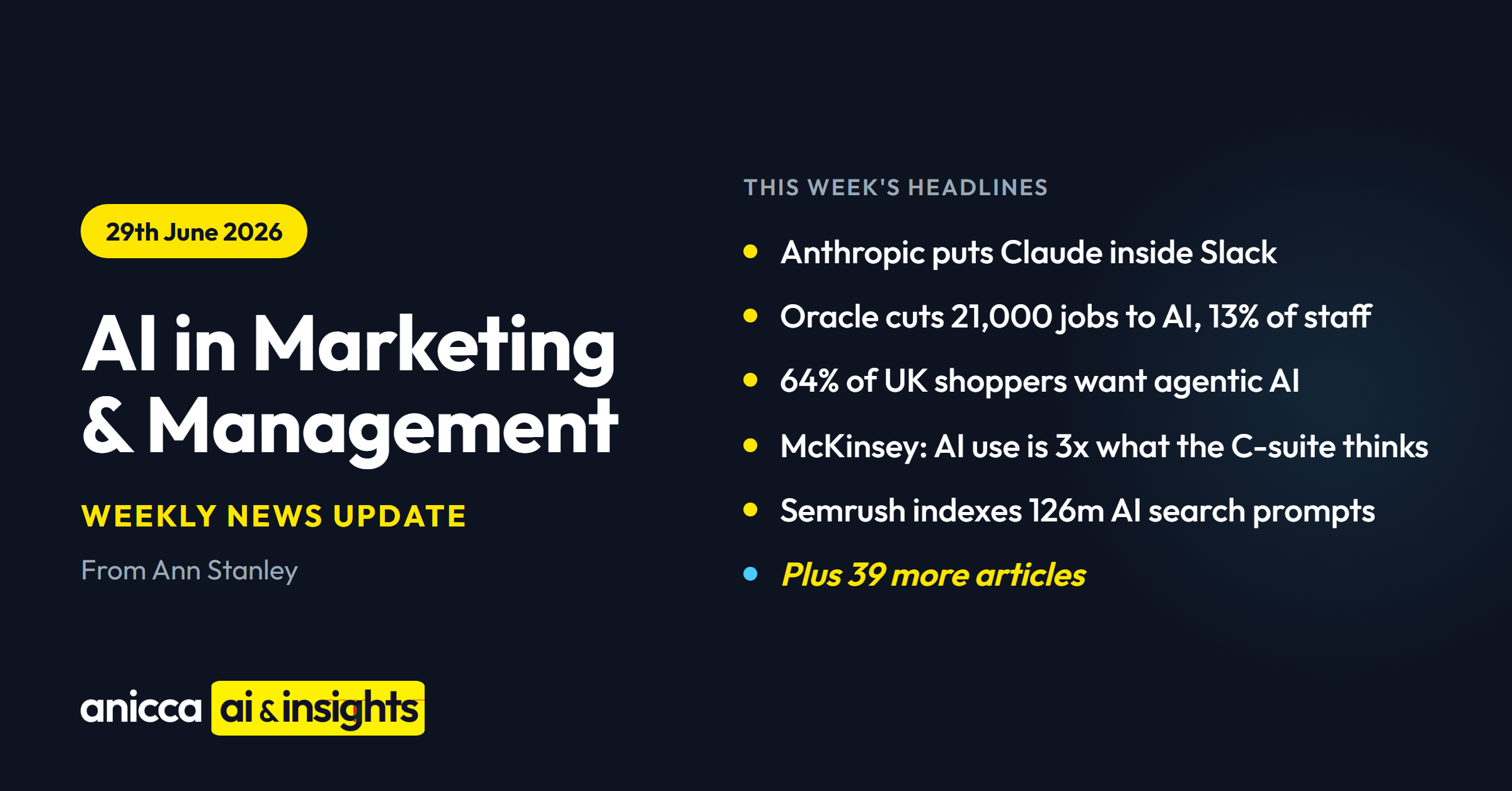
This Week in AI in Marketing & Management (29th Jun 26)
Agentic Commerce Arrives, GPT-5.6 Held Back, and AI Hits the Workforce
This was the week agentic commerce stopped being a slide in a keynote and started being shipped. Salesforce, Visa, Amazon and Klarna all moved on the same theme: AI agents that can browse, recommend and pay on behalf of shoppers. At the same time, OpenAI staggered the release of GPT-5.6 at the US government’s request, Anthropic launched Claude Tag inside Slack, and Google delayed Gemini 3.5 Pro to July. On the management side, Oracle confirmed 21,000 AI-related job losses, AWS’s CEO pushed back hard against replacing junior staff with AI, and McKinsey research showed leaders are systematically underestimating how much AI their own teams already use. Here is what marketers and managers need to do about it.
In this week’s round-up
AI News, Tech & Tools
- Anthropic launches Claude Tag, an always-on AI teammate inside Slack
- OpenAI staggers GPT-5.6 release after US government request
- Google delays Gemini 3.5 Pro to July as it tweaks the frontier model
- OpenAI publishes research on how AI agents are transforming work
- EU AI Act transparency obligations come into force on 2 August 2026
- Five Eyes agencies warn of national-security risks from frontier AI
AI in Marketing
- Google launches Ask Ad Manager, its first AI agent for publishers
- Google June 2026 spam update lands alongside Ads Strength Match labels and AI reporting access
- OpenAI says ChatGPT ad dismissals have dropped 50% as relevance improves
- Google adds AI guidance to Demand Gen campaigns
- Microsoft Advertising Activate 2026 unveils AI Max, UCP and impression-based remarketing
- Google Ads launches promotion mode and Smart Bidding Exploration for Performance Max
- Meta rolls out new AI ad tools and the Creator Marketing Hub
- TikTok expands Symphony Agent and Cannes-launched agentic creator tools
- Semrush releases expanded 2026 AI Visibility Index covering 126 million AI search prompts
- LinkedIn is now part of your AI search footprint
- The Cannes AI search crisis is actually about brand coherence
- Albertsons integrates branded product placement into AI search results
- Harris Poll finds consumers are tired of AI in advertising
- Marketing Week: is AI forcing a renegotiation of agency relationships?
AI in Management
- MIT Sloan: three approaches to measuring AI ROI
- AWS CEO calls replacing junior staff with AI “one of the dumbest ideas”
- Oracle admits AI has cost 21,000 jobs, around 13% of its workforce
- A new coalition forms to ready the US workforce for AI upheaval
- McKinsey: C-suite think 4% of staff use AI daily, the real figure is 13%
- Bain: most CEOs think they are leading an AI transformation, they are managing a pilot portfolio
- HR: 9 in 10 leaders say AI will create new entry-level roles, and middle managers are essential
AI in E-commerce, Retail and Agentic Commerce
- Salesforce unveils its biggest Agentforce Commerce release yet
- Visa launches Agentic Ready programme for agentic commerce in Europe
- Klarna partners with OnePay to exclusively power Walmart instalment loans
- Digital Commerce 360: data and AI strategies now determine where consumers shop
- Airwallex targets agentic commerce after hitting $11bn valuation
- Amazon’s new Alexa+ ad format previews advertising’s agentic future
- 64% of UK consumers want to use agentic AI for shopping
AI for Other Sectors and Industries
- PUBLIC SECTOR: UK backs new AI labs at Oxford and UCL
- PUBLIC SECTOR: UK Government sets up Responsible AI Advisory Panel
- HEALTHCARE: HHS details takeaways from sweeping AI request for information
- MANUFACTURING: UK firms shift from AI pilots to industrial execution
- ENERGY: World Economic Forum on harnessing AI for the energy sector
Wrap-up
AI News, Tech & Tools
Anthropic launches Claude Tag, an always-on AI teammate inside Slack
Sources: Anthropic | TechCrunch | 23 June 2026
Anthropic introduced Claude Tag, a new way for teams to work with Claude that starts in Slack, where Claude joins channels as a named team member rather than a bot users have to invoke. According to Anthropic, teams can tag Claude into conversations the same way they would tag a colleague, and Claude builds up organisational context from the messages, files and threads it is given access to over time.
TechCrunch frames Claude Tag as a strategic play to capture the layer of company knowledge that lives in Slack, Microsoft Teams and similar tools, where most operational decisions actually happen. Rather than positioning Claude as a chatbot users visit on a website, Anthropic is putting the model where work already takes place. The TechCrunch report notes this puts Anthropic in direct competition with Microsoft Copilot for the same surface area and gives Anthropic a route to long-running context that a one-off chat session cannot match.
Why it matters
For marketing teams, this changes how AI assistance gets used day-to-day. Instead of switching to a separate Claude tab to ask for a campaign brief or a competitor summary, the assistant lives in the channel where the work is being discussed. Marketing leaders should pilot Claude Tag in one channel first (a campaign planning channel works well) and write a clear data-handling note for the team before they tag it into anything containing client data or unannounced launches. The organisations that get value from this are the ones who set the guardrails before adoption, not after.
OpenAI staggers GPT-5.6 release after US government request
Sources: The Guardian | TechCrunch | 9to5Mac | 26 June 2026
OpenAI is staggering the release of GPT-5.6 after a request from the Trump administration, limiting initial access to a small group of trusted partners. The Guardian reports the move is part of a wider tightening of how frontier models are released, which has also affected Anthropic’s recently announced Mythos model. TechCrunch notes that OpenAI has publicly said restrictions of this kind should not become the norm, framing the staggered rollout as an exception rather than a new baseline.
9to5Mac confirms GPT-5.6 is rolling out across both ChatGPT and Codex, arriving roughly two months after GPT-5.5. The new model is positioned as a meaningful step up on reasoning and code generation, but most users outside the trusted-partner group will see it appear in their accounts over a longer window than recent OpenAI launches. OpenAI has not given a clear date for general availability.
Why it matters
For marketing teams who build on the OpenAI API, this introduces planning uncertainty. If you have an agent or content workflow waiting for the GPT-5.6 capability uplift, treat the timeline as soft and keep your current GPT-5.5 implementation as the production version until you actually see the new model in your account. The bigger signal here is that frontier-model release is now a political conversation, not just a product one, and that has implications for any business that wants predictability in its AI vendor roadmap.
Google delays Gemini 3.5 Pro to July as it tweaks the frontier model
Source: businessinsider.com | 24 June 2026
Business Insider has learned that Google has pushed the launch of Gemini 3.5 Pro into July, citing further tuning work on the model. The delay affects Google’s next frontier release and the agentic features that depend on it, including longer-context multi-step tasks and the larger token windows Google has been previewing in developer briefings.
The slip is short but it lines up with a wider pattern this month of major model releases being pushed or staggered. With OpenAI restricting GPT-5.6 access and Anthropic now positioning Claude Tag rather than a new headline model, July is shaping up to be the month when the next round of frontier capability actually reaches teams who can build on it.
Why it matters
If you are evaluating Gemini for marketing workflows (multi-language campaign generation, large-document analysis, agentic research) hold the procurement decision for a few weeks rather than committing on the current 3.0 capability set. The new model will materially change the price-performance comparison against Claude and GPT-5.x once it lands.
OpenAI publishes research on how AI agents are transforming work
Source: openai.com | 25 June 2026
OpenAI released a research paper this week showing how AI agents are moving from short, single-prompt tasks to longer, more complex multi-step work. The paper draws on usage patterns from ChatGPT business customers and codifies what most early adopters already see in practice: the value of agents is not in faster typing, it is in completing tasks that previously required several humans handing work between each other.
The research breaks down where agents are reaching task completion at scale (research, code review, customer support triage) and where they are still failing (anything requiring judgement against information not in their context window, or coordination across systems with brittle authentication). The paper is unusually honest about the failure modes for an OpenAI publication.
Why it matters
For marketing leaders, the practical read is this: stop measuring AI value in prompts per day or seats deployed, and start measuring it in tasks that used to need a human handoff and no longer do. Pick three workflows in your team this month, document the handoffs, and try replacing one handoff with an agent. That is where the productivity gain actually sits.
EU AI Act transparency obligations come into force on 2 August 2026
Source: datamatters.sidley.com | Sidley Austin | 24 June 2026
Law firm Sidley Austin published a compliance briefing this week reminding organisations that from 2 August 2026 they will be subject to the transparency obligations set out in Article 50 of the EU AI Act. The obligations require providers and deployers of AI systems to clearly disclose AI-generated or AI-manipulated content, including chatbots interacting with humans, synthetic audio, image, video and text content, and emotion-recognition or biometric-categorisation systems.
The briefing flags that the obligations apply to any organisation offering AI systems to users in the EU, not only EU-headquartered companies, and that the disclosure must be machine-readable where technically feasible. Sidley notes that the European Commission has signalled that enforcement is going to begin with the most obvious breaches (undisclosed deepfakes, undisclosed AI customer service agents) rather than edge cases.
Why it matters
UK marketers serving EU audiences need to act now, not in late July. Audit every AI touchpoint the customer sees: chatbots, AI-generated images in ads, AI-written email copy, synthetic voice in IVR. Add the disclosure where required, document the decisions you have made for the touchpoints where you think disclosure is not required, and brief your agency partners on the same rules. The fine ceilings are large enough that “we didn’t know” is not a defensible answer.
Five Eyes agencies warn of national-security risks from frontier AI
Source: theguardian.com | 22 June 2026
Signals intelligence agencies in Australia, the United States, the United Kingdom, New Zealand and Canada (the Five Eyes alliance) issued a rare joint statement warning that AI models capable of devastating attacks on governments and businesses are months, not years, away. The statement followed the Trump administration’s decision to block foreign nationals from accessing Anthropic’s Fable model, citing cyber-offensive capability.
The Guardian reports the statement is unusual in two respects: a joint Five Eyes public statement on a single technology category is rare, and it identifies a specific commercial AI model rather than speaking in general terms about state actors. The agencies are urging boards and CISOs to plan for a threat environment where attackers can use frontier models for vulnerability discovery, automated exploitation and large-scale social engineering.
Why it matters
This is a board-level conversation, not just a security-team one. For marketing teams, the immediate read is on brand impersonation and synthetic-content attacks: voice clones of your CEO, fake press releases on lookalike domains, AI-generated customer-service impersonation. Make sure your brand-protection workflow includes monitoring for synthetic content and that your crisis comms playbook has a scenario for a high-quality fake-incident attack on your brand.
AI in Marketing
Google launches Ask Ad Manager, its first AI agent for publishers
Source: searchenginejournal.com | 24 June 2026
Google has launched Ask Ad Manager, the first conversational AI agent inside Google Ad Manager, aimed at publisher ad operations teams. The agent troubleshoots delivery issues, builds reports on the fly, and answers configuration questions in plain English, replacing many of the workflow steps that previously required navigating multiple Ad Manager screens or raising a support ticket.
Search Engine Journal notes the launch is the first of several agentic features Google has signalled for the publisher stack, and is being framed as a productivity move for under-resourced ad ops teams rather than as a replacement for the human role. Early access is rolling out to enterprise publishers first, with broader availability planned later in the year.
Why it matters
For publishers and any brand running first-party Ad Manager, this changes the day-to-day shape of the ad-ops job. The teams who get value will be the ones who train their ops staff to ask the right diagnostic questions, not the ones who treat the agent as a black box. Expect equivalent agents to appear inside Google Ads (advertiser side) over the next 12 months, and start writing the playbooks now.
Google June 2026 spam update lands alongside Ads Strength Match labels and AI reporting access
Source: seroundtable.com | 26 June 2026
Search Engine Roundtable’s weekly recap confirms Google rolled out the June 2026 spam update this week, with reports of significant ranking volatility across affected sites. Alongside the spam update, Google released new Strength Match labels inside Google Ads, giving advertisers clearer signals on how broad-match keywords are being expanded by AI, and rolled out broader access to AI reporting features that had been in limited preview.
The combination of all three landing in the same week is notable: a core spam update tightening organic ranking, plus paid-side AI controls that give advertisers more visibility into how Google’s automation is interpreting their keywords. SEOs and PPC managers running the same accounts will see effects on both sides of the dashboard at once.
Why it matters
Run a Search Console drop check this week against the top 50 pages and compare against the spam update timeline. On the paid side, log into Google Ads and check the Strength Match labels on your top-spending Performance Max and broad-match campaigns. If the AI is matching to queries that are not commercially relevant, that is now visible and addressable in a way it was not a fortnight ago.
OpenAI says ChatGPT ad dismissals have dropped 50% as relevance improves
Source: searchengineland.com | 25 June 2026
OpenAI confirmed that users are now dismissing ads inside ChatGPT 50% less often than at the format’s launch, which the company attributes to improvements in relevance matching and ad placement timing inside the conversation flow. Search Engine Land notes that the figure, while self-reported, is the first concrete engagement signal OpenAI has shared since ChatGPT ads went live.
The detail behind the headline is more interesting than the number: OpenAI says relevance is being driven by treating the ad slot as a recommendation rather than a paid interruption, with the model deciding when an ad fits the conversation rather than serving on a fixed cadence. This is closer to native advertising than to traditional search ads, and it changes how brands should think about creative for the channel.
Why it matters
If you have been waiting to test ChatGPT ads, the engagement data is now strong enough to justify a pilot budget. Treat creative as recommendation-style rather than direct-response (no shouting, no urgency tactics, no aggressive CTAs) and measure on assisted conversions rather than last-click. The brands building learning in this channel now will have a cost-per-acquisition advantage when paid AI search inventory expands.
Google adds AI guidance to Demand Gen campaigns
Source: socialmediatoday.com | 26 June 2026
Google has rolled out AI-powered guidance inside Demand Gen campaigns, giving advertisers in-product assistance for creative selection, format mix and asset prioritisation. Social Media Today reports the update also expands the format range available inside Demand Gen, bringing the channel closer to feature parity with Performance Max while keeping its top-of-funnel positioning.
The AI guidance is meant to reduce the manual asset-management overhead that has held back Demand Gen adoption for smaller advertisers, and to surface format combinations the algorithm is finding effective inside an account. The update is rolling out globally this week.
Why it matters
For brands using Demand Gen, this is a meaningful unlock if you have been short of in-house creative resource. Treat the AI suggestions as a starting point rather than a final answer, and pair them with a human review of brand tone before publishing. The risk is over-optimising for performance signals and losing brand consistency across formats.
Microsoft Advertising Activate 2026 unveils AI Max, UCP and impression-based remarketing
Source: almcorp.com | 24 June 2026
Microsoft Advertising used its Activate 2026 event this week to launch AI Max, a new campaign type that consolidates Microsoft’s AI ad automation into a single product, alongside upgrades to Performance Max, a new Universal Commerce Protocol (UCP) and impression-based remarketing audiences. AI Max is Microsoft’s direct answer to Google’s Performance Max and Demand Gen consolidation, building on its existing AI Audiences and Copilot ad creative tools.
The UCP launch is the most strategically significant announcement: Microsoft is positioning UCP as an open standard for connecting commerce data across retailers, payment providers and AI shopping agents, an explicit play for the agentic commerce middleware layer. Impression-based remarketing replaces the cookie-based equivalent that has become unreliable as third-party cookie deprecation rolls out across browsers.
Why it matters
If you spend in Microsoft Ads, this is the year to test AI Max rather than running pure manual search campaigns alongside it. For e-commerce brands, the UCP announcement is worth a deeper look from the engineering team: an open commerce protocol could materially simplify the integration work of being visible to AI shopping agents (compared to building bespoke integrations with each retailer or each agent provider).
Google Ads launches promotion mode and Smart Bidding Exploration for Performance Max
Source: ppc.land | Ginny Marvin commentary | 22 June 2026
PPC Land covers Google’s launch of promotion mode in Google Ads, alongside Smart Bidding Exploration for Performance Max and a bidding-target overhaul scheduled for 17 August 2026. Google’s Ginny Marvin walked through what actually changes for advertisers: promotion mode lets brands signal time-limited offers more clearly to the algorithm, Smart Bidding Exploration tests bidding strategies the advertiser has not configured, and the August bidding-target update changes how target CPA and target ROAS are interpreted at the portfolio level.
The promotion-mode launch is the most immediately useful: until now, signalling a flash sale or a limited-time offer to Google’s automation has required either manual bid adjustments or campaign duplication. Promotion mode is the first native control for time-bound offers inside Performance Max and Demand Gen.
Why it matters
Mark the 17 August date in your PPC team’s calendar now. The bidding-target overhaul will change reported performance in ways that look like a campaign change when it is actually a measurement change, and accounts that do not understand the difference will overreact. Test promotion mode on your next major sale period and benchmark against the bid-adjustment approach you used previously.
Meta rolls out new AI ad tools and the Creator Marketing Hub
Source: almcorp.com | 26 June 2026
Meta introduced a wave of AI ad tools across Facebook and Instagram this week, including a new creative testing environment for advertisers, upgraded AI text generation, and the launch of a Creator Marketing Hub to centralise brand-creator collaboration. The creative testing environment is the headline release: advertisers can now generate, test and iterate ad variations inside Meta Ads Manager without the previous reliance on external creative tools.
The Creator Marketing Hub centralises Meta’s previously fragmented creator and influencer tools into one workflow, covering brief distribution, content approval, payment and performance reporting. Meta is positioning the Hub as a direct response to advertiser feedback that creator partnerships were operationally too heavy compared to traditional ad buying.
Why it matters
For paid-social teams, the creative testing environment is worth a pilot this quarter, particularly if you currently brief external designers for ad variations. The Creator Marketing Hub is more interesting for brands running formal creator programmes (10-plus creators per quarter) where the operational overhead has been the limiting factor on scale.
TikTok expands Symphony Agent and Cannes-launched agentic creator tools
Sources: Social Media Today | eMarketer | 22-24 June 2026
TikTok launched a new wave of AI creation tools at Cannes Lions 2026, expanding the Symphony Agent so it can generate new promotions based on trending campaigns, text prompts and visual references. Social Media Today reports the update gives marketers the ability to spin up campaign variants in minutes that previously required briefing a creator or an agency.
eMarketer’s coverage from Cannes goes deeper on the influencer-marketing dimension: TikTok’s new agentic tools sit inside the Symphony ecosystem and let brands automate parts of the creator-brief and creator-discovery process. The pitch to advertisers at Cannes was explicit, that AI is now central to how influencer marketing is operationalised on TikTok, not just a creative-assist add-on.
Why it matters
For brands with a TikTok presence, plan a small test of Symphony Agent on your next campaign and run it side-by-side with your usual creative process. Compare not just performance but also production time and creative variance. The bigger strategic point is that agentic creative is now standard across all the major paid social platforms (Meta, TikTok, Google), and the platforms that do it best will win share of budget over the next 18 months.
Semrush releases expanded 2026 AI Visibility Index covering 126 million AI search prompts
Source: businesswire.com | 26 June 2026
Semrush released an expanded version of its 2026 AI Visibility Index this week, now drawing on 126 million US AI search prompts across ChatGPT, Perplexity, Gemini and Google AI Overviews. The study analyses how brands are mentioned, cited and represented inside AI-generated answers, and is now the largest publicly available dataset on AI search visibility.
The headline finding is that AI-search brand visibility is highly category-dependent: in some categories the top three brands in AI answers match the top three in organic Google rankings, but in others (notably finance, healthcare and B2B SaaS) the AI-answer leaders are significantly different from the organic leaders. Citation patterns also vary sharply by AI platform, with Perplexity citing more independent publishers than ChatGPT or Gemini.
Why it matters
GEO (generative engine optimisation) is now a measurable discipline, not a vibe. Pull your category from the Semrush data, see where you actually rank inside AI answers versus organic, and prioritise the gap. If your category is one where AI-answer leaders differ from organic leaders, your competitive position in AI search is not what your SEO dashboard tells you it is.
LinkedIn is now part of your AI search footprint
Source: thedrum.com | Henry McIntosh, Twenty One Twelve | 22 June 2026
Twenty One Twelve founder Henry McIntosh, writing in The Drum, argues that LinkedIn has shifted from being purely a trust and reputation channel to being a core input into how AI engines cite and recommend brands. McIntosh explains that AI systems pull heavily on LinkedIn content (company pages, employee posts, long-form articles) when building answers about B2B brands, and that the platform now rewards evidence (named clients, real numbers, specific case studies) over volume.
The article gives a practical framework for auditing your LinkedIn footprint through an AI-citation lens: are your company-page descriptions specific enough to be cited? Are your senior team’s posts saying things AI engines can actually quote? Is there a concentration of “trusted voice” content from named people rather than a fire-hose of anonymous corporate posts?
Why it matters
For B2B brands, LinkedIn now has a direct line to AI-search visibility. Brief your senior team (CEO, MD, function heads) to post evidence-led content from their personal profiles at least weekly. Concentrated, named, specific content from a handful of senior people will outperform a high-volume schedule of generic company-page posts in AI citations. This is a six-month exercise, not a one-week sprint.
The Cannes AI search crisis is actually about brand coherence
Source: digiday.com | 24 June 2026
Digiday’s Cannes briefing this week reframes the AI search anxiety that dominated the festival floor: the real issue is not that AI is breaking discovery, it is that AI exposes brand incoherence in ways traditional search did not. When a brand says one thing on its website, a different thing in PR, a third thing on LinkedIn and a fourth thing in customer reviews, AI engines synthesise the mess into a confused answer, and that confused answer is what consumers see.
The piece quotes several CMOs at Cannes who said the AI search audit they ran on their own brand returned answers that did not match how their brand team would describe the company. The diagnosis from agency leaders at the festival was consistent: brand consistency, message discipline and editorial governance now matter for SEO in a way they have not since the early 2000s.
Why it matters
Run a brand-coherence audit in the next 30 days. Ask ChatGPT, Gemini and Perplexity each three questions about your brand (what we sell, who we serve, what makes us different) and compare the answers to your brand positioning document. The gap is your work list. This is a cross-functional fix: marketing, PR, customer experience and product all need to be saying the same thing for AI to summarise the brand correctly.
Albertsons integrates branded product placement into AI search results
Source: marketingdive.com | 25 June 2026
Albertsons Media Collective, the retail-media arm of grocery chain Albertsons, has partnered with Criteo to integrate branded product placement into AI-powered conversational search inside Albertsons’ own properties. Ads can now appear inside conversational product carousels when a shopper asks the AI for a recommendation, blurring the line between organic AI recommendations and paid placement.
Marketing Dive notes this is one of the first concrete commercial implementations of AI search ads in retail media, separate from Amazon’s earlier ChatGPT ad experiments. The Criteo partnership gives brands the ability to bid for placement inside AI-generated answers in the same way they would bid for sponsored search results.
Why it matters
For CPG and grocery brands, retail-media budget that historically went into sponsored product placement now needs a line item for AI-search placement. Pilot small, measure attributable revenue carefully (the conversational format makes attribution harder than traditional search) and treat this as the leading edge of where retail media goes next. Other major grocers will follow Albertsons within the next 12 months.
Harris Poll finds consumers are tired of AI in advertising
Source: marketingbrew.com | 24 June 2026
New Harris Poll research released at Cannes finds that large majorities of consumers are now less likely to trust ads they believe were made by AI, and less likely to buy from brands that openly use AI-generated advertising. Marketing Brew reports the findings as the clearest consumer-side signal yet that “AI” as a marketing claim has gone from novelty to negative.
The research breaks down the trust gap by category: technology and entertainment audiences are more tolerant of AI-generated ads, while financial services, healthcare and food brands face the steepest trust penalty. The finding mirrors what several creative agencies at Cannes said privately: the smart move is now to use AI in production and to avoid talking about it in the marketing.
Why it matters
Stop putting “powered by AI” in headlines and product names if your audience is not in tech. Use AI behind the scenes to produce better creative, faster, but let the work speak for itself. The brands that quietly use AI to lift quality will outperform the brands that loudly claim AI as a feature.
Marketing Week: is AI forcing a renegotiation of agency relationships?
Source: marketingweek.com | 25 June 2026
Marketing Week interviewed three senior marketers on how AI is reshaping spend, expectations and the future of the client-agency relationship. The common thread: clients are not necessarily cutting agency spend, but they are reallocating it, with budget moving away from production-heavy retainers and towards strategy, integration and AI-implementation services.
One interviewee describes the dynamic as “robbing Peter to pay Paul” inside the same agency: the creative-production team shrinks, the strategy and data team grows. Another argues that the strongest agencies will be the ones that proactively bring AI capability to the client rather than waiting for the client to ask, with the weakest being those still selling hours-based delivery models for work AI can now do faster.
Why it matters
If you are a marketing director, this is the year to renegotiate your agency scopes. Be specific about what AI capability you expect from the agency (creative production speed, audience analysis, GEO audit, agentic media buying) and ask for evidence of how they are using it on your account. If your agency cannot give a clear answer, you have a procurement question to answer before your next budget cycle.
AI in Management
MIT Sloan: three approaches to measuring AI ROI
Source: sloanreview.mit.edu | 22 June 2026
MIT Sloan Review published a framework this week setting out three approaches to measuring AI return on investment: function-focused (measuring ROI inside one team or department), enterprise (measuring across the whole business), and coordinated (a hybrid that tracks both function-level value and cross-functional spillover). The article argues that most organisations are doing function-focused measurement by default and missing the bigger value pool that sits in cross-functional spillover.
The piece is unusually direct about why AI ROI measurement is hard: many of the gains (faster decisions, better hires, less customer churn) show up in metrics that no one was attributing to AI before, and so look like organic improvement. The coordinated approach forces organisations to attribute these gains explicitly, which surfaces both the wins and the failures more clearly.
Why it matters
If your AI ROI conversation is happening only at the team or function level, you are systematically under-measuring value. Stand up a coordinated tracking approach this quarter: pick five cross-functional outcomes you care about (revenue per employee, time-to-decision, customer NPS, hire quality, churn), measure them before and after AI deployment, and put the numbers in front of your board.
AWS CEO calls replacing junior staff with AI “one of the dumbest ideas”
Source: fortune.com | 28 June 2026
AWS CEO Matt Garman pushed back hard this week against the idea that AI should replace junior employees, calling it “one of the dumbest ideas” and arguing that the practice is bad for business in the long run because it cuts off the talent pipeline that becomes the next generation of senior staff. Fortune reports the comments as a direct counter to recent statements from Anthropic CEO Dario Amodei (who warned of AI displacing entry-level workers) and Ford CEO Jim Farley (who said AI will wipe out half of white-collar jobs).
Garman’s argument is straightforward: junior roles are how organisations build institutional knowledge, develop senior leaders and create the bench depth that makes a company resilient. Replacing those roles with AI saves money in the short term but removes the foundation of the workforce in the medium term, with consequences that show up five to ten years later in succession planning and culture.
Why it matters
For marketing leaders, the practical read is to resist the temptation to cut graduate intake and junior roles on the assumption that AI fills the gap. Instead, redesign the junior role so that it focuses on the work AI does not do well (judgement, relationship building, in-person research, brand stewardship) and uses AI as a productivity tool. The teams that get this right will have a serious talent advantage by 2030.
Oracle admits AI has cost 21,000 jobs, around 13% of its workforce
Source: forbes.com | Mary Roeloffs | 23 June 2026
Forbes reports that an annual regulatory filing by Oracle has revealed the company has laid off 21,000 people, almost 13% of its workforce, over the past year, with AI cited as the primary driver. The filing is unusually specific in attributing the cuts to AI-driven productivity gains across engineering, customer support and back-office functions, and signals more cuts may follow as AI implementation continues.
The Oracle figure adds to a growing pattern of large enterprise software companies attributing significant layoffs to AI rather than to demand softness or restructuring. Forbes notes the disclosure is part of a wider shift in how public companies are starting to talk about AI-related workforce changes in regulated filings, where vague language is no longer acceptable.
Why it matters
This is the largest single AI-attributed layoff disclosure to date in enterprise software, and it sets a benchmark other CFOs will be asked about by analysts. For marketing leaders inside large companies, expect questions from your CEO about which marketing roles AI will replace, and have a credible, written answer ready that distinguishes productivity gain (do more with the same team) from displacement (do the same with fewer people). The framing matters.
A new coalition forms to ready the US workforce for AI upheaval
Source: wsj.com | 25 June 2026
The Wall Street Journal reports on a new coalition of US companies and policymakers that has launched to prepare the workforce for what they describe as major AI-driven disruption. The coalition is funded by a mix of corporates and foundations and is focused on retraining at scale, not on academic research, with specific programmes targeting customer service, administrative roles and entry-level professional services.
The article notes that the coalition’s stated assumption is that AI will displace tens of millions of US workers over the next decade and that retraining at the scale required cannot be done by individual employers acting alone. The political read is that this is the private sector trying to get ahead of regulation, by demonstrating voluntary action on workforce transition before any government mandate forces the issue.
Why it matters
For UK marketing leaders, this is a signal of where the US conversation is going and a useful prompt to ask the same question in your own organisation: who in your marketing team is doing work AI will substantially change in the next 18 months, and what is your retraining path for them? Start the conversation before you need it, and budget for it in the next planning cycle.
McKinsey: C-suite think 4% of staff use AI daily, the real figure is 13%
Source: siliconcanals.com | 24 June 2026
A McKinsey survey released this week shows a significant perception gap between executives and employees on AI adoption. C-suite leaders believed only 4% of their staff used AI for at least 30% of their daily work, but the real figure, reported by employees themselves, was 13%, more than three times higher. Silicon Canals frames the gap as evidence that workplace AI is spreading through everyday employee habits faster than leadership dashboards can detect.
The implication of the gap is that companies are operating on inaccurate adoption data and likely under-investing in guardrails, training and shared tooling. If 13% of staff are already heavy AI users, but leadership thinks the number is 4%, the organisation has no view of which tools are being used, what data is being shared with them, or what good practice looks like.
Why it matters
Run an anonymous AI usage survey of your marketing team this month and ask three questions: which AI tools do you use, on what tasks, and with what kind of data. The answers will tell you what your real adoption rate is, where your data-leakage risks sit, and where your best internal AI champions are hiding. You can then sponsor those champions formally and turn shadow adoption into a planned programme.
Bain: most CEOs think they are leading an AI transformation, they are managing a pilot portfolio
Source: bain.com | 25 June 2026
Bain’s new “Proprietary Intelligence” report argues that most CEOs believe they are leading an AI transformation, but in reality they are managing a portfolio of disconnected pilots, and the two are not the same. The report identifies the differentiator as proprietary data and proprietary workflow: companies that win with AI are those that build on data and workflows their competitors do not have, not those that adopt the same generic AI tools faster.
Bain’s framework distinguishes between three states: experimenting (running pilots, measuring nothing), implementing (pilots running but not connected to strategy), and transforming (AI changes how the company makes decisions and builds advantage). Most companies the consultancy has surveyed are stuck at the implementing stage, with no clear path from pilot to transformation.
Why it matters
Audit your marketing AI work against the Bain framework: how many of your AI initiatives are connected to a strategic outcome (revenue, retention, margin) versus how many are pilots with no destination? If the honest answer is “mostly pilots”, the work this quarter is to kill two pilots and double down on the one connected to a clear business outcome. Spreading thin is the most common failure mode in AI right now.
HR: 9 in 10 leaders say AI will create new entry-level roles, and middle managers are essential
Source: techradar.com | Cognizant and Pearson research | 22 June 2026
New joint research from Cognizant and Pearson finds that 9 in 10 HR leaders believe AI will create new entry-level roles, not just destroy existing ones, and that middle managers are essential to the transformation. The research positions middle management as the critical layer where AI workflow change either happens or stalls, because middle managers control day-to-day work design in a way that senior leaders and HR cannot.
The TechRadar coverage notes the disconnect between this view and the layoff-driven narrative from Oracle, Ford and others: HR leaders see AI as a workforce-redesign opportunity, while CFOs see it as a cost-reduction opportunity. The outcomes depend heavily on which view dominates inside the leadership team.
Why it matters
For marketing directors, invest in your middle managers this year. They are the ones who actually decide whether AI gets used well or used badly inside the team. Give them training time, AI tool budget and explicit responsibility for AI adoption in their pod. The senior-level AI strategy memos do not matter much if the middle manager is too busy to lead the change in practice.
AI in E-commerce, Retail and Agentic Commerce
Salesforce unveils its biggest Agentforce Commerce release yet
Source: salesforce.com | 25 June 2026
Salesforce announced its biggest Agentforce Commerce release yet this week, positioning it as one platform connecting shoppers, merchants and AI shopping agents across B2C, B2B, point of sale and order management. The release adds agentic capability across every step of the commerce journey, with shoppers able to use AI agents that hand off to merchants’ own agents at the point of purchase.
The announcement is strategically significant because it puts Salesforce squarely in the middleware layer of agentic commerce, the same layer Microsoft is targeting with Universal Commerce Protocol and Visa is targeting with Agentic Ready. Salesforce’s advantage is that many large retailers already run their commerce platforms on Salesforce, giving Agentforce a built-in distribution route the other players do not have.
Why it matters
If your e-commerce platform is Salesforce Commerce Cloud, the Agentforce Commerce update is now part of the standard product roadmap conversation with your account team. For brands not on Salesforce, the announcement is a useful benchmark: ask your e-commerce platform vendor what their agentic-commerce roadmap is and how they are positioning against Agentforce. Vendors without a clear answer are unlikely to be the right partner for the next three years.
Visa launches Agentic Ready programme for agentic commerce in Europe
Source: ffnews.com | 22 June 2026
Visa launched Visa Agentic Ready this week, a global programme designed to support the payments ecosystem as it prepares for agentic commerce. The programme covers payment-processor certification, merchant onboarding, fraud-prevention standards for agent-initiated transactions, and a developer toolkit for building agent-to-merchant payment flows.
The Europe rollout is significant given the regulatory complexity of the region (PSD2, strong customer authentication, GDPR around shopper data shared with agents), and Visa is positioning Agentic Ready as the trust layer that makes agentic commerce viable in regulated markets. The first wave of certified partners includes payment processors and a small number of large merchants.
Why it matters
For UK and EU e-commerce brands, agentic commerce is not a future concern, it is a 2026 concern. Talk to your payment provider about Agentic Ready certification, work out your position on agent-initiated transactions (allow, restrict, surcharge) and document your fraud-handling approach for the new transaction type. Brands that get policy and payments right early will be the ones agents are happy to transact with first.
Klarna partners with OnePay to exclusively power Walmart instalment loans
Source: ffnews.com | 22 June 2026
Klarna confirmed a partnership with OnePay to exclusively offer instalment loans for purchases at Walmart across the United States. The deal makes Klarna the sole BNPL provider for one of the largest retail networks in the world and is a significant commercial win in a category where Affirm has historically dominated the Walmart relationship.
The strategic context is the rising importance of payment-flexibility options inside AI-shopping experiences: when an agent recommends a product, the question of “how do I pay for this” needs a clean answer, and BNPL providers with retailer-exclusive deals become the default in that flow. The Walmart deal gives Klarna a privileged position in any agentic shopping journey that ends at Walmart’s catalogue.
Why it matters
For e-commerce brands, BNPL is becoming part of the agentic-commerce stack, not just a checkout option. Review which BNPL providers your AI shopping integrations support and check whether your provider has the major-retailer relationships that AI agents are likely to default to. The competitive dynamic is shifting from “which BNPL converts best at checkout” to “which BNPL is integrated with the agent the shopper is using”.
Digital Commerce 360: data and AI strategies now determine where consumers shop
Source: digitalcommerce360.com | 25 June 2026
Digital Commerce 360 published survey research this week showing that online shoppers now make destination choices based on how comfortable they feel about a retailer’s data and AI practices. The headline finding is a trust gap: shoppers want personalisation but distrust the data collection that makes it possible, and the retailers that close the gap win share of wallet.
The research breaks down the trust gap by age band, with younger shoppers more accepting of personalisation in exchange for clear data-handling but less accepting of opaque AI recommendations. Older shoppers are the reverse: more comfortable with AI recommendations from trusted brands, less willing to share data for personalisation.
Why it matters
For e-commerce brands, AI personalisation and data transparency need to be designed together, not separately. Audit your privacy notice, your personalisation onboarding, and your AI recommendation explanations against your two main customer cohorts. The brands that can explain clearly what data they use, what they do with it, and why a recommendation appeared, will outperform brands with better algorithms but worse transparency.
Airwallex targets agentic commerce after hitting $11bn valuation
Source: finextra.com | 25 June 2026
Cross-border payments business Airwallex has reached an $11 billion valuation on the back of a $320 million funding round, with the company explicitly signalling that the capital will fund a push into autonomous finance and agentic commerce. Finextra reports the round positions Airwallex as a serious challenger to legacy cross-border payment providers for the AI-agent-initiated transaction layer.
The agentic-commerce angle is the more interesting part: Airwallex is building infrastructure for transactions where an AI agent on the buyer side transacts directly with an AI agent on the seller side, across borders, in different currencies, with appropriate FX and compliance handling baked into the payment flow. This is closer to true agentic payments than the bolt-on agent-payment features the card networks are building.
Why it matters
For UK businesses selling cross-border to EU or US customers, this is a payments-vendor question worth raising with your finance team. The cross-border layer is going to look different in 18 months and the brands that have a flexible payment infrastructure will move faster. Airwallex is one to evaluate in any cross-border payments review this quarter.
Amazon’s new Alexa+ ad format previews advertising’s agentic future
Sources: Digiday | Business Insider | Observer | 22-23 June 2026
Amazon made three major agentic-commerce moves this week. Digiday reports on Amazon’s new Alexa+ agentic ad format, which inserts ads into the AI shopping conversations Alexa+ users have on Echo devices, raising new questions about paid versus organic visibility inside agent interactions. Business Insider broke the story that Amazon has bought its first-ever ChatGPT ads, a strategic move designed to reach more shoppers while deliberately limiting OpenAI’s access to Amazon’s underlying shopping data. Observer reports that Prime Day 2026 will be the largest live test of AI shopping agents to date, with Amazon, Walmart, Target and other major retailers using the event to learn how agentic discovery changes shopper behaviour.
Taken together, the three stories describe a company moving on every dimension of agentic commerce at once: as a buyer of agent inventory (ChatGPT ads), as a seller of agent inventory (Alexa+ ads), and as the live testing ground for agent-driven discovery (Prime Day). The Business Insider piece on the ChatGPT-ads move is particularly notable for the data dimension, Amazon wants exposure on ChatGPT but does not want OpenAI to know which shoppers convert.
Why it matters
Prime Day 2026 is the closest thing the industry has to a live experiment on how AI shopping agents change conversion behaviour at scale. Watch the post-event reporting carefully for signals on agent share of basket, agent-driven new-customer acquisition, and the ratio of agent-initiated to human-initiated purchases. For brands selling on or against Amazon, treat Prime Day as a learning event, not just a sales event, and instrument your own data collection accordingly.
64% of UK consumers want to use agentic AI for shopping
Source: finance.yahoo.com | 22 June 2026
New survey research finds 64% of UK online shoppers want to use agentic AI for shopping, but adoption is being held back by concerns about trust, security and accuracy. The research surveyed UK consumers across age bands and found the trust gap is especially pronounced for higher-value purchases, where shoppers want the convenience of an agent but want to make the final decision themselves.
The most cited barriers are: the worry that an agent will buy the wrong product, the worry that payment data will be exposed in the process, and the worry that the recommendations are paid placements dressed up as objective advice. The research is one of the first UK-specific consumer datasets on agentic-commerce intent and gives a useful counterweight to the more US-skewed coverage of the topic.
Why it matters
For UK e-commerce brands, the demand for agentic shopping is already there, the work this year is removing the trust barriers. Make sure your product pages have clear specifications agents can read, your reviews are visible to third-party agents, and your customer-service workflow can handle “an agent bought the wrong thing for me” returns gracefully. The brands that smooth these edges first will earn agent preference faster.
AI for Other Sectors and Industries
PUBLIC SECTOR: UK backs new AI labs at Oxford and UCL
Source: gov.uk | 22 June 2026
The UK government announced backing for new AI research labs at Oxford and UCL, focused on making AI cheaper, more reliable, and easier for businesses and public services to adopt. The announcement positions the labs as a UK-specific response to the dominance of US frontier-model labs, with an applied focus on the kind of AI that mid-sized organisations actually deploy rather than the largest frontier models.
The labs will work on areas including model efficiency (running good models on less compute), reliability (reducing hallucination in production AI), and ease-of-deployment (making it less specialised work to put AI into a business). The funding is part of a wider UK Industrial Strategy push to position the country as a leader in applied AI rather than only in foundational research.
Why it matters
For UK SMEs, this is good news long-term: cheaper, more reliable AI lowers the barrier to adoption. In the short term, watch for the lab outputs (open-source tools, benchmarks, deployment guides) and pilot the most relevant ones with your internal AI team or your agency partner. The applied focus of the labs is a deliberate choice and one UK businesses should make the most of.
PUBLIC SECTOR: UK Government sets up Responsible AI Advisory Panel
Source: openaccessgovernment.org | 22 June 2026
The Government Digital Service has established a Responsible AI Advisory Panel to guide the use of AI across UK public services. The panel covers procurement standards, transparency obligations for AI-driven public services, bias and fairness testing, and the citizen-facing communication of AI-driven decisions. The first work programme focuses on AI in benefits assessment, fraud detection and health-service triage.
The advisory panel sits alongside the new Oxford and UCL labs as part of a broader UK push to combine an applied research base with a clear public-sector governance framework. The signal to private-sector suppliers is that selling AI into UK public services will require demonstrable compliance with whatever the panel publishes as standards.
Why it matters
For any business selling into UK public sector, get ahead of the panel’s recommendations rather than waiting for them to become procurement requirements. The standards will be more demanding than current commercial best practice on transparency, bias testing and explainability, and the early movers in compliance will have a procurement advantage when the standards become formal.
HEALTHCARE: HHS details takeaways from sweeping AI request for information
Source: healthcaredive.com | 26 June 2026
The US Department of Health and Human Services published its takeaways from a recent AI request-for-information consultation with the healthcare sector. The headline finding is that healthcare wants HHS to coordinate AI strategy across federal agencies and provide concrete implementation and governance support, rather than each agency setting its own approach. The healthcare sector is signalling that fragmented federal AI guidance is itself a barrier to adoption.
The findings cover priority areas including clinical decision support, administrative automation, claims processing and population-health analytics. The respondents asked for clearer rules on training data sourcing, on transparency obligations to patients, and on liability for AI-influenced clinical decisions, all of which are likely to inform HHS policy work over the next year.
Why it matters
For UK healthcare marketers and any brand selling into NHS or private healthcare, the US conversation is a leading indicator of what the UK conversation will be in 6 to 12 months. Track the HHS work programme, brief your team on the governance themes (training data, transparency, liability), and use the framing in your own internal AI work. Healthcare is the sector where AI governance will be the most prescriptive, and getting ahead is the only sensible play.
MANUFACTURING: UK firms shift from AI pilots to industrial execution
Source: manufacturingmanagement.co.uk | 24 June 2026
Manufacturing Management reports that UK manufacturers are moving from early-stage AI pilots to real industrial execution, marking a new phase in digital transformation. The article tracks the shift from one-off use cases (predictive maintenance demos, quality-inspection trials) to AI being embedded in production planning, supply-chain optimisation and shopfloor decision-making at scale.
The piece quotes manufacturers who say the change has been driven less by AI capability improvement and more by integration maturity: connecting AI to actual production systems, not just to data warehouses, is what unlocks the value. The execution gap, not the technology gap, was the bottleneck for the last 24 months.
Why it matters
For B2B marketers selling into manufacturing, the buyer conversation has shifted. Buyers no longer want to hear about AI capability in the abstract, they want to hear about integration, change management and operational embedding. Re-cut your sales narrative around execution and case studies of AI inside live production lines, not around model accuracy or feature lists. The buyers most ready to spend in 2026 are the ones past the pilot stage.
ENERGY: World Economic Forum on harnessing AI for the energy sector
Source: weforum.org | 24 June 2026
The World Economic Forum published a piece this week on how AI is becoming a powerful enabler across the energy value chain, from grid optimisation and demand forecasting through to predictive maintenance and renewables integration. The article introduces two new tools designed to help energy companies pursue more sustainable operations, framed around grid resilience and operational efficiency.
The piece is notable for the cost-and-carbon framing: AI is being positioned as both a productivity tool and a sustainability tool, with energy companies under pressure on both fronts. The WEF argues this dual framing is the right one for the sector, since pursuing efficiency without an explicit sustainability lens risks deploying AI in ways that increase, rather than reduce, total energy use.
Why it matters
For brands selling into energy and utilities, lead with the dual benefit (cost and carbon) and have credible numbers for both. The buying signal in the sector is shifting from purely technical proof to combined commercial-and-sustainability proof, and proposals that only address one side will lose to those that address both.
Key Takeaways
- Agentic commerce moved from concept to live infrastructure this week, with Salesforce Agentforce Commerce, Visa Agentic Ready, Microsoft UCP and Amazon’s Alexa+ ad format all shipping together. Treat 2026 H2 as the year to write your agentic-commerce policy, not the year to research it.
- OpenAI staggered GPT-5.6 at US government request and Google delayed Gemini 3.5 Pro to July. Treat your current production models as the planning baseline through Q3 and avoid committing to roadmaps that assume a specific frontier release date.
- EU AI Act transparency obligations kick in on 2 August 2026. Audit every consumer-facing AI touchpoint (chatbots, AI-generated images, synthetic voice, AI customer-service agents) and add disclosure where required, document where you have decided it is not required.
- The McKinsey 4% versus 13% gap on AI adoption is your prompt to run an anonymous AI usage survey of your team this month. The real adoption rate is higher than leadership thinks, and the data-handling risk is wherever shadow adoption is concentrated.
- Oracle’s 21,000 AI-related layoffs and AWS CEO Matt Garman’s pushback against replacing juniors with AI capture the year’s central management debate. Redesign junior roles around the work AI does not do well, do not cut the role entirely.
- Semrush’s 126-million-prompt AI Visibility Index makes GEO measurable. Pull your category and prioritise the gap between AI-answer ranking and organic ranking, especially in B2B SaaS, finance and healthcare where the two diverge most.
- The Harris Poll trust data on AI-generated ads is clear: use AI in production, do not market it as a feature. The brands that loudly claim “powered by AI” are losing trust faster than the brands quietly using it to lift creative quality.
Frequently Asked Questions
What should marketing teams do first about the EU AI Act transparency obligations coming on 2 August 2026?
Start with an audit of every consumer-facing AI touchpoint in your marketing operation: chatbots, AI-generated images and video in ads, synthetic voice in IVR, AI-written email copy, AI customer-service agents. Document each one, decide whether disclosure is required under Article 50, and add the disclosure where it is. Keep a written record of the decisions you make, including the touchpoints where you have decided disclosure is not required. That record is your defence if questioned later.
How should we measure AI ROI in marketing without falling into the pilot trap Bain describes?
Pick three to five cross-functional outcomes that matter to your business (revenue per marketer, time from brief to live campaign, customer acquisition cost, customer NPS, average campaign performance against benchmark) and measure them before and after AI deployment. Avoid measuring AI by inputs (seats deployed, prompts generated) and avoid measuring it inside one function only. The MIT Sloan coordinated approach (track both function-level and cross-functional outcomes) is the most rigorous framework available this week.
Should we pilot ChatGPT ads now that OpenAI says dismissals have dropped 50%?
Yes, with a small test budget and recommendation-style creative rather than direct-response creative. The engagement signal is strong enough to justify learning, but the channel is still maturing and last-click attribution will under-credit it. Measure on assisted conversions and on incremental brand search lift, not on direct ROAS, and keep the test budget capped until you have at least 4 weeks of data.
How do we get ahead of the McKinsey adoption gap inside our own team?
Run an anonymous survey of your marketing team this month with three questions: which AI tools you use, on what tasks, and with what data. Promise the results will not be used punitively. The answers tell you what your real adoption rate is, where your data-leakage risks sit, and who your best internal AI champions are. Then sponsor those champions formally, give them tooling budget, and turn shadow adoption into a planned programme. Most marketing teams will find their real adoption rate is significantly higher than leadership assumes.
Conclusion
This week made three things clear. First, agentic commerce is live infrastructure now, not a future concept, and brands need a working policy on agent-initiated transactions, payment flow, and how their product data is presented to third-party agents. Second, the workforce question has split into two camps: the cost-cut camp (Oracle, parts of Ford) and the redesign camp (AWS, the HR research), and which camp dominates inside your leadership team will define what your AI programme actually looks like. Third, AI search visibility is measurable, with the Semrush index providing the largest open dataset to date, and GEO is now a discipline you can audit and improve like any other channel.
Three actions to take from this week. Run a brand-coherence audit by asking ChatGPT, Gemini and Perplexity the same three questions about your company and compare to your brand positioning. Run an anonymous AI usage survey of your team and act on the gap. Audit your consumer-facing AI touchpoints against the EU AI Act transparency obligations before 2 August.
Want help applying these to your marketing? Book a free 30-min Thursday AI Club consultation at https://anicca.co.uk/thursday-ai-club/

Join the Thursday AI Club
A hands-on AI club for marketers and managers. Fortnightly 3-hour sessions: Hour 1 is an open Q&A on any AI question; Hours 2-3 split into a workshop track (for newbies) and an advanced track (live demos and deeper questions).
Led by Ann Stanley, Darren Wynn, James Allen.
Membership: £40/month or £400/year
This roundup is compiled from publicly available sources using AI-assisted research. While we review every article for accuracy, our analysis reflects our interpretation of the original reporting. We strongly encourage readers to click through to the original sources linked throughout this post for full context and detail. If you spot anything that needs correcting, please let us know.