We trialled OpenAI’s ads on ChatGPT in the UK – here’s what we found
Early access to ChatGPT ads gave us a first look at the platform, the creative, the costs and the targeting. Here’s an honest breakdown of what’s working, what isn’t, and where the gaps still are as of July 2026.
Paid media doesn’t get a new mainstream surface very often. So when the chance came to run live ads inside ChatGPT here in the UK, we took it and treated it the way we’d treat any new channel: launch properly, test deliberately, and report back honestly.
This article is an honest review of the platform as it stands today. It’s early, and plenty will change. But if you’re weighing up whether ChatGPT ads deserve a line in your 2026 media plan, this should save you a few of the lessons we have learnt so far.
The platform: Familiar architecture, lacking depth
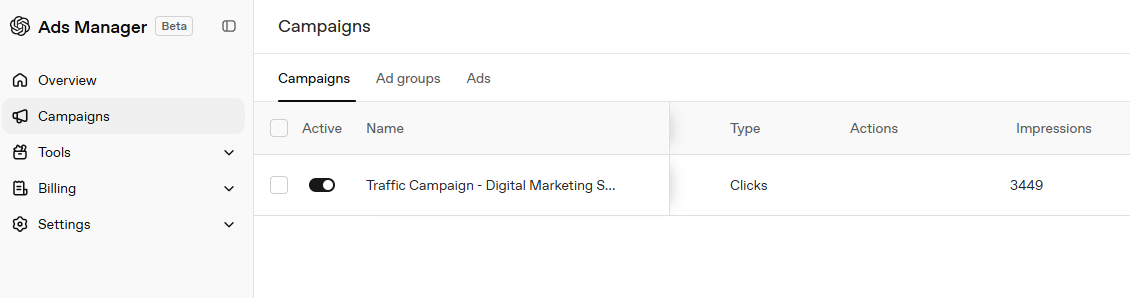
The first thing that stands out is how recognisable it all is. If you’ve built a campaign in Google Ads or Meta, you’ll feel at home immediately.
- A classic account structure. Everything sits in the familiar campaign > ad group > ad hierarchy. There’s no relearning to do here.
- Basic functionality, for now. The core controls are there, but this is clearly a first release. Don’t expect the depth of levers you’re used to pulling elsewhere.
- Reporting is metrics-only. You get your headline numbers, and that’s it. There are no placement insights, no conversation-category reporting, and without a clear testing plan none of the “why did this work” context that makes a mature platform easy to optimise. You’re making decisions on outcomes, not explanations.
- Two objectives available. Right now you can run awareness and traffic campaigns. A conversion objective is flagged as coming soon and that’s the one most performance marketers will be waiting for before they commit a real budget.
- Measurement is built in: What all performance marketers look for in a platform, its here and its functioning in a similar way to other ad platforms. Track page views and key events like purchase or leads.
The takeaway: the foundation is solid and the learning curve is gentle. The intelligence layer, the reporting and insight that lets you improve week on week, is the part that still needs heavy development to make it truly useful.
The ads: Character count is paramount, treat the image as branding
This is where the early quirks really show, and where a bit of discipline pays off.
- You can build multiple ads to test. Good news, the testing fundamentals are intact, so you can run variants against each other from day one.
- Truncation is heavy. This is the big one. Ads are being cut short aggressively, so your character count genuinely matters. Front-load your message, get the value proposition in early, and assume the tail of your copy may never be seen.
- The image renders small. Don’t lean on it to carry information. Text-heavy creative gets lost at this size. Instead, use it as a branding opportunity, a clean logo or a recognisable brand cue does far more work here than a busy graphic.
- Native blending varies. Some placements look noticeably more native than others. Once the conversation moves on and the user keeps scrolling, the more native formats blend into the surrounding response to the point of near-invisibility. That’s a double-edged sword: great for a non-intrusive experience, but something to weigh when you’re judging visibility and attention.
Truncated ad vs shorter character count
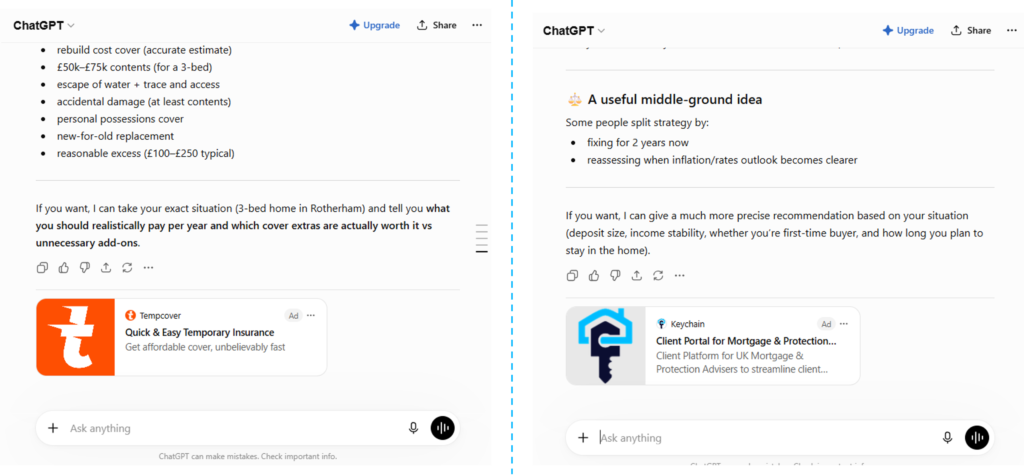
If there’s one rule to take away: write tight, brand clearly, and don’t rely on the image to do heavy lifting (for now).
The costs: Falling, but still above average
This is where you’ll want to go in with your eyes open, because the economics are not cheap at this stage if you want to see real traction.
- A £15 minimum daily budget. It sounds modest, but it doesn’t stretch far once the platform’s suggested bids come into play.
- The platform guides you on CPM and CPC targets. Helpful in principle, but once you launch, it starts nudging you that a bid increase would be beneficial.
- A recommended starting CPM of £45. That sits well above what you’d typically pay on the likes of Meta. You can bid below the recommendation, but you’re then trading delivery against efficiency, and with a £15 floor there isn’t a lot of room to experiment cheaply.
The honest read: this is priced like a premium, early-access surface with limited supply. If you’re used to Meta CPMs, these costs will seem high. For the right market they are workable, but as with everything testing will be key.
Measurement: the pixel’s here, even if the conversion objective isn’t
Here’s a nuance worth separating out, because it’s easy to conflate the two. The conversion objective, the ability to optimise a campaign toward a conversion is still coming soon. But conversion tracking is already available, and that’s a meaningful distinction.
- The setup will feel familiar. Measurement runs on a base pixel plus event tracking, in much the same way as Meta. If you’ve implemented a pixel and events before, the knowledge carries straight over, you fire the base tag, then layer the events that matter to your funnel.
- Track now, optimise later. Because the pixel is live but the conversion objective isn’t, you can measure outcomes today even though you can’t yet get the platform to bid toward them. That’s actually an argument for getting your tracking in early: build the measurement foundation now, gather the data, and you’ll be ready the moment optimisation opens up.
- Expect some GTM customisation. Getting the tag firing correctly in Google Tag Manager took a bit of custom work, this isn’t quite a clean, drop-in template yet. Factor in some setup and QA time rather than assuming it’ll deploy in a couple of clicks.
- Consent mode applies as normal. The tag is subject to the same consent mode restrictions as every other tag in your container. So the usual UK and EU consent considerations shape what you can and can’t collect, your ChatGPT measurement is governed by consent exactly as your other platforms are, and you should plan your reporting around that from the outset.

The honest read: measurement is further along than the campaign objectives might suggest. Getting the pixel in early is a low-cost way to be ready before the performance features land.
The targeting: context hints reward strong prompters
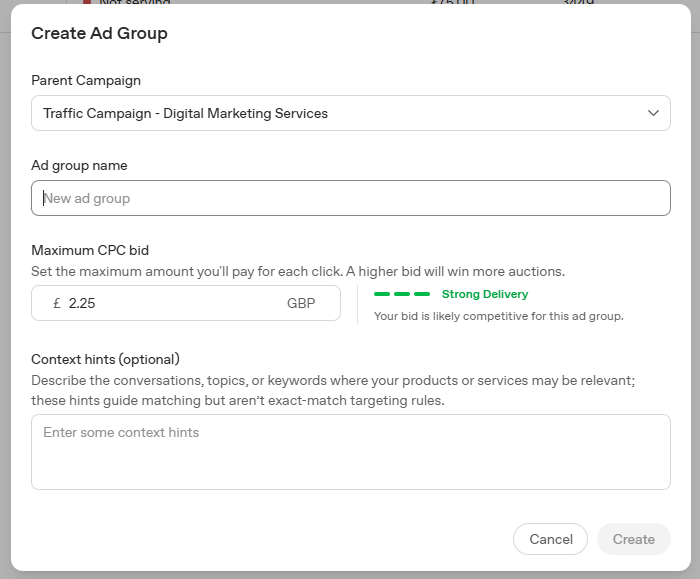
Here’s where ChatGPT ads start to overlap the likes of Performance Max but remain unique in the sense there are no audience targets. The ads rely solely on context hints.
- You’re working with context hints, not audiences. There’s no age-and-interest targeting to fall back on. Instead you’re aligning to the context of the conversation, which means the people who’ve spent real time understanding how prompts behave have a natural edge. If your team lives and breathes prompting, this is where that experience translates into commercial advantage.
- Ad group tests are your research tool. The most reliable way to understand which prompts and contexts are actually performing is to structure ad group tests and let the data tell you. Treat it as discovery, not just optimisation.
- The classic tests still hold. For all the novelty, the fundamentals haven’t changed. Test different creative, different messaging and different ad lengths – the same disciplines that serve you everywhere else serve you here too.
- No retargeting yet. The pixel is there and gathering data, one key missing feature at the moment is remarketing. With a lack of audience targeting you are not yet able to include or exclude specific audiences. One to watch.
What to watch for: know who’s actually seeing your ads
Before you put anything live, get clear on one thing, the audience you can reach today is narrower than it looks.
At present, ads are only served to users on the free and Go plans. So the real question is whether your customers are the sort of people using ChatGPT on those tiers in the first place. If your audience skews toward heavier, paying users, a meaningful slice of them simply won’t see your ads yet. That doesn’t rule the channel out, but it should shape your expectations, your targeting logic and the way you judge early results.
The highest-leverage takeaways
If you’re deciding whether ChatGPT ads belong in your 2026 plan, these are the moves that matter most:
- Go in for the learning, not the scale. The platform is in its infancy, reporting is thin, and the conversion objective isn’t here yet. Treat this as a test-and-learn budget, not a performance channel, for now.
- Write for truncation. Front-load your message and keep it tight.
- Use the image for brand, not detail. It’s too small to do anything else well.
- Budget for a premium. A £15 floor and a £45 recommended CPM mean the maths only works if you’ve planned for it. Recommended minimum £500 test budget for a 1 week campaign.
- Get the pixel in early. Conversion tracking is live even though the conversion objective isn’t, so build your measurement foundation now and be ready when optimisation opens up.
- Lean on prompting expertise. Context-based targeting rewards teams that genuinely understand how people talk to ChatGPT.
- Check your audience fit. Free and Go users are all you can reach today, make sure that’s where your customers are.
This is a channel worth watching closely. The fundamentals are recognisable, the audience is enormous, and the platform is only going to mature. Getting your tests in now while it’s still early and relatively uncontested is exactly how you build the edge you’ll want as the platform develops.
Thinking about running ChatGPT ads?
If you’d like a hand getting set up, from account structure and creative built for truncation, through to prompt-led testing and a budget plan that actually stacks up, we can help. We’re already running live campaigns on the platform and learning what works. Get in touch and we’ll help you launch your ChatGPT ads the right way.