Voice Agents for E-Commerce: User Guide & Live Demo
In the fast-paced world of e-commerce, customer expectations are constantly evolving. Shoppers demand instant gratification, personalised experiences, and seamless support across every touchpoint. Traditional customer service models, often burdened by long wait times, limited operating hours, and inconsistent responses, are struggling to keep pace. This is where the transformative power of voice agents for e-commerce comes into play, offering a sophisticated, scalable, and highly efficient solution to meet the demands of the modern digital consumer.
For e-commerce marketing and client service managers, understanding the strategic advantages and key features of deploying advanced voice agents is no longer a luxury but a necessity. These AI-powered virtual assistants are not just automated answering machines; they are intelligent, conversational interfaces designed to enhance the entire customer journey, from pre-purchase inquiries to post-sale support.
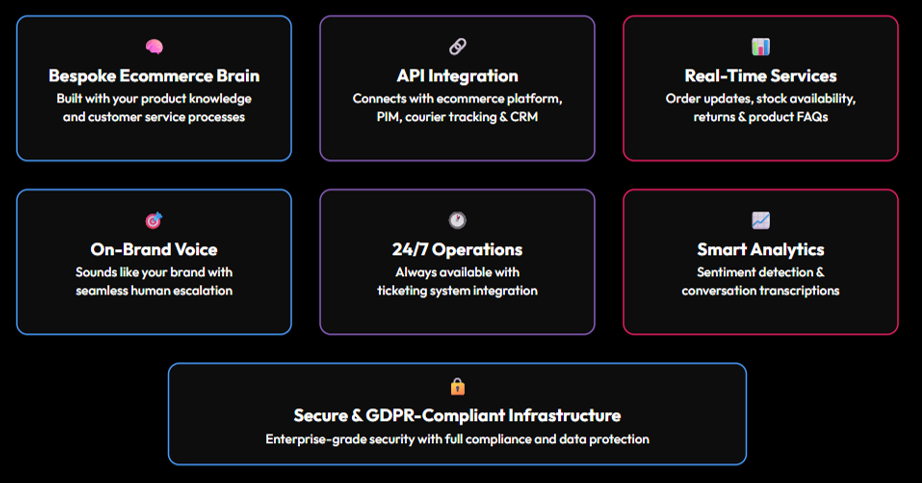
Elements of Voice Agents for e-commerce
How Natural Do They Sound? Do Voice Agents really sound like humans?
Listen to a Live Chat with Ann Stanley talking to Charlie – our e-commerce Voice Agent Demo, built for CharlesBentley.com
If the player doesn’t appear, open the recording in a new tab.

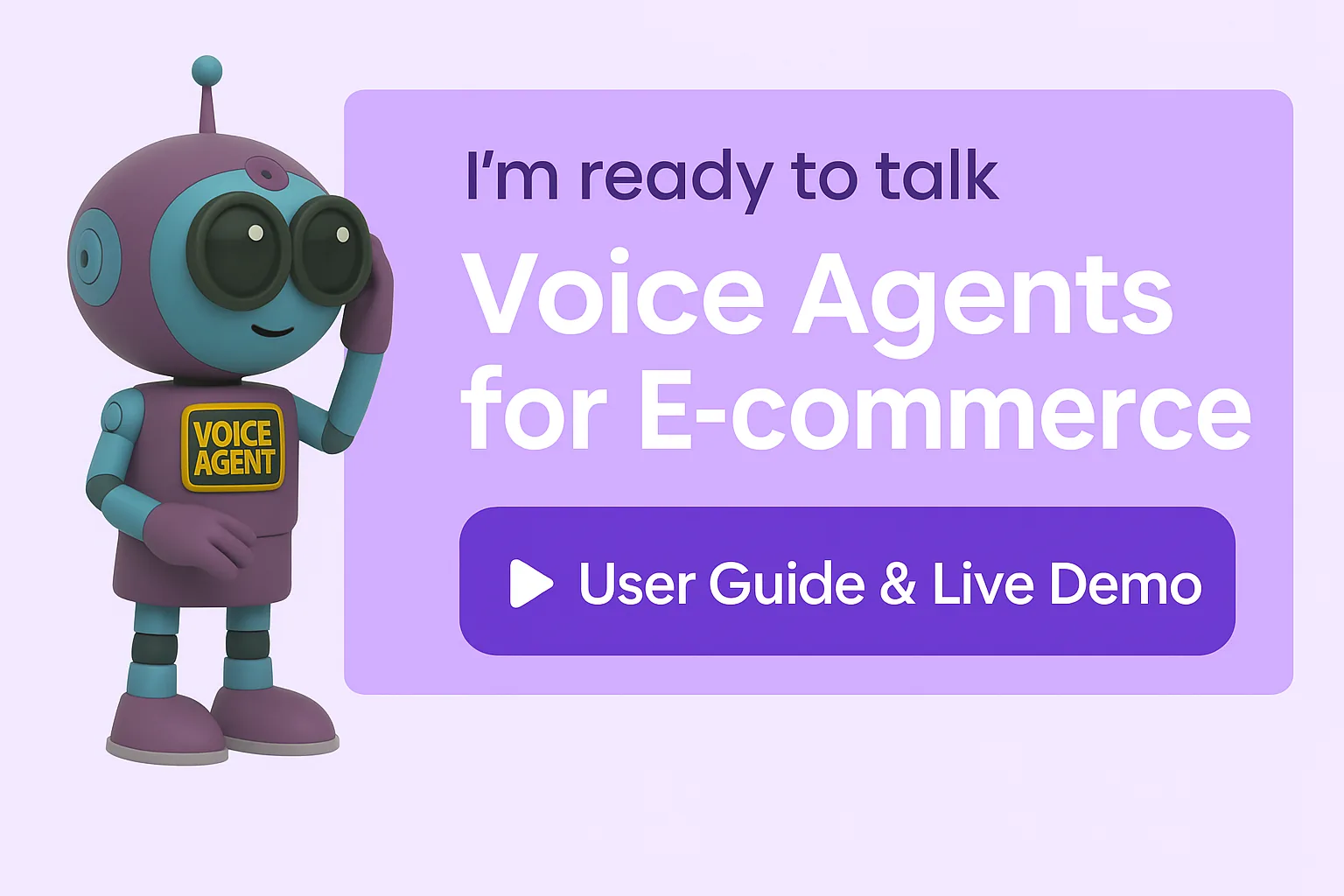
You can click on the image below to request a call back and instant demo of Charlie, our Voice Agent, or you can complete the form at the end of this guide.

Why Voice Agents are Essential for Modern E-commerce Customer Service
Here are some of the main uses of Voice Agents for e-commerce and customer services
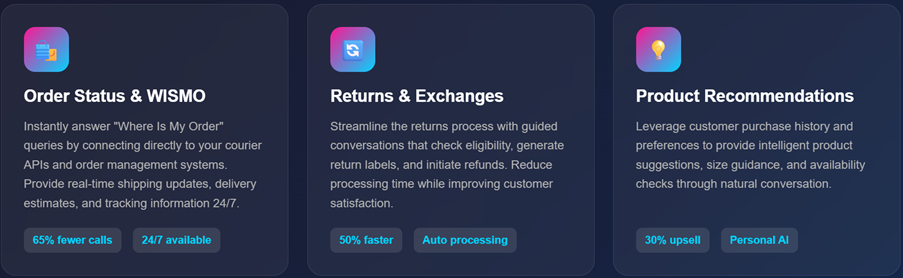
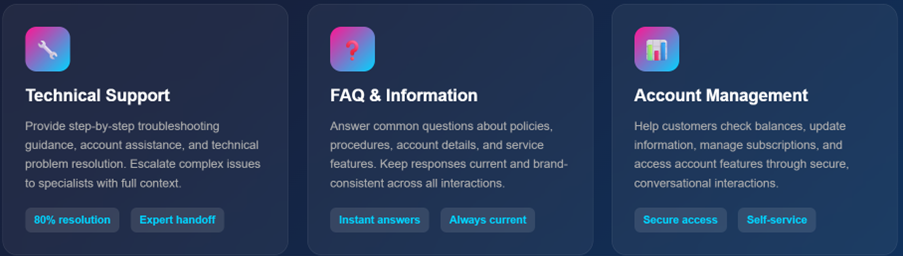
Built for E-commerce: Specialised Capabilities That Drive Results
While general-purpose voice agents handle basic customer service, e-commerce success requires specialised features designed specifically for online retail challenges. These capabilities go far beyond simple FAQ responses to provide actionable solutions that directly impact customer satisfaction and operational efficiency.
WISMO (Where Is My Order) Automation
Real-time Order Tracking connects directly to your e-commerce platform and courier APIs to provide instant, accurate updates. When customers ask about their order, the agent immediately accesses live tracking information, delivery estimates, and any status changes without human intervention.
Proactive Communication can reach out to customers about delivery delays, successful deliveries, or required actions (like providing access codes for secure delivery). This proactive approach prevents frustrated customers from calling when issues occur.
Courier Integration spans multiple delivery partners, automatically determining which courier is handling each shipment and providing appropriate tracking information and contact details. This eliminates the common customer frustration of being directed to the wrong courier.
Returns and Exchange Processing
Automated Returns Initiation allows customers to start return processes immediately, with the agent collecting necessary information, explaining policies, and generating return labels where applicable. This reduces the administrative burden on human staff while ensuring consistent policy application.
Smart Return Forms can be presented during conversations when complex return reasons need documentation. The agent guides customers through the process, ensuring all necessary information is captured for manual review while maintaining conversational flow.
Returns Policy Enforcement ensures consistent application of your return policies, with the agent explaining time limits, condition requirements, and any applicable fees clearly and uniformly to every customer.
Inventory and Product Support
Real-time Stock Checks provide instant availability information, preventing customer disappointment and allowing immediate alternative suggestions when products are out of stock.
Product Information Access connects to your PIM (Product Information Management) system to answer detailed questions about specifications, compatibility, sizing, and features without requiring human expertise.
Cross-selling and Upselling opportunities arise naturally during support conversations, with the agent able to suggest complementary products or alternatives based on the customer’s specific needs and purchase history.
Order Modification and Support
Order Changes can be processed automatically when modifications are possible (address changes, delivery instructions) or escalated appropriately when human intervention is required.
Payment and Billing Support handles common payment questions, explains charges, and can initiate refund processes within appropriate security protocols.
Account Management allows customers to update delivery preferences, communication settings, and account information through conversational interaction rather than complex online forms.
These e-commerce-specific features typically handle 65-70% of inbound customer service queries automatically, allowing human agents to focus on complex problem-solving, relationship building, and revenue-generating activities that truly require human expertise.
Benefits of an e-commerce Voice Agent & AI Chatbots
The shift towards digital-first interactions has amplified the need for customer service solutions that are always on, always accurate, and always helpful. Voice agents address several critical pain points faced by e-commerce businesses:
24/7 Availability and Instant Resolution
Unlike human agents, voice agents operate round the clock, ensuring that customers can get immediate answers to their queries, regardless of time zones or business hours. This constant availability is crucial for e-commerce, where customers might be browsing or encountering issues at any given moment. From checking order statuses to initiating returns, voice agents can provide instant resolutions, significantly reducing customer frustration and improving satisfaction.
Scalability to Handle Peak Demands
E-commerce experiences significant fluctuations in customer contact volumes, particularly during sales events, holiday seasons, or product launches. Scaling a human customer service team to meet these surges is expensive and logistically challenging. Voice agents for e-commerce offer unparalleled scalability, capable of handling thousands of simultaneous interactions without a drop in service quality, ensuring no customer is left waiting.
Cost Reduction and Operational Efficiency
Automating routine and repetitive customer inquiries through voice agents can lead to substantial cost savings. Businesses can reallocate human agents to more complex, high-value interactions, improving overall team productivity. This operational efficiency not only reduces labour costs but also streamlines workflows, allowing customer service teams to focus on building deeper customer relationships.
Enhanced Customer Satisfaction and Loyalty
By providing quick, accurate, and consistent support, voice agents contribute directly to higher customer satisfaction. When customers feel heard and their issues are resolved efficiently, their loyalty to the brand strengthens. This positive experience can lead to repeat purchases and valuable word-of-mouth referrals, driving long-term business growth.
Empowering Your Team: Voice Agents as Internal Tools
While customer-facing applications get most of the attention, voice agents can dramatically improve internal operations by serving as intelligent assistants for your existing team. This internal usage represents one of the most overlooked opportunities for operational efficiency in e-commerce businesses.
Quick Information Access means your customer service staff can use the voice agent to instantly retrieve courier tracking details, order statuses, inventory levels, and customer history without navigating multiple systems or waiting for page loads. A team member can simply ask “What’s the status of order 12345?” and receive complete information including tracking details, delivery estimates, and any previous customer interactions.
Faster Issue Resolution occurs when human agents can quickly access comprehensive information during customer calls. Instead of putting customers on hold while searching through different systems, staff can use the voice agent to pull together all relevant data in seconds, allowing them to focus on problem-solving rather than information gathering.
Training and Knowledge Transfer becomes more effective when new team members can ask the voice agent complex procedural questions, get instant access to company policies, or understand product specifications without interrupting senior colleagues. The agent becomes a 24/7 training resource that scales infinitely.
Workload Distribution improves as routine information requests from internal teams (like sales asking for stock levels or For e-commerce and customer service managers needing performance metrics) can be handled instantly by the voice agent, freeing up technical staff for more strategic work.
By implementing voice agents for internal use alongside customer-facing applications, businesses typically see 30-40% reduction in time spent on information retrieval tasks, allowing human agents to handle 20-30% more complex customer interactions per day.
Key Features of a High-Performing Voice Agent for E-commerce
To truly revolutionise customer service, an e-commerce voice agent must possess a robust set of features that go beyond basic automation. Here are the critical capabilities to look for:
Human-Like Conversations Based on Natural Language Understanding (NLU) and Processing (NLP)
At the heart of any effective voice agent is its ability to understand and process human language naturally. Advanced NLU and NLP capabilities allow the agent to interpret complex queries, recognise intent, and extract relevant information, even when customers use colloquialisms, slang, or incomplete sentences. This ensures a fluid, human-like conversation, rather than a rigid, menu-driven interaction, making the experience intuitive and frustration-free for customers seeking support from voice agents for ecommerce.
How Voice Agents Work – The role of LLM and Speech-to-Text and Text-to-Speech LLM
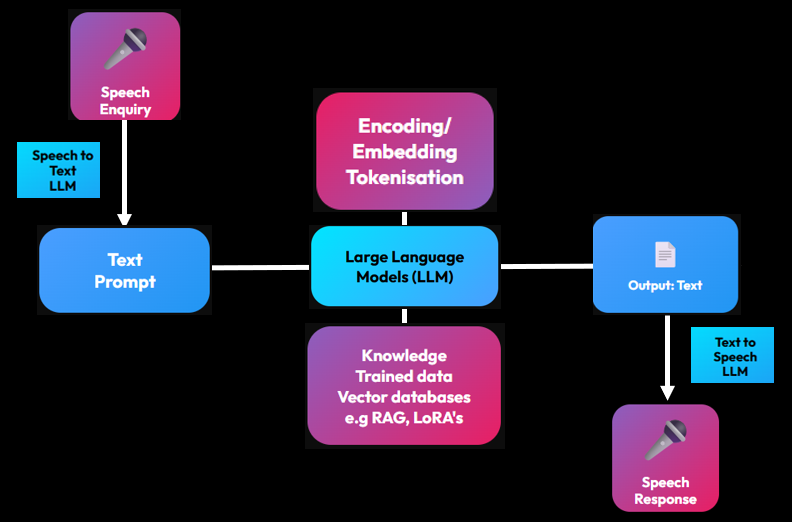
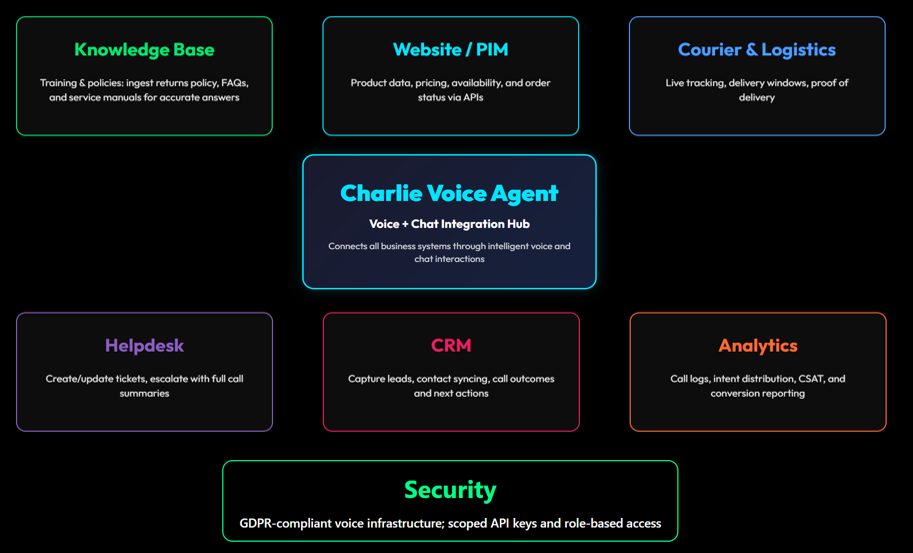
Seamless Integration with Couriers, E-commerce Platforms, Help-Desks & CRM (using API & RAG)
A truly powerful voice agent doesn’t operate in a silo. It must seamlessly integrate with your existing Customer Relationship Management (CRM) systems, e-commerce platforms (e.g., Shopify, Magento, Salesforce Commerce Cloud), inventory management, and order fulfilment systems. This integration allows the voice agent to access real-time customer data, order history, shipping details, and product information, enabling personalised and contextually aware responses. For instance, a customer asking “WISMO – Where’s my order?” can receive an immediate, accurate update based on their specific order number and shipping status.
Sources of data used in e-commerce Voice Agents
Personalisation and Contextual Awareness
Modern customers expect personalised interactions. A sophisticated voice agent can leverage customer data to offer tailored recommendations, address customers by name, recall past interactions, and understand their purchase history. This contextual awareness allows the agent to provide highly relevant support, whether it’s suggesting complementary products, troubleshooting a specific item they’ve purchased, or offering loyalty programme benefits. This level of personalisation significantly elevates the customer experience provided by voice agents.
Omnichannel Support Capabilities
Customers interact with e-commerce businesses across multiple channels – voice, chat, email, social media. A cutting-edge voice agent should be part of an integrated omnichannel strategy. This means it can seamlessly hand off conversations to human agents when necessary, with full context of the prior interaction. It should also be able to retrieve information from other channels to provide a consistent and unified customer experience, regardless of how the customer chooses to communicate.
Proactive Engagement and Outbound Calling
Beyond inbound query handling, advanced voice agents for e-commerce can initiate proactive outbound communications. This could include sending automated delivery updates, reminding customers about abandoned carts, confirming appointments, or even conducting post-purchase satisfaction surveys. Proactive engagement demonstrates a commitment to customer service and can significantly reduce inbound call volumes by addressing potential issues before they arise.
Data Analytics and Reporting
The insights gained from voice agent interactions are invaluable. A robust voice agent solution provides comprehensive analytics and reporting tools. These tools track key metrics such as call volume, resolution rates, common queries, customer sentiment, and agent performance (for human handoffs). This data allows For e-commerce and customer service managers to identify trends, pinpoint areas for improvement, optimise agent scripts, and make data-driven decisions to enhance overall customer service strategy.
Multilingual Support
For e-commerce businesses operating in a global market, multilingual capabilities are essential. A voice agent that can communicate fluently in multiple languages broadens your reach, caters to a diverse customer base, and provides a localised experience, fostering greater trust and satisfaction among international customers.
Secure and Compliant Operations
Handling customer data, especially payment information and personal details, requires stringent security measures and compliance with regulations like GDPR in the UK and Europe. A reliable voice agent solution must be built with robust security protocols, data encryption, and adherence to relevant industry standards and data protection laws, ensuring customer trust and safeguarding sensitive information.
The Power of a Companion AI Chatbot
Modern customers don’t think in channels—they think in conversations. While voice agents excel at providing immediate, personal support, the most sophisticated e-commerce solutions now integrate voice and chat capabilities within a unified platform. This hybrid approach recognises that customers may prefer to switch between voice and text during the same interaction, depending on their environment, privacy needs, or the complexity of their query.
Live Chat Widget Integration allows customers to access the same intelligent agent through an on-site chat interface, providing identical capabilities to the voice agent but in text format. This means a customer can start a conversation via chat during a meeting (when speaking isn’t appropriate), then continue the same conversation by phone later when they need more detailed assistance.
Seamless Channel Switching ensures that context is preserved when customers move between voice and chat. If a customer begins a return request via chat but needs to speak to someone about a specific issue, the voice agent already knows their order details, previous conversation history, and can pick up exactly where the chat left off.
Smart Embedded Forms can be triggered during conversations when complex information needs to be captured. For instance, during a returns process, the agent can present a structured form for the customer to complete while maintaining the conversational flow, then route this information directly to the appropriate team for manual review.
This omnichannel approach significantly improves customer satisfaction by meeting them where they are most comfortable, while maintaining the efficiency and consistency that makes voice agents so valuable for e-commerce operations.
Implementing Voice Agents: Best Practices for E-commerce & Customer Service Managers
Successfully integrating voice agents into your e-commerce customer service strategy requires careful planning and execution:
Define Clear Objectives
Before deployment, clearly define what you aim to achieve. Is it reducing call volume, improving first-contact resolution, enhancing customer satisfaction, or reducing operational costs? Specific, measurable objectives will guide your implementation and allow you to track success.
Start Small, Scale Gradually
Begin by automating a few high-volume, low-complexity queries (e.g., “What’s my order status?”). As the voice agent learns and improves, gradually expand its capabilities to handle more complex interactions. This iterative approach allows for continuous optimisation and minimises disruption.
Continuous Optimisation and Training
Voice agents are not “set it and forget it” solutions. Regularly review performance data, identify areas where the agent struggles, and refine its knowledge base and conversational flows. Continuous training, often involving machine learning, is key to improving accuracy and effectiveness.
Seamless Human-Agent Handoff
While voice agents are powerful, there will always be instances where a human touch is required. Ensure a smooth, contextual handoff to a live agent, providing the human with all the relevant information from the voice interaction. This prevents customers from having to repeat themselves and ensures a seamless experience.
Data Privacy and Security
Prioritise data privacy and security from the outset. Ensure your voice agent solution complies with all relevant data protection regulations and that customer data is handled securely throughout the interaction lifecycle.
Your Voice Agent Development Journey: From Concept to Deployment
Understanding the development process helps set realistic expectations and ensures successful implementation. Voice agent projects follow a structured approach that balances sophistication with speed to market.
Phase 1: Foundation & Setup (4-12 weeks)
Persona Design & Brand Alignment forms the critical foundation. This involves defining your agent’s voice characteristics, tone of communication, and brand personality. Will your agent be formal and professional, or friendly and conversational? How should it handle frustrated customers? This persona development typically takes 1-2 weeks but influences every subsequent interaction.
API Integration Architecture connects your voice agent to existing systems. For e-commerce applications, this includes your platform (Shopify, Magento, WooCommerce), courier tracking systems, CRM, help desk software, and inventory management. Complex integrations requiring custom API development can extend this phase significantly.
Knowledge Base Development involves training the agent using your existing FAQs, product information, returns policies, and customer service scripts. This process uses Retrieval-Augmented Generation (RAG) to ensure accurate, up-to-date responses. The quality of your existing documentation directly impacts this timeline.
Testing & Refinement includes comprehensive testing across different scenarios, accents, background noise levels, and edge cases. This iterative process typically involves 2-3 weeks of testing and adjustment before launch.
Timeline Impact Factors:
- Simple booking/FAQ agents: 4-6 weeks
- Standard e-commerce integration: 8-10 weeks
- Complex multi-system integration: 10-12 weeks
- Enterprise implementations: 12+ weeks
Phase 2: Advanced Features & Optimisation (Ongoing)
Multi-language Support can be added post-launch, typically requiring 2-3 weeks per additional language for proper training and cultural adaptation.
Voice Cloning allows the agent to speak in a specific person’s voice (with appropriate consent), useful for brand consistency or when specific team members have strong customer relationships.
Extended Channel Integration includes WhatsApp Business, Facebook Messenger, Instagram Direct, and SMS capabilities, typically requiring 3-4 weeks per channel.
Advanced Analytics & Reporting provides deeper insights into customer sentiment, conversion tracking, and performance optimisation, usually implemented 4-6 weeks post-launch once sufficient data is available.
Visual Elements such as product carousels, image sharing, and rich media responses can enhance the customer experience, particularly in chat implementations.
The key to successful implementation is starting with a solid Phase 1 foundation, then adding Phase 2 enhancements based on actual usage patterns and customer feedback.
Understanding the Investment: Costs, ROI, and Financial Impact
Voice agent implementation represents a significant operational investment, but one that typically delivers measurable returns within 6-12 months for active e-commerce businesses. Understanding the cost structure helps build realistic business cases and budget appropriately.
Investment Structure
Setup Costs vary significantly based on complexity and integration requirements. Simple FAQ and appointment booking agents require minimal custom development, while sophisticated e-commerce solutions with multiple API integrations, custom workflows, and advanced features represent substantial technical projects.
Ongoing Operational Costs typically range from £500 to £2,500 monthly (plus VAT), representing approximately 10% of the initial setup investment. This covers hosting, maintenance, updates, performance monitoring, and technical support. The ongoing cost reflects the complexity and call volume of your implementation.
Factors Affecting Investment Level:
- Integration Complexity: Direct API connections to e-commerce platforms, courier systems, and CRMs increase development time
- Customisation Requirements: Unique workflows, special business logic, and bespoke features
- Volume Requirements: Higher call volumes may require enhanced infrastructure
- Security Needs: Additional compliance requirements for regulated industries
- Testing Thoroughness: Extensive testing across multiple scenarios and edge cases
Return on Investment Analysis
Direct Cost Savings come from reduced human customer service hours. If your voice agent handles 65% of routine inquiries (typical performance), and you currently process 1,000 customer contacts monthly at £8 per interaction, the monthly saving approaches £5,200. Annual savings of £62,400 against ongoing costs of £18,000-£30,000 represent substantial ROI.
Indirect Benefits often exceed direct savings:
- Extended Hours: 24/7 availability captures customers who would otherwise abandon purchases
- Faster Resolution: Immediate responses improve customer satisfaction and reduce repeat contacts
- Consistency: Uniform service quality regardless of time, staff availability, or seasonal pressures
- Scalability: Handle peak periods without proportional staffing increases
Revenue Impact can be significant for e-commerce businesses. Improved customer experience, faster problem resolution, and 24/7 availability typically increase customer lifetime value by 15-25%. For a business with £2M annual revenue, this improvement represents £300,000-£500,000 additional value.
Implementation Timeline Investment
Standard E-commerce Implementation: 2-3 months of development time, similar in scope and complexity to building a comprehensive website. This timeline reflects the technical integration requirements, testing needs, and refinement process necessary for production-quality deployment.
Rapid Deployment Options: Simpler implementations focusing on appointment booking and basic FAQ handling can be deployed in 4-6 weeks, allowing faster time-to-value for businesses with straightforward requirements.
Free Consultation: Most professional implementations include a comprehensive 1-hour consultation to understand specific requirements, assess integration complexity, and provide accurate project specifications and quotations.
The investment in voice agent technology typically pays for itself through operational savings within the first year, while delivering customer experience improvements that drive long-term revenue growth.
The Future of Customer Service: Voice Agents and Beyond
The evolution of voice agents for e-commerce is far from over. We can expect to see even more sophisticated capabilities, including predictive analytics that anticipate customer needs before they even articulate them, hyper-personalisation driven by deeper AI insights, and even more seamless integration with augmented and virtual reality shopping experiences. As technology advances, voice agents will become even more indispensable tools for creating exceptional customer journeys and driving competitive advantage in the e-commerce landscape.

Live, Interactive Voice Agent Demo—Personalised To Your Website In 2–5 Minutes
Share your URL and details—Charlie, our Voice Agent, will call you shortly with a personalised demo
Conclusion
For e-commerce marketing and client service managers, embracing voice agents is a strategic move that promises significant returns. By leveraging their key features – from advanced NLU to seamless integration and proactive engagement – businesses can not only meet but exceed customer expectations. The result is a more efficient operation, reduced costs, and, most importantly, a highly satisfied and loyal customer base. Invest in intelligent voice solutions today to future-proof your customer service and unlock new levels of growth for your e-commerce business.
For more information on how Anicca can help you build and implement your own voice agent, get in touch with our team today.