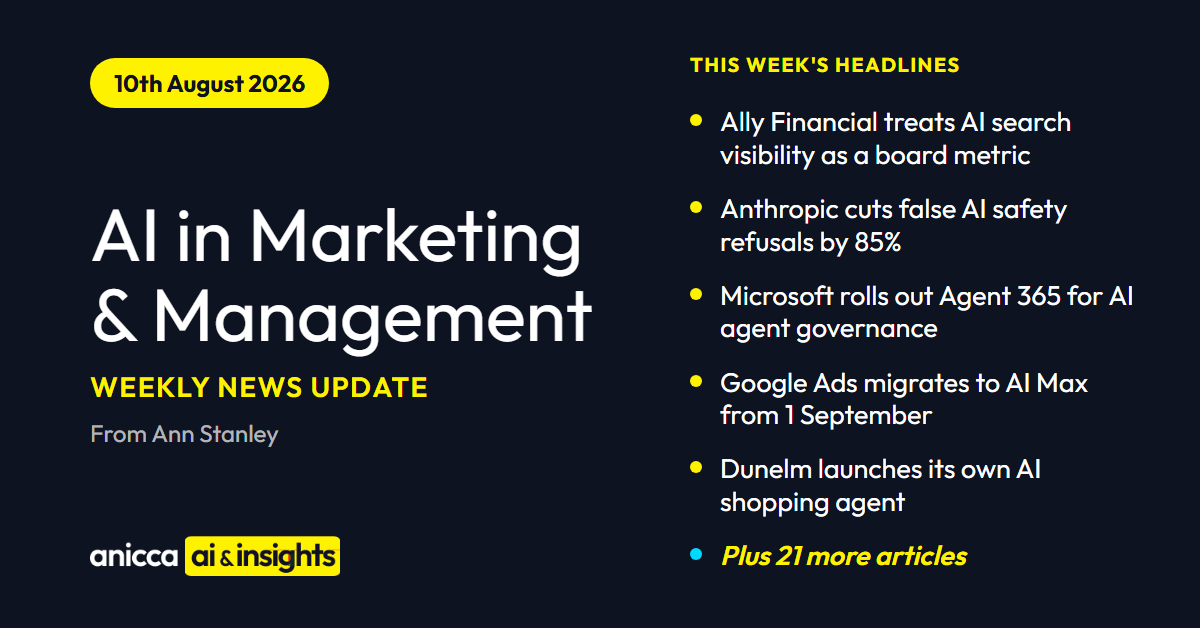
This Week in AI in Marketing & Management (10th Aug 26)
This Week in AI in Marketing & Management: The Machine-Readable Brand Era
The week ending 10 August 2026 marked a decisive shift in how brands, platforms and regulators think about AI-driven visibility and control. Ally Financial made the case that machine-readable brand architecture now sits at the heart of the CMO role, while Reddit moderators battled a fresh wave of AI-generated SEO spam trying to game LLM citations. On the regulatory front, EU AI Act Article 50 transparency rules came into force, and the UK’s AI minister left the door open to formal regulation. Meanwhile Google Ads confirmed a 1 September migration of Automatically Created Assets (ACA) and campaign-level broad match into AI Max, and Dunelm launched its “Ask Dunelm” shopping agent.
Table of Contents
- AI can knock on the door. Your CRM marketing platform is still the house.
- AI minister leaves door open to regulation of advanced AI models
- Anthropic improves Claude Fable 5’s biology safeguards, cutting false positives 85%
- OpenAI launches ChatGPT Work and Codex education plugins
- Microsoft rolls out Agent 365 and Entra Agent ID for governing AI agents
- Infosys expands Metsä Group IT deal with agentic AI focus
- The machine-readable brand: Inside Ally Financial’s AI search strategy
- Building an AI search strategy: Six signals that decide LLM citations
- Can Reddit fend off a new wave of AI SEO spam?
- khaa-lo targets AI search marketing intelligence for emerging brands
- Google Ads to migrate ACA and campaign-level broad match to AI Max on 1 September
- Google’s July 2026 AI updates recap
- Your future workforce already works for you
- UK tech professionals invest in leadership skills for AI-driven change
- Enterprise-wide AI transformation starts with change management
- AI changed what work looks like. Now the operating model must follow
- EU AI Act Article 50 transparency rules take effect
- AI readiness in payroll: From concept to reality
- Your AI policy means nothing if your people do not know about it
AI in E-commerce, Retail and Agentic Commerce
- Agentic commerce is the next frontier but retailers are struggling to keep up
- AI shopping agents may be harder to shut out of ecommerce sites
- Dunelm launches ‘Ask Dunelm’ AI shopping agent
AI for Other Sectors and Industries
- EDUCATION: Denmark tightens rules on students using AI to cheat
- LEGAL: UK opens Legal Services AI Growth Lab for applications
- HEALTH: 90% of NHS clinical staff now use AI day to day, survey finds
- HR: 95% of HR leaders report heavier workloads as AI adoption accelerates
AI News, Tech & Tools
AI can knock on the door. Your CRM marketing platform is still the house.
Source: searchengineland.com | Optimove | 4 August 2026
Optimove has pushed back on the growing claim that AI assistants like ChatGPT and Claude will make CRM marketing platforms redundant. Using the Model Context Protocol (MCP) as its central metaphor, the piece argues MCP is the “door”, the assistant is a visitor doing the reasoning, and the marketing platform is the “house” holding the customer data, decisioning logic and years of accumulated performance signals.
The argument matters because a wave of AI-native marketing tools is being pitched as full replacements for enterprise CRM stacks. Optimove’s position: assistants are genuinely intelligent, but they cannot invent the underlying customer facts. Strip out the platform and the visitor is left standing in an empty lot.
Why it matters
Do not rip out your CRM under the illusion that an LLM plus MCP endpoint is a substitute. The strategic move is the opposite: harden the “house” by cleaning customer data, formalising decisioning rules, and exposing well-governed MCP endpoints so assistants can reason against your best data. Marketers who treat MCP as a delivery layer, not a replacement architecture, will get the productivity gains without hollowing out their competitive advantage, which is proprietary customer knowledge.
AI minister leaves door open to regulation of advanced AI models
Source: computing.co.uk | 3 August 2026
UK AI minister Kanishka Narayan told Reuters this week that the government would consider statutory regulation of advanced AI models if the current voluntary regime proves inadequate. The remarks reopen a debate the Starmer government had largely closed, having rebranded the AI Safety Institute as the AI Security Institute and signalled a pro-innovation, light-touch stance versus the EU AI Act.
Recent disclosures by OpenAI and Anthropic around advanced cyber and biological capabilities have sharpened the concern. Currently AISI relies on voluntary access from OpenAI, Anthropic and Google to stress-test frontier models pre-release. Critics argue this cooperation model cannot scale as powerful open-source and Chinese models proliferate outside the voluntary framework.
Why it matters
UK marketers should stop assuming they have a permanent regulatory holiday relative to EU peers. If Westminster shifts, expect obligations closer to the EU AI Act model, including transparency, documentation and risk classification. Build your AI governance now against EU AI Act standards, not the UK voluntary regime. That way you are compliant in Europe by default and future-proofed at home when the political weather changes, which on current evidence could happen inside 12 months.
Anthropic improves Claude Fable 5’s biology safeguards, cutting false positives 85%
Source: anthropic.com
Anthropic has tuned Claude Fable 5’s biology safety classifiers to reduce “fallbacks” (where the system routes a query to a less capable model) by around 85% across its products. Everyday health and educational queries, interpreting lab results, understanding symptoms, learning biology, will now largely stay on the frontier model. Dual-use requests around virology, toxicology and molecular design still fall back to Opus 5.
Anthropic frames this as a deliberate trade-off: get frontier capability into more hands quickly, while managing genuine uplift risk to malicious actors developing biological weapons. Trusted access pathways for professional biology research and drug development are being built separately.
Why it matters
This is a template every enterprise buyer should study. Anthropic is publicly quantifying the false-positive cost of safety layers, then reducing it. When you evaluate frontier models for marketing or research use, ask vendors for equivalent metrics: how often does safety tuning block legitimate work? Vague answers signal an over-cautious model that will frustrate your teams. Specific percentages signal a vendor that treats usability as a first-class metric alongside safety.
OpenAI launches ChatGPT Work and Codex education plugins
Source: openai.com | 4 August 2026
OpenAI has released three new education plugins for ChatGPT Work and Codex targeting K-12 teachers, college educators and college students. Each plugin packages role-specific skills, instructions and common workflows so users bypass complex prompt construction. Distribution runs through ChatGPT Edu and ChatGPT for Teachers district deployments, with the K-12 educator plugin integrating with Learning Commons for public AI datasets.
The move signals OpenAI’s next distribution play: pre-configured plugins tuned to specific job families rather than generic chat. K-12 educators can create differentiated resources and interactive visuals; college students get study, planning and project execution scaffolding built on their own course materials.
Why it matters
The plugin model is coming to your marketing stack next. Expect vertical plugins for performance marketers, brand teams and CRM managers within 12 months. The strategic question for CMOs: do you wait for OpenAI, Anthropic or Google to define what a “marketing plugin” looks like, or do you build proprietary internal plugins now on top of ChatGPT Work or Copilot Studio that codify your team’s best workflows? First movers will bake competitive advantage into daily practice.
Microsoft rolls out Agent 365 and Entra Agent ID for governing AI agents
Source: microsoft.com | microsoft.com | 6 August 2026
Microsoft published two connected updates this week detailing how it governs AI agents internally and how customers can do the same. Agent 365 is Microsoft’s internal framework for cataloguing, managing and monitoring agents across the estate. Microsoft Entra Agent ID plus Dataverse agent users, now in public preview, extends this to customers: each AI agent gets a discrete Entra identity, least-privileged Dataverse security roles, and a full audit trail.
The practical effect is that agents stop being anonymous automations sharing generic app credentials. An agent that updates CRM records or drafts outreach can be identified, permissioned and revoked like any user. Microsoft cites its Sales Development Agent as the reference implementation.
Why it matters
Agent identity is now the foundational security question. If you are piloting agents in Salesforce, HubSpot, Dynamics or bespoke stacks and cannot answer “which agent did this, under what permissions”, stop and fix it. Expect auditors and CISOs to demand agent identity registers within 12 months. Microsoft’s move sets the pattern; other vendors will follow. Build your agent register now, ideally aligned to Entra or an equivalent identity provider, before you have 50 agents you cannot account for.
Infosys expands Metsä Group IT deal with agentic AI focus
Source: itbrief.co.uk | Sofiah Nichole Salivio | 5 August 2026
Infosys has expanded its multi-year agreement with Finnish forest industry group Metsä (EUR 5.8 billion 2025 sales, 8,800 staff) to overhaul the company’s IT operations. Infosys will use its Topaz Fabric platform to introduce agentic AI into service management, issue resolution and cost management, covering application management, cloud operations, workplace services, service desk and on-site IT at mills.
CIO Kristiina Lammila framed the deal as a shift in sourcing model: consolidating IT with a single strategic partner to simplify a fragmented estate. It reflects a wider trend of industrial groups using agentic AI as the lever to justify consolidation with a lead systems integrator.
Why it matters
The IT outsourcing model is being repriced around agentic AI. If you are a CMO managing significant marketing operations spend, expect similar consolidation pitches from your systems integrators inside 12 months, framed as “agentic MarOps”. Be specific in demanding evidence: how many workflows automated, what cost per resolved ticket, what governance model? Do not sign multi-year deals against agentic AI promises without measurable milestones tied to real reductions in run cost.
AI in Marketing
The machine-readable brand: Inside Ally Financial’s AI search strategy
Source: fortune.com | Ruth Umoh | 6 August 2026
Ally Financial CMO Andrea Brimmer told Fortune she no longer thinks the title “chief marketing officer” captures her role. Brimmer now oversees communications, UX, creative services, customer acquisition and an internal product innovation studio, and spends as much time optimising how large language models understand Ally as she does approving TV commercials. The strategy: make the brand machine-readable so LLMs recommend Ally when consumers ask AI assistants for financial services.
The Ally example gives a rare public look at how a Fortune 500 CMO is restructuring the function around AI-driven discovery. Brimmer frames marketing’s contribution in terms a CFO recognises: customer acquisition cost, lifetime value, and now share of AI recommendations.
Why it matters
This is the clearest signal yet that AI search visibility is now a board-level metric. If your brand is not being cited by ChatGPT, Claude, Gemini and Perplexity when prospects ask about your category, your funnel is quietly drying up. Audit your machine readability: structured data, factual consistency across owned properties, third-party citations, review corpus. Then set a monthly measurement rhythm for LLM citation share alongside traditional SEO share of voice. This is not optional for 2027 planning.
Building an AI search strategy: Six signals that decide LLM citations
Source: searchenginejournal.com
A former Google Ads scaling lead has laid out a strategy for AI search visibility, arguing you cannot bid your way into an AI answer. Six signals decide whether assistants name your brand, most of which live off your website: third-party citations, structured factual assertions, entity consistency, review depth, category authority signals, and machine-readable content architecture. The author’s consultancy has now run programmes for over a dozen VC- and PE-backed startups.
The core argument mirrors lessons from the paid search era: platforms reward signals they can measure, not effort you put in. Budget should follow evidence, not habit. Each platform shift, broad match, mobile, automated bidding, hands value to whoever adapts first. AI search is the next such shift.
Why it matters
The approach here is close to what worked with SEO 2012-2015: build authority off-site, structure information on-site, measure obsessively. The difference is measurement is harder because LLMs do not expose logs. Invest in tools that sample LLM responses across representative prompts for your category, track citation share weekly, and reallocate content and PR spend to the signals moving the needle. Treat this as a two-year competency build, not a quick win.
Can Reddit fend off a new wave of AI SEO spam?
Source: theverge.com | Mia Sato
Reddit mentions have become disproportionately valuable in the AI search era because LLMs weight the platform heavily as a source of “authentic” opinion. The Verge documents how brands, or agencies working for them, are astroturfing subreddits with fake product endorsements. In one r/SkincareAddiction case, a user named Primary-Taro4254 kept praising Honeydew Labs hypochlorous acid spray across multiple unrelated threads before moderators flagged and banned the account.
Subreddit moderators are increasingly professional at detecting patterns, but the incentive to spam has never been higher. LLMs cite Reddit threads verbatim, meaning a single planted comment can influence brand recommendations for months.
Why it matters
Do not do this. Astroturfing Reddit is a fast route to permanent brand bans and a Verge exposé with your name in the headline. The legitimate route is harder but durable: build genuine community presence, respond honestly under a verified brand account, and invest in the product quality that generates unprompted positive mentions. Also monitor: agencies pitching “Reddit seeding” services should be treated with the same suspicion as link farms in 2015.
khaa-lo targets AI search marketing intelligence for emerging brands
Source: thenextweb.com
khaa-lo has built an AI search marketing intelligence platform aimed at emerging brands, and its next expansion is around understanding the prompts consumers actually use. Rather than only tracking whether a brand is cited, the platform is moving upstream to map the intent taxonomy behind LLM queries in each category, so brands can optimise for prompt patterns that matter commercially.
The move mirrors the arc of paid search tooling in the late 2000s, when keyword research became a distinct discipline. Prompt research is emerging as its equivalent for the AI search era.
Why it matters
Start building your prompt taxonomy internally. What are the ten highest-commercial-intent prompts a prospect might ask ChatGPT or Perplexity about your category? Which of your competitors get named for each? This is the AI-era equivalent of a keyword universe, and it will define content strategy for the next three years. Tools like khaa-lo will accelerate the work, but the strategic thinking belongs in-house.
Google Ads to migrate ACA and campaign-level broad match to AI Max on 1 September
Source: seroundtable.com | Barry Schwartz | 7 August 2026
Google has confirmed that from 1 September 2026 campaigns using Automatically Created Assets (ACA) or campaign-level broad match will be automatically upgraded to AI Max for Search. Google’s advertiser email says settings will be configured to mirror legacy setups: ACA campaigns move to AI Max with search term matching and text customisation on by default; campaign-level broad match campaigns migrate with equivalent match logic.
Menachem Ani, who shared the notification on X, called it “the great merge continues”. The change effectively consolidates several Google Ads AI features under the AI Max umbrella, giving Google more latitude to expand queries, generate creative and reshape auctions.
Why it matters
This is not optional. If you have ACA or campaign-level broad match live in September, you are on AI Max whether you planned for it or not. Between now and 1 September, audit affected campaigns, baseline current CPA and ROAS, and prepare exclusion lists and brand safety controls. Post-migration, watch for expanded query matching pulling in irrelevant traffic. Advertisers who ignore this deadline will discover unexplained performance swings in Q4, exactly when the stakes are highest.
Google’s July 2026 AI updates recap
Source: blog.google | 4 August 2026
Google published its monthly AI recap covering July 2026 launches across Gemini models, Google Labs, Gemini Notebook, Workspace and Cloud. The volume is consistent with Google’s now-established cadence of releasing incremental AI features across its products every month, from developer tooling to consumer search.
The pattern matters less for individual features than for the cumulative pressure it puts on Microsoft, OpenAI and Anthropic. Google is executing a distribution-first strategy: reach every knowledge worker through Workspace, every developer through Cloud, every consumer through Search and Gemini app.
Why it matters
Assume Google will be the default AI layer for a large share of your customers and employees inside two years. That means your content, product data and brand signals need to be optimised for Gemini’s understanding first, not as an afterthought. Establish a quarterly review of Google AI product changes and how they affect your Workspace integrations, ad performance and organic visibility. The compounding effect of monthly updates is easy to miss month by month, painful to catch up on annually.
Your future workforce already works for you
Source: fortune.com | Ravin Jesuthasan and Tauseef Rahman | 7 August 2026
Mercer’s Ravin Jesuthasan and Tauseef Rahman argue that in the AI era, the future workforce is largely the current workforce, redeployed. The economics of retraining existing employees on AI-augmented workflows beat the cost of external hiring plus onboarding, particularly given severance and turnover exposure. The piece pushes back on the reflexive “AI means layoffs” narrative dominating boardrooms.
The argument has particular force for marketing functions, where institutional knowledge of brand voice, customer segments and creative history is hard to rebuild externally. Redeploying existing marketers onto AI-augmented tasks preserves that knowledge while lifting output.
Why it matters
Before you sign off on marketing headcount cuts driven by AI productivity claims, model the retraining alternative. What would it cost to move 30% of your marketing team onto AI-augmented roles (prompt engineers, agent supervisors, LLM QA leads) versus letting them go and hiring externally in 18 months? The internal path is almost always cheaper and faster to productivity, but it requires HR and marketing leadership to sit together and design the transition now.
AI in Management
UK tech professionals invest in leadership skills for AI-driven change
Source: hrnews.co.uk | 4 August 2026
New O’Reilly data reported by HR News shows UK tech professionals are shifting learning investment from purely technical AI skills toward leadership and change management capabilities. The finding reflects a growing recognition that AI deployment success depends more on organisational adoption than model choice or infrastructure setup.
The pattern echoes similar shifts during earlier technology waves (cloud, mobile) where technical proficiency became necessary but insufficient. Leaders who could align stakeholders, redesign processes and manage transitions captured the value.
Why it matters
CMOs should recognise the same shift is coming for marketing leadership. The competitive advantage in 2027 will not go to teams with the best prompt engineers, it will go to teams whose leaders can restructure workflows, redesign roles and drive adoption. Invest in change leadership development for your marketing directors and heads of channel, not just AI tool training. Also, when recruiting senior marketing hires, weight change leadership evidence at least equally with AI fluency.
Enterprise-wide AI transformation starts with change management
Source: cio.com | 7 August 2026
CIO magazine argues that enterprise AI programmes are failing not on technology but on change management. The piece surveys CIOs deploying AI across large organisations and finds a consistent pattern: proofs of concept succeed technically but stall at scale because leaders underestimate the workflow redesign, stakeholder alignment and cultural adjustment required.
The article aligns with a growing consensus (see also IBM Consulting and Mercer commentary this week) that the “operating model” question, not the “which model” question, is where AI ROI is decided.
Why it matters
If your marketing AI programme is stuck in proof-of-concept purgatory, the problem is almost certainly not the technology. Audit the change management envelope: who owns rollout, what workflows are being redesigned, how are success metrics defined, what does the training plan look like? Budget for change management at 30-50% of total AI programme cost. Any lower and you are building a technically impressive pilot that never reaches production scale.
AI changed what work looks like. Now the operating model must follow
Source: fortune.com | Neil Dhar, IBM Consulting | 3 August 2026
IBM Consulting Senior VP Neil Dhar argues that AI adoption has outpaced operating model change. Organisations have rolled out access, mandated experimentation and expanded tool availability, but decision-making structures, accountability lines and leadership expectations remain configured for a pre-AI world. The result: adoption without transformation.
Dhar frames this as the “new fault line” in enterprise AI. Deployment does not deliver results; rewiring workflows and accountability does. The piece is a call for leaders to treat AI as an operating model question, not a tooling question.
Why it matters
For marketing leaders, the actionable question is: which decisions in your team could now be made faster or better with AI in the loop, and are your approval structures redesigned to reflect that? If your creative review still runs on the same five-stage sign-off it did in 2022, you are leaving speed on the table. Map decision rights explicitly. Identify where AI recommendations can be auto-approved within defined guardrails. This is where operating model transformation lives in practice.
EU AI Act Article 50 transparency rules take effect
Source: itbrief.co.uk | itpro.com | Joseph Gabriel Lagonsin | 4 August 2026
Article 50 of the EU AI Act came into force on 2 August 2026. Organisations operating in or selling into EU markets must now disclose when users interact with an AI system, label AI-generated or manipulated content, and provide information about biometric and emotion-recognition tools. The rules sit alongside wider obligations on risk management, data governance and technical documentation.
Compliance and legal specialists say this milestone shifts many companies from preparation to enforcement mode. RAIDS AI called the transparency phase “necessary but incomplete”, warning that regulation still moves far slower than the underlying technology, particularly around AI systems in production.
Why it matters
Immediate marketing actions: label AI-generated ads, images and copy where consumers might reasonably assume human authorship; add clear disclosures on chatbots and AI-driven personalisation experiences; document your AI use inventory with legal. Enforcement will not be uniform on day one, but early cases will set precedent. UK-only marketers are not exempt if you serve EU customers. Treat Article 50 as the baseline transparency standard globally, it is cheaper than running two compliance regimes.
AI readiness in payroll: From concept to reality
Source: kpmg.com
KPMG UK argues that AI in payroll and labour has moved from future concept to present performance driver. Leading vendors are embedding AI into platforms, and organisations are seeing measurable results. The eye-catching stat: payroll and labour leakage from tax non-compliance and overpayments typically runs 2-4% of total labour spend, meaning a 50,000-employee organisation could be losing £8-12 million a year to preventable errors.
KPMG cautions that value depends on operational foundations first: data quality, system integration, controls, service delivery, governance and change readiness. Many organisations have a global payroll strategy on paper but operate through fragmented systems and manual controls.
Why it matters
The payroll example illustrates a broader principle for marketers: AI amplifies whatever operational quality already exists. If your customer data, attribution model or campaign tagging is fragmented, AI will amplify the mess, not fix it. Before rolling out AI-driven personalisation, media buying or content generation, invest six to nine months in data foundations. The 2-4% leakage figure has a marketing equivalent in wasted spend and misattributed conversions, and it is worth quantifying explicitly to fund the foundational work.
Your AI policy means nothing if your people do not know about it
Source: thehrdirector.com | 7 August 2026
The HR Director argues that AI policy documentation has become a compliance theatre exercise: most organisations now have written AI policies, but few employees know they exist, and fewer still can articulate what they permit or prohibit. The piece calls for treating AI policy as a communications and training programme, not a legal artefact.
The gap matters because Article 50 transparency obligations, brand safety exposure and data leakage risk all depend on employee behaviour, not policy text. A policy no one reads is not a control.
Why it matters
Audit your own team this week. Ask five marketers what your AI policy says about using customer data in ChatGPT, about disclosing AI-generated creative to clients, about approved vendors. If they cannot answer, your policy is decorative. Run a 30-minute team briefing, publish a one-page summary in the daily tools your team uses (Slack, Teams), and repeat every quarter. The cost is trivial; the risk of skipping it is a regulatory breach or a brand safety incident.
AI in E-commerce, Retail and Agentic Commerce
Agentic commerce is the next frontier but retailers are struggling to keep up
Source: retailtechinnovationhub.com
Retail Technology Innovation Hub reports that agentic commerce, where AI shopping agents browse, compare and transact on behalf of consumers, is now the clear next frontier for retail technology. But most retailers are struggling to adapt. Product data, checkout flows and merchandising logic were built for human shoppers, not agents that parse structured feeds and prioritise machine-readable specs over lifestyle imagery.
The gap is widening quickly. Early-adopter retailers with clean product data and agent-friendly APIs are pulling ahead in agent-mediated conversions, while laggards are effectively invisible to a growing share of purchase intent.
Why it matters
If you run ecommerce, agent readiness is now a board topic. Audit your product feeds for completeness and structured attributes, expose category taxonomies via clean APIs, and test how leading shopping agents (Perplexity Comet, OpenAI agents, retailer-specific agents) currently see and rank your catalogue. Retailers who ignore this will find they still have traffic in 2027 but a shrinking share of the purchase decisions that traffic used to represent, because more decisions will be made upstream by agents.
AI shopping agents may be harder to shut out of ecommerce sites
Source: emarketer.com | 5 August 2026
EMARKETER analyses recent legal and technical developments around Perplexity’s Comet browser and Amazon’s response, concluding that AI shopping agents may be harder for retailers to block than initially assumed. The direction of travel favours agent access, driven by consumer demand and competitive pressure among retailers not wanting to be the first to reject an agent’s shoppers.
The implication: even retailers that would prefer to protect margins by blocking agents will find the strategy untenable over time. Better to shape the terms of engagement now than fight a losing exclusion battle.
Why it matters
Do not build your ecommerce strategy on the assumption you can block AI agents. Instead, define your agent commercial framework: which agents you accept, what data you expose, what commission or referral economics you accept, how you protect brand experience when an agent aggregates you alongside competitors. Retailers that write these rules early will negotiate from strength; those that wait will accept whatever terms Amazon, Perplexity and OpenAI dictate.
Dunelm launches ‘Ask Dunelm’ AI shopping agent
Source: internetretailing.net | 6 August 2026
UK homewares retailer Dunelm has launched “Ask Dunelm”, an AI-powered shopping assistant embedded in its site. The agent helps shoppers navigate the catalogue conversationally, answer product questions and receive personalised recommendations, positioning Dunelm alongside Marks & Spencer and John Lewis peers investing in owned shopping agents rather than only optimising for third-party agents.
The launch reflects a two-track strategy emerging across UK retail: build your own agent experience for direct customers who arrive via your site or app, while separately ensuring your product data is well-structured for third-party agents that may bring customers via LLM-mediated discovery.
Why it matters
Dunelm’s move sets a UK benchmark. If you are a mid-market UK retailer without an owned agent on the roadmap for 2027, you are already behind. The build-versus-buy question matters less than the strategic decision to have one. Start with a scoped MVP tied to your top three purchase questions (sizing, availability, coordinating products) rather than trying to launch a fully conversational replacement for site navigation. Iterate based on real conversion data.
AI for Other Sectors and Industries
EDUCATION: Denmark tightens rules on students using AI to cheat
Source: theguardian.com | 6 August 2026
The Danish government has announced new rules requiring upper secondary school students (aged 16-19) to orally defend their written essays, with schools encouraged to run written assignments under controlled conditions with computer monitoring. Around 9,000 students each year submit the “større skriftlige opgave” (SSO) major assignment, which will now require oral defence. Education minister Magnus Heunicke said “action is needed now” as AI cheating has become a growing problem.
Denmark is also preparing a comprehensive national AI-in-education strategy. The measures reflect a wider European debate about how to preserve assessment integrity when generative AI can produce convincing essays on demand.
Why it matters
The Danish response has implications well beyond education. Any industry using written assessments for hiring, certification or performance evaluation faces the same integrity problem, and the same likely solution: oral or live components that verify the human is still in the loop. Marketing leaders running graduate assessment centres, agency pitch processes or internal promotion reviews should audit which written elements are now compromised and add live components. The credentialing and hiring landscape is quietly being redesigned around this issue.
LEGAL: UK opens Legal Services AI Growth Lab for applications
Source: legalfutures.co.uk | 6 August 2026
The Ministry of Justice has opened applications for the Legal Services AI Growth Lab, a regulatory sandbox where law firms, conveyancers and legal technology developers can test AI-driven products directly with regulators before taking them to market. Around a dozen proposals will be selected from the first round, each given roughly nine months of structured engagement with the Solicitors Regulation Authority, the Council for Licensed Conveyancers and the Information Commissioner’s Office. Applications close on 27 September 2026.
Justice minister Sarah Sackman KC and AI minister Kanishka Narayan are backing the scheme, which is aimed at resolving regulatory questions around client confidentiality, legal privilege and data protection before products reach clients, not after. The lab cannot create legislative exemptions, so participants still work inside existing rules, but they get a direct line to the regulators who interpret them.
Why it matters
For any agency or in-house team using AI on client-confidential material, which now covers most legal-adjacent work such as contracts, compliance and due diligence, the lab is a signal that UK regulators would rather test AI use cases in the open than police them after the fact. Watch what early guidance comes out of the sandbox on data protection and privilege. It is likely to become the reference point other professional-services regulators point to when clients ask how AI tools should handle confidential information.
HEALTH: 90% of NHS clinical staff now use AI day to day, survey finds
Source: resultsense.com | 4 August 2026
A Censuswide survey of 1,000 NHS staff, commissioned by clinical documentation vendor Heidi, found that 90% now use AI in their clinical work, rising to 96% among hospital doctors, pharmacists and mental health professionals. 65% developed their own AI habits ahead of any formal workplace guidance, and 80% report a rising administrative load, averaging 1.3 hours of paperwork a day on top of a full patient list. Clinical documentation was the single biggest frustration, cited by 56% of respondents.
Concerns sit alongside the adoption numbers rather than behind them: 28% doubt AI’s accuracy, 30% worry about over-reliance, and 35% want clearer accountability for AI-influenced clinical decisions. As with any vendor-commissioned research, the headline adoption figure should be read with that in mind, but the underlying pattern, informal AI use running ahead of formal policy, matches what independent NHS surveys have found through 2026.
Why it matters
This is the same shadow-adoption pattern showing up across every sector this year: staff reach for AI to manage workload before governance catches up, then organisations spend the following months retrofitting policy around habits that are already fixed. If your team’s AI use has outpaced your written guidance, the NHS numbers are a preview of what happens next: harder-to-shift habits, and accountability questions you would rather have answered in advance.
HR: 95% of HR leaders report heavier workloads as AI adoption accelerates
Source: peoplematters.in | 5 August 2026
New research shows 95% of HR leaders report heavier workloads as AI adoption accelerates, not lighter. The counterintuitive finding reflects the fact that AI creates new categories of work (policy design, governance, training, employee comms about AI, dispute resolution about AI-driven decisions) faster than it eliminates old ones.
The data punctures the popular narrative that AI is a straightforward productivity win for function heads. In practice, senior leaders are absorbing more strategic complexity even as their teams get more efficient at individual tasks.
Why it matters
Marketing leaders should expect the same dynamic. Your team’s task-level productivity will rise, but your workload as director or CMO will grow because you now own AI governance, vendor selection, training, ethical review and stakeholder education on top of everything else. Budget your own time accordingly. Push routine decisions further down, delegate more AI experimentation authority to team leads, and protect strategic thinking time. Otherwise you will burn out managing an AI transformation instead of leading one.
Key Takeaways
- Ally Financial’s CMO now spends as much time optimising LLM understanding of the brand as approving TV ads: AI search visibility is a board metric, and your competitors are measuring it monthly.
- Google Ads automatically migrates ACA and campaign-level broad match to AI Max on 1 September 2026: audit affected campaigns, baseline performance, and prepare exclusions before Q4.
- EU AI Act Article 50 transparency rules are now in force: label AI-generated content, disclose AI interactions, and document your AI inventory, even for UK-only marketers serving EU customers.
- Microsoft Entra Agent ID plus Dataverse agent users (public preview) sets the pattern for agent identity: build your agent register now before you have 50 unaccounted agents.
- 95% of HR leaders report heavier workloads under AI adoption: expect the same dynamic in marketing leadership and protect strategic thinking time explicitly.
- Payroll leakage typically runs 2-4% of labour spend (£8-12m for a 50,000-employee organisation): the marketing equivalent in wasted spend and misattribution is worth quantifying to fund data foundations.
- Dunelm’s “Ask Dunelm” agent and rulings favouring Perplexity Comet mean retailers cannot block agents indefinitely: define your agent commercial framework now.
- 90% of NHS clinical staff now use AI day to day, most of it ahead of formal guidance: check whether your own team’s AI use has already outpaced your written policy, because retrofitting governance afterwards is harder than writing it first.
Frequently Asked Questions
How should I start measuring AI search visibility for my brand?
Define 20-30 high-intent prompts a prospect might realistically ask ChatGPT, Claude, Gemini or Perplexity in your category. Sample responses weekly across all four platforms and track citation share against your top three competitors. Treat it like share of voice: measure the trend, not the absolute number.
Do UK-based marketers need to comply with EU AI Act Article 50?
If you sell into or serve EU customers, yes. The Act applies based on where the AI system is used, not where your company is registered. The pragmatic move is to treat Article 50 transparency (labelling AI content, disclosing AI interactions) as your global standard rather than running two compliance regimes.
Should I build my own shopping agent or optimise for third-party agents?
Both, but sequence them. Start with product data quality and structured feeds, which benefit third-party agent visibility immediately and are prerequisites for your own agent. Then build a scoped owned agent focused on your top three purchase questions. A fully conversational replacement for site navigation is a two-year project, not an MVP.
Conclusion
This week’s stories cluster around one theme: the infrastructure of AI-mediated business is being built in public, and the window for strategic positioning is narrower than most leadership teams assume. Three priorities for the next 90 days. First, treat AI search visibility as a measured, monthly discipline with a named owner, not a side project. Second, prepare for the 1 September Google Ads AI Max migration and simultaneously put EU AI Act Article 50 compliance into practice across your content and chatbot estate. Third, define your agent commercial framework, whether you sell direct-to-consumer, B2B or via marketplaces, before the terms are set for you by Amazon, Perplexity or OpenAI. The organisations that will win in 2027 are the ones treating these as connected infrastructure decisions today.
Need help adapting your AI marketing strategy? Contact the Anicca team for expert guidance.


Join the Thursday AI Club
A hands-on AI club for marketers and managers. Fortnightly sessions, 2-5pm UK: Hour 1 is an open Q&A on any AI question; Hours 2-3 split into a workshop track (for newbies) and an advanced track (live demos and deeper questions).
Led by Ann Stanley, Darren Wynn, James Allen.
Membership: £40/month or £400/year
This roundup is compiled from publicly available sources using AI-assisted research. While we review every article for accuracy, our analysis reflects our interpretation of the original reporting. We strongly encourage readers to click through to the original sources linked throughout this post for full context and detail. If you spot anything that needs correcting, please let us know.