This Week in AI in Marketing & Management (5th May 26)
Stripe, Google and OKX All Bet on Agentic Commerce, Microsoft Launches a Legal Agent, AI Max Turns 1, and an MCP Crisis Hits 200,000 Servers
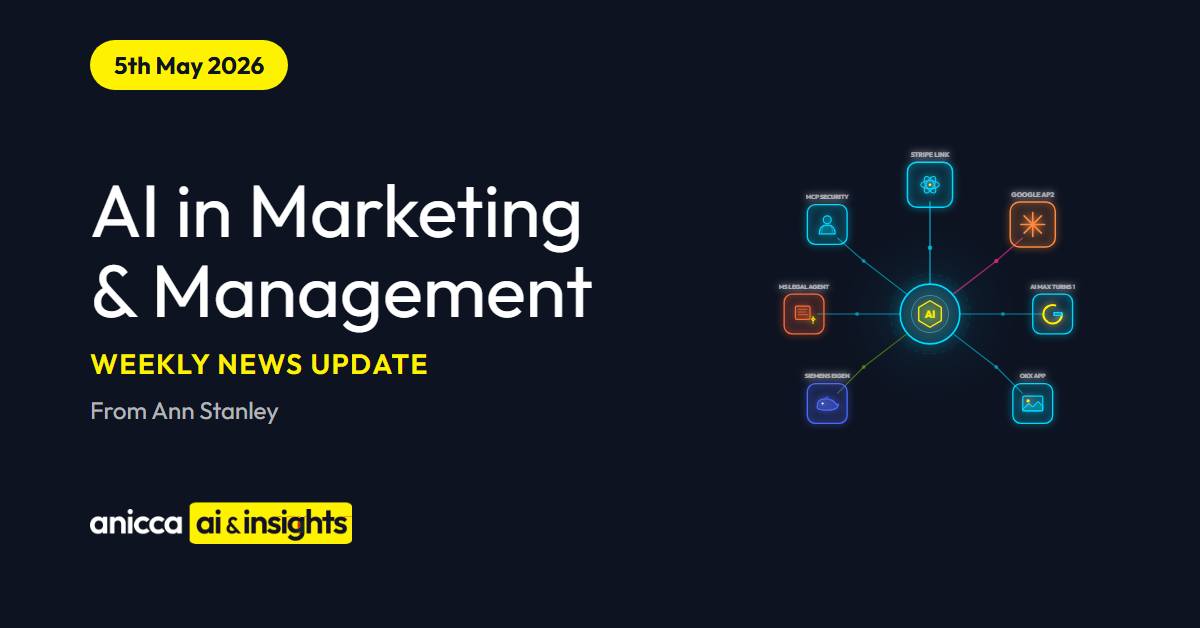
This was the week agentic commerce stopped being a slide in a keynote and became a market. Inside three days, Google donated its Agent Payments Protocol to the FIDO Alliance, OKX published an open standard called APP, and Stripe upgraded Link so autonomous agents can spend on your behalf at Sessions 2026. In parallel, Google Ads turned AI Max one year old with new control features, Microsoft launched a Legal Agent inside Word, Siemens released its Eigen engineering agent commercially, a Pennsylvania bank CEO let his AI clone front an earnings call, and security researchers exposed a flaw across roughly 200,000 MCP servers just as Anthropic launched Claude Security. Microsoft researchers also named the 40 jobs most exposed to AI, and Bernard Marr called the new career divide already showing up in the data. Twenty-nine stories follow, organised by category.
Table of Contents
- 200,000 MCP servers expose a command execution flaw, Anthropic responds with Claude Security
- OpenAI is reportedly building a phone where AI agents replace apps
- Claude for Creative Work launches, with Adobe joining as a connector partner
- Gemini personalisation features land in the UK first
- Google Cloud launches Agents CLI to streamline AI agent development
- Polestar launches Google Gemini in cars, the first major rollout outside Mercedes-Benz
- Google Ads AI Max turns one with AI Brief, text disclaimers and Shopping plus Travel expansion
- Meta launches AI ad connectors that work with outside chatbots
- Snapchat launches sponsored AI chatbots, the first native AI ad inventory at scale
- Can a fake brand win in AI search? A new experiment says yes
- B2B SEO and GEO 2026: eMarketer’s annual visibility briefing
- The 90-day AI search sprint: how to rebuild your marketing for 2026 visibility
- How to build SEO agent skills that actually work, by Mike King
- Microsoft researchers reveal the 40 jobs most exposed to AI, including teachers
- Bernard Marr: the new AI career divide is already starting to show
- The AI layoffs debate is far from over: Salesforce and Gartner challenge the job-loss narrative
- Aon CEO to insurance leaders: your AI strategy is only half the equation
AI in E-commerce, Retail and Agentic Commerce
- Amazon says Rufus users are up 115% and engagement is up 400%
- Walmart 2026 annual report: three takeaways on AI, e-commerce and stores
- AI shopping hits a trust ceiling even as adoption keeps rising
- Google donates the Agent Payments Protocol to the FIDO Alliance, with 60 industry backers
- OKX launches APP, an open standard for agent commerce on X Layer
- Stripe upgrades Link so autonomous AI agents can shop and pay at Sessions 2026
AI for Other Sectors and Industries
- Legal: Microsoft launches a Legal Agent for Word, built with the team that joined from Robin AI
- Manufacturing: Siemens makes its Eigen AI engineering agent commercially available, with 50% efficiency gains
- Finance: Customers Bank CEO uses an AI clone on the earnings call, signs OpenAI partnership
- HR: SHRM publishes the State of AI in HR 2026, with 92% of CHROs forecasting deeper integration
- Education: US Department of Education will prioritise AI in awarding K-12 grants
- Design tools: Stitch from Google Labs adds an AI design agent and infinite canvas
AI News, Tech & Tools
200,000 MCP servers expose a command execution flaw, Anthropic responds with Claude Security
Source: venturebeat.com and securityweek.com | 1 to 2 May 2026
Security firm Ox flagged a command execution flaw in the standard input and output transport used by roughly 200,000 publicly-reachable Model Context Protocol servers, the connectors that let Claude and other agentic systems talk to external tools. The flaw lets an attacker who can reach a server craft an input that executes arbitrary code on the host, and Anthropic has so far declined to patch it at the protocol level on the grounds that the design assumes a trusted local environment. Anthropic’s response landed a day later in the form of Claude Security, a new commercial product that sits between the model and the tools it calls, scanning agent traffic for prompt injection, exfiltration patterns and policy violations.
The two stories together paint the security position for agent infrastructure honestly. The protocol layer is fast, useful and has a real attack surface. The mitigation layer is now being sold separately. American Banker reported within hours that JPMorgan, Citi and BNY are all using MCP-based stacks for their agent pilots and have inherited the third-party cybersecurity risk that comes with the protocol’s current design.
Why it matters
For any business already piloting Claude with internal MCP connectors, the practical question this week is not whether the architecture is fundamentally sound, it is whether you can see what the agent is doing in real time. Plan to add an inspection layer between model and tool, whether that is Claude Security, an open-source equivalent, or your own logging and policy enforcement. Treat any MCP server reachable from outside your network as a known liability until the patch position changes.
OpenAI is reportedly building a phone where AI agents replace apps
Source: techcrunch.com | TechCrunch | 27 April 2026
TechCrunch reported on 27 April that OpenAI is in advanced development of a consumer hardware device that does away with the app grid in favour of a single agentic interface. The product would be the visible end of OpenAI’s acquisition of Jony Ive’s io design firm last year, with shipments targeted for late 2026 according to multiple supply-chain sources. Instead of opening Uber, Booking.com and Deliveroo as separate apps, the user would speak or type the intent and the device would call whichever agent and provider can fulfil it.
The strategic logic is clear and slightly unsettling for the rest of the mobile ecosystem. If the agent is the interface, the brand the user remembers is the agent and the operating system, not the service that actually fulfils the request. Apple and Google both have their own agentic plays underway (Apple Intelligence reorganised under a former Anthropic exec, Gemini for Home expanding to 16 new countries), but neither has yet committed to throwing the app paradigm out.
Why it matters
For brands, the hardest question agentic phones raise is the one no marketing team currently has an answer to: how do you get specified by the agent when the user is not browsing? The early signals are that structured product data, real-time inventory, and explicit pricing in machine-readable form will matter more than your homepage hero image. Start the work now, even before the device launches, because Apple and Google will roll the same logic into iOS and Android within the same window.
Claude for Creative Work launches, with Adobe joining as a connector partner
Source: anthropic.com and blog.adobe.com | 28 April 2026
Anthropic released Claude for Creative Work on 28 April, a new product surface targeted explicitly at writers, designers, marketers and creative directors rather than developers. It bundles long-context drafting, brand-voice training, image generation through partner models, and a structured workflow for moving a brief through ideation, draft, critique and final asset. On the same day, Adobe announced Adobe for Creativity Connector, which lets Claude pull in assets from Creative Cloud libraries, send drafts back to Photoshop and InDesign, and share Frame.io review links.
The Adobe partnership is the more strategically interesting half of the story. Adobe spent the last twelve months investing heavily in Firefly and pushing the Adobe-only AI narrative. Letting Claude into Creative Cloud through a first-party connector signals that the lock-in argument has lost. Customers want their brand and asset systems available to whichever model they prefer, and Adobe has decided to compete on the asset infrastructure rather than the generation surface.
Why it matters
For any agency or in-house creative team running Adobe, this is the cleanest invitation yet to bring Claude into the actual production pipeline. The pattern to expect over the next two quarters is the same connector model from Microsoft for Office, from Salesforce for Marketing Cloud and from Canva. Plan a creative-tools audit now, identifying which of your team’s daily-use tools have a Claude connector available, scheduled, or unlikely.
Gemini personalisation features land in the UK first
Source: blog.google | Google UK | 29 April 2026
Google launched Gemini personalisation features in the UK on 29 April, ahead of the wider European and US rollout. UK Gemini users can now opt in to let Gemini draw on their Search history, YouTube watch activity and Google Workspace content to tailor answers. The launch coincides with new on-device controls letting users see exactly which signals the model is pulling and revoke them per category.
The UK-first sequencing is interesting on its own. Google has chosen the most heavily regulated AI market in Europe to test its most personally-sensitive Gemini feature, on the bet that ICO-grade transparency controls will travel well to the EU AI Act and US state laws coming into force later in 2026.
Why it matters
For UK marketers, the practical implication is that Gemini results for your customers will start diverging significantly based on personal history, not just query intent. Brand visibility in Gemini becomes a function of how often a user has interacted with you across Google’s surfaces, not only how well your content ranks against a query. The early lesson is that owned-media engagement (newsletter opens, YouTube subscriptions, repeat site visits) is now feeding into AI answer composition, which makes loyalty work pay back in a place it never did before.
Google Cloud launches Agents CLI to streamline AI agent development
Source: infoq.com | InfoQ | April 2026
Google Cloud introduced Agents CLI inside its Agent Platform, a unified command-line interface that wraps the Agent Development Kit (ADK), local testing, evaluation and deployment to Google Cloud runtimes. The interesting design decision is that Agents CLI is built to be invoked by other AI development tools using natural language, with explicit support for Gemini CLI, Claude Code and OpenAI Codex. A developer in Claude Code can ask “deploy this agent to Cloud Run” and the model translates the request into the right Agents CLI sequence.
This is part of a wider Google Cloud push that includes Agent Studio for prompt design, Agent Runtime for hosted deployment, and Agent Sandbox for safe code execution. The implicit message is that Google wants to be the runtime layer underneath whichever agent-building tool a developer prefers, rather than competing for the developer surface itself.
Why it matters
For agencies and in-house teams building custom agents for clients, the ground rules just shifted. The cost and complexity of moving from a local prototype to a production deployment dropped meaningfully this week. The competitive question is no longer “can we build an agent?” but “can we build an agent that delivers measurable business value within the time the client expects?” Time-to-deployment has become the differentiator, not the prototype itself.
Polestar launches Google Gemini in cars, the first major rollout outside Mercedes-Benz
Source: media.polestar.com | Polestar | 30 April 2026
Polestar announced on 30 April that Gemini is now available across its Polestar 3 and Polestar 4 vehicles via an over-the-air update, replacing the previous Google Assistant integration. Drivers can use natural language for navigation, climate, music and search, and the assistant can chain multi-step requests together (find a charging station within ten minutes that also has a coffee shop within walking distance, then route there). Mercedes-Benz launched a similar Gemini integration earlier in 2026; Polestar is the first volume manufacturer to follow.
The bigger context is that Google has now placed Gemini inside the cabin of every car in two of the four largest premium electric brands in Europe. Volvo, BMW and Audi are all reportedly evaluating equivalent integrations, with announcements expected before the end of the year.
Why it matters
For automotive marketers and dealerships, the in-car AI assistant is becoming a brand signal as visible as the infotainment screen and as decisive as battery range. For non-automotive brands, the second-order effect is that voice search inside cars is about to scale rapidly, and the queries are different from desktop or mobile (more local, more time-sensitive, more comparison-driven). If you sell something a driver might want to compare on a journey, your structured data and Google Business Profile freshness now carry weight they did not last quarter.
AI in Marketing
Google Ads AI Max turns one with AI Brief, text disclaimers and Shopping plus Travel expansion
Source: blog.google, searchenginejournal.com and seroundtable.com | 30 April to 1 May 2026
Google announced on 30 April that AI Max for Search is one year old, with a substantial set of updates that materially change how advertisers steer the campaign type. The headline addition is AI Brief, a structured place to give AI Max written guidance on which products to lead with, which queries are off-strategy and which messaging to favour. Text disclaimers let advertisers attach mandatory regulatory or category-specific text to all AI-generated assets without writing each variant by hand. AI Max is also expanding from Search-only into Shopping campaigns and Travel campaigns, which together account for a large share of paid revenue across Anicca’s e-commerce client base.
The expansion timing is not coincidental. Google announced two weeks ago that Dynamic Search Ads will be retired and migrated into AI Max by the end of 2026. AI Brief and text disclaimers are the controls that let DSA-heavy advertisers move with confidence rather than reluctance. Google’s own data, cited in the announcement, shows AI Max delivering an average 13% uplift in conversions versus standard search at the same cost-per-acquisition target.
Why it matters
For any e-commerce or lead-gen account currently running DSA at scale, this week is the moment to start the controlled AI Max test. AI Brief gives you the editorial control DSA never had, text disclaimers solve the compliance headache that has held back regulated categories, and the Shopping and Travel expansion finally makes AI Max the unified surface Google has been promising for two years. Run a controlled budget split, measure for sixty days, and you will have the evidence you need before the forced migration starts in Q3.
Meta launches AI ad connectors that work with outside chatbots
Source: socialmediatoday.com | Social Media Today | 1 May 2026
Meta launched AI Ad Connectors on 1 May, a set of APIs that let third-party AI assistants and chatbots fetch live Meta-served creative, drop sponsored placements into their conversational responses, and send conversion signals back to Meta Ads Manager. The first set of integrations covers Anthropic Claude, Microsoft Copilot, ChatGPT and a list of consumer apps that build on top of those models. The Connector follows Meta’s own internal experiments with sponsored AI personas inside Messenger and WhatsApp, but extends the same logic outside Meta’s owned surfaces.
The economic pitch is straightforward. Conversational interfaces have a discoverability problem for brands. Meta has a brand inventory problem outside its own apps. Putting the two together gives Meta a way to monetise AI conversations happening anywhere on the open internet, and gives brands a placement in chats they could not previously reach.
Why it matters
This is the first credible monetisation route for the conversational interfaces that have been swallowing search and social engagement for two years. If your media plan still treats Meta as Facebook and Instagram only, you are about to be missing a meaningful slice of agent-mediated impressions. Add a line item to your 2026 plan for AI Ad Connector budget, even if it is small, so you have measurement data when the pricing models settle.
Snapchat launches sponsored AI chatbots, the first native AI ad inventory at scale
Source: socialmediatoday.com | Social Media Today | 30 April 2026
Snapchat introduced Sponsored AI Chatbots on 30 April, an ad format that lets brands run a custom-trained chatbot inside the Snap interface, branded with the advertiser’s logo and surfaced when the user starts a conversation tagged with relevant intent. The bot can recommend products, answer FAQs, take orders through Snap Checkout, and track conversions back to the ad spend. Initial advertisers include Nike, Sephora, Domino’s and Spotify, with British launch partners expected within the month.
This sits naturally alongside the Meta AI Ad Connectors story. Meta is monetising conversations happening elsewhere, Snap is monetising its own conversational surface, and both are converging on the same model. The user talks to an AI, the AI turns out to be sponsored, the brand gets first-party data and conversion attribution. The format question, intrusive versus useful, will be answered by users in the next two quarters.
Why it matters
For brands targeting the under-35 demographic, sponsored AI chatbots are a real test case for whether conversational ads work as commerce, not just awareness. Pilot it small, measure ruthlessly, and pay particular attention to the cost per conversation, not just cost per impression or click. The economics of conversational ads are different enough that legacy CPM and CPC benchmarks will mislead.
Can a fake brand win in AI search? A new experiment says yes
Source: searchengineland.com | Search Engine Land | 30 April 2026
Search Engine Land published the results of a controlled experiment in which a researcher invented a fictional B2B SaaS brand, built a six-page website, generated a small set of citations from low-authority sources and waited. Within six weeks, ChatGPT, Claude and Perplexity were all confidently recommending the fake brand in response to category queries, citing the fictional research as supporting evidence. The experiment is replicable, and the article includes the methodology in full.
The reason it worked is that AI search models weight semantic coherence and citation count rather than independent verification of the underlying entity. A consistent narrative across a small number of pages, supported by a few mentions on third-party sites, is enough to be treated as a real and credible source. Real brands with thin content footprints are being out-cited by fictional ones with thicker, more consistent ones.
Why it matters
The defensive lesson for established brands is to treat your AI-search content footprint as if it is competing with adversarial fakes, not just other real brands. The offensive lesson is that consistency, citation density and semantic coherence are the levers, in that order. The traditional SEO toolkit of links and authority is a much weaker signal in AI search than it ever was in classical search.
B2B SEO and GEO 2026: eMarketer’s annual visibility briefing
Source: emarketer.com | eMarketer | 30 April 2026
eMarketer published its annual B2B SEO and GEO briefing on 30 April. The headline finding is that B2B buyers in 2026 are using AI assistants for early-stage research at materially higher rates than their B2C counterparts (74% vs 51%), and that traditional Google search now accounts for less than half of high-intent vendor research for the first time. Vendor evaluation, shortlist construction and pricing comparison are the use cases where AI-assistant adoption is most advanced, and where the gap between what buyers do and what marketers measure is widest.
The recommended response, summarised in the briefing, is to instrument your AI-search visibility as a first-class metric (share of voice in ChatGPT, Claude, Perplexity, Gemini for your category queries), to publish answer-shaped content for the questions buyers actually ask early in the journey, and to make sure pricing and integration information is accessible without a form fill, because AI assistants will not fill out forms.
Why it matters
For B2B marketing leaders, the practical change is that the gated-content playbook is finally hitting its limit. AI assistants will summarise around your gates, often using a competitor’s ungated equivalent as the source. The next twelve months are about deciding which content has to stay gated for legitimate qualification reasons, and which has to be released to compete for AI-search citations.
The 90-day AI search sprint: how to rebuild your marketing for 2026 visibility
Source: searchenginejournal.com | Search Engine Journal | 1 May 2026
Search Engine Journal published a 90-day sprint plan for marketing teams that have decided 2026 is the year to take AI search seriously. The plan is structured around three thirty-day phases: audit current visibility across ChatGPT, Claude, Perplexity and Gemini for category-defining queries; rebuild ten priority content pages around the answer patterns those models reward; and instrument a measurement loop so the team can see whether visibility is moving week on week. The plan is deliberately small enough to launch without a budget approval cycle.
The most useful part of the framing is the explicit decision to deprioritise traditional ranking metrics for those ninety days. Google rank for the priority queries is treated as a baseline, not a target, on the grounds that the queries that matter for buying decisions are increasingly being answered inside AI assistants rather than on the SERP.
Why it matters
Most marketing teams have heard for two years that AI search needs a strategy, and most still do not have one. The 90-day sprint is a credible way to make a start without committing to a full strategic rewrite. If you are an agency, this is the kind of structured engagement that converts cleanly into a billable retainer. If you are in-house, it is a defensible plan to put in front of your CMO.
How to build SEO agent skills that actually work, by Mike King
Source: searchengineland.com | Search Engine Land | 1 May 2026
Mike King published the most useful piece of practical agent-engineering writing for marketers in months. The argument is that what makes an SEO agent reliable is not a better prompt, it is the architecture around it. Most “AI SEO agents” being shared on social media are single prompts dressed up as agents, and they produce output that is roughly 40% wrong because there is no verification layer. Run the same agent twice and you get different findings, different severity labels, different recommendations.
The proposed architecture treats skills as folders, not files, with scripts, references, memory and templates. The build order is reviewer first (which defines what good looks like), then workers, then production. King’s team reports a 99.6% human approval rate on 270 internal-linking recommendations because every recommendation passes through a reviewer agent before it reaches a human. The takeaway sentence is that the teams producing great work are not those with the best analysts, they are the ones with the best review process.
Why it matters
For any agency or in-house team building production agents in 2026, this is the architectural pattern to copy. Build the reviewer first, treat skills as folders, version them, log every run. The agencies that take this seriously will be selling validated AI work to clients in twelve months. The ones that release single prompts dressed up as agents will be embarrassed by their own output before the year is out.
AI in Management
Microsoft researchers reveal the 40 jobs most exposed to AI, including teachers
Source: fortune.com | Fortune | 30 April 2026
Microsoft Research published a study identifying the 40 occupational categories where generative AI tools are already being used at scale, ranked by exposure rather than displacement. The top of the list is dominated by knowledge work: translators and interpreters, customer service representatives, sales representatives, market research analysts, writers and authors, technical writers, public relations specialists, telemarketers and editors. Teachers appear in the top twenty, with the researchers noting that a substantial slice of teacher AI use is for lesson preparation and grading rather than direct instruction.
The study is careful to distinguish exposure from substitution. A high exposure score means workers in that occupation are using AI tools daily, not that the role is going away. The most useful analytical move is to read the list as the leading edge of where productivity, organisational design and skill development pressure is most concentrated, rather than as a redundancy forecast.
Why it matters
If your team falls into the top twenty exposed roles, the conversation has already shifted from “should we use AI?” to “are we using it as well as our competitors?” For agency leaders, the actionable insight is that copywriters, account managers, PPC specialists and analysts are all on the list, which means the productivity benchmark for billable hours is rising fast. Repricing engagements before the benchmark resets against you is the harder, smarter move.
Bernard Marr: the new AI career divide is already starting to show
Source: forbes.com | Forbes | 27 April 2026
Bernard Marr published a sharp piece arguing that the AI career divide is no longer a forecast, it is observable in 2026 hiring and retention data. The pattern Marr describes has three layers: the top quartile of AI-fluent professionals are commanding meaningful salary premiums (Marr cites 30% to 50% above peers in equivalent roles); the middle is being asked to do more work for the same pay because their employer assumes AI tools have made them more productive; and the bottom is seeing roles automated faster than retraining can keep up.
The piece sits awkwardly alongside the Microsoft 40-jobs study, because the same data set can be read either way. Optimists see the augmentation thesis: AI-fluent workers earn more. Pessimists see the displacement thesis: AI-illiterate workers earn less or lose roles. Both readings are happening simultaneously inside the same organisations.
Why it matters
For HR and people leaders, the operational priority for 2026 is not whether to invest in AI literacy training, it is how to make it part of the contract of employment rather than an optional benefit. The companies that are paying their AI-fluent staff 30% more this year did not do it deliberately, they did it because they could not retain talent any other way. The structural change in compensation is now visible in the data.
The AI layoffs debate is far from over: Salesforce and Gartner challenge the job-loss narrative
Source: cxtoday.com | CX Today | 30 April 2026
CX Today gathered the counter-evidence to the AI-driven-layoffs narrative that has dominated coverage since Snap’s announcement two weeks ago. Salesforce data shows customer service teams that integrate AI agents alongside human representatives have grown headcount, not shrunk it, with a 12% rise in support team size at customers who have rolled out Agentforce. Gartner’s parallel research found that 47% of customers actually want a human after the AI conversation, not instead of it, and that the most successful contact centres in 2026 are those running parallel human and AI tracks.
The debate matters because the narrative shape sets the procurement conversation. If executives are convinced AI is a cost-reduction lever, they will buy on cost-per-resolved-ticket. If executives are convinced AI is an augmentation lever, they will buy on customer-lifetime-value uplift. The evidence in 2026 is increasingly that the augmentation buyers get the better long-run economics, but the cost-cutter narrative still wins more boardroom conversations.
Why it matters
For operations and customer-experience leaders, the practical implication is to insist on parallel measurement. Track cost-per-ticket, but also track customer satisfaction, first-contact resolution, and total customer lifetime value across the segment touched by the AI agent. Without those parallel measures, you will be cutting your way to a worse customer experience and a measurable revenue hit eighteen months later.
Aon CEO to insurance leaders: your AI strategy is only half the equation
Source: insurancebusinessmag.com | Insurance Business UK | April 2026
Aon CEO Greg Case used a sector keynote to argue that insurance leaders are over-rotating on AI strategy and under-investing in AI risk strategy. The argument is straightforward: every insurer’s clients are now using AI in operations the insurance policies were never written to cover, every insurer’s underwriting models are being challenged by AI-generated novel claim categories, and every insurer’s own use of AI in claims handling and pricing is creating new regulatory exposure. Aon’s data, cited in the keynote, shows insurance industry AI risk losses up 280% year-over-year in 2026, with the largest single category being directors and officers liability claims tied to AI decisions.
Case’s framing applies far beyond insurance. Most companies have an AI adoption strategy and no AI risk strategy. The two need to develop in parallel, with the same level of board attention, or the gap between them will become the headline news story rather than the success of either programme.
Why it matters
For any management team running an AI adoption programme, the matching question to ask in the next board meeting is “what is our AI risk programme?” If the answer is “we will deal with that when it comes up”, the implicit risk premium has just gone up. Most professional indemnity, directors and officers, and cyber insurance policies have AI exclusions or sublimits that materially change the protection the policy actually provides.
AI in E-commerce, Retail and Agentic Commerce
Amazon says Rufus users are up 115% and engagement is up 400%
Source: modernretail.co | Modern Retail | 30 April 2026
Amazon disclosed during its Q1 2026 earnings call that monthly active users of Rufus, its in-app AI shopping assistant, are up 115% year-over-year, with average session engagement up 400%. The company described Rufus as the most-used Amazon feature launched since Alexa, with measurable increases in Prime member basket size and retention among households that have used the assistant more than three times. Rufus now answers product, comparison, fit, sizing and care-instruction questions across the Amazon catalogue, and the next release will add multi-product comparison side-by-side.
The competitive implication for non-Amazon retailers is acute. Buyers who learn to compare and evaluate products inside an AI assistant are not browsing the rest of the open web in the same way. Walmart’s parallel investment in its own assistant (mentioned in the next story) is the same logic playing out at a different scale.
Why it matters
For any brand selling through Amazon, the Rufus signal is that product-data quality (titles, bullet points, A+ content, structured attributes) is now your largest controllable lever for visibility inside the assistant. For brands selling outside Amazon, the longer-term challenge is that buyers are being conditioned to expect an AI assistant in every retail context. If you do not have one, the comparison is not “your site versus a competitor’s site”, it is “your site versus a Rufus session”. Plan accordingly.
Walmart 2026 annual report: three takeaways on AI, e-commerce and stores
Source: retaildive.com | Retail Dive | 28 April 2026
Walmart published its 2026 annual report this week, and Retail Dive distilled it into three takeaways relevant to e-commerce strategy. First, e-commerce is now Walmart’s fastest-growing margin contributor, with online grocery margins overtaking in-store margins for the first time. Second, Walmart’s AI investment is concentrated on supply-chain orchestration and personalisation, not customer-service replacement, with measurable inventory-cost savings cited as the single largest AI ROI line. Third, store investment is increasing, not decreasing, with the “store-as-fulfilment-hub” model being pushed across the entire estate.
Walmart’s strategy choices read as a deliberate counter to Amazon’s pure-play digital model. The AI investment funds the back-end logistics that make the omnichannel proposition work. The store investment commits to physical presence as a competitive advantage that pure-play digital cannot match.
Why it matters
For UK retailers watching Walmart, the lesson is that the most credible defence against Amazon-style agentic commerce is a logistics advantage, not a marketing one. Tesco, Sainsbury’s and Asda are running similar plays, with mixed urgency. For brands, the implication is that the retailers most likely to give you growth in 2026-27 are those investing in supply-chain AI, because they will have the inventory accuracy and fulfilment speed that AI-mediated buyers expect.
AI shopping hits a trust ceiling even as adoption keeps rising
Source: martech.org | MarTech | 1 May 2026
MarTech reported on a Salsify survey of 4,000 consumers in the US, UK, France and Germany finding that while AI shopping adoption keeps rising (now 41% of consumers have used an AI assistant for a purchase decision in the last 90 days), trust in AI shopping recommendations has flattened at around 38% across all four markets. The trust gap is most acute on price (consumers do not believe the AI is showing them the cheapest option) and on reviews (consumers do not believe the AI is summarising reviews honestly).
The mismatch between rising adoption and stalled trust is the interesting bit. Consumers are using AI shopping because it is faster and more convenient, but they are not yet treating its recommendations as reliable enough to act on without verification. The next twelve months will show whether the trust ceiling rises as AI assistants get better at price transparency and review summarisation, or whether it hardens as consumers learn to use AI for research but humans for decisions.
Why it matters
For brands selling through any AI-mediated retail surface, the trust gap is your opportunity. Make pricing transparent, surface independent reviews verbatim, and explicitly cite your sources. The brands that build trust into the AI shopping experience first will own the early relationship the assistant defaults to recommending. The brands that hide pricing or curate reviews will be the ones the assistant routes around.
Google donates the Agent Payments Protocol to the FIDO Alliance, with 60 industry backers
Source: blog.google and thepaypers.com | 28 April 2026
Google announced on 28 April that it is donating its Agent Payments Protocol (AP2) to the FIDO Alliance, the standards body that runs the FIDO and WebAuthn passwordless authentication specifications. Sixty organisations joined the announcement, including American Express, Mastercard, PayPal, Adyen and Visa. AP2 is designed to let an AI agent transact on behalf of a human user with cryptographic proof of intent, which means the merchant has tamper-proof evidence that the user authorised the specific purchase, not just the agent in general. Google is also releasing AP2 v0.2 with explicit “Human Not Present” support, alongside Verifiable Intent, a complementary standard co-developed with Mastercard.
Donating the protocol to FIDO is the strategically important move. By moving stewardship to a neutral standards body, Google removes the risk that AP2 becomes Google-only and accelerates adoption among merchants who would not deploy a Google-controlled standard. FIDO has the regulatory credibility and existing payments-industry relationships to push AP2 into card scheme rules and merchant gateway specifications faster than Google could on its own.
Why it matters
For e-commerce platforms, payment processors and any merchant accepting agent-driven payments, AP2 becoming a FIDO standard is the signal to start serious roadmap work this quarter. Mastercard, Visa and PayPal are all behind it; American Express has joined; the rest of the merchant gateway industry will follow within months. If your checkout cannot accept and verify an agent-driven payment with cryptographic proof of intent by Q4, you will be the friction point in someone else’s customer journey.
OKX launches APP, an open standard for agent commerce on X Layer
Source: okx.com and theblock.co | 29 April 2026
One day after Google donated AP2 to FIDO, crypto exchange OKX published its own open standard for agent commerce, called APP (Agent Payments Protocol, deliberately the same acronym). APP defines how agents quote, negotiate, escrow, meter, settle and resolve disputes, supported by a Payment SDK, an OKX Agentic Wallet (self-custodial, TEE-secured, with session keys for autonomous signing), and runtime support for 20+ blockchains. APP is built on OKX’s X Layer, a low-gas Ethereum-compatible network. Backers include AWS, Alibaba Cloud, Nansen, Uniswap, Paxos and QuickNode, alongside ecosystem support from Base, the Ethereum Foundation, Solana, Sui, Aptos and Optimism.
The naming collision with Google’s AP2 is not accidental. OKX is positioning APP as the on-chain alternative to AP2, on the argument that on-chain settlement, escrow and dispute resolution are better suited to agent-to-agent commerce than card networks. The two protocols can coexist (an agent might use AP2 for retail purchases and APP for B2B SaaS subscriptions), but the strategic question for the industry is whether agent commerce ends up settled on card networks, on-chain, or split between the two.
Why it matters
For any business considering agent-mediated B2B sales (procurement automation, SaaS subscriptions, API metering), APP is the standard worth tracking through 2026. The on-chain settlement model removes the chargeback risk that makes card-based agent payments awkward, and the escrow primitive solves the trust problem when two unfamiliar agents are transacting. The likely 2027 picture is AP2 in retail, APP in B2B, with hybrid models bridging the two.
Stripe upgrades Link so autonomous AI agents can shop and pay at Sessions 2026
Source: techcrunch.com | TechCrunch | 30 April 2026
Stripe used its annual Sessions conference on 30 April to unveil a substantial upgrade to Link, its consumer payment wallet. Link can now be connected to AI agents through an OAuth permission flow, allowing the agent to construct a “spend request” that the user approves before the transaction executes. Behind the scenes, the upgrade is built on Stripe’s new Issuing for Agents capability, which provisions virtual cards with real-time authorisation limits, spending controls and full transaction visibility. For agents transacting at scale, Stripe has also introduced Shared Payment Tokens, backed by underlying cards or bank accounts but exchangeable without exposing the underlying credential.
Stripe’s framing positions Link as the consumer-friendly wrapper around two harder problems: how do you give an agent enough payment power to be useful without giving it the keys to your bank account, and how does the merchant get the same fraud protection and chargeback rights they get from a card-not-present transaction. The OAuth flow plus virtual cards plus tokenisation is a credible answer to both, and the launch makes Stripe the first of the major payment processors with a working agent-commerce stack.
Why it matters
Combine the Stripe announcement with Google’s AP2 to FIDO and OKX’s APP launch in the same week, and the picture is unambiguous. Agent commerce moved from concept to infrastructure between Monday 28 April and Wednesday 30 April. The merchants who wire up agent-friendly checkouts in 2026 will see materially higher conversion when agentic phones, browsers and assistants launch at scale. The merchants who do not will be invisible to the agent, no matter how good their human-facing experience is.
AI for Other Sectors and Industries
Legal: Microsoft launches a Legal Agent for Word, built with the team that joined from Robin AI
Source: artificiallawyer.com | Artificial Lawyer | 30 April 2026
Microsoft launched a Legal Agent inside Word on 30 April, the first sector-specific agent Microsoft has released as part of its Copilot family. The Legal Agent flags non-conforming clauses against an organisation’s playbook, recommends edits to align with internal standards, and produces a structured redline that a lawyer can accept, modify or reject. The product was built in close collaboration with the team that joined Microsoft from Robin AI earlier in the year, and follows structured workflows rather than generic instruction-following, which Microsoft says delivers materially fewer hallucinations than a general AI model handed the same contract.
The launch matters because it puts a credible AI legal-review tool into a Word document on roughly every legal professional’s desktop, without requiring a separate platform purchase. Spellbook, Harvey and Robin AI built the category, but Microsoft now sits inside the workflow where lawyers actually live. The pricing model (bundled into Microsoft 365 Copilot for legal-tier customers) makes the procurement decision a matter of seat-licence allocation rather than a new vendor selection.
Why it matters
For in-house legal teams and law firm operations leaders, the Microsoft Legal Agent forces the question that has been quietly avoided for two years: which contract review tool sits inside our Word workflow as standard? For specialist legal AI vendors, the launch is a strong signal that vertical AI products will be absorbed into horizontal productivity suites faster than the standalone vendors expected. The category will not disappear, but the customer base for premium-priced specialist tools is about to shrink.
Manufacturing: Siemens makes its Eigen AI engineering agent commercially available, with 50% efficiency gains
Source: manufacturingdigital.com | Manufacturing Digital | April 2026
Siemens unveiled Eigen, its industrial AI engineering agent, at Hannover Messe 2026 and announced commercial availability the same week. Eigen is among the first commercially-available AI systems that can plan and execute industrial automation engineering tasks (designing PLC logic, generating control code, simulating machine behaviour, optimising for cycle time) with a human engineer supervising rather than driving. Siemens reports up to 50% efficiency gains in automation engineering work, with early customer deployments at automotive OEMs and FMCG manufacturers.
Eigen sits alongside SAP’s supply-chain agents and NVIDIA’s Vision Execution System (Toyota is an early customer), all unveiled at the same Hannover Messe. The combined effect is that the entire industrial software stack now has agentic AI as a first-class capability, less than 18 months after the same companies were still describing AI as “experimental” in shareholder communications.
Why it matters
For B2B marketers selling into manufacturing, the buyer’s appetite for AI-native solutions is now demonstrably higher than it was at the start of 2026. The conversation has moved from “should we explore AI?” to “which agent stack are you compatible with?” If your product cannot integrate with Siemens, SAP or NVIDIA’s agent layers, it is going to be a harder sell. For brands marketing to industrial buyers, the implication is that your buyers’ day jobs are increasingly mediated by AI agents, which changes how technical content is consumed.
Finance: Customers Bank CEO uses an AI clone on the earnings call, signs OpenAI partnership
Source: cnbc.com | CNBC | 27 April 2026
Customers Bancorp, the parent of Pennsylvania-based Customers Bank, made headlines on its Q1 2026 earnings call when CEO Sam Sidhu let an AI clone of himself field analyst questions for the second half of the call. The clone, trained on Sidhu’s prior calls and public commentary, answered questions on net interest margin, loan loss provisions and AI strategy in his voice, with the human Sidhu visible on screen but allowing the AI to speak. The bank used the same call to announce a deepened partnership with OpenAI, embedding OpenAI engineers into its operations to automate internal processes.
The stunt reads as a marketing moment, but the partnership is the substantive news. Customers Bank is one of the more aggressive mid-sized US banks on AI adoption, and the OpenAI deal places it alongside JPMorgan (whose CIO is running a $20 billion technology budget with $2.5 billion in expected AI value) as an early test of how deeply a bank can integrate a frontier AI lab into core operations.
Why it matters
For financial services marketers, the AI clone moment will travel further than the partnership in news cycles, but the partnership is the one to watch. OpenAI’s strategy of embedding its own engineers into bank operations is a model that will be replicated across financial services through 2026, and it will create reference customers OpenAI uses to win the rest of the sector. Expect competing announcements from Anthropic, Google and Microsoft within the quarter, each with a different bank and a different framing.
HR: SHRM publishes the State of AI in HR 2026, with 92% of CHROs forecasting deeper integration
Source: shrm.org | SHRM | 2026
The Society for Human Resource Management published the 2026 State of AI in HR report, the most comprehensive recent benchmark of where HR functions are with AI adoption. The headline numbers: 46% of organisations expect to use AI in HR this year, North American HR departments lead at 68% adoption, 92% of CHROs anticipate further integration, and 87% forecast greater AI use in HR processes overall (up from 83% in 2025). The top barrier to adoption, cited by 67% of respondents, is lack of awareness of AI’s capabilities, not budget, technology or governance.
The report’s most useful framing is that HR is no longer supporting AI adoption inside the organisation, HR is leading it. The role is shifting from process administration to architecting how human and AI workforces collaborate, how skills are built, bought or borrowed, and how the productivity dividend gets distributed across the organisation. The CHROs who treat the role as the architect of human-AI collaboration are the ones cited as model adopters.
Why it matters
For agency leaders and in-house marketing leaders, the SHRM data is a reminder that your HR partners are now key stakeholders in any AI rollout that affects how teams work, not just how teams are paid. Engage HR early on AI tooling decisions, particularly those that change role definitions, performance measurement or skills frameworks. The HR teams that are most advanced on AI are also the ones most willing to support cross-functional AI adoption with proper training infrastructure.
Education: US Department of Education will prioritise AI in awarding K-12 grants
Source: k12dive.com | K-12 Dive | April 2026
The US Department of Education announced new guidance under which AI-related capability will become an explicit priority criterion in federal K-12 grant awards. The change covers competitive grants for technology integration, teacher professional development, curriculum development and student assessment, with applicants required to describe how their proposed projects will use, teach or evaluate AI as part of the funded work. State-level adoption is also accelerating, with five states (Idaho, Ohio, Utah, Tennessee and Virginia) having enacted comprehensive AI-in-schools policies, and 134 AI-related education bills introduced across 31 states as of March 2026.
The federal-level change is the more strategically significant one, because it routes federal money toward AI-equipped schools and away from those that cannot articulate an AI plan. The downstream effect on edtech procurement is meaningful: vendors with credible AI offerings will see grant-funded purchasing accelerate, while vendors without will see budget shift away.
Why it matters
For edtech marketers and any business serving K-12 buyers, the federal grant prioritisation is the procurement tailwind to align messaging with this quarter. Make sure your sales materials make the AI capability of your product unambiguous, and that your case studies include the grant-funding language buyers will need to use in their applications. For agencies serving the education sector, this is a pitch opportunity worth running before the next fiscal cycle starts.
Design tools: Stitch from Google Labs adds an AI design agent and infinite canvas
Source: blog.google and stitch.withgoogle.com | April 2026
Stitch, the AI UI design tool from Google Labs that launched at Google I/O 2025, received a substantial update with an AI-native infinite canvas, multi-screen generation (up to five interconnected screens from a single prompt), automatic user-journey mapping, and code export across seven framework targets. The new AI Design Agent reasons across the entire project’s evolution, with an Agent Manager that tracks parallel design directions and lets the user pursue multiple ideas without losing earlier work. Designs export to Figma, AI Studio and Antigravity, with HTML and CSS as standard output.
The product is free, which is the most strategically interesting decision in the announcement. Google has chosen to give away a serious UI design tool while Adobe charges for Firefly and Figma charges for AI features. The implicit pricing argument is that owning the design surface is worth more to Google than monetising it directly, because the surface generates training data and feeds Gemini’s understanding of how humans build interfaces.
Why it matters
For marketing teams without a permanent designer, Stitch is now a credible option for landing page mockups, app screens and brand prototypes. For agencies, it is a tool worth introducing to clients who currently brief in vague terms, because Stitch surfaces the design decisions that need to be made before a brief is workable. The competitive question for Adobe and Figma is whether the free-tier strategy from Google forces them to bundle more AI capability at the same price, or to defend their premium tiers more aggressively.
Key Takeaways
- Agent commerce became real this week. Google donated AP2 to FIDO with 60 industry backers, OKX published its on-chain APP standard, and Stripe upgraded Link for AI agents at Sessions 2026. The infrastructure question shifted from “if” to “when” inside seventy-two hours.
- Google Ads AI Max turned one with the controls advertisers needed. AI Brief lets you steer the campaign editorially, text disclaimers solve compliance, and Shopping plus Travel expansion makes AI Max the unified surface Google has been building toward. Run a controlled test before forced DSA migration starts in Q3.
- MCP security is now a board-level conversation. 200,000 servers exposed to a command execution flaw, Anthropic launching Claude Security as a paid product, and US banks publicly identifying the third-party risk. If you are running internal MCP connectors, add an inspection layer before you scale.
- Microsoft launched a Legal Agent inside Word. Vertical AI products are being absorbed into horizontal productivity suites faster than specialist vendors expected. Specialist legal AI tools will not disappear, but their addressable customer base just shrunk.
- Workforce data shows AI augmenting the top quartile and squeezing the rest. Microsoft’s 40-jobs report and Bernard Marr’s career-divide piece both confirm the pattern. AI-fluent staff command a 30% to 50% premium, the middle is doing more for the same pay, and the bottom is being automated faster than retraining keeps up.
- Salesforce and Gartner data challenge the AI-equals-layoffs narrative. Customer service teams that integrate AI agents alongside humans grow headcount, not shrink it. Insist on parallel measurement before you cut on the basis of cost-per-ticket alone.
- Sector AI adoption is accelerating across the board. Microsoft in legal, Siemens Eigen in manufacturing, Customers Bank with OpenAI in finance, SHRM data on HR, federal grant prioritisation in education, Polestar Gemini in cars. Every category is moving.
Frequently Asked Questions
If agent commerce is now real, what should I actually do this month?
Three concrete steps. First, audit your checkout for agent-readiness: can a Stripe Link agent flow complete a purchase, can your platform accept an AP2 cryptographic intent payload, can your fraud rules cope with virtual-card transactions originated by an agent? Second, brief your finance and legal teams on the new payment standards so when the Mastercard or Visa product team calls about AP2 implementation in Q3, you are not starting from scratch. Third, plan the merchant-side measurement so when agent transactions start arriving, you can tell them apart from human ones. The brands that do these three steps in May and June will be at the front of the queue when the volume scales in Q4.
Should I migrate my Dynamic Search Ads to AI Max now or wait?
Migrate now, with a controlled split test. AI Max gives you AI Brief for editorial control, text disclaimers for compliance and a 13% average conversion uplift in Google’s data. The forced migration starts in Q3 and concludes by the end of 2026, so you have a six to nine month window to build evidence before the migration is mandatory. Use that window to compare AI Max performance against your current DSA baseline on the same query set, measure for at least sixty days, and bring the data to your next quarterly planning meeting. The teams that test now will set the migration plan; the teams that wait will be told what their plan is.
How worried should I be about the MCP security flaw if I am running Claude in Claude Code?
The flaw is in publicly-reachable MCP servers, not in Claude or Claude Code itself. If your MCP connectors are local-only and your machine is not exposed, the practical risk is low. If you are running MCP servers on cloud infrastructure that is reachable from outside your network, treat them as a known liability until Anthropic changes its patch position or until you have inserted Claude Security or an equivalent inspection layer. The simplest mitigation is to keep MCP servers on a private network, use mutual TLS for any cross-host traffic, and log every tool call with the full payload so you can audit after the fact.
What is the right response to the Microsoft Legal Agent if I am at a smaller specialist legal AI vendor?
The two viable responses are deeper specialisation or platform integration. Deeper specialisation means doubling down on capabilities Microsoft will not build (regulatory compliance for specific jurisdictions, deep domain expertise in narrow practice areas, complex multi-document discovery). Platform integration means becoming the recommended specialist tool that the Microsoft Legal Agent calls when it hits its limits, ideally through a published connector standard. The middle path of “general legal AI tool, slightly better than Microsoft’s” is the position that gets squeezed hardest.
Conclusion
This week was an inflection point for agent commerce, with Google, OKX and Stripe all delivering production-grade infrastructure inside three days. The accompanying AI Max anniversary, Microsoft Legal Agent launch, Siemens Eigen general availability, Polestar Gemini rollout and SHRM HR benchmark all reinforce the same pattern: AI is moving from category to default infrastructure across every industry that matters to a marketing or management leader. The right operating posture for the rest of 2026 is to assume agent-mediated experiences are the new baseline, audit your own readiness against that assumption, and prioritise three concrete actions: instrument your AI-search visibility as a first-class metric, run a controlled AI Max test before the forced DSA migration starts, and audit your checkout for agent-readiness before the volume arrives in Q4.
Want help making sense of how all this applies to your business? Get in touch with Anicca Digital for expert guidance on AI-search visibility, AI Max migration, agentic commerce readiness and the wider AI marketing transition.
Want the full deep-dive with expert analysis?
If you would like to talk through how any of this week’s news applies to your business, get in touch directly. We help marketers and managers find where AI delivers measurable returns, prioritise what to tackle first, and implement the tools, agents and automations that move the numbers.
- AI search and GEO audits across ChatGPT, Claude, Gemini and Perplexity
- Agentic commerce readiness for e-commerce and B2B SaaS
- Google Ads AI Max migration ahead of the forced DSA cutover in Q3
- AI training, agents and automations tailored to your team and tooling stack
Ann Stanley · Founder & CTO, Anicca Digital and Co-Founder & CMO, Anicca AI & Insights
[email protected] · 07930 384443 · LinkedIn
Darren Wynn · Managing Director, Anicca Digital and Co-Director, Anicca AI & Insights
[email protected] · 07958 426014 · LinkedIn
Or join us live every other Thursday at The Thursday AI Club. Session 3 this Thursday 7th May, 2pm to 5pm BST: AI Agents and n8n Automation, build your first AI agent end-to-end. £40 per month or £400 for the year, no VAT.
Or contact us through the Anicca website →


Thursday AI Club
A hands-on AI club for marketers and managers. Fortnightly 3-hour sessions: Hour 1 is an open Q&A on any AI question; Hours 2-3 split into a workshop track (for newbies) and an advanced track (live demos and deeper questions).
Led by Ann Stanley, James Allen.
Membership: £40/month or £400/year
Join the Thursday AI Club →This roundup is compiled from publicly available sources using AI-assisted research. While we review every article for accuracy, our analysis reflects our interpretation of the original reporting. We strongly encourage readers to click through to the original sources linked throughout this post for full context and detail. If you spot anything that needs correcting, please let us know.