This Week in AI in Marketing & Management (11th May 26)
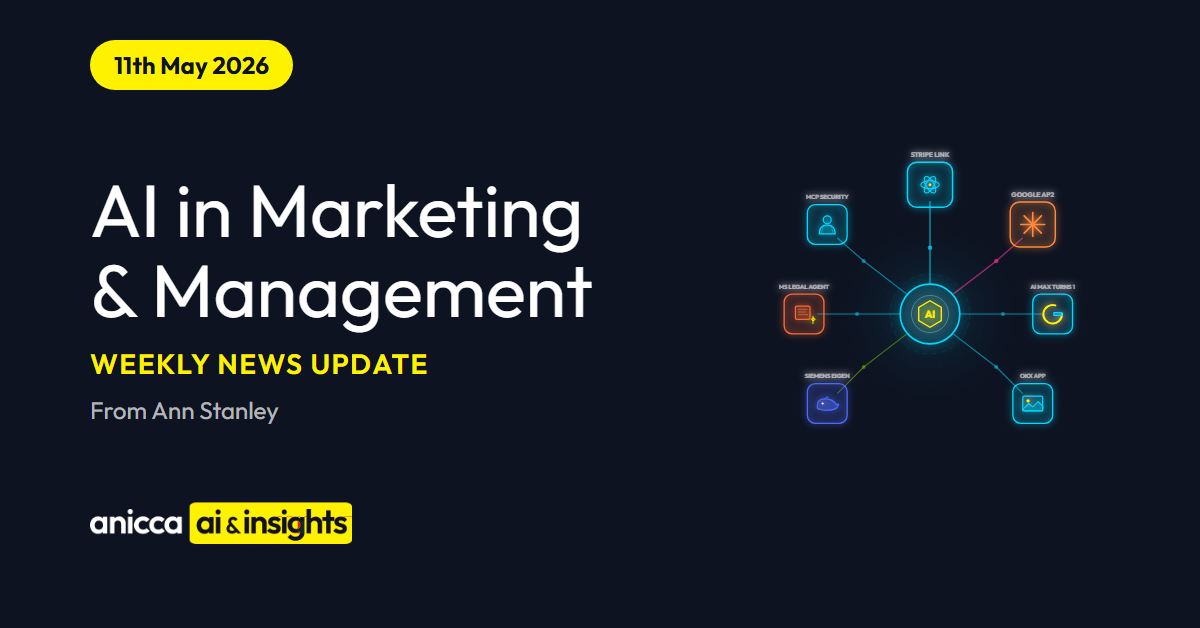
The week ending 11th May 2026 marked a clear shift from AI experimentation to operational reality. Microsoft took Agent 365 to general availability as shadow AI became an enterprise security crisis, while Anthropic introduced “dreaming” to let Claude agents learn from past sessions and signed a SpaceX compute deal worth 300MW. OpenAI opened ChatGPT ads to self-serve buyers with CPC bidding, and Google rolled out AI-powered bidding across Search and Shopping ahead of Google Marketing Live. Meanwhile, Cloudflare and Coinbase announced major AI-related job cuts, and agentic commerce moved from concept to live deployment at Wayfair, Etsy and beyond.
Table of Contents
- Microsoft takes Agent 365 to general availability as shadow AI becomes an enterprise threat
- Claude agents can now “dream”, and Anthropic signs a 300MW SpaceX compute deal
- OpenAI opens ChatGPT ads to self-serve buyers with CPC bidding
- OpenAI launches new voice intelligence features in its API
- Google’s April 2026 AI roundup
- Google adds AI-powered bidding and demand-led budgeting to Search and Shopping
- Google Marketing Live 2026 preview: turn data into decisions
- Google says AI creative should help brands differentiate, not blend in
- Performance Max for ecommerce in 2026: the hybrid strategy
- Why AI visibility starts before search and ends with citations
- Latest AI-powered martech news and releases
- Stop naming AI features after human processes
- Search News Buzz: Google AI black box, links in AI, ChatGPT Ad Manager, Ask.com shutters
- AI-driven layoffs accelerate: Cloudflare, Coinbase and a growing list
- Yale: real AI job destruction hits before careers can start
- ServiceNow launches Autonomous Workforce at Knowledge 2026
- Fewer CEOs believe AI will reduce hiring, EY-Parthenon survey finds
AI in E-commerce, Retail and Agentic Commerce
- Wayfair wants “to be everywhere” in agentic AI commerce
- Etsy launches its app within ChatGPT
- Sopra Steria: up to €310bn of European ecommerce could be AI-assisted within 10 years
- Data privacy is shoppers’ biggest AI shopping fear, by far
- AI shopping agents trigger “false decline” crisis for merchants
- ReFiBuy raises $13.6m to accelerate agentic commerce optimisation
- eBay UK’s Eve Williams on competing in an AI commerce era
AI for Other Sectors and Industries
- HEALTHCARE: NHS AI commission finds trust is the primary barrier to deployment
- LEGAL: Harvey and Legora poach senior lawyers from City firms with equity upside
- LEGAL: Microsoft, Google and Anthropic move directly into legal as AI-first firm models emerge
- FINANCE: UK insurance industry takes deliberate, incremental approach to AI
AI News, Tech & Tools
Microsoft takes Agent 365 to general availability as shadow AI becomes an enterprise threat
Source: venturebeat.com | May 2026
Microsoft moved Agent 365, its management platform for AI agents, out of preview last week. The product positions itself as a unified control plane that lets enterprise IT and security teams observe, govern and secure AI agents wherever they run, including inside Microsoft’s ecosystem, on AWS Bedrock, Google Cloud, employee endpoints and partner SaaS tools.
The most striking element of the launch is Microsoft’s aggressive push into discovering and managing local AI agents, the coding assistants and personal productivity tools that employees install on their own devices without IT approval. David Weston, Microsoft’s Corporate Vice President of AI Security, told VentureBeat enterprises are trying to balance “YOLO, just let anything run” with “oh no, where nothing works at all”.
Why it matters
Shadow AI is the new shadow IT, and it has arrived faster than governance frameworks can absorb. Marketing teams are particularly exposed: copywriters, analysts and campaign managers are routinely installing AI tools that touch customer data, brand assets and ad accounts. CMOs should commission an audit of AI tool usage across their teams within the next 30 days, then work with IT to define which agents are sanctioned, which need wrappers, and which need blocking. Waiting for an incident is no longer a viable strategy.
Claude agents can now “dream”, and Anthropic signs a 300MW SpaceX compute deal
Sources: zdnet.com, venturebeat.com, anthropic.com | 6 May 2026
At its Code with Claude developer conference, Anthropic unveiled “dreaming”, a capability that lets Claude Managed Agents learn from their own past sessions and self-improve over time. Legal AI firm Harvey reported task completion rates rising roughly 6x after implementing dreaming, while Wisedocs cut document review time by 50% using the now-public-beta “outcomes” feature. CEO Dario Amodei disclosed Q1 2026 saw 80x annualised revenue growth, far exceeding the company’s 10x plan.
Separately, Anthropic announced a partnership with SpaceX granting access to all compute capacity at the Colossus 1 data centre, more than 300 megawatts and over 220,000 NVIDIA GPUs within the month. The company is doubling Claude Code’s five-hour rate limits for Pro, Max, Team and Enterprise plans, removing peak hours reductions, and significantly raising API limits for Opus models. The SpaceX deal joins existing 5GW agreements with Amazon and with Google/Broadcom.
Why it matters
Self-improving agents change the economics of marketing automation. If your customer service agent gets 6x better at task completion just by reviewing its own logs, the human review tier shrinks dramatically. The compute story is equally important: Anthropic, Microsoft, Google and OpenAI are all locking in multi-gigawatt capacity through 2027. Pricing pressure on AI services should ease as that capacity comes online, but only for buyers on long-term commercial agreements. Lock in your enterprise terms now if you have not already.
OpenAI opens ChatGPT ads to self-serve buyers with CPC bidding
Sources: openai.com, searchenginejournal.com | 5-7 May 2026
OpenAI expanded its ChatGPT ads pilot with a new beta self-serve Ads Manager, cost-per-click bidding, and expanded measurement tools. Agency partners include Dentsu, Omnicom, Publicis and WPP, with technology partners Adobe, Criteo, Kargo, Pacvue and StackAdapt joining the ecosystem. OpenAI insists ads remain clearly separated from ChatGPT’s answers and that no conversation data is shared with advertisers.
The move marks the formal start of ChatGPT as a buyable media channel rather than a managed-service pilot. CPC bidding aligns the auction model with how Google and Meta train marketers to think about performance, lowering the cognitive switch cost for paid media teams.
Why it matters
ChatGPT is becoming the third major performance media platform alongside Google and Meta. UK and Irish marketers should plan small test budgets, £5,000 to £25,000, in Q3 2026 to learn the platform before competitors do. Pay particular attention to how ChatGPT attributes conversions, since the platform sits between consideration and conversion in ways traditional click attribution cannot capture. Brief your agency now on partner status and technical integration paths.
OpenAI launches new voice intelligence features in its API
Source: techcrunch.com | 7 May 2026
OpenAI added a suite of voice intelligence features to its API this week, expanding capabilities for developers building voice-driven applications and agents. The launch sits alongside the broader push to make voice a primary interface for AI rather than a bolt-on feature.
The timing aligns with rising enterprise demand for voice agents in customer service, sales qualification and field operations, where text interfaces are impractical. OpenAI’s move puts pressure on specialist voice AI vendors who have built moats around latency and naturalness.
Why it matters
Voice is the next frontier for marketing automation, particularly for inbound enquiry handling and outbound qualification. Marketers running phone-heavy lead funnels should pilot voice agents on a single product line within the next quarter. The savings on first-line response are real, but the bigger prize is consistency: voice agents do not have bad days, and they capture every word for later analysis and CRM enrichment.
Google’s April 2026 AI roundup
Source: blog.google | 8 May 2026
Google published its monthly recap of AI announcements covering Gemini model updates, developer tooling, NotebookLM enhancements and infrastructure expansion. The post functions as a single reference for product, research and cloud updates released across April.
While individually each item is incremental, the cumulative pace tells the strategic story: Google is shipping across every layer of the AI stack simultaneously, from silicon to consumer apps. The breadth is increasingly hard for any rival to match outside Microsoft.
Why it matters
For senior marketing leaders, the practical takeaway is that Google’s surface area is expanding faster than most teams can evaluate. Set a quarterly cadence to review the Google AI roundup with your media, SEO and analytics leads, decide which two or three updates warrant testing, and ignore the rest. Trying to keep up with everything is a recipe for paralysis.
AI in Marketing
Google adds AI-powered bidding and demand-led budgeting to Search and Shopping
Source: searchengineland.com | May 2026
Google rolled out new AI-powered bidding capabilities and demand-led budgeting across Search and Shopping campaigns. The updates allow advertisers to shift budget dynamically based on real-time demand signals rather than fixed daily caps, with bidding models that account for cross-channel intent.
The release lands ahead of Google Marketing Live and signals continued automation of the bid layer. Manual control over individual keywords continues to recede, replaced by goal-based inputs and creative variants the AI selects across surfaces.
Why it matters
Demand-led budgeting is a meaningful change for retailers with seasonal or promotional cycles. The risk is that automated systems chase efficient demand at the expense of brand-building reach. Build clear floors and ceilings into your campaign structure, and use Google’s new Mix Experiments beta to validate that AI-driven budget shifts are actually growing incremental revenue rather than just reallocating existing demand.
Google Marketing Live 2026 preview: turn data into decisions
Source: blog.google | 5 May 2026
Google previewed three priorities for Google Marketing Live 2026: simplifying data, understanding what drives growth, and acting at AI speed. The post sets up the agenda for the main event and frames Google’s pitch to advertisers facing fragmented measurement and growing creative volume demands.
The framing reflects a wider industry truth: the bottleneck has shifted from media buying to data quality and creative supply. Marketers who lack clean first-party data and a creative production pipeline cannot use the new automation effectively.
Why it matters
Treat the GML preview as a planning document. Audit your first-party data foundation now, including consent records, server-side tagging, and CRM integration with Google Ads. Then assess whether your creative pipeline can produce the volume and variant count Google’s AI now requires. If either is weak, the new bidding and creative tools will underperform regardless of how much budget you allocate.
Google says AI creative should help brands differentiate, not blend in
Source: searchenginejournal.com | May 2026
Google addressed mounting concerns about repetitive AI-generated ads, advertiser controls, and brand differentiation at scale. The company emphasised that AI tools should expand rather than homogenise creative output, and pointed to controls that let brands enforce style guidelines, banned terms and visual identity rules.
The defence comes as marketers report ad fatigue and a “sea of sameness” in AI-generated creative across categories. Brand managers are pushing back on auto-generated assets that strip out distinctive brand codes in pursuit of performance metrics.
Why it matters
Distinctive brand assets matter more, not less, in an AI creative world. Codify your visual identity, tone of voice, taglines and category cues in a brand kit your platforms can enforce. Audit a sample of AI-generated ads quarterly to confirm distinctiveness has not eroded. The brands that will win in AI-driven media are those whose AI-generated work still looks unmistakably like them.
Performance Max for ecommerce in 2026: the hybrid strategy
Source: searchenginejournal.com | May 2026
Tony Adam at Search Engine Journal argues that running Performance Max alongside Standard Shopping gives advertisers the control, visibility and reach needed for profitable ecommerce growth. Five years in, treating PMax as set-and-forget drains budget; active guidance is non-negotiable.
The hybrid approach uses Standard Shopping for top sellers and brand terms where transparency and control matter most, while PMax captures incremental long-tail and discovery demand. The combination requires careful negative keyword management and account structure to avoid cannibalisation.
Why it matters
If you are running PMax alone, you are likely overpaying for traffic you would have won at lower CPCs through Standard Shopping. Audit your top 20 SKUs by revenue and test pulling them into a Standard Shopping campaign with negatives applied to PMax. Most ecommerce advertisers see a 10-20% efficiency gain from this structure within 60 days.
Why AI visibility starts before search and ends with citations
Sources: searchengineland.com, martech.org | May 2026
Two strong analyses this week argue that AI visibility is no longer about ranking on your own domain. AI systems rarely cite brand-owned sites directly; instead, they corroborate information across third-party sources including review sites, trade publications, Wikipedia, Reddit and industry directories. Brands must coordinate PR, affiliate marketing and SEO to ensure consistent representation across the intermediaries that LLMs trust.
Citation has replaced ranking as the primary measure of success. Google AI Overviews increasingly draws from longer, conversational queries where third-party corroboration outweighs on-site optimisation. Brands that fail to influence the broader ecosystem risk being misrepresented or omitted entirely from AI answers.
Why it matters
The marketing org chart needs rethinking. PR, SEO and affiliate teams have historically operated in silos with separate KPIs; AI visibility forces them into a single workflow. Map the top 20 third-party sites that LLMs cite for your category, audit your presence and accuracy on each, and assign owners. This is one of the highest-utilise investments a marketing team can make in 2026.
Latest AI-powered martech news and releases
Source: martech.org | Constantine von Hoffman | May 2026
MarTech’s weekly roundup flagged a Wall Street Journal warning that AI growth may be partly fuelled by subsidies and partner deals rather than real end-customer demand, raising risk for marketers betting heavily on AI vendors. The piece collates new product releases across the martech stack, with a focus on agentic features.
The subsidy concern matters for procurement: vendors offering aggressive pricing today may need to raise prices substantially once subsidies unwind. Multi-year contracts signed in 2026 should include clear price-protection clauses.
Why it matters
Do not assume current AI vendor pricing reflects steady-state economics. When negotiating renewals or new deals, push for fixed pricing for 24-36 months, exit clauses if the vendor is acquired, and data portability commitments. The companies most exposed to a vendor reset are those with deeply embedded AI workflows and no fallback path.
Stop naming AI features after human processes
Source: wired.com | 6 May 2026
Wired published a sharp critique of AI vendors using human cognitive metaphors like “dreaming”, “thinking” and “reasoning” to describe model features. The argument: anthropomorphising AI inflates user expectations, distorts public understanding, and complicates regulatory and ethical conversations.
The piece arrived the same week Anthropic shipped its “dreaming” feature, lending the critique extra force. Marketers face a parallel temptation to use the same vocabulary in customer-facing copy.
Why it matters
Brand language matters. Resist the urge to describe your AI features using human cognitive verbs in customer communications. “Learns from past interactions” is more accurate and less brittle than “remembers” or “dreams”. The reputational risk of overclaiming AI capabilities falls hardest on regulated sectors and on brands that depend on customer trust, which is most of them.
Search News Buzz: Google AI black box, links in AI, ChatGPT Ad Manager, Ask.com shutters
Source: seroundtable.com | Barry Schwartz | 8 May 2026
Barry Schwartz’s weekly recap covered Google’s increasingly opaque AI systems, the role of links in AI answers, the expansion of UCP checkout, the new ChatGPT Ad Manager and the shutdown of Ask.com after nearly three decades. The video format aggregates a busy week of search news in one place.
The Ask.com closure marks the end of a search era; the brand was a household name in the early 2000s. Its quiet exit underscores how completely the search market has consolidated and how little room remains for non-AI-native challengers.
Why it matters
Google’s AI systems are becoming harder to audit even as they consume more of your media spend. Pressure your agency to document model behaviour, asset performance and audience targeting at the granular level Google still permits. The window for that visibility is closing.
AI in Management
AI-driven layoffs accelerate: Cloudflare, Coinbase and a growing list
Sources: ibtimes.co.uk, reuters.com, businessinsider.com | May 2026
Cloudflare announced 1,100 redundancies, roughly one-fifth of its global workforce, citing a 600% surge in internal AI use over three months and “thousands of AI agent sessions” daily across engineering, finance, HR and marketing. CEO Matthew Prince described the move as a structural redesign for the “agentic AI era” rather than cost-cutting; Cloudflare’s Q1 revenue grew 34% to $639.8 million. Coinbase separately announced cuts of around 14% of its workforce, also citing AI efficiencies.
Business Insider’s running tally now includes Snap, Salesforce, Block and others citing AI in workforce reductions. A March Challenger, Gray and Christmas report found AI was named in 8% of job cut plans for the year so far. Notably, the cuts at Cloudflare and Coinbase came alongside strong financial results, suggesting AI restructuring is now decoupled from financial distress.
Why it matters
The narrative has shifted from “AI augments work” to “AI changes headcount”. Marketing leaders should expect their CFOs to ask how AI is reshaping team size and structure within the next budget cycle. Get ahead of that conversation: map every marketing role to AI-augmentable, AI-replaceable and AI-resistant tiers, and have a 12-month plan that shows productivity gains without forced redundancies. The teams that proactively redesign their structure will weather this better than those who wait to be restructured.
Yale: real AI job destruction hits before careers can start
Source: insights.som.yale.edu | 4 May 2026
Yale Insights published research showing AI’s most measurable employment impact is on entry-level roles, not mid-career professionals. Graduate hiring in knowledge sectors is contracting as AI absorbs the tasks juniors traditionally performed: research summaries, first-draft analysis, basic coding and routine reporting.
The pattern threatens the talent pipeline. If junior roles disappear, the funnel that produces tomorrow’s senior managers narrows dramatically. Firms benefit short-term from cost savings but face succession risk five to ten years out.
Why it matters
Marketing departments are particularly vulnerable. The traditional path from executive to manager to head of channel relied on years of doing the routine work. Redesign your graduate programme around AI-augmented apprenticeships where juniors learn to direct and audit AI rather than compete with it. Treat early-career talent as a 10-year investment, not a current-year cost line.
ServiceNow launches Autonomous Workforce at Knowledge 2026
Source: fortune.com | 5 May 2026
ServiceNow unveiled Autonomous Workforce at its Knowledge 2026 conference, positioning AI as a worker rather than a helper across IT, CRM, HR, finance, legal, procurement, security and risk. The company said its internal AI resolves IT service desk cases 99% faster than humans, and across its customer base 91% of cases now resolve without reassignment, handling more than 100 million customer cases monthly.
The new AI Control Tower governance capability is included by default in all products, allowing enterprises to track, risk-score and manage agent proliferation. ServiceNow University has grown to 2 million learners, up 80% year on year, signalling significant enterprise demand for AI workforce reskilling.
Why it matters
ServiceNow’s framing matters because it is one of the few enterprise platforms with the breadth to govern agents across departments. Marketing, customer service and ops will increasingly share governance infrastructure. Engage your IT team early on agent governance standards before marketing-specific tools create their own siloed control planes that will need to be unified later at significant cost.
Fewer CEOs believe AI will reduce hiring, EY-Parthenon survey finds
Source: personneltoday.com | May 2026
An EY-Parthenon survey of 1,200 CEOs across 21 countries found only 20% expect AI to reduce hiring, down sharply from 46% in 2024. Almost all (99%) expect AI to change workforce strategy over three years; 42% anticipate large-scale reskilling and 44% are redesigning roles to combine human and AI capabilities. Eighty per cent plan to increase AI investment in 2026; just 1% plan to reduce spending.
The results sit awkwardly against the high-profile AI layoffs at Cloudflare and Coinbase, suggesting the headline-grabbing cuts may not represent the broader CEO consensus. EY-Parthenon’s Andrea Guerzoni framed the real risk as a skills gap, not job losses.
Why it matters
The contradiction between this survey and the layoff headlines is itself the story. Most companies are reskilling, not cutting, but the loudest examples are doing the opposite. Calibrate your internal communications carefully: marketing teams reading layoff news will assume the worst unless leadership explicitly explains the company’s reskilling stance. Make AI training a visible, funded programme rather than a vague aspiration.
AI in E-commerce, Retail and Agentic Commerce
Wayfair wants “to be everywhere” in agentic AI commerce
Source: digitalcommerce360.com | 5 May 2026
On its Q1 earnings call, Wayfair CEO Niraj Shah confirmed the retailer is working with Perplexity, OpenAI and Google on agentic commerce integrations, alongside ad unit betas with Meta and Pinterest. CFO Kate Gulliver said Wayfair is using AI both off-site (through ChatGPT integrations) and first-party, including merchandising and customer journey acceleration.
Wayfair ranks 11th in the Digital Commerce 360 Top 2000 and is the highest-ranking home furnishings retailer. The “be everywhere” stance signals that major retailers are no longer choosing one agentic platform but distributing inventory and ad inventory across all of them simultaneously.
Why it matters
The “be everywhere” model is the new default for category leaders. Mid-sized retailers cannot match Wayfair’s resources, but the strategic principle still applies: pick the two agentic surfaces most relevant to your category (likely ChatGPT and Google for most UK retailers) and prioritise integration there. Waiting for one winner to emerge is a losing strategy.
Etsy launches its app within ChatGPT
Source: techcrunch.com | 5 May 2026
Etsy launched its native app within ChatGPT, giving shoppers access to over 100 million listings through conversational search. Users can tag @Etsy directly in a prompt with natural language requests like “Help me find a Mother’s Day gift under £100 for someone who loves gardening”. The app is in beta.
The launch is one of the most prominent commerce integrations on the ChatGPT platform to date and signals Etsy’s bet that conversational discovery suits its long-tail catalogue better than traditional keyword search.
Why it matters
For ecommerce brands, the question is no longer whether to integrate with ChatGPT but how. Long-tail catalogues with rich product attributes (descriptions, materials, makers, occasions) have a structural advantage in conversational discovery. Audit your product data: if your descriptions still read like SEO templates, conversational AI will struggle to surface them accurately.
Sopra Steria: up to €310bn of European ecommerce could be AI-assisted within 10 years
Source: retailtechinnovationhub.com | May 2026
Sopra Steria’s survey of 8,400 European consumers found up to €310 billion of UK and European ecommerce transactions could be AI-assisted within ten years. The UK is Europe’s most ready market: 50% shop online weekly versus 36% in Germany. But UK consumers are also demanding: only 20% would pay for an AI shopping agent (versus 30% in Germany), 57% fear theft of bank details, and just 13% would trust an agent with health or food shopping.
Trust is the binding constraint, not technology. Across Europe, 41% of consumers do not trust any single organisation to provide their AI shopping agent. Banks emerge as one of the few categories with sufficient consumer trust to play a credible role.
Why it matters
UK retailers face a paradox: the most ready agentic market in Europe, with consumers least willing to pay for the service. Free agentic experiences will need to be funded through margin or merchant fees, not subscription. Categories like energy, insurance and electronics are the early wedge; food and health are years away. Plan your roadmap around delegation-friendly categories first.
Data privacy is shoppers’ biggest AI shopping fear, by far
Source: emarketer.com | 5 May 2026
EMARKETER research shows data privacy is the dominant consumer concern about AI shopping, far ahead of accuracy, price or convenience worries. The finding aligns with the Sopra Steria trust data and underscores how privacy will gate adoption of agentic commerce.
The implication is that retailers cannot win agentic commerce purely on UX or price; they must also win on visible, credible privacy practices. Brands that have invested in clear consent flows and minimal data collection will have an edge.
Why it matters
Make privacy a marketing message, not a compliance footnote. Audit how prominently and clearly you explain what an agentic interaction shares with your systems, and make that explanation accessible at the point of decision rather than buried in a policy document. UK consumers in particular are sensitive on this front given GDPR awareness.
AI shopping agents trigger “false decline” crisis for merchants
Source: thefintechtimes.com | May 2026
Chargebacks911 warned that legitimate AI-initiated purchases are increasingly being misclassified as bot fraud, triggering false declines and revenue loss. Imperva’s 2025 Bad Bot Report found 51% of internet traffic is now bot-driven, 37% of which is malicious, while AI shopping agents operate within browsers in patterns that fraud systems cannot reliably distinguish from bad bots. The Paypers projects agentic commerce could account for 25-30% of global online purchases by 2030.
Visa and Mastercard are piloting agent-initiated transactions with banking partners. Founder Monica Eaton said current fraud systems “were not designed for a world where a legitimate AI agent and a malicious bot look almost identical”.
Why it matters
Test your checkout’s tolerance for agent-initiated purchases now. Run controlled tests where ChatGPT, Perplexity or Operator-style agents complete real purchases on your site and measure decline rates. If a meaningful share fail at payment, you are losing revenue today and the problem will compound rapidly. Engage your payment provider on agent-friendly verification protocols.
ReFiBuy raises $13.6m to accelerate agentic commerce optimisation
Source: channelx.world | May 2026
ReFiBuy, an Agentic Commerce Optimisation platform, closed a $13.6 million Series Seed led by NewRoad Capital Partners with participation from Ridge Ventures, Silicon Road Ventures, Incubate Fund and VELA Partners. The platform’s Commerce Intelligence Engine enriches product catalogues so AI shopping agents interpret SKUs accurately, citing Bain projections that agentic commerce could reach $300-500 billion in US sales by 2030.
The funding signals that ACO (Agentic Commerce Optimisation) is becoming a recognised category alongside SEO and paid media. Most product catalogues were built for human browsing and keyword discovery, not for AI agents that need explicit context about who a product is for and when to recommend it.
Why it matters
ACO is the next layer of structured data work. SEO teams should add agentic commerce optimisation to their remit: enriching product feeds with use-case context, occasion, audience fit and comparative reasoning. Without that work, AI agents will default to whichever competitor has the cleanest data, regardless of price or quality.
eBay UK’s Eve Williams on competing in an AI commerce era
Source: retail-week.com | May 2026
Retail Week interviewed eBay UK general manager Eve Williams on the marketplace’s competitive stance amid rising agentic commerce and platform competition. Williams positioned eBay’s long-tail catalogue and trust mechanisms as differentiators that AI-led discovery should amplify rather than threaten.
The interview reflects a wider marketplace strategy: established platforms with deep inventory and seller relationships are betting that agentic commerce will favour breadth and verified supply over greenfield interfaces.
Why it matters
For brands selling across multiple marketplaces, the agentic shift may consolidate rather than fragment your channel mix. Track which marketplaces are integrating with ChatGPT, Perplexity and Google’s shopping agents, and prioritise inventory placement on the surfaces with the cleanest agent integrations. eBay’s positioning will be tested over the next 18 months.
AI for Other Sectors and Industries
HEALTHCARE: NHS AI commission finds trust is the primary barrier to deployment
Source: resultsense.com | 6 May 2026
The National Commission into the Regulation of AI in Healthcare received over 770 evidence submissions, roughly one-third from patients and the public. The headline finding: trust, not technical capability, is the primary barrier to NHS AI adoption. Public respondents broadly support AI as a clinician support tool but resist AI making high-stakes decisions independently.
Concerns concentrated around post-market surveillance and legal accountability for clinical decisions. Final recommendations are expected summer 2026, with a public webinar on 20 May. Trusts must prioritise governance frameworks addressing liability, surveillance and patient communication before procurement.
Why it matters
For health-adjacent marketers and life sciences communicators, the trust framing is critical. Public AI healthcare messaging that emphasises “AI replaces” rather than “AI supports” will face hostile reception. Anchor all communications in clinician-led decision-making with AI as the support layer.
LEGAL: Harvey and Legora poach senior lawyers from City firms with equity upside
Source: resultsense.com / Financial Times | 7 May 2026
Harvey ($11bn valuation) and Legora ($5.5bn as of March 2026) are aggressively recruiting senior lawyers from City firms, offering salaries above $300,000 plus equity. Legora has built a team of around 70 legal engineers, roughly 90% of whom are former practising lawyers; Alex Fortescue-Webb, formerly Ashurst’s global head of legal managed services, now leads the team.
Equity upside in fast-growing AI legaltech now competes directly with the traditional partnership track. Established firms face pressure to develop internal AI capability to retain senior talent as the gap between AI-native and traditional practices widens.
Why it matters
The legal vertical is a leading indicator for professional services more broadly. Marketing agencies, accountancy and consulting firms should expect similar talent dynamics within 12-18 months. If you cannot offer equity, offer skill development and proximity to advanced AI work as your retention strategy.
LEGAL: Microsoft, Google and Anthropic move directly into legal as AI-first firm models emerge
Source: legaltechnology.com | 5 May 2026
Legal IT Insider reports that legal teams are increasingly engaging directly with AI platforms from Microsoft, Google and Anthropic rather than waiting for traditional legal software vendors. New chief AI officer roles are appearing inside major firms, influencing adoption strategy, governance and cultural change.
The piece explores how AI-first or AI-native firm models are being defined, with process design, collaboration and measurement positioned as critical success factors as firms move from pilots to production.
Why it matters
The “buy from big tech direct, not via specialist vendor” pattern will repeat across professional services. Marketing operations leaders should evaluate whether their current martech vendors are adding value above what Microsoft Copilot, Google Workspace AI or Anthropic’s enterprise offering already provides. Stack consolidation is coming.
FINANCE: UK insurance industry takes deliberate, incremental approach to AI
Source: fintech.global | 5 May 2026
I adoption rather than rapid, headline-grabbing transformation. The research highlights that pricing, underwriting and claims automation remain the primary AI use cases for UK insurers, with measurable gains in operational efficiency and risk assessment accuracy. However, only a minority of UK insurance leaders surveyed believe their governance frameworks are keeping pace with the speed of AI innovation, signalling a growing tension between ambition and accountability.
Customer-facing personalisation is where UK insurers are visibly lagging international peers, with data quality cited as a significant barrier to delivering tailored experiences at scale. The FCA Consumer Duty is also shaping this cautious posture, pushing firms to prove fair value and clear communication before rolling out AI-driven pricing or product recommendations. The result is an industry advancing on AI, but doing so through pilots, governance reviews and incremental wins rather than wholesale reinvention.
Why it matters: For marketers in financial services, this signals that AI-powered personalisation campaigns must be built on solid data foundations and clear regulatory alignment. Speed-to-market matters less than provable fairness, transparency and customer outcomes, and that should shape every brief, channel plan and creative test.
Key Takeaways
- UK insurers are favouring controlled AI adoption, with pricing, underwriting and claims automation leading use cases according to the Earnix 2026 Insurance Trends Report.
- Only a minority of UK insurance leaders believe internal governance is keeping pace with AI innovation, creating a clear opportunity for marketers to lead on trust and transparency messaging.
- Customer-facing personalisation in UK insurance lags international peers, largely due to poor data quality, so invest in first-party data hygiene before scaling AI campaigns.
- The FCA Consumer Duty is actively shaping AI deployment in financial services; align all AI marketing outputs with fair value and clear communication principles.
- Incremental, pilot-led AI rollouts are outperforming big-bang transformations, suggesting marketing teams should plan AI initiatives in 90-day test cycles.
- Combining automation in claims and pricing with personalised, compliant communications offers the strongest near-term ROI for UK insurance marketers.
FAQ
How should UK financial services marketers approach AI personalisation under the FCA Consumer Duty?
Start by mapping every AI-driven customer touchpoint against the four Consumer Duty outcomes: products and services, price and value, consumer understanding, and consumer support. Build documentation that shows how your AI models avoid bias and deliver fair value, and work closely with compliance from the brief stage rather than at sign-off. This approach reduces rework and builds AI use cases that can scale safely.
What is the biggest barrier to AI-powered marketing in UK insurance right now?
Data quality, according to the Earnix 2026 report. Without clean, unified, consented customer data, personalisation engines produce generic or inaccurate outputs that erode trust. Marketers should prioritise CRM hygiene, identity resolution and consent management before investing in advanced AI personalisation tools.
Should we wait for governance to catch up before investing in AI marketing?
No, but proceed with measured pilots. Run small, well-documented AI experiments in lower-risk areas such as content generation, audience segmentation and campaign optimisation, and use the learnings to inform governance. Waiting risks falling behind international competitors who are already moving on personalisation.
Conclusion
The UK insurance sector’s deliberate approach to AI offers a useful template for any regulated marketing team. Speed alone is not the win; provable fairness, clean data and governance-aligned execution are what convert AI investment into sustainable growth. The Earnix findings make clear that the firms gaining ground are those treating AI as a series of measurable, governed steps rather than a single leap.
Three actions to take this quarter: first, audit your customer data quality and consent records before scaling any personalisation work. Second, build a Consumer Duty-aligned AI governance checklist into your marketing workflow, covering bias, transparency and fair value. Third, launch one small AI pilot, perhaps in content personalisation or audience modelling, with clear success metrics and a 90-day review point. Incremental wins, documented and repeated, will outperform ambitious launches that stall in compliance review.
Need help adapting your AI marketing strategy? Contact the Anicca team for expert guidance.


Thursday AI Club
A hands-on AI club for marketers and managers. Fortnightly 3-hour sessions: Hour 1 is an open Q&A on any AI question; Hours 2-3 split into a workshop track (for newbies) and an advanced track (live demos and deeper questions).
Led by Ann Stanley, James Allen.
Membership: £40/month or £400/year
Join the Thursday AI Club →This roundup is compiled from publicly available sources using AI-assisted research. While we review every article for accuracy, our analysis reflects our interpretation of the original reporting. We strongly encourage readers to click through to the original sources linked throughout this post for full context and detail. If you spot anything that needs correcting, please let us know.