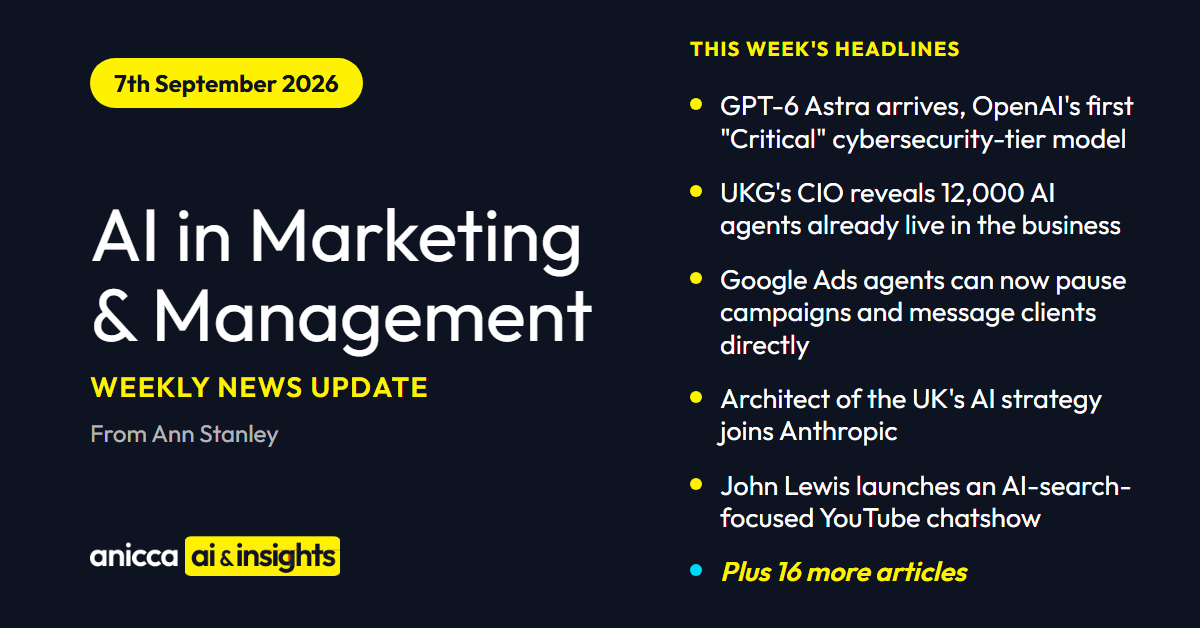
AI in Marketing & Management (7th Sep 26): GPT-6 Astra Arrives as UKG Runs Its Workforce on 12,000 AI Agents
OpenAI has launched GPT-6 Astra, the first model it has classified as meeting a Critical cybersecurity risk threshold on release, while UKG’s chief information officer has put more than 12,000 internal AI agents to work across the business and Google Ads connectors now let an agent pause campaigns and draft client emails without anyone opening the Google Ads interface. Matt Clifford, the architect of the UK’s AI strategy, has joined Anthropic, and John Lewis is building an online chatshow purely to be found by AI search. Below, we cover what has changed across AI News and Tools, Marketing, Management, E-commerce and Agentic Commerce, and the Other Sectors picking up AI deployments of their own this week.
Table of Contents
- GPT-6 Astra: a new generation of intelligence
- Architect of UK’s AI strategy joins Anthropic
- Introducing agentic video understanding with Gemini
- Google starts September with AI momentum after longest losing streak in over a decade
- What happens to PPC when you stop managing Google Ads through Google Ads
- John Lewis launches YouTube chatshow to improve AI search results
- Google Ads labels AI-generated store rating review summaries
- The B2B buyer journey now starts in AI search
- Marketing metrics you can trust to steer your campaigns
- The age of Generative Engine Optimisation
- UKG’s CIO says HR tech is AI’s next big bet, with 387 AI tools and 12,000 agents already live
- AI will make businesses vanilla, human instinct will matter more
AI in E-commerce, Retail and Agentic Commerce
- Amazon Alexa can now alert you when something new might tempt you to shop
- Anthropic unveils Claude features focused on agentic commerce
- Which AI sources are sending the most referral traffic to online retailers
- The race to own AI shopping
- Stripe, Worldpay, PayPal, Square and Adyen lead the way amid omnichannel payments platform boom
AI for Other Sectors and Industries
- PUBLIC SECTOR: Polimill builds Japan’s next-generation public AI infrastructure
- PUBLIC SECTOR: Microsoft Fabric arrives in GCC High to build the data foundation for government AI
AI News, Tech & Tools
GPT-6 Astra: a new generation of intelligence
Source: openai.com | OpenAI | 2 September 2026
OpenAI has launched GPT-6 Astra, which it calls its most intelligent and aligned model yet, saturating FrontierMath Tier 4 with a 98 per cent score, ARC-AGI-3 with 99.9 per cent, and ExploitBench with a perfect 100 per cent. Astra is rolling out today to a limited set of organisations and will reach all ChatGPT Plus, Pro, Business and Enterprise users over the coming days, alongside availability through the OpenAI API, Microsoft Azure and AWS Bedrock. Standard API pricing is $10 per million input tokens and $50 per million output tokens.
The significant part is the safety classification. OpenAI says Astra is the first model to meet the “Critical” threshold for cybersecurity capability under its Preparedness Framework, after the model achieved a 100 per cent success rate on ExploitBench, against 78.5 per cent for its predecessor GPT-5.6 Sol, and discovered two previously unknown zero-day vulnerabilities during internal testing, which OpenAI is now disclosing to the affected software maintainers. Advanced tasks such as building proof-of-concept exploits remain restricted to vetted testers through OpenAI’s Daybreak programme for now.
Why it matters
This is the first time a major lab has classified its own model as meeting a “Critical” risk threshold on release, not a marketing claim, a formal safety designation. For any business running Claude, Gemini or GPT models near sensitive systems, Astra’s jump in offensive security capability is also a jump in what a poorly secured or misused deployment could do, governance and access controls matter more with this release than with any previous one.
Architect of UK’s AI strategy joins Anthropic
Source: theguardian.com | The Guardian | 2 September 2026
Matt Clifford, 41, who drafted the UK government’s AI action plan and advised both Keir Starmer and Rishi Sunak, has joined Anthropic as managing director, international affairs, a year after stepping down from his unpaid role as the government’s AI opportunities adviser. He will lead Anthropic’s engagement with governments outside the US, including the UK, Europe, Asia-Pacific and India, while remaining chair of the government-backed Advanced Research and Invention Agency and of Entrepreneurs First, the venture firm he co-founded.
A campaign group has raised “revolving door” concerns about the move, part of a now well-established pattern: Nick Clegg went from deputy prime minister to Meta in 2018, Rishi Sunak took advisory roles at Microsoft and Anthropic after leaving Downing Street, and former chancellor George Osborne joined OpenAI.
Why it matters
Clifford will effectively be negotiating with the same governments he recently advised on AI policy, on Anthropic’s behalf. For any UK business tracking how AI regulation is likely to develop, watch which governments Clifford engages with first, that is a reasonable early signal of where Anthropic expects the next major policy conversations to happen.
Introducing agentic video understanding with Gemini
Source: blog.google | Google | 1 September 2026
Google has launched agentic video understanding across Gemini 3.7 Flash, 3.6 Flash and 3.5 Flash-Lite, letting the model dynamically scan and search video segments instead of processing every frame at a fixed rate. Google reports the approach cuts token consumption by up to 88 per cent and analysis costs by up to 66 per cent, while improving accuracy by up to 7 per cent, gains that are most pronounced on long-form video, from ten-minute how-to guides to 90-minute lectures.
The feature is live now for video uploads and YouTube videos through the Gemini API in Google AI Studio and the Gemini Enterprise Agent Platform, activated by setting the API configuration to “agentic”.
Why it matters
Video analysis at scale has been expensive enough that most marketing teams only sampled it. An 88 per cent drop in token consumption changes that maths, brand safety review, competitor ad monitoring, and UGC moderation across large video libraries all become viable to run continuously rather than on a spot-check basis.
Google starts September with AI momentum after longest losing streak in over a decade
Source: cnbc.com | CNBC | 2 September 2026
Google shares entered September having just ended a four-month losing streak, the longest since 2015, before a run of good news. The company launched Gemini 3.8 Flash, its third Flash model release in six weeks, alongside a new cybersecurity model aimed at government and enterprise customers, Berkshire Hathaway CEO Greg Abel offered a public vote of confidence in Alphabet’s AI position, and a federal judge rejected the Justice Department’s push to force Google to sell its ad exchange.
The turnaround follows a difficult summer in which Google lost ground in the AI model race, saw high-profile departures, and underwent a significant restructuring inside DeepMind.
Why it matters
None of this changes what Google Ads or Search actually do day to day, but a company under this much competitive and legal pressure has strong reasons to move fast on both model releases and product changes to rebuild confidence. Expect the pace of Google Ads and Search announcements to stay high through autumn.
AI in Marketing
What happens to PPC when you stop managing Google Ads through Google Ads
Source: searchenginejournal.com | Search Engine Journal
Google Ads MCP connectors now let an AI agent pause underperforming ad groups, summarise overnight spend across every account, and draft a client explanation email, all without a human logging into the Google Ads interface. MCP, the Model Context Protocol, gives an AI assistant a curated, permissioned way to read live data from a specific tool and take real actions inside it, the same principle as a standard API, but built for agents rather than software. The agent only sees the data and actions it has explicitly been given permission to handle.
The article draws a direct comparison with Google Ads Scripts in 2012, when PPC practitioners first got programmatic control over accounts with almost no guardrails, and some automations ran unchecked until they caused real damage. MCP connectors hand agents far more capability than Scripts ever did, including natural language instructions rather than code.
Why it matters
The 2012 comparison is the part worth sitting with. Scripts taught the industry that automation without review causes expensive mistakes at machine speed. Before letting an agent pause campaigns or message clients unsupervised, agencies need the same kind of guardrails Scripts eventually forced on the industry, approval thresholds, spend caps, and a human in the loop on anything client-facing.
John Lewis launches YouTube chatshow to improve AI search results
Source: theguardian.com | The Guardian | 3 September 2026
John Lewis is launching an online chatshow and social media studio built specifically to make itself and its products more visible to chatbots and more prominent in AI search results. The Gift List “vodcast”, hosted by TV presenter Angela Scanlon with Louis Theroux as the first guest, will run six episodes on YouTube up to Christmas, with clips spread across other social platforms, following the success of sister chain Waitrose’s Dish podcast.
Outgoing John Lewis boss Peter Ruis said that a year ago just 0.3 per cent of the department store’s customers were searching for products via AI large language models such as ChatGPT, and that figure has already risen to 2.5 per cent, growing exponentially across all age groups. AI models tend to prioritise third-party advice and live content when forming their answers, which the Guardian notes is forcing retailers to rethink their marketing plans.
Why it matters
A rise from 0.3 per cent to 2.5 per cent in a year is the kind of number that should be moving budget, not just raising eyebrows. John Lewis’s response is not an SEO tweak, it is a genuine content studio built to feed AI systems the third-party, conversational content those systems already prefer over branded copy.
Google Ads labels AI-generated store rating review summaries
Source: seroundtable.com | Barry Schwartz | 1 September 2026
Google Ads has started labelling a new “What customers love” section within sponsored search results as “AI-generated from the store rating reviews,” spotted by Sachin Patel and reported by Barry Schwartz at Search Engine Roundtable. It follows Google’s existing use of AI-generated snippets and summaries elsewhere in Google Ads, including AI-written product descriptions in Shopping ads and AI-generated summaries of store ratings that have been running for some time.
The labelling itself is new, even though the underlying AI summarisation is not, suggesting Google is being more explicit about disclosing where AI has written the copy shoppers see next to a paid listing.
Why it matters
Retailers do not control the wording in these AI-generated summaries, only the underlying review data feeding them. If your store ratings are thin or outdated, that is now visibly shaping what shows up as an AI-written summary next to your ad. Keeping review volume and recency healthy has just become a paid media concern, not only an organic one.
The B2B buyer journey now starts in AI search
Source: thedrum.com | Research by Gilroy, published via The Drum | 1 September 2026
Research from marketing agency Gilroy, based on analysis of 555,973 online opinions from UK B2B marketing and revenue leaders, found that 67 per cent say buyers typically research solutions through AI search tools before ever speaking to a salesperson, well ahead of events and webinars at 13 per cent and traditional search engines at 9 per cent. ChatGPT is the most cited platform during research, named by 42 per cent, followed by Gemini at 17 per cent, with Claude and Perplexity taking smaller shares.
Despite that shift, 77 per cent of the leaders surveyed said they are not confident their organisation can adapt its marketing strategy to stay visible and competitive as AI search evolves.
Why it matters
A 67 per cent to 77 per cent gap, most buyers now researching via AI, most marketers not confident they can respond, is the real story here, not the AI adoption number itself. B2B content built for a human reading a landing page is not automatically the content an AI model chooses to summarise when a buyer asks it to compare suppliers.
Marketing metrics you can trust to steer your campaigns
Source: blog.google | Google Ads | 2 September 2026
In the latest Ads Decoded episode, Google’s Ginny Marvin sits down with John Chen, senior director of product management for Ads Measurement, to address a problem most marketers know well: attribution, incrementality testing and media mix modelling often produce conflicting answers about what is actually working. The episode covers building a measurement approach across all three, capturing longer purchase journeys with Qualified Future Conversions, and why treating media spend like planting seeds beats chasing short-term ROAS.
A bonus episode features Patrick Gilbert and Nechama Teigman of AdVenture Media walking through Meridian, Google’s open-source media mix modelling tool, covering how AI coding tools have lowered the technical barrier to running it and why data variance matters more than budget size when planning a test.
Why it matters
The “measurement stack” framing matters because none of attribution, incrementality or MMM is reliable alone. If your reporting still leans on one of the three in isolation, particularly last-click attribution, this is a prompt to build the comparison rather than trust a single number.
The age of Generative Engine Optimisation
Source: deloitte.com | Deloitte Digital Switzerland
Deloitte Digital Switzerland has published its own view on Generative Engine Optimisation, arguing that AI is becoming the new front door to brand discovery across consumer goods, retail, medical devices, financial services and luxury. Deloitte’s GEO Assessment measures five things: how often a brand is mentioned in AI answers, its share of the overall conversation, sentiment, whether it is a top recommendation, and how much of its narrative it controls versus third parties, combined into what it calls an AI Visibility Index.
Among the figures Deloitte cites, 51 per cent of B2B software buyers now start their research with AI chatbots, brands ranking first on Google can appear in under 20 per cent of AI answers for the same queries, and Deloitte says it has found false information in 7 per cent of AI responses it has tested.
Why it matters
The 7 per cent hallucination figure and the under-20-per-cent visibility gap for page-one Google rankings are worth remembering even without buying Deloitte’s assessment product: ranking well in traditional search and being visible in AI answers are genuinely two different jobs, and neither guarantees the other.
AI in Management
UKG’s CIO says HR tech is AI’s next big bet, with 387 AI tools and 12,000 agents already live
Source: fortune.com | John Kell | 2 September 2026
Prakash Kota, chief information officer at HR software company UKG, has overseen the launch of 387 internal AI applications built from more than 1,400 employee-submitted ideas, alongside more than 12,000 AI agents now running inside the business. Kota joined UKG in April 2025 after a 20-year career at Autodesk, the last seven as its CIO, and within his first 90 days centralised UKG’s technology department across the two legacy businesses formed when Kronos and Ultimate Software merged in October 2020. Within six months he had consolidated the company’s ERP onto Microsoft and its CRM onto Salesforce.
ChatGPT Enterprise and Google’s Gemini Enterprise are now available to all 14,000 UKG employees, and the product and engineering teams are using Anthropic’s Claude Code directly. Kota said he is deliberately avoiding multi-year software contracts because the technology is moving too quickly to lock the business in. “In the AI era, everyone is talking about how work will be reshaped, how do employees and workers coexist?” he said. “HR tech is going to be a huge area of investment in every company.”
Why it matters
This is one of the clearest public numbers yet on internal agent adoption at scale, and it comes from the company selling HR software to everyone else. If UKG needs 12,000 agents to run its own operations, agencies advising clients on AI transformation should expect client-side IT and HR teams to be asking harder questions about agent governance and vendor lock-in, not just chatbot pilots.
AI will make businesses vanilla, human instinct will matter more
Source: computing.co.uk | Computing UK
Mike Anderson, who has spent more than 40 years leading through technological change, including board roles at News UK and Associated Newspapers, helping launch Metro, and founding digital transformation consultancy Chelsea Apps Factory for clients including Vodafone, KPMG, Waitrose and Transport for London, argues that as AI standardises what businesses and services can do, human judgement becomes the actual point of difference. Anderson, now co-founder of AI incubator Yeti and author of Serious Fun in Business: A Human Algorithm, calls this the Human Algorithm.
“If you consider that AI will eventually make all businesses and services vanilla and capable of doing the same things, then the point of difference is going to be humans,” Anderson said, drawing on lessons from three career shifts he has lived through: print to digital, desktop to mobile, and digital to AI.
Why it matters
Anderson has been through this pattern before and watched genuine differentiators get commoditised each time. His argument is not anti-AI, it is a reminder that once every competitor has access to the same AI capability, instinct, judgement and relationships become the actual differentiator again, not the technology itself.
AI in E-commerce, Retail and Agentic Commerce
Amazon Alexa can now alert you when something new might tempt you to shop
Source: techcrunch.com | Sarah Perez | 1 September 2026
Amazon has launched “Update Me When,” a new feature inside its Alexa for Shopping AI assistant that sends personalised notifications when something new or relevant happens that could prompt a purchase, a favourite brand launching a product line, a new season of a favourite show, a followed artist announcing a tour, or an author releasing a new book. Consumers currently have to configure these alerts themselves.
Historically Alexa has mainly answered direct product questions. This launch, alongside several other AI shopping features Amazon revealed the same day, marks a shift towards anticipating a purchase moment before the shopper thinks to ask.
Why it matters
This moves Alexa from a reactive search tool to a proactive discovery channel, which is a genuinely different kind of visibility to compete for. Brands used to optimising for search queries now need to think about which triggers, a launch, a restock, a seasonal moment, are worth surfacing to a shopper who never searched for them at all.
Anthropic unveils Claude features focused on agentic commerce
Source: digitalcommerce360.com | Digital Commerce 360 | 2 September 2026
Anthropic has released a set of prebuilt shopper and merchant-facing agent designs for Claude, calling the package a “blueprint” in an announcement dated 2 September. Early users putting the new agentic commerce capabilities to use include Accenture, Mastercard, Visa and Shopify, positioning Anthropic directly against OpenAI and Google in the race to power agentic shopping. Anthropic said the designs build on what it has already learned watching retailers build and use custom agents on its existing platform.
The blueprint is designed to give a retailer a working starting point for conversational product discovery, rather than each merchant building agent infrastructure from scratch.
Why it matters
A named client list this strong, Visa, Mastercard, Shopify and Accenture, on day one suggests Anthropic is not experimenting quietly here. Retailers weighing which AI platform to build agentic commerce around now have three credible options with live enterprise partners, this is becoming a real vendor decision, not a future one.
Which AI sources are sending the most referral traffic to online retailers
Source: digitalcommerce360.com | Digital Commerce 360 | 3 September 2026
Adobe Analytics found AI-associated referral traffic to ecommerce sites rose 62 per cent year on year in July, with shoppers referred by AI tools generating 53 per cent more revenue per visit than other shoppers. New AI Commerce Rankings data from Digital Commerce 360 and ReFiBuy, drawn from the Top 1000 Database of North American online retailers by annual web sales, shows which large language models account for the largest shares of that AI traffic, with ChatGPT and Claude both seeing their shares shift between the first and second quarter of 2026.
Overall referral volume from AI sources has not yet overtaken traditional search, but the conversion gap is where Digital Commerce 360 says merchants should be paying attention.
Why it matters
A 53 per cent higher revenue per visit is not a rounding error. Even while AI referral volume stays below search’s, the customers arriving through it are converting at a rate worth tracking separately in analytics, rather than folding into a generic “other referral” bucket where the signal gets lost.
The race to own AI shopping
Source: practicalecommerce.com | Armando Roggio | 6 September 2026
Practical Ecommerce argues that Anthropic’s new agentic commerce blueprint makes a specific approach practical for retailers: offering conversational product discovery through Claude while retaining full control of their own catalogue, checkout, customer relationship and brand experience. The alternative, letting a shopping agent complete transactions entirely outside the retailer’s own site, risks the retailer becoming invisible infrastructure behind someone else’s assistant.
Roggio frames the current moment as ecommerce entering a race to own the AI interface through which its own customers actually shop, rather than simply reacting to whichever agent shows up at checkout.
Why it matters
This is the practical decision retailers actually need to make right now, not whether to support AI shopping agents, but whether to build the integration on their own terms or wait for a third-party agent to intermediate the relationship for them. The businesses moving first get to set the terms.
Stripe, Worldpay, PayPal, Square and Adyen lead the way amid omnichannel payments platform boom
Source: retailtechinnovationhub.com | Scott Thompson | 7 September 2026
Juniper Research forecasts that total revenue from omnichannel payment platforms will grow 57 per cent over the next five years, from $56 billion in 2026 to $108 billion by 2031, driven by merchants seeking to cut the operational burden of managing payments across channels. Juniper ranked the 16 leading omnichannel payment platforms globally, including Stripe, Worldpay, PayPal, Square and Adyen, on channel coverage, feature range and future business prospects.
Integration with third-party systems, particularly enterprise resource planning software, is flagged as the differentiator that matters most to merchants choosing between platforms, more than raw feature count.
Why it matters
Payments infrastructure rarely makes marketing news, but it directly shapes what agentic commerce and AI shopping assistants can actually do at checkout. A retailer on a fragmented, poorly integrated payments stack will struggle to support agent-initiated purchases regardless of how good its AI strategy looks everywhere else.
AI for Other Sectors and Industries
PUBLIC SECTOR: Polimill builds Japan’s next-generation public AI infrastructure
Source: openai.com | OpenAI | 31 August 2026
Japanese company Polimill has built QommonsAI, an OpenAI-powered platform now used by roughly 1,050 municipalities and about 550,000 public employees across Japan, covering assembly response, public services, social welfare and legal search. Polimill started with Surfvote, a citizen platform for exchanging views on politics and society, but found that local government teams were too consumed by daily operations to properly reflect citizens’ input, so it built a generative AI platform for public sector workflows instead, releasing QommonsAI in October 2024.
A central challenge was fragmented data, each municipality has its own workflows and document formats, so Polimill standardised assembly minutes nationally and used AI to add metadata and build a search foundation that works across municipalities and time periods. Development time has been shortened three to five times using OpenAI’s Codex, according to Polimill.
Why it matters
1,050 municipalities and 550,000 public employees is a genuinely large, verifiable deployment of AI inside government, not a pilot. The fragmented-data problem Polimill solved, standardising formats before applying AI, is the same blocker most private-sector organisations hit before AI can be useful across departments.
PUBLIC SECTOR: Microsoft Fabric arrives in GCC High to build the data foundation for government AI
Source: microsoft.com | Microsoft | 2 September 2026
Microsoft Fabric, its unified data and AI platform, becomes available in public preview for US Government Community Cloud High customers from 2 September 2026, with general availability from 1 October 2026. Fabric brings data integration, analytics, databases, real-time intelligence and business intelligence together in a single platform built on OneLake, aimed at government agencies whose data is currently scattered across clouds, databases and operational systems in ways that limit what AI agents can actually access.
Microsoft frames this as the step agencies need before moving from isolated AI experiments to production-ready agent systems grounded in trusted organisational knowledge, with feature availability varying by workload as the rollout expands.
Why it matters
Government agencies have been as constrained by fragmented data as any private business, arguably more so given compliance requirements. A dedicated GCC High release signals Microsoft expects serious agentic AI demand from government customers specifically, not just a compliance checkbox for an existing product.
Key Takeaways
- UKG has 12,000 AI agents and 387 internally built AI tools live already, treat that as a benchmark for what “AI adoption at scale” actually looks like inside a mid-size enterprise
- Google Ads MCP connectors let agents pause campaigns and message clients directly, put spend caps and approval thresholds in place before letting an agent act unsupervised, learning the lesson of 2012’s Scripts era
- John Lewis’s AI-search traffic grew from 0.3 per cent to 2.5 per cent of customers in a year, check whether your own analytics are even tracking AI referral traffic as its own segment yet
- Google Ads is now labelling AI-generated “What customers love” summaries built from your store reviews, keep review volume and recency healthy, it is shaping paid listing copy you do not control
- 67 per cent of B2B buyers research via AI search before contacting sales, but 77 per cent of marketers are not confident they can adapt, audit whether your content is written to be summarised by an AI model, not just read by a person
- AI-referred shoppers spend 53 per cent more per visit than other traffic, according to Adobe Analytics, break this out as its own segment in reporting rather than folding it into general referral traffic
- Anthropic, OpenAI and Google now all have named enterprise partners in agentic commerce, this has moved from experimental to a real platform decision retailers need to make this quarter
Frequently Asked Questions
Should we let an AI agent manage parts of our Google Ads account directly?
Only with clear guardrails in place first. MCP connectors give agents real permission to pause campaigns and take other actions, so set spend thresholds and approval steps before switching anything to autonomous, and keep a human reviewing any client-facing output such as drafted emails.
How do we know if we are visible in AI search results, not just Google’s classic search?
Start by asking the major AI tools, ChatGPT, Gemini and Claude, direct questions a customer would ask about your category, and note whether your brand appears and how it is described. Deloitte’s data this week is a useful reminder that ranking first on Google does not guarantee AI visibility, they are genuinely separate problems.
Is agentic commerce worth building for now, or worth waiting on?
With Anthropic, OpenAI and Google all naming live enterprise partners this week, waiting no longer avoids the decision, it just means someone else decides how your brand shows up in agentic shopping first. Practical Ecommerce’s framing is right: the question is whether you control that integration or a third party does.
Where should we be tracking AI referral traffic in our own analytics?
As its own segment, separate from generic referral or direct traffic. With AI-referred shoppers converting at meaningfully higher value per visit according to Adobe’s data, folding that traffic into a catch-all bucket means losing the signal that would justify investing in it further.
Conclusion
The theme running through this week is that agentic AI has stopped being a pilot conversation in three separate places at once, inside Google Ads accounts, inside enterprise workforces like UKG’s, and inside retail checkout. None of it removes the need for human oversight, if anything the Scripts-era lesson in this week’s PPC story is a warning about exactly that. Businesses that put governance in place now, spend caps on agents, clear content built for AI summarisation, and a real decision on agentic commerce integration, will be in a stronger position than those still waiting for the technology to settle down. It will not settle down, it is moving faster each week.
Need help adapting your AI marketing strategy? Contact the Anicca team for expert guidance.

Join the Thursday AI Club
A hands-on AI club for marketers and managers. Fortnightly sessions, 2-5pm UK: Hour 1 is an open Q&A on any AI question; Hours 2-3 split into a workshop track (for newbies) and an advanced track (live demos and deeper questions).
Led by Ann Stanley, Darren Wynn, James Allen.
Membership: £40/month or £400/year
This roundup is compiled from publicly available sources using AI-assisted research. While we review every article for accuracy, our analysis reflects our interpretation of the original reporting. We strongly encourage readers to click through to the original sources linked throughout this post for full context and detail. If you spot anything that needs correcting, please let us know.