SEO in a Zero-Click World: What’s Actually Working in 2026
The SEO landscape has transformed dramatically. If your organic traffic graph looked more like a plateau than a growth curve last year, you’re not alone. The reality is stark: 60% of Google searches now result in zero clicks. But before you abandon your SEO strategy, understand this—SEO isn’t dead, it’s just evolved.
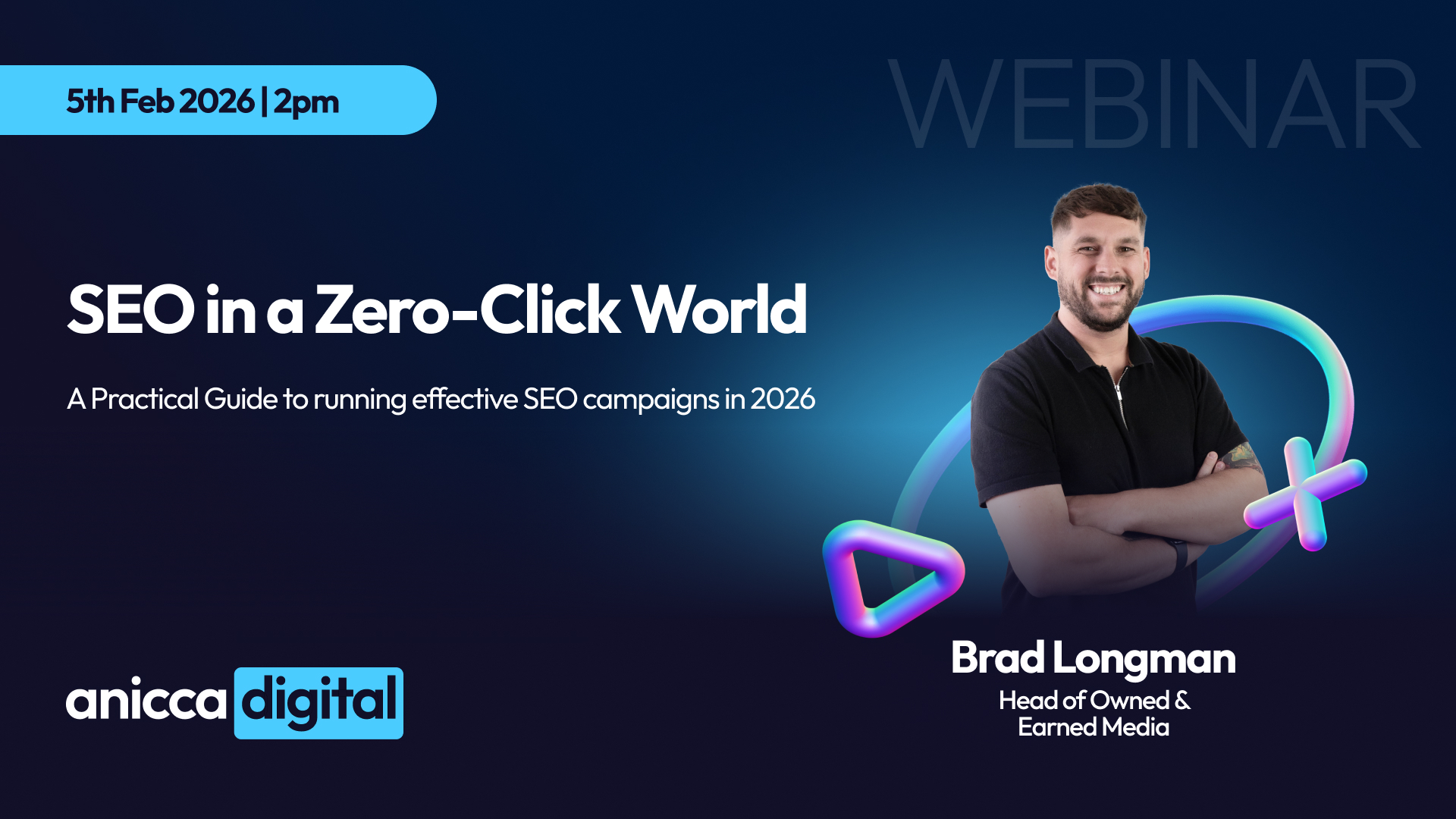
At Anicca, we’ve been helping e-commerce businesses navigate these changes for 19 years. In our recent webinar, Brad, our Head of Owned and Earned Media, broke down what’s actually working in SEO right now and how businesses can adapt their strategies to maintain visibility and drive results.
The Zero-Click Reality
According to 2024 data from SparkToro and Datos, approximately 60% of searches in Europe resulted in no clicks whatsoever. In the US, the figure was similar at 58.5%. Of the 40% that did click, only 74% selected an organic result. This was before AI Overviews were rolled out with real intensity in the UK, so these numbers are likely higher.
What’s driving this shift? Search results have become extraordinarily crowded. A typical product search now displays shopping ads, AI overviews, sponsored products, video carousels, rich snippets, and local packs—all before a user sees the first traditional organic result. In many cases, users find their answers without ever leaving Google.
Position Matters More Than Ever
Understanding click-through rates by position is crucial for prioritising your SEO efforts. Research from Backlinko reveals telling statistics:
· Position 1 captures approximately 27.6% of clicks
· Position 2 receives around 15%
· Position 3 gets about 11%
· Below position 3, you’re receiving less than 10% of clicks
· Position 7 captures less than 4% of clicks
This means if you’re ranking on page one but sitting at position nine, you’re barely getting any traffic. The strategic focus should be on moving existing page one rankings from positions 4-10 up to positions 1-3, rather than trying to push page four rankings onto page one.
The Fundamentals Still Matter
Despite the noise around AI and generative engine optimisation, the fundamentals of SEO remain critical. You can pass Core Web Vitals, have perfect structured data markup, and earn links from major publications, but if you’re not specifically optimising your pages for search queries, search engines won’t know when to show your website.
The basics that drive results include:
Title Tags: Does your primary keyword appear naturally in your title? Is it compelling enough to earn clicks?
URL Structure: Does your artificial grass page sit at /artificial-grass or /page-xyz? Logical URLs matter.
Meta Descriptions: While Google rewrites these 90% of the time, a well-crafted description with keywords, USPs, and a call-to-action will serve you well in the remaining cases.
H1 Tags: When Google doesn’t use your page title in search results, it defaults to your H1. Ensure alignment between these elements.
Page Content: Are you fully covering the topic? Are you linking to supporting content? Are you building a comprehensive enough picture that users don’t need to return to Google?
Match Intent to Content Type
Understanding user intent is critical. Google classifies keywords based on what it believes a user wants to accomplish: commercial, navigational, transactional, or informational queries each trigger different types of results.
Search for “kitchen bins” and you’ll see category pages dominating results; Google recognises commercial intent. Search “how to lay artificial grass” and you’ll find guides, videos, and tutorials—informational intent. If you’re trying to rank a blog post for a commercial keyword, or a product page for an informational query, you’re fighting an uphill battle. For e-commerce businesses, this alignment is particularly crucial for maximising visibility and conversions.
The AI Search Challenge
Google AI Overviews and ChatGPT have fundamentally changed how people search. Google wants to keep users on its properties—whether that’s staying on the search results page or moving to YouTube. AI models have the same objective.
The challenge with optimising for AI is its inconsistency. Recent research by SparkToro found there’s less than a 1 in 100 chance that ChatGPT or Google’s AI Mode would provide the same list of brands twice, even for identical queries. Brad tested this himself with artificial grass recommendations and received completely different results within 30 seconds of asking the same question.
What does this mean practically? You can’t reliably track your AI visibility the way you track traditional rankings. Instead, focus on ensuring AI models understand your business in relation to specific topics. Feed them comprehensive, authoritative content that fills gaps in your market. While you can’t guarantee placement, you can maximise the chances AI recognises your expertise.
Moving Forward
The rise of zero-click searches doesn’t signal the death of SEO—it signals evolution. Success in 2025 requires understanding that fewer clicks doesn’t mean less value. It means being more strategic about which battles to fight, which positions to prioritize, and how to create content that genuinely serves user needs whether they click through or not.
At Anicca, we help businesses navigate these complexities with data-driven strategies focused on what actually moves the needle. The fundamentals haven’t changed—they’ve just become more important than ever.
Want to learn more about SEO marketing strategy and AI tools? Check out our webinar resources for more practical insights you can use straight away.
Thursday AI Club
A hands-on AI club for marketers and managers. Fortnightly 3-hour sessions: Hour 1 is an open Q&A on any AI question; Hours 2-3 split into a workshop track (for newbies) and an advanced track (live demos and deeper questions).
Led by Ann Stanley, James Allen.
Membership: £40/month or £400/year
Join the Thursday AI Club →