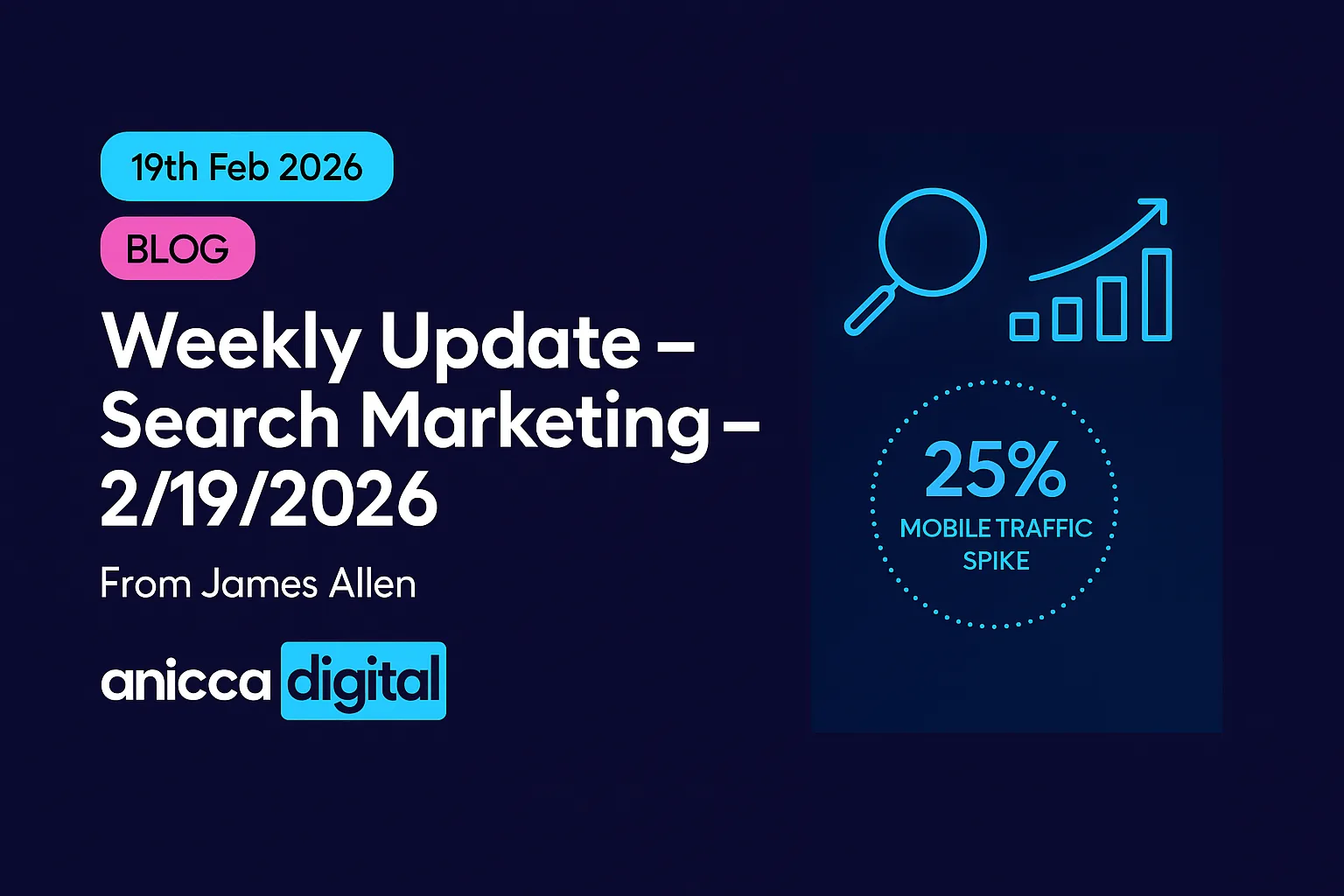
Weekly Update – Search Marketing – 19th February 2026
Estimated reading time: 19 minutes
This week’s SEO news roundup explores the rapid changes in AI-powered search, analytics, and advertising. Discover how Google’s AI Overviews are reshaping organic traffic, why Meta and TikTok are embedding AI deeper into their ad platforms, and what the latest research means for tracking search visibility and brand recommendations. With AI-driven updates coming thick and fast, it’s vital for marketers to stay agile and informed to keep their strategies ahead of the curve.
Table of Contents
AI Search & SEO Developments
- Google launches more visible links in AI Overviews and AI Mode
- Google Search Console AI-powered configuration rolling out
- Google’s Jeff Dean: AI Search relies on classic ranking and retrieval
- Rand Fishkin proved AI recommendations are inconsistent – here’s why and how to fix it
- ChatGPT Has 12% of Google’s Search Volume but Google Sends 190x More Traffic to Websites
- Anonymized Queries Make Up Nearly Half of Google Search Console Traffic
- Update: AI Overviews Reduce Clicks by 58%
- Gemini 3 wiped out 46% of cited domains and left 1 in 10 AI Overviews without any sources
- AI Visibility Tracking for Small Teams: A Practical Guide
- Is Your Brand Visible in AI Search Results? Here’s How to Find Out
- How Semrush MCP Connects Your AI Tools to Live Marketing Data
- How to Choose the Best Prompts to Monitor Your AI Search Visibility
- How to Track AI Overviews: Mentions, Citations, Click Loss, and the Traffic Google Won’t Show You
Analytics & Measurement
- Google Search Console AI-powered configuration rolling out
- Google Ads adds beta data source integrations to conversion settings
- Anonymized Queries Make Up Nearly Half of Google Search Console Traffic
- How Semrush MCP Connects Your AI Tools to Live Marketing Data
PPC, Paid Media & Ad Platforms
- Google shifts Lookalike to AI signals in Demand Gen
- Meta adds Manus AI tools into Ads Manager
- TikTok launches AI-powered ad options for entertainment marketers
- Google Ads adds beta data source integrations to conversion settings
AI Tracking & Practical Guides
- AI Visibility Tracking for Small Teams: A Practical Guide
- Is Your Brand Visible in AI Search Results? Here’s How to Find Out
- How to Choose the Best Prompts to Monitor Your AI Search Visibility
- How to Track AI Overviews: Mentions, Citations, Click Loss, and the Traffic Google Won’t Show You
Google & Platform Feature Updates
- Google Search Console AI-Powered Configuration Goes Live
- Hover Pop Up Links Official In Google AI Overviews & AI Mode
Strategic Insights
- Strategic Directions: Navigating the AI-Driven Search and Advertising Landscape
- Key Takeaways
- Frequently Asked Questions
- Conclusion
AI Search, Analytics, and Ad Platform Shifts: What Search Marketers Need to Know
The latest wave of search marketing news highlights the rapid evolution of AI-powered search, analytics, and advertising tools across Google, Meta, TikTok, and leading SEO platforms. Google is rolling out more visible links within AI Overviews, launching natural language analytics in Search Console, and shifting audience targeting in Demand Gen to AI-driven signals. Meanwhile, Meta and TikTok are embedding AI deeper into ad management, and new research reveals the growing impact of AI on search visibility, traffic measurement, and brand recommendations. For agencies and marketers, these changes signal a need for more agile strategies, closer monitoring of AI-driven features, and a renewed focus on both technical and brand authority. The following updates and analysis break down what’s changing, what it means for SEO and PPC professionals, and how to stay ahead in a market where AI is reshaping every aspect of search and advertising.
Google launches more visible links in AI Overviews and AI Mode
Google has introduced a significant update to AI Overviews and AI Mode, making links within these AI-generated answers much more prominent. Now, when users hover over a link on desktop, a pop-up card appears with additional details about the linked website. This enhancement is designed to encourage more engagement with source content and facilitate easier navigation for users seeking to verify or explore information further. For digital marketers and publishers, this could be a pivotal shift, potentially increasing referral traffic from Google’s AI-powered experiences, which have previously been criticised for keeping users within the search ecosystem and reducing click-throughs.
For SEO professionals, the move underscores the growing importance of optimising content not just for traditional rankings, but also for inclusion and citation within AI Overviews. High-quality, authoritative, and well-structured content is more likely to be referenced by Google’s AI systems, and now, with increased link visibility, there’s a greater opportunity to reclaim some of the organic traffic previously lost to zero-click experiences. However, a key challenge remains: there are still no direct measurement tools in Search Console to track traffic specifically from AI Overviews, so marketers will need to rely on indirect analytics signals and careful monitoring of referral patterns.
At a strategic level, agencies should brief clients on these changes and consider updating reporting practices to reflect new engagement opportunities. The introduction of hover pop-up links also signals Google’s intent to address publisher concerns around attribution and visibility in AI-driven search results. As AI Overviews continue to expand, brands that invest in content quality, technical SEO, and entity optimisation will be best positioned to benefit from these evolving user journeys. Proactive communication and education with stakeholders will be crucial as the boundaries between traditional and AI-powered search continue to blur.
Google Search Console AI-powered configuration rolling out
Google has officially launched its AI-powered configuration tool within Search Console, now available to all users. This feature allows marketers to use natural language queries to customise performance reports, removing the need for manual filter setup and making it easier to surface actionable insights. By simply describing the analysis required, AI configures the Performance report selecting metrics, applying filters, and setting up comparisons on the fly. This marks a major step forward in making analytics more accessible and intuitive, especially for teams that may not have the resources or time for deep manual analysis.
For search professionals, the implications are significant. Faster, more flexible reporting means less time spent on repetitive tasks and more time focused on interpreting trends and making strategic decisions. The tool’s ability to handle complex comparisons and filter configurations based on natural language input could help uncover insights that might otherwise be missed, particularly for those managing large or complex sites. While the feature is currently limited to the Performance report for Search results, it’s a clear indicator of Google’s commitment to embedding AI into every stage of the analytics process.
Agencies and in-house teams should encourage experimentation with this tool, as it can reveal new optimisation opportunities and help identify shifts in performance that may be linked to broader changes in search behaviour or algorithm updates. As AI continues to reshape analytics, staying ahead of these features will be crucial for demonstrating ROI and maintaining a competitive edge. Senior decision-makers should see this as a chance to streamline reporting workflows and empower their teams to focus on high-value analysis and strategic planning, rather than manual data wrangling.
Google shifts Lookalike to AI signals in Demand Gen
Google is transforming the way Lookalike audiences work in Demand Gen campaigns, shifting from strict targeting segments to AI-driven optimisation signals starting March 2026. Rather than limiting ad delivery to users within a predefined Lookalike pool, the new approach uses Lookalike tiers as guidance, allowing Google’s algorithms to expand reach to users predicted to convert. This mirrors the Optimised Targeting model and reflects a wider industry trend towards automation and AI-first audience expansion, as seen with Meta’s recent changes.
For PPC professionals, this shift means less granular control but potentially greater campaign scale and improved CPA or conversion volume. Advertisers can still opt out to retain legacy targeting, but the default will be the new signal-based model. This change requires a rethink of audience strategies, as the boundaries of targeting become more fluid and machine-led optimisation takes precedence. Early testing and close monitoring of performance will be vital to understand the impact on reach, cost, and conversion quality.
At a higher level, agencies should proactively communicate these changes to clients and prepare for increased automation in campaign management. This is not just a technical update; it’s a strategic shift that may affect budget allocation, reporting, and overall campaign objectives. Senior marketers will need to balance the benefits of broader reach and automation against the risks of reduced control and potential audience dilution. The key will be to test, analyse, and adapt quickly, ensuring that campaigns remain efficient and aligned with business goals as Google continues to prioritise machine-led optimisation.
Meta adds Manus AI tools into Ads Manager
Meta Platforms has integrated Manus AI directly into Ads Manager, providing advertisers with built-in automation tools for campaign research, reporting, and optimisation. Manus AI acts as an in-workflow assistant, helping users build reports, conduct audience research, and analyse campaign performance more efficiently. The rollout includes in-stream prompts and pop-up alerts to encourage adoption, signalling Meta’s commitment to embedding AI across its ad ecosystem and driving measurable returns from its AI investments.
For paid media professionals, this integration offers a practical opportunity to streamline workflows, uncover insights faster, and potentially improve campaign outcomes by leveraging AI-driven recommendations. The Manus AI assistant is designed to make everyday tasks (such as report building and audience segmentation) quicker and less resource-intensive, freeing up time for strategic analysis and creative optimisation. Early adopters may gain a competitive edge by identifying new efficiencies and optimisation opportunities before these tools become standard across the industry.
From a strategic perspective, agencies and brands should encourage their teams and clients to test Manus AI features early, as Meta is clearly prioritising tools that tie AI investment to measurable ad performance. Monitoring results and sharing best practices will be key as Meta continues to expand its AI capabilities. For senior marketers, the move signals a broader shift towards automation and data-driven decision-making in paid media management, making it essential to stay informed and agile as the landscape evolves.
TikTok launches AI-powered ad options for entertainment marketers
TikTok has introduced two new AI-powered ad formats for entertainment marketers in Europe, aimed at boosting engagement and conversions for streaming and ticketed content. The Streaming Ads format uses AI to personalise content based on user engagement, while the New Title Launch targets high-intent users using signals like genre preference and price sensitivity. With 80% of TikTok users reporting the app influences their streaming choices, these tools offer marketers a direct way to shape audience behaviour and drive measurable results.
For agencies and brands in the entertainment sector, these new ad types present a timely opportunity to turn cultural moments and viral trends into subscriptions, ticket sales, or higher viewership. The AI-driven formats enable more precise targeting and personalisation, helping marketers reach users most likely to convert. The rollout coincides with major industry events, reinforcing TikTok’s growing influence in entertainment marketing and its ability to connect brands with highly engaged, intent-driven audiences.
Marketers should consider integrating these new ad types into their campaigns to capitalise on TikTok’s viral reach and data-driven targeting capabilities. For senior decision-makers, the move highlights the importance of adapting to platform-specific innovations and leveraging AI to stay ahead of consumer trends. As TikTok continues to expand its advertising toolkit, brands that move quickly to test and optimise these formats will be best positioned to capture attention and drive ROI in an increasingly competitive digital landscape.
Google’s Jeff Dean: AI Search relies on classic ranking and retrieval
In a recent interview, Google’s chief AI scientist Jeff Dean clarified that AI-powered search still fundamentally relies on traditional ranking and retrieval systems. AI Overviews and AI Mode use classic search infrastructure to filter and rank tens of thousands of documents before generating responses. Visibility in AI search depends on meeting established quality, relevance, and freshness signals. Large language models (LLMs) do not bypass ranking or crawl prioritisation, but instead synthesise answers from a carefully curated set of high-quality sources.
For search marketers, this is a crucial reminder that the core principles of SEO remain as important as ever, even as AI-driven features become more prominent. Comprehensive, authoritative content and technical SEO best practices are still essential for inclusion in AI-generated results. Covering topics thoroughly and ensuring content is up-to-date are key to building topical authority and maintaining strong site health, both of which are rewarded by Google’s evolving ranking systems.
At a strategic level, this insight should reassure agencies and brands that investment in content quality, technical optimisation, and entity management remains foundational. While AI changes how answers are synthesised and presented, the competition to enter the underlying candidate set is still a search problem. Senior marketers should focus on building long-term authority and ensuring their digital assets are robust, as AI search experiences will continue to reward those who excel in both traditional and AI-driven ranking systems.
Rand Fishkin proved AI recommendations are inconsistent – here’s why and how to fix it
Rand Fishkin’s latest research reveals that AI-generated brand recommendations are highly inconsistent, with significant variability in which brands appear for the same prompts. The study found that fewer than 1 in 100 AI runs produced identical lists, highlighting the probabilistic nature of AI outputs. However, brands with strong, corroborated digital footprints achieved more consistent visibility, pointing to the importance of building confidence at every stage of the algorithmic pipeline – ensuring entity homes are clear, claims are corroborated by authoritative sources, and brand presence spans knowledge graphs, document indexes, and concept graphs.
For marketers, this research is a wake-up call to prioritise structured data, third-party validation, and consistent messaging across platforms. The key to reliable AI recommendations is not just tracking outputs, but actively optimising the inputs that AI systems use to evaluate brand authority and relevance. Agencies should audit clients’ digital presence, focus on entity optimisation, and encourage multi-source corroboration to improve AI visibility and move from inconsistent to consistent inclusion in AI-driven search and recommendation systems.
At a senior level, this is about more than just technical SEO. It’s about brand strategy, reputation management, and digital PR. Brands that invest in building a robust, multi-faceted digital footprint will see compounding advantages as AI systems increasingly rely on confidence and corroboration to make recommendations. Understanding and addressing the “cascading confidence” framework will be essential for brands aiming to achieve consistent inclusion in AI-driven search and recommendation systems, and for agencies looking to deliver measurable, long-term value.
Google Ads adds beta data source integrations to conversion settings
Google Ads has introduced a beta feature allowing advertisers to connect external data sources, such as BigQuery and MySQL, directly within conversion action settings. This integration aims to enrich conversion metrics with first-party data, improving measurement accuracy and campaign optimisation. By embedding data connections inside conversion settings, Google reduces friction for syncing offline or backend data, making advanced measurement accessible to a broader range of advertisers. Acessible to non-enterprise teams, operating without dedicated data engineering resources.
For agencies and brands, leveraging these integrations can help offset data loss from privacy changes, enhance bidding strategies, and drive stronger ROI. Marketers should explore connecting relevant databases to their Google tag, monitor the impact on performance signals, and adjust attribution models as needed. The ability to feed richer customer data directly into conversion tracking means smarter bidding, clearer attribution, and potentially stronger campaign outcomes.
At a strategic level, this move reflects the increasing importance of data integration and measurement as key differentiators among ad platforms. Senior marketers should ensure their teams are up to speed with the latest native data integration capabilities and are prepared to adapt measurement frameworks as privacy regulations and data availability continue to evolve. Staying current with these developments will be critical for maintaining a competitive edge and delivering actionable insights to clients.
ChatGPT Has 12% of Google’s Search Volume but Google Sends 190x More Traffic to Websites
A new Ahrefs study finds that while ChatGPT now handles 12% of Google’s search volume, Google still drives 190 times more traffic to websites. The analysis highlights that, despite the rapid growth of conversational AI, traditional search remains the primary driver of web visits. ChatGPT’s business model is built around keeping users in conversation, whereas Google’s model connects users to external websites, resulting in much higher click-through rates for organic search.
For marketers, this means that while optimising for AI search and LLM citations is increasingly important, classic SEO strategies and Google visibility remain essential for traffic generation. The research underscores the need for a balanced approach: invest in AI visibility and prompt tracking, but do not neglect the fundamentals of organic search. Brands that focus solely on AI optimisation risk missing out on the vast majority of traffic still driven by Google.
Agencies should use these findings to guide clients on resource allocation, ensuring efforts to appear in AI results complement, rather than replace, established SEO best practices. Senior decision-makers should be wary of overhyping the immediate impact of conversational AI on traffic generation and instead focus on holistic digital visibility. Combine traditional SEO with emerging AI strategies to maximise reach and engagement.
Anonymized Queries Make Up Nearly Half of Google Search Console Traffic
Ahrefs’ latest research reveals that nearly 50% of Google Search Console traffic now comes from anonymised queries, up from previous years. This trend poses significant challenges for marketers seeking granular keyword data and complicates performance analysis. As search behaviour shifts towards longer, more conversational queries (driven by AI search and changing user habits) Google’s privacy thresholds mean that a growing share of search traffic cannot be attributed to specific keywords.
For SEO professionals, this means that traditional keyword-level optimisation and reporting are becoming less effective. Marketers must increasingly rely on broader performance metrics, such as landing page data, engagement rates, and conversion tracking, to measure ROI and identify optimisation opportunities. The rise in anonymised queries also makes it harder to diagnose traffic changes or attribute performance shifts to specific campaigns or content updates.
Agencies should communicate these limitations to clients, set realistic expectations, and focus on actionable strategies which drive measurable results. Senior marketers should explore alternative data sources and tools to fill gaps in reporting and invest in analytics capabilities that provide a more holistic view of digital performance. The ability to adapt reporting and optimisation strategies to a world with less keyword data will be a key differentiator for successful search teams.
Update: AI Overviews Reduce Clicks by 58%
Ahrefs has updated its analysis on the impact of Google’s AI Overviews, finding that these AI-generated summaries now reduce organic clicks by 58%. As AI Overviews expand to more countries and languages, many websites are experiencing continued declines in organic search traffic. This trend highlights the growing importance of optimising for AI visibility and adapting content strategies to maintain relevance in an evolving SERP landscape.
For marketers, it’s critical to monitor traffic patterns, assess the impact of AI features on key pages, and explore new ways to earn citations or mentions within AI Overviews. The data suggests that traditional ranking positions are no longer a reliable predictor of traffic, as AI-generated answers increasingly satisfy user intent without requiring a click. This shift towards zero-click search means that visibility within AI Overviews is now a key metric for digital success.
Agencies should proactively communicate these changes to clients, adjust reporting to account for shifting click dynamics, and invest in strategies that enhance brand authority and topical relevance. For senior marketers, the findings reinforce the need for agile content strategies, robust analytics, and a willingness to experiment with new optimisation tactics. Staying informed and responsive to the evolving search ecosystem will be essential for maintaining and growing organic traffic in the age of AI.
Gemini 3 wiped out 46% of cited domains and left 1 in 10 AI Overviews without any sources
SE Ranking’s latest study reveals that the rollout of Google’s Gemini 3 model led to a dramatic reduction in the number of domains cited in AI Overviews. 46% of previously cited domains disappeared, and 10% of AI Overviews now lack any source attribution. This shift signals a tightening of Google’s citation criteria and raises concerns for publishers about declining visibility and lost referral traffic. The changes have disproportionately affected smaller sites, while the most authoritative domains have retained their positions as top-cited sources.
For search marketers, the findings highlight the need to focus on building authoritative, high-quality content that stands out as a trusted source. The concentration of citations among a smaller pool of domains means that competition for AI Overview visibility is intensifying, and only the most credible and well-established brands are likely to maintain or improve their presence. Monitoring AI Overview citations and adapting to evolving algorithms will be crucial for maintaining digital presence and driving traffic as Google continues to refine its AI-powered search features.
Agencies should audit clients’ content for expertise, accuracy, and relevance, and prioritise strategies that increase the likelihood of being cited in AI-generated results. For senior marketers, the findings underscore the importance of long-term investment in brand authority, digital PR, and multi-channel presence. As AI-driven features become more selective in their citations, brands that fail to keep pace risk being excluded from key discovery channels and losing ground to more authoritative competitors.
AI Visibility Tracking for Small Teams: A Practical Guide
Semrush has published a practical guide for small teams looking to monitor their brand’s presence in AI-powered search results. The guide outlines affordable tools and key metrics for tracking AI visibility, including prompt tracking, citation monitoring, and competitive benchmarking. With AI-generated answers now influencing a growing share of discovery and recommendation journeys, understanding where and how your brand appears in platforms like Google AI Overviews and ChatGPT is becoming essential.
For agencies and small businesses, implementing these strategies can help identify optimisation opportunities, measure the impact of AI-driven search changes, and demonstrate value to clients. The guide highlights free and low-cost tools that make AI visibility tracking accessible, emphasising the importance of monitoring aggregate visibility across prompt clusters rather than focusing on individual rankings, which are often highly volatile in AI systems.
Marketers should use these insights to prioritise high-value prompts, correct outdated or inaccurate information, and benchmark their performance against competitors. For senior decision-makers, the message is clear: proactive monitoring and management of AI visibility is now a core part of digital marketing, not a luxury. Teams that adapt early and build robust tracking workflows will be best positioned to maintain brand relevance and respond quickly to changes in the AI search landscape.
Is Your Brand Visible in AI Search Results? Here’s How to Find Out
This Semrush article guides marketers through the process of checking brand visibility in AI search results, such as Google AI Overviews and ChatGPT citations. It explains how to identify whether your brand is being referenced, spot outdated or incorrect information, and use free tools to monitor AI presence. The piece emphasises the importance of prompt tracking and regular audits to ensure brand information remains accurate and prominent in AI-generated answers.
For agencies and businesses, these practices are critical for protecting reputation, driving traffic, and capitalising on new discovery channels. The article suggests actionable steps for correcting misinformation and improving the likelihood of being cited by AI systems, including updating entity homes, securing third-party corroboration, and monitoring sentiment and context in AI responses.
Senior marketers should treat AI visibility as an ongoing discipline, not a one-off project. Regular monitoring, rapid response to inaccuracies, and a focus on building authoritative, up-to-date digital assets will be essential for staying ahead as AI search becomes a dominant force. The brands that succeed will be those that treat AI visibility as a core component of their digital strategy, integrating it with broader SEO, PR, and reputation management efforts.
How Semrush MCP Connects Your AI Tools to Live Marketing Data
Semrush’s MCP (Marketing Connector Platform) enables seamless integration between AI tools and live marketing data, allowing teams to query SEO, competitive, and performance metrics without manual exports. This connectivity streamlines workflows for marketing, SEO, and product teams, ensuring everyone accesses the same up-to-date data source. The MCP connector acts as a bridge between AI agents and live data, supporting real-time decision-making and reducing data silos across organisations.
For agencies and brands, leveraging MCP can improve collaboration, accelerate reporting, and enhance the quality of insights available to both technical and non-technical stakeholders. The platform supports a variety of AI-driven analytics and reporting tools, making it easier to measure campaign effectiveness, benchmark against competitors, and identify emerging trends. By automating data flows and supporting agentic, always-on intelligence, MCP helps teams move from reactive reporting to proactive optimisation.
Senior marketers should view MCP as an infrastructure investment that supports scalable, cross-functional intelligence. As AI-driven insights become central to digital marketing success, the ability to connect live data to AI tools will be a key differentiator. Teams that embrace this approach will be able to respond more quickly to market changes, align strategy across departments, and deliver more compelling results to clients and stakeholders.
How to Choose the Best Prompts to Monitor Your AI Search Visibility
Ahrefs provides a comprehensive guide on selecting effective prompts to track AI search visibility. As AI-powered search platforms like ChatGPT and Google AI Overviews generate responses based on user prompts, monitoring which queries trigger brand mentions is crucial. The article outlines strategies for identifying high-impact prompts, analysing competitive landscapes, and adapting tracking lists as search behaviours evolve.
For marketers, this approach enables more accurate measurement of AI visibility and helps prioritise optimisation efforts. The guide recommends grouping related prompts to get a directional overview of performance, rather than focusing on volatile individual rankings. It also highlights the importance of combining prompt tracking with other data sources (such as server logs, traffic analytics, and competitor analysis) to build a holistic picture of AI-driven visibility.
Agencies should implement prompt tracking to demonstrate value to clients, uncover new opportunities, and stay ahead of changes in AI-driven search. Senior marketers should ensure that prompt tracking is integrated into broader reporting and optimisation frameworks, with regular updates to reflect shifting user behaviour and AI platform features. The brands that succeed will be those that treat AI prompt monitoring as a dynamic, ongoing process, constantly refining their approach to maximise digital visibility.
How to Track AI Overviews: Mentions, Citations, Click Loss, and the Traffic Google Won’t Show You
Ahrefs details advanced methods for tracking the impact of Google’s AI Overviews, including monitoring mentions, citations, and estimating lost clicks. As Google withholds granular AI Overview data, marketers must rely on third-party tools and creative analytics to assess visibility and traffic shifts. The article explains how to set up tracking for brand mentions, analyse citation frequency, and estimate the true impact on organic performance, using a combination of analytics workarounds, prompt tracking, and competitive benchmarking.
For agencies, these techniques are vital for demonstrating value to clients and identifying areas for optimisation. Marketers should combine AI Overview tracking with traditional SEO metrics to gain a holistic view of search visibility, using tools like Ahrefs Brand Radar, custom analytics scripts, and regex filters in Google Search Console. The ability to track AI Overview performance at scale will be increasingly important as zero-click search becomes the norm.
Senior marketers should invest in analytics capabilities that can adapt to the evolving search landscape, ensuring that reporting frameworks capture both traditional and AI-driven visibility. Proactive monitoring, regular analysis, and a willingness to experiment with new tracking methods will be essential for maintaining a competitive edge as AI features become more prominent in search results.
Google Search Console AI-Powered Configuration Goes Live
Google has fully rolled out its AI-powered configuration tool in Search Console, enabling all users to leverage natural language queries for customising performance reports. This feature allows marketers to describe the analysis they want, and the AI automatically applies relevant filters and settings, streamlining the reporting process. For search professionals, this advancement means faster, more intuitive access to actionable insights and a reduced need for manual report configuration.
Agencies should encourage clients to utilise this tool to uncover hidden trends and optimise their SEO efforts more efficiently. The ability to quickly generate custom reports based on natural language input can help identify emerging opportunities, diagnose performance issues, and support more agile decision-making. As AI-driven analytics become standard, staying current with these features will be essential for maintaining a competitive advantage and delivering greater value to clients.
For senior marketers, the rollout signals a broader shift towards automation and user-centric analytics in digital marketing. Investing in training and process updates to take full advantage of AI-powered reporting will help teams stay ahead of the curve and ensure that insights are translated into effective action.
Hover Pop Up Links Official In Google AI Overviews & AI Mode
Google has officially launched hover pop-up link cards in AI Overviews and AI Mode, enhancing the visibility and usability of source links. When users hover over a link, a contextual card appears, providing more information about the destination site. This update aims to increase user engagement and drive more traffic to cited websites from AI-generated search results, addressing longstanding concerns about the impact of AI Overviews on organic click-through rates.
For marketers, the change highlights the importance of optimising content for inclusion in AI Overviews and ensuring that linked pages provide clear, authoritative information. The improved link visibility could help offset some of the traffic losses associated with zero-click search, making it even more critical to secure citations in AI-generated answers. Agencies should monitor referral traffic and adjust content strategies to maximise the benefits of increased link visibility, focusing on entity optimisation, structured data, and third-party corroboration.
At a strategic level, the update reinforces the need for proactive adaptation to AI-driven changes in search behaviour. Senior marketers should ensure that teams are equipped to track and respond to shifts in referral patterns, update reporting frameworks, and communicate the value of AI visibility to stakeholders. As AI-driven features become more integrated into search, staying agile and informed will be crucial for maintaining and growing organic traffic.
Strategic Directions: Navigating the AI-Driven Search and Advertising Landscape
The latest developments in AI search, analytics, and advertising signal a fundamental shift in how digital visibility, measurement, and campaign optimisation are managed. For SEO and PPC professionals, the rise of AI-powered features demands a more agile, data-driven approach. Traditional ranking and content quality remain essential, but success increasingly depends on a brand’s ability to secure citations, maintain consistent entity signals, and adapt quickly to platform changes.
Senior marketers and agency leaders must invest in robust tracking, reporting, and optimisation frameworks that bridge the gap between classic SEO/PPC and emerging AI-driven opportunities. This includes monitoring AI visibility, leveraging new analytics integrations, and embracing automation in both search and paid media. Communication and education (both internally and with clients) will be key to setting expectations, demonstrating value, and ensuring that strategies evolve in step with the market.
Ultimately, the brands and agencies that thrive will be those that combine technical excellence with proactive brand management, data integration, and a willingness to experiment with new tools and tactics. As AI continues to reshape the digital landscape, staying ahead will require a blend of foundational best practices and forward-thinking innovation. Ensure that every touchpoint, from organic search to paid campaigns, is optimised for both human and machine audiences.
Key Takeaways
- Google’s AI Overviews are changing how users engage with organic results, making it vital to optimise for citations and monitor referral traffic closely.
- AI-powered analytics in Google Search Console and new data integrations in Google Ads offer marketers more intuitive and actionable reporting tools.
- Meta and TikTok are embedding AI deeper into their ad platforms, so paid media teams should test new features early to stay ahead of competitors.
- With nearly half of Search Console queries now anonymised, marketers must rely more on holistic performance metrics rather than granular keyword data.
- AI-driven features are reducing organic clicks, so brands should focus on building authority and adapting content strategies for zero-click environments.
- Prompt tracking and AI visibility monitoring are now essential practices for both small and large teams to maintain and grow digital presence.
- Staying agile and proactive is key, as AI-driven changes are impacting both SEO and PPC strategies across all major platforms.
Frequently Asked Questions
How will AI Mode and AI Overviews affect my SEO strategy?
AI Mode and Overviews mean that traditional rankings are no longer the sole driver of traffic. To stay visible, focus on producing authoritative, well-structured content that is likely to be cited by AI systems, and monitor your brand’s presence in AI-generated answers regularly.
What changes should I make to my Google Ads campaigns with new AI-driven signals?
With Google shifting to AI-driven optimisation signals in Demand Gen, you should test campaigns under the new model, monitor performance closely, and be prepared to adjust audience strategies as automation expands reach beyond traditional segments.
How do I optimise for AI Overviews and secure more citations?
Prioritise content quality, technical SEO, and entity optimisation. Ensure your brand’s digital footprint is robust, claims are corroborated by authoritative sources, and structured data is properly implemented to increase the likelihood of being cited in AI Overviews.
What’s the best way to track AI search visibility and prompt performance?
Use prompt tracking tools to monitor which queries trigger brand mentions in AI results. Combine this with analytics workarounds, citation monitoring, and competitive benchmarking to get a holistic view of your AI-driven visibility.
How should I adapt reporting as more queries become anonymised in Google Search Console?
Shift your focus from keyword-level data to broader metrics such as landing page performance, engagement, and conversions. Use alternative data sources and invest in analytics capabilities that provide a complete picture of digital performance.
Conclusion
The ongoing evolution of AI in search, analytics, and advertising is reshaping digital marketing strategies across the board. For SEO and PPC professionals, the key is to blend foundational best practices with a willingness to embrace new AI-driven tools and tactics. By proactively monitoring AI visibility, adapting to platform changes, and investing in robust analytics, brands can maintain their competitive edge and drive measurable results. Stay ahead of the curve by keeping informed, testing new features, and integrating AI visibility into your core strategy.
Need help adapting your search strategy for AI-driven search? Contact the Anicca team for expert guidance on SEO and PPC in the AI era.