This Week in AI in Marketing & Management (18th May)
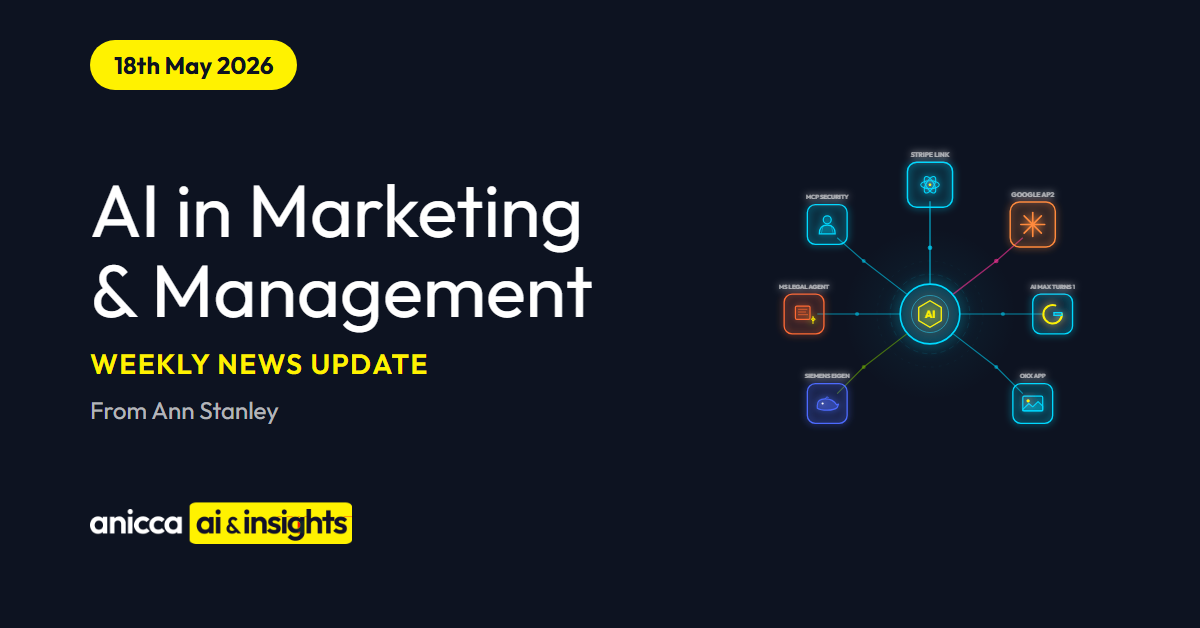
Anthropic launches Claude for Small Business, Alexa eats search, Google readies Gemini 4
The week ending 18 May 2026 was dominated by a single strategic theme: AI assistants moving from the sidebar to the search bar. Amazon killed Rufus and put Alexa for Shopping directly inside its main search experience, while Google teed up Gemini 4 and agentic Chrome features ahead of I/O. Anthropic opened a new front with Claude for Small Business and Claude for Legal expansions. Meanwhile, Google’s own AI search guide bluntly told marketers that GEO and AEO are “still SEO”, and CEOs globally raised AI investment even as 78% admitted a failed AI strategy could cost them their job.
Table of Contents
- Anthropic launches Claude for Small Business with 15 agentic workflows
- Google previews Android 17, Gemini Intelligence and Gemini 4 ahead of I/O
- Google’s new AI search guide calls AEO and GEO “still SEO”
- B2B marketers say AI search is now their top buyer channel
- Semrush: 11 practical ways marketers are using AI for SEO in 2026
- The 90-day AI search sprint: rebuilding marketing for AI visibility
- Google quietly changes search terms reporting for AI queries
- Search news recap: ranking volatility, FAQ rich results gone, AI assistant tracking in GA4
- CEOs raise AI investment as 78% admit failed AI strategy could cost them their job
- UKG is named a leader for agentic AI in frontline workforce operations
- CHROs and chief talent officers convene to operationalise AI across the talent lifecycle
AI in E-commerce, Retail and Agentic Commerce
- Alexa for Shopping replaces Rufus as Amazon bets on agentic search
- Google partners with Affirm and Klarna to bring BNPL to agentic commerce
- AI reshapes print-on-demand ecommerce
- Shoplazza on AI “terraforming” the future of ecommerce
AI for Other Sectors and Industries
- LEGAL: Anthropic expands Claude for Legal as Harvey and Legora battle for the AI law market
- HEALTHCARE: Trump and Kennedy move to relax safeguards for AI healthcare tools
- HEALTHCARE: Morgan Lewis publishes 2026 AI compliance playbook for healthcare leaders
- FINANCE: UK insurance CEOs say AI is putting human judgement “back at the centre”
- Should we still invest in GEO/AEO services if Google says they are “still SEO”?
- How should we prepare for Google I/O 2026 on 19 May?
- What’s the single most important thing to do about Amazon’s Alexa for Shopping?
AI News, Tech & Tools
Anthropic launches Claude for Small Business with 15 agentic workflows
Source: anthropic.com | 13 May 2026
Anthropic has launched Claude for Small Business, a package of connectors and ready-to-run workflows that embeds Claude inside Intuit QuickBooks, PayPal, HubSpot, Canva, Docusign, Google Workspace and Microsoft 365. The product ships with 15 agentic workflows spanning finance, operations, sales, marketing, HR and customer service, plus 15 skills built around tasks small business owners flagged as the biggest time sinks, from planning payroll to chasing invoices and kicking off marketing campaigns.
Co-founder Daniela Amodei framed the launch as a public benefit play, noting that small businesses make up 44% of US GDP and nearly half of private-sector employment but have lagged on AI adoption. Activation runs through Claude Cowork as a toggle install, with a human approval step before anything sends, posts or pays, a deliberate guardrail given the high-stakes finance and HR workflows on the menu.
Why it matters
For agencies and marketing leaders serving SMB clients, this changes the conversation. Claude is no longer a chat window, it is the operating layer inside the CRM, the design tool and the accounting system. Expect HubSpot-native workflows to become a competitive battleground, and prepare to redesign client onboarding around workflow adoption rather than seat licences. If your agency’s value prop relies on “doing the work in QuickBooks or HubSpot”, you have roughly two quarters to move up the value chain into strategy, brand and creative direction.
Google previews Android 17, Gemini Intelligence and Gemini 4 ahead of I/O
Source: wired.com, techcrunch.com, investing.com | 12-15 May 2026
Google used its second annual Android Show to pre-trail the I/O 2026 keynote on 19 May. Headline announcements: “Gemini Intelligence” as the official packaging for on-device AI on flagship phones, vibe-coded widgets that users generate on the fly, Gemini built into Chrome on Android (capable of finishing bookings and form-filling autonomously), and Googlebook, a new line of AI-native laptops launching this autumn with Acer, Asus, Dell, HP and Lenovo, featuring a Gemini-powered “Magic Pointer” cursor.
Bank of America’s Justin Post separately told clients to expect a major Gemini model launch at I/O itself, either Gemini 4 or a substantial 3.X upgrade, with stronger reasoning, coding, multimodal and long-context capabilities, plus cheaper Flash variants. BofA also flagged deeper agentic capabilities across Chrome, Gmail, Maps, Calendar, Search and Android, with Gemini autonomously booking reservations, editing calendars and managing shopping workflows, all gated by user approval.
Why it matters
Google is positioning Gemini as the default cross-app agent on Android and ChromeOS, which has direct consequences for marketers. If Gemini in Chrome starts completing bookings and shopping journeys, your conversion funnel is being intermediated by an agent that decides which site to transact on. Audit your structured data, your Universal Commerce Protocol readiness, and your Google Merchant centre feeds now. Treat I/O on 19 May as a strategic event, not a developer one, and brief your CMO before competitors do.
AI in Marketing
Google’s new AI search guide calls AEO and GEO “still SEO”
Source: searchenginejournal.com | Matt G. Southern
Google has published an official AI Search guide that flatly states Answer Engine Optimisation (AEO) and Generative Engine Optimisation (GEO) are “still SEO”. The guide also names several tactics site owners can safely ignore: llms.txt files, content chunking for AI consumption, and specialist AI-specific schema markup. The message: the fundamentals (helpful content, clean technical SEO, structured data, E-E-A-T signals) still carry the weight in AI Overviews and AI Mode.
The guide arrives as the agency landscape splinters into “GEO specialists” charging premium retainers for what Google is now publicly framing as standard SEO hygiene. It also lands alongside a quieter change Brooke Osmundson flagged at SEJ this week: Google has updated Search Terms reporting in Ads to show “interpreted queries” for AI Mode, AI Overviews, Lens and autocomplete traffic, meaning advertisers no longer see the user’s actual words.
Why it matters
The GEO gold rush just got a cold shower from the source. Push back on agencies pitching expensive “AI-specific” rebuilds and instead audit the basics: schema coverage, internal linking, author authority, original research. Separately, the search terms change is material for paid teams. If you cannot see the verbatim query, your negative keyword strategy and intent matching degrade. Lean harder on first-party conversion data and value-based bidding, and pressure your Google rep for clarity on what “interpreted” actually means.
B2B marketers say AI search is now their top buyer channel
Source: martech.org | 14 May 2026
A new 10Fold report, “The Visibility Reset”, finds that 52% of B2B tech marketing leaders now view AI-generated search as their top channel for reaching buyers. Website traffic is being demoted as a primary KPI, with AI visibility and lead quality stepping into its place. The report argues that as AI floods the web with similar content, brands need stronger trust signals to be cited: media coverage, analyst mentions, expert bylines, proprietary research, peer-review sites and influencer validation.
The shift is forcing a rethink of attribution. If a CFO reads an AI summary that cites your research, never visits your site and then takes a meeting six weeks later, your standard funnel reporting will miss it entirely. Marketers are starting to track AI citation share, branded query volume and influenced pipeline rather than session counts.
Why it matters
If you are a B2B CMO still reporting MQLs and sessions to the board, you are reporting on the past. Build a citation dashboard, commission original research that AI engines will actually cite, and shift budget from generic blog production to PR, analyst relations and proprietary data. Practically, that means fewer 1,500-word listicles and more 30-page reports with surveyable data points. Internal alignment matters too: get sales to start asking “where did you first hear about us?” in discovery calls.
Semrush: 11 practical ways marketers are using AI for SEO in 2026
Source: semrush.com | Cecilia Meis | 11 May 2026
Semrush has published a substantial guide based on a survey of 100 B2B and B2C marketers, mapping how AI is actually deployed across SEO workflows in 2026. The four main application areas: automation of repetitive tasks (keyword research, meta generation, content audits), data analysis across thousands of signals, content optimisation against top-ranking pages, and predictive insights forecasting ranking potential.
The headline finding is one of restraint: AI handles data and drafts, humans handle strategy, accuracy and brand voice. The guide includes copy-paste prompts for each use case and is explicit that AI is not a replacement for SEO expertise, a notable shift in tone from the 2024-25 “AI replaces SEO teams” rhetoric.
Why it matters
Use this as a benchmarking document. If your in-house SEO team is not yet using AI for SERP analysis, content gap identification and bulk meta generation, you are operating below median. Conversely, if you have replaced senior SEO judgement with AI outputs, you are likely producing the undifferentiated content the 10Fold report just warned about. The winning operating model: AI for breadth and speed, senior humans for editorial direction, brand voice and topical authority.
The 90-day AI search sprint: rebuilding marketing for AI visibility
Source: searchenginejournal.com | Heather Campbell
Search Engine Journal has published a 90-day playbook for rebuilding marketing operations around AI visibility. The framework treats AI visibility as a learnable, measurable skill rather than a mystical art, with discrete sprints for citation auditing, content restructuring, authority building and measurement infrastructure. The recap stresses that AI visibility compounds: brands that establish authority signals now will dominate AI citations for years.
The structure mirrors a classic agile transformation: 30 days of audit and baseline, 30 days of structural fixes, 30 days of authority and citation work, with KPIs at each gate. It is one of the first public playbooks pitched specifically at enterprise marketing teams rather than freelance SEOs.
Why it matters
Most CMOs are still treating AI search as an experiment. A 90-day sprint forces operational discipline and gives the board something measurable. The single most valuable exercise: baseline your current citation share across ChatGPT, Gemini, Claude and Perplexity for your top 20 commercial queries, then track weekly. Without that baseline, every “AI SEO” investment is unfalsifiable.
Google quietly changes search terms reporting for AI queries
Source: searchenginejournal.com | Brooke Osmundson
Google has updated how it reports search terms in Google Ads for AI Mode, AI Overviews, Lens and autocomplete queries. Advertisers are now seeing “interpreted queries”, essentially Google’s paraphrased version of user intent, rather than the verbatim search input. The change rolled out quietly with no formal announcement, and PPC managers have been reverse-engineering the implications all week.
The practical impact: negative keyword lists built on exact-match terms may no longer fire as expected, and intent analysis becomes harder to validate. It compounds the visibility loss from match type changes over the past three years and pushes advertisers further toward Google’s automated bidding and value-based signals.
Why it matters
This is a quiet but significant control loss for paid search teams. Audit your top 20 negative keywords this week and check whether interpreted query traffic is leaking through. Lean harder into conversion value reporting, offline conversion uploads and enhanced conversions, because Google is increasingly asking you to trust the algorithm rather than the query. If your agency reports primarily on search term wins, demand a new reporting framework that emphasises business outcomes.
Search news recap: ranking volatility, FAQ rich results gone, AI assistant tracking in GA4
Source: seroundtable.com | Barry Schwartz
Barry Schwartz’s weekly recap captures a turbulent week for search. Heavy ranking volatility hit on 13 and 14 May, Google updated its spam policies to explicitly cover AI responses in Search, Google Discover performance data went missing for 7 and 8 May, and FAQ rich results have been removed from search results entirely. A new study also found that schema markup does not measurably influence AI citations, contradicting a year of agency advice.
On the platform side, Google Ads is teasing new AI-powered dashboards, will automatically link YouTube channels, and Google Analytics has rolled out a new AI assistant traffic dimension that tracks ChatGPT, Gemini and Claude as referrers. Merchant centre is testing “Merchant Advisor” and new out-of-stock options, and the Agencies portal is now globally available.
Why it matters
The GA4 AI assistant referral tracking is the most actionable item: turn it on this week and you will finally have first-party data on AI-driven traffic by platform. The FAQ rich results removal hits any site that built content templates around them, expect a noticeable CTR drop on affected queries. And the schema-does-not-influence-citations study should sharpen your editorial calendar: spend the saved time on original data, expert authorship and external authority.
AI in Management
CEOs raise AI investment as 78% admit failed AI strategy could cost them their job
Source: fairplaytalks.com | 14 May 2026
Two CEO surveys this week paint a striking picture. A global study of 900 CEOs found nearly eight in ten (78%) believe a failed AI strategy could cost them their job, with boards demanding measurable results and stronger governance. Despite this, CEOs are still increasing AI investment, prioritising long-term growth and strategic resilience even amid geopolitical instability and economic uncertainty.
The same publisher reported a parallel finding: 70% of workers fear AI-driven layoffs, with burnout, political stress and workplace distrust all rising sharply. The gap between executive AI optimism and workforce anxiety is now one of the defining management challenges of 2026.
Why it matters
If three-quarters of CEOs think AI could end their tenure, expect aggressive top-down mandates and shorter patience for “pilot purgatory”. Marketing leaders should pre-empt this by tying AI initiatives to specific revenue or cost lines on the P&L within 90 days. On the workforce side, communicate constantly and concretely: vague reassurances about “AI augmenting roles” no longer cut through. Show specific examples of work redesign, name the skills you are funding, and be honest about which roles will shrink.
UKG named a leader for agentic AI in frontline workforce operations
Source: techrseries.com
UKG has been named a leader in Nucleus Research’s April 2026 Workforce Management Value Matrix for the seventh consecutive year, with additional recognition from Lighthouse Research & Advisory, H3 HR Advisors and HR.com. The honours focus on UKG’s agentic Workforce Operating Platform, which moves frontline workforce management from static scheduling to real-time, autonomous alignment of labour, cost and compliance.
UKG Chief Product Officer Suresh Vittal framed the frontline workforce as “the biggest opportunity in the enterprise”, where small decisions compound rapidly. UKG Rapid Hire was specifically singled out for transforming high-volume frontline hiring, an area where agentic AI is now reducing time-to-fill from weeks to days for hourly roles.
Why it matters
For marketing and ops leaders in retail, hospitality and logistics, this matters because customer experience is increasingly determined by frontline staffing in real time. Agentic workforce platforms can automatically reflex to a sudden footfall spike or a regional weather event. Your marketing campaigns can be flagged into these systems so that staffing follows demand, an integration most brands are not yet asking for. Have the conversation with your COO this quarter.
CHROs and chief talent officers convene to operationalise AI across the talent lifecycle
Source: huntscanlon.com | 12 May 2026
Hunt Scanlon Media is convening nearly 300 CHROs, chief talent officers, AI technology leaders and executive recruiters at the Harvard Club in New York on 11 June to examine how leading organisations are operationalising AI across the talent lifecycle. The agenda spans where AI delivers measurable value, governance and change management, and the leadership capabilities required in an AI-influenced workforce.
True co-founder Josh Withers will argue that most firms remain “AI-using” rather than “AI-native”, operating disconnected tools instead of integrated systems. Walmart Chief Talent Officer Lorraine Stomski will discuss translating AI investment into workforce impact at enterprise scale alongside Riviera Partners’ head of AI Kyle Langworthy.
Why it matters
The talent leaders setting AI policy in your business are increasingly the same people deciding which marketing roles get hired, restructured or removed. CMOs should be building direct relationships with their CHRO and head of talent now, co-designing the skills taxonomy for marketing in an AI-native world. Waiting for HR to “tell you what’s changing” is the wrong posture; co-author the policy.
AI in E-commerce, Retail and Agentic Commerce
Alexa for Shopping replaces Rufus as Amazon bets on agentic search
Source: modernretail.co, adweek.com | Lauren Johnson
Both Modern Retail and Adweek dug into the strategic implications of Amazon retiring Rufus in favour of Alexa for Shopping. The new assistant is embedded in the main Amazon search bar (not a side chatbot), draws on cross-device Alexa conversations and shopping history, and is available to all shoppers, not just Prime members. It can build shopping guides, automate routine purchases and surface 12-month price histories.
Adweek’s analysis pulls out the advertising angle: Alexa for Shopping is a far bigger commercial surface than Rufus ever was, and Amazon’s retail media network is now sitting on a conversational discovery layer with massive monetisation potential. The pivot also signals Amazon’s view that third-party agentic shopping (via ChatGPT, Perplexity and Google) is a real threat best countered by owning the agent inside the store.
Why it matters
Brands selling on Amazon need to start testing how Alexa for Shopping describes their products, today, and how it positions them against competitors in head-to-head comparison prompts. Optimise A+ content for conversational summarisation, expand FAQ-style content in product detail pages, and brief your Amazon Ads team to ask reps about agent-aware ad inventory before competitors lock it up. The shoppers who use Alexa for Shopping will be Amazon’s highest-value cohort within 12 months.
Google partners with Affirm and Klarna to bring BNPL to agentic commerce
Source: digitalcommerce360.com | 13 May 2026
Google has announced partnerships with Affirm and Klarna to bring buy now, pay later into AI Mode and the Gemini app, enabling AI agents to complete purchases with BNPL on consumers’ behalf via Google Pay. Both providers built their integrations to comply with the Universal Commerce Protocol (UCP), the open standard for agentic commerce co-developed by Google and Shopify.
Ashish Gupta, Google’s VP and GM of merchant shopping, framed payment reliability and security as “critical” for AI-mediated transactions. The move signals that the agentic commerce stack is hardening: protocol (UCP), payment rails (Google Pay plus BNPL providers), and discovery surface (AI Mode and Gemini) are now stitched together end-to-end.
Why it matters
If your e-commerce stack is not yet UCP-aware, you have a finite window before agentic transactions route around you. Speak to your Shopify, BigCommerce or Salesforce Commerce Cloud rep this month about UCP support and timeline. For finance and CMO teams, BNPL in agentic flows will likely increase basket size but also charge-back complexity, so revisit fraud, return and chargeback policies before AI traffic ramps. This is the plumbing being laid for the next phase of online retail.
AI reshapes print-on-demand ecommerce
Source: practicalecommerce.com | 14 May 2026
Practical Ecommerce examines how generative AI is restructuring print-on-demand (POD), historically a margin-thin category dominated by Printify, Printful and Redbubble. AI image generation has collapsed the cost of creating sellable designs from $20-50 per design (using a freelancer) to effectively zero, prompting an explosion of micro-niche stores and a saturation problem on marketplace platforms.
The piece argues the winners will be operators who use AI for trend detection and rapid testing rather than just design generation, and who invest in brand and community to escape the commoditisation trap that pure AI-generated catalogues fall into.
Why it matters
POD is the canary in the coal mine for any creative-led e-commerce category. If your business depends on visual differentiation (apparel, home decor, gifting, accessories), assume your competitors can now produce thousands of variants overnight. Defensible value shifts to brand, community, curation and physical product quality. Treat AI as a research and testing tool, not a primary creative engine, or you will join the marketplace noise rather than rise above it.
Shoplazza on AI “terraforming” the future of ecommerce
Source: techcrunch.com (sponsored)
In a TechCrunch Brand Studio piece, Shopify-competitor Shoplazza argues that AI is “terraforming” e-commerce, reshaping how consumer behaviour is predicted, how stores are merchandised, and how shopping urges are protected. The piece frames AI as both a personalisation engine and a fraud and safety layer, sitting invisibly across every stage of the consumer journey.
While the article is vendor-authored, the underlying claim, that AI is becoming infrastructure rather than feature, mirrors what Google, Amazon and Anthropic announced this week. The convergence of messaging across vendors suggests 2026 is the year “AI as infrastructure” stops being marketing copy and starts being a procurement requirement.
Why it matters
For brands evaluating commerce platforms in 2026, AI-native capability is no longer a nice-to-have. When you next renegotiate your platform contract, ask hard questions about UCP support, agentic checkout, AI-driven personalisation, and fraud detection. Vendors who cannot answer crisply on all four should be discounted, regardless of their incumbent advantage.
AI for Other Sectors and Industries
LEGAL: Anthropic expands Claude for Legal as Harvey and Legora battle for the AI law market
Source: techcrunch.com | Lucas Ropek | 12 May 2026
Anthropic has expanded Claude for Legal with new plug-ins and MCP connectors targeting specific practice areas, including document search and review, case law research, deposition prep and document drafting. The move escalates a heated AI legal market where Harvey raised $200m at an $11bn valuation in March, and rival Legora closed a $600m Series D in April alongside a Jude Law-fronted ad campaign.
Anthropic’s approach differs by extending its general-purpose Claude into legal rather than building a dedicated vertical product. This positions firms to use one model across legal, finance and operational workflows, a meaningful procurement advantage over single-purpose vendors.
Why it matters
For marketing leaders in professional services firms, expect AI capability to become a pitch differentiator within the next 12 months. Clients will increasingly ask “what AI do you use and how does it affect my fees?”. If you market legal, accounting or consulting services, develop a clear, defensible narrative on AI use, data security and human oversight. The same shift will hit any sector where billable hours or expert time is the product.
HEALTHCARE: Trump and Kennedy move to relax safeguards for AI healthcare tools
Source: kffhealthnews.org | 13 May 2026
KFF Health News reports that the Trump administration and HHS Secretary Robert F. Kennedy Jr. are moving to relax oversight of AI healthcare tools, including ambient scribes and AI features built into electronic health records. The deregulation push aims to accelerate adoption but raises concerns about clinical accuracy, patient consent and data use in a category where errors carry direct safety consequences.
Ambient scribes (AI tools that transcribe and summarise clinical conversations) have been one of the fastest-spreading healthcare AI use cases, with major providers including Permanente, HCA and Ascension deploying them at scale. Lighter regulation will accelerate procurement but shift more compliance and clinical risk onto health systems themselves.
Why it matters
US healthcare marketers, particularly those at provider networks and health-tech vendors, should expect a more permissive regulatory environment but a more scrutinous patient and clinician audience. Build your messaging around clinical validation, transparency and human oversight, not speed. Outside the US, watch closely: divergence between US and EU/UK regulation will affect cross-border product strategy and competitive positioning.
HEALTHCARE: Morgan Lewis publishes 2026 AI compliance playbook for healthcare leaders
Source: jdsupra.com
Law firm Morgan Lewis has published a three-part series for healthcare executives covering AI deployment legal questions, BAA and data governance contracting, and a practical compliance checklist. Core issues: whether HIPAA applies to a given AI use case, whether protected health information is implicated, and whether use is justified under treatment, payment or healthcare operations lawful pathways.
The series emphasises contracting as the central compliance lever, allocating responsibility, restricting downstream data use, and clarifying ownership of inputs and outputs. It mirrors a pattern emerging across regulated sectors: AI compliance is increasingly procurement-driven rather than purely technical.
Why it matters
Even outside healthcare, the contracting playbook is transferable. If your business uses AI tools that touch customer data, financial data or employee data, your vendor contracts probably need rewriting. Ask your legal team three questions: who owns the outputs, how is our data used to train models, and what indemnities exist if the AI produces harmful or non-compliant output? If you cannot answer all three crisply, you have unmanaged risk.
FINANCE: UK insurance CEOs say AI is putting human judgement “back at the centre”
Source: insurancebusinessmag.com | 14 May 2026
A new CEO study in UK insurance argues that AI deployment, far from removing humans, is putting expert judgement “back at the centre” of underwriting, claims and broking. The thesis: AI handles the data ingestion and pattern-matching, freeing senior underwriters and claims handlers to focus on the complex, contextual decisions where human expertise drives both better outcomes and customer trust.
The finding contrasts sharply with workforce anxiety surveys this week showing 70% of workers fear AI-driven layoffs. The insurance sector’s experience suggests the actual impact may be more nuanced: junior roles compressed, senior expertise elevated, customer-facing roles redesigned rather than removed.
Why it matters
For marketing leaders in financial services, this is a useful narrative: AI as augmentation of expertise rather than replacement. It plays well with consumers wary of opaque algorithms and with regulators demanding accountability. Build campaigns around named experts using AI to deliver faster, more accurate decisions, rather than around the AI itself. The brand wins when human expertise is the hero and AI is the supporting cast.
Key Takeaways
- Amazon’s switch from Rufus to Alexa for Shopping moves AI from a side chatbot to the default search bar; brands must test how Alexa describes their products now.
- Google I/O on 19 May is expected to bring Gemini 4 (or a major 3.X), agentic Chrome features and Googlebook laptops; brief your CMO before competitors react.
- Google’s official AI search guide says GEO and AEO are “still SEO” and names llms.txt, chunking and AI-specific schema as ignorable; push back on agencies pitching expensive AI rebuilds.
- 52% of B2B marketing leaders now rank AI search as their top channel; shift budget from generic content to proprietary research, PR and analyst relations.
- 78% of CEOs fear a failed AI strategy could cost them their job, while 70% of workers fear AI layoffs; close the gap with concrete, transparent workforce communication.
- Google + Affirm + Klarna + Shopify’s Universal Commerce Protocol is now a working agentic checkout stack; audit your commerce platform’s UCP readiness.
- Anthropic, Harvey and Legora are turning legal AI into a $10bn+ category; expect AI capability to become a pitch differentiator across all professional services within 12 months.
Frequently Asked Questions
Should we still invest in GEO/AEO services if Google says they are “still SEO”?
Invest in the underlying fundamentals (structured data, E-E-A-T, original research, technical SEO) rather than premium-priced “AI-specific” services. Most “GEO tactics” sold today are repackaged SEO with a markup. Focus spend on citation tracking tools and content authority, not on llms.txt files or AI-specific schema, which Google has explicitly said are not used.
How should we prepare for Google I/O 2026 on 19 May?
Brief your CMO and exec team in advance that I/O is now a marketing event, not just a developer one. Expect Gemini 4, deeper agentic Chrome features, and tighter shopping integration. Have a 48-hour response plan: who will analyse announcements, who will brief client leads, and which tests you will run within the first week to assess impact on search, ads and commerce.
What’s the single most important thing to do about Amazon’s Alexa for Shopping?
Test how Alexa for Shopping describes your products today against your top three competitors using natural-language prompts a buyer might ask. Document the gaps, then update your A+ content, FAQ sections and review response strategy to fill them. Brands that optimise for conversational summarisation in the next 90 days will dominate the new Amazon discovery surface.
Conclusion
This week confirmed that 2026 is the year AI moves from feature to infrastructure across marketing, management and commerce. Amazon’s Alexa for Shopping, Google’s pre-I/O announcements, Anthropic’s Claude for Small Business and the agentic BNPL integrations all point the same direction: AI is now the primary interface between customer and brand, and the protocols, payment rails and authority signals are hardening fast. Three actions for the next 30 days. First, baseline your AI citation share across ChatGPT, Gemini, Claude and Perplexity for your top 20 commercial queries. Second, audit your commerce platform’s Universal Commerce Protocol readiness and your Amazon A+ content for conversational summarisation. Third, build a transparent internal narrative about AI’s impact on your team before the workforce anxiety surveys turn into your retention problem.
Need help adapting your AI marketing strategy? Contact the Anicca team for expert guidance.
This roundup is compiled from publicly available sources using AI-assisted research. While we review every article for accuracy, our analysis reflects our interpretation of the original reporting. We strongly encourage readers to click through to the original sources linked throughout this post for full context and detail. If you spot anything that needs correcting, please let us know.

Thursday AI Club
A hands-on AI club for marketers and managers. Fortnightly 3-hour sessions: Hour 1 is an open Q&A on any AI question; Hours 2-3 split into a workshop track (for newbies) and an advanced track (live demos and deeper questions).
Led by Ann Stanley, James Allen.
Membership: £40/month or £400/year
Join the Thursday AI Club →