This Week in AI in Marketing & Management (24th Aug 26)
Claude Reaches Every Device as Agentic AI Teammates Arrive
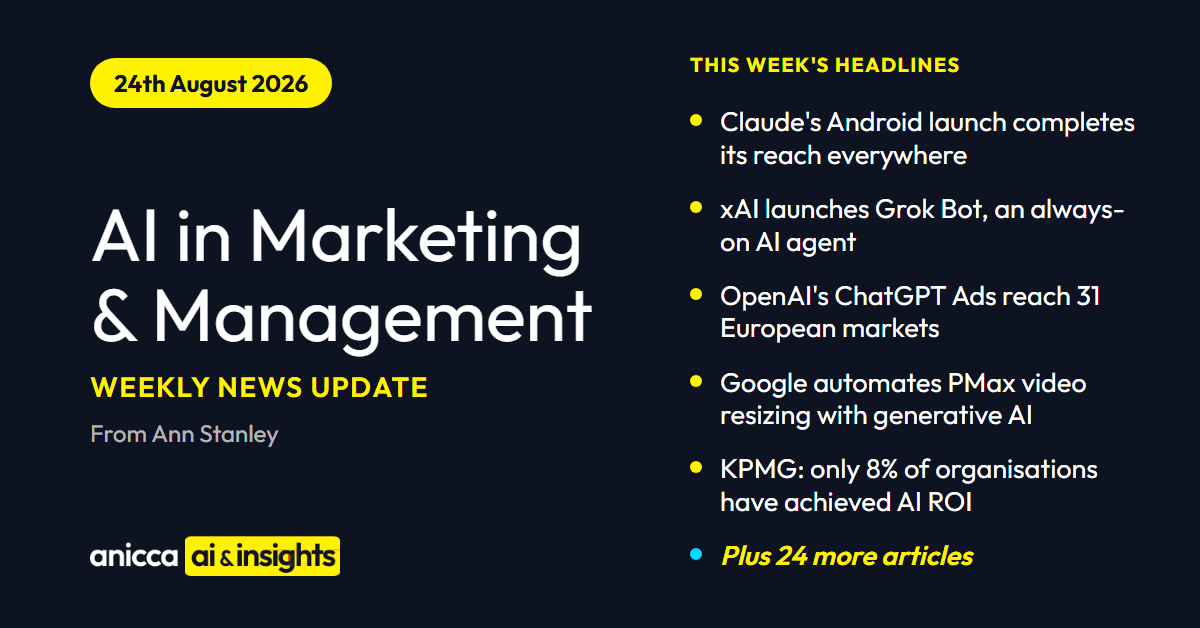
This week, Anthropic completed Claude’s reach across every device, launching on Android to join web, iOS, desktop and every major IDE, while xAI pushed further into agentic AI with Grok Bot, an always-on AI teammate that gets its own persistent cloud computer. OpenAI extended its own reach in a different direction, taking ChatGPT Ads live in 31 European markets and pushing ChatGPT further into personal territory with a teen-focused product, a Mac keystroke logger and an Apple Messages plug-in. Google kept its foot on the accelerator with generative AI resizing for Performance Max video and Gemini 3.7 Flash powering AI Mode, while Seismic and Highspot merged to create a $100m-a-year AI revenue enablement giant. Here’s the full weekly briefing for senior marketers and management teams.
Table of Contents
- Claude’s Android launch completes its reach across desktop, IDEs and mobile
- xAI’s Grok Bot expands beyond beta as agentic AI teammates get their own computer
- OpenAI launches ChatGPT for Teens with study mode and parental controls
- Google packs Search and Gemini with new AI study tools
- ChatGPT can now send texts via new Apple Messages plug-in
- OpenAI’s Computer History feature logs Mac keystrokes in plain text
- Business websites dominate Gemini’s local AI citations, but results are unstable
- The three real barriers to AI adoption inside marketing teams
- Proofpoint opens AI security engineering centre in India
- Seismic and Highspot merger creates $100m-a-year AI enablement giant
- Google Ads uses generative AI to resize Performance Max video
- Google introduces AI Max experiment and planning tools for Search
- August 2026 spam update, Gemini 3.7 Flash powers AI Mode
- About pages shape AI visibility more than marketers realise
- What query fan-out means for SEO strategy
- AI bot data reveals which pages LLMs actually consume
- OpenAI brings ChatGPT ads to 31 European markets
- California’s AI advertising disclosure bill nears a final vote
- UK AI Minister urged to prioritise skills and adoption over start-up count
- KPMG: Only 8% of organisations have achieved established AI ROI
- AI will fail where managers are not ready
- UK workforce shifts to temporary hires as AI reshapes skill needs
AI in E-commerce, Retail and Agentic Commerce
- Amazon’s AI shelf forces brands to fight for agentic visibility
- AI Commerce Rankings show unexpected winners: Nixon, Online Labels, CustomInk
- How AI has transformed retail work
- Five predictions for 2026 holiday shopping
AI for Other Sectors and Industries
- ENERGY: Hedge funds pile into energy as AI compute demand collides with geopolitics
- HEALTHCARE: Innovaccer and Mastek partner to scale healthcare AI across the US
- HR: Five ways to move from HR leadership into the C-suite
AI News, Tech & Tools
Claude’s Android launch completes its reach across desktop, IDEs and mobile
Source: claude.com | 20 August 2026
Anthropic launched a native Claude app for Android on 20 August, giving Claude full vision, multilingual and reasoning capability across web, iOS and Android for the first time. It completes a build-out that already spans the Claude Code command line, native VS Code and JetBrains IDE extensions, the desktop app, and Cowork, Anthropic’s agentic workspace that has been rolling out to web and mobile since July.
The result is that a single Claude login now reaches almost everywhere someone works: a browser tab, a phone, an IDE, or a terminal on a company laptop. That convenience is also the risk. Anthropic’s own terms explicitly prohibit sharing account credentials outside the official client, because whichever device signs in with that login inherits whatever the session can see, including local project files Claude Code has been granted access to and any cloud-based files shared through a Workspace.
Why it matters
If anyone on your team is sharing a single Claude login to save on seats, they are breaching Anthropic’s terms and handing another device access to whatever that session can see. Whoever signs in on their own device gets whatever that account’s connected files and Workspaces expose. Audit who holds Claude credentials, move to seat-based enterprise accounts with admin-provisioned access, and treat “just share the login” requests from staff as a policy conversation, not a convenience.
xAI’s Grok Bot expands beyond beta as agentic AI teammates get their own computer
Source: unite.ai and reworked.co | 11 and 18 August 2026
xAI launched Grok Bot in public beta on 11 August, an always-on AI agent that gets its own persistent cloud computer, signs into a user’s existing tools and services, and completes multi-step tasks unsupervised. Users can run several Bots at once, assigning one as a “chief of staff” that coordinates specialist Bots for tasks such as inbox triage, expenses or recruiting, with Bots able to message each other directly.
xAI expanded access beyond the initial beta later the same week, alongside the release of Grok 4.6, its flagship model built for long-running agent work with a 500,000-token context window. Beta access now spans SuperGrok Plus, SuperGrok Heavy ($300 a month), and Cursor’s Ultra ($200 a month) and Teams Premium plans, with enterprise access waitlist-only through xAI’s sales channel.
Why it matters
This is a genuinely different pitch to Claude Code or ChatGPT’s agent tools: xAI is selling a persistent, always-on teammate rather than a session you open and close. If your team already holds a Cursor Ultra seat, Grok Bot beta access effectively comes free with a subscription your developers may already have. Track whether competitors start running agent teams for content, research or customer service before you have tested the same approach yourself.
OpenAI launches ChatGPT for Teens with study mode and parental controls
Source: openai.com and bloomberg.com | 18 August 2026
OpenAI introduced ChatGPT for Teens, a version of the assistant automatically assigned to users estimated or self-declared to be 13-17. It bundles Study Mode, guiding-question prompts, knowledge checks, and stronger safety guardrails, backed by the company’s Under-18 Model Spec and Teen Safety Blueprint. Parents get new controls, and OpenAI is using age-prediction models to route younger users into the restricted experience by default.
The launch coincides with Google’s own education push, which added AI-generated interactive visuals, 3D simulations, a dedicated student hub, and customised practice quizzes across Search and Gemini. Both companies are targeting the same demographic that education startups like Knowt and Gauth already serve, with pedagogy features built around retrieval practice and self-explanation.
Why it matters
For B2C marketers in education, publishing, tutoring and family-focused categories, the teen AI market is now a two-horse race between OpenAI and Google. Expect discovery for study-related queries to shift inside Study Mode conversations rather than open web search, and start thinking about how your brand shows up when an AI is scaffolding a learning journey. If you sell to parents, parental controls are a new distribution channel worth watching.
Google packs Search and Gemini with new AI study tools
Source: techcrunch.com | Aisha Malik | 19 August 2026
Google rolled out a slate of student-focused features including AI-generated interactive visuals, 3D simulations, a dedicated student hub, and customised practice quizzes. On Search, students can now generate custom tools that visualise concepts, and Gemini’s study experience is being positioned as the default homework and revision assistant.
The move is a direct response to ChatGPT’s dominance among students. It also signals Google’s willingness to route users through Gemini for learning-heavy queries, potentially reducing traditional Search traffic to educational publishers and Q&A sites like Quora and Chegg.
Why it matters
If your content strategy relies on informational or educational queries, expect the top of funnel to keep contracting inside AI-generated answers. The countermove is to be the source Gemini cites, not the destination it replaces. Structured explainers, original data, and clearly labelled expertise are what get pulled into these interactive tools.
ChatGPT can now send texts via new Apple Messages plug-in
Source: techcrunch.com | Lucas Ropek | 20 August 2026
OpenAI launched an Apple Messages plug-in that lets ChatGPT sort, analyse, edit and send texts on a user’s behalf. It also works with Codex and ChatGPT Work, extending agentic behaviour into personal and professional messaging. Users must explicitly connect the inbox, but once connected, conversation content is available to the model.
This lands alongside a separate OpenAI feature, Computer History, that logs Mac keystrokes and stores them as plain text for ChatGPT to search. That capability is not being launched in the EEA, Switzerland or the UK, a telling signal about how OpenAI is navigating GDPR and UK data-protection risk.
Why it matters
Agentic AI is quietly moving from browsers into messaging apps and the operating system itself. For CMOs, this is a wake-up call on two fronts: first, employees may connect ChatGPT to work devices in ways that expose customer PII, so update your acceptable-use policies now. Second, if agents start drafting and sending consumer messages, your SMS and rich-message CRM programmes may soon compete with AI-mediated inboxes.
OpenAI’s Computer History feature logs Mac keystrokes in plain text
Source: thenextweb.com
OpenAI’s new Computer History feature records what users do on a Mac and turns it into searchable memory for ChatGPT. The resulting files are stored in plain text, and the feature is deliberately excluded from the EEA, Switzerland and the UK, reflecting regulatory concerns.
Security researchers have flagged the plain-text storage as a significant risk if a device is compromised, because the log potentially includes passwords, private messages and confidential business information. The exclusion of major regulated markets suggests OpenAI itself expects data-protection authorities to push back hard.
Why it matters
The real story here is enterprise risk. Even if the feature is not available in the UK today, employees using personal accounts on Macs shared with work environments could be exposed. IT and marketing operations leaders should treat this as a prompt to audit which AI features are enabled on managed and BYOD devices, and revisit DLP policies before shadow AI becomes shadow breach.
Business websites dominate Gemini’s local AI citations, but results are unstable
Source: martech.org | 20 August 2026
A new Steady Demand analysis of 14,472 citations from 1,487 local search queries across 50 US metro areas found that nearly 60% of Gemini’s local citations pointed directly to business websites, beating directories, review platforms and forums combined. The bigger finding was “Grounding Drift”: identical queries often produced different AI recommendations and different cited sources.
When the same 1,487 queries were run through ChatGPT, the platforms rarely cited the same sources or recommended the same businesses. That inconsistency means visibility on one AI engine tells you very little about visibility on another.
Why it matters
For local and multi-location brands, this is a strong argument to invest in your own website content rather than assume directory syndication is enough. It also means AI visibility monitoring needs to cover multiple engines and multiple query runs to be meaningful. Reporting to a board on “our ChatGPT share of voice” is not a strategy if Gemini shows a completely different picture the next morning.
The three real barriers to AI adoption inside marketing teams
Source: martech.org | Ryan Phelan | 18 August 2026
Ryan Phelan argues the biggest barriers to AI adoption are internal: inconsistent training, bias concerns, and tactics running ahead of strategy. He challenges Charlene Li’s framing that “fear of public embarrassment” is the dominant blocker, pointing instead to divergent views on AI’s value across departments as the main cause of stall.
Smaller companies are moving faster because they have fewer sign-offs and fewer competing agendas. Larger organisations, by contrast, often deploy tools without a shared definition of success, leading to duplicated pilots and inconsistent governance.
Why it matters
Do not overlook this: your AI programme is more likely to fail from misalignment than from the wrong model choice. CMOs should insist on a written AI strategy that names the business problems being solved, the metrics that count as success, and the training budget attached. Without that, individual teams will keep buying overlapping tools that never scale.
Proofpoint opens AI security engineering centre in India
Source: computerweekly.com | 21 August 2026
Proofpoint has launched a dedicated AI security engineering centre in India, focused on building defences against AI-driven phishing, deepfake impersonation and prompt-injection attacks. The site will house data scientists, ML engineers and threat researchers building tools for enterprise customers.
The move mirrors similar investments from Palo Alto Networks, CrowdStrike and Cisco, all of whom are racing to embed AI both as a defence measure and as a governance capability for enterprise AI deployments.
Why it matters
Cyber budgets are increasingly tied to AI governance, not just perimeter defence. Marketing leaders should expect security teams to demand more rigorous vendor reviews of any AI tool that touches customer data, including AI email platforms, personalisation engines and agentic ad tools. Build that review time into your procurement plans.
AI in Marketing
Seismic and Highspot merger creates $100m-a-year AI enablement giant
Source: martech.org | Constantine von Hoffman | 20 August 2026
Seismic and Highspot have merged, operating as Seismic under CEO Rob Tarkoff. The combined business serves 2,500 customers and 3.5 million users, with more than $100m a year committed to R&D across AI agents, governed content, engagement intelligence and revenue workflows. It processes 550 million buyer-seller interactions and 33 million revenue actions annually.
Forrester analysts Peter Ostrow and Kathleen Pierce warned that many customers may lack the data integration needed to actually use the combined platform. For every customer ready for advanced revenue enablement, they said, two or three struggle with disconnected systems, chaotic content, or poor sales-marketing alignment.
Why it matters
The tech is running ahead of the plumbing. Before you buy into the next tier of AI-powered enablement, audit your CRM integration, content governance and sales-marketing data flow. Otherwise you are paying for AI agents that cannot see the data they need. This merger is also a signal that martech consolidation is accelerating, so plan renewal cycles with vendor consolidation risk in mind.
Google Ads uses generative AI to resize Performance Max video
Source: searchengineland.com | Anu Adegbola | 17 August 2026
Google is rolling out a Performance Max upgrade that uses generative AI to extend existing video ads into missing aspect ratios, filling gaps in horizontal, vertical and square inventory. Advertisers who do not want the treatment must contact account management or submit Google’s opt-out form by 4 September.
This extends earlier PMax enhancements that repurposed horizontal video into square and vertical automatically. The new step goes further by generating pixels, not just cropping them, which introduces creative and brand-safety questions Google is asking advertisers to accept by default.
Why it matters
Diarise 4 September. If your brand has strict visual identity, product accuracy or regulated-category requirements (finance, healthcare, alcohol), opt out and produce native formats yourself. For everyone else, the practical implication is that your existing PMax video library just got more valuable, and creative teams should focus on generating strong hero assets Google can adapt rather than producing every ratio manually.
Google introduces AI Max experiment and planning tools for Search
Source: blog.google | Brandon Ervin | 20 August 2026
Google is rolling out A/B testing for AI Max in Search campaigns from September, letting advertisers test different budgets and ROI targets across multiple campaigns in a single experiment. New capabilities also allow AI Max experiments with brand and location controls enabled, and Performance Planner now applies suggested bid and budget changes with one click.
The updates are aimed at advertisers reluctant to hand over control to AI Max without a clear before-and-after view. Google is essentially productising reassurance to accelerate adoption.
Why it matters
If you have paused AI Max testing over control concerns, this removes an excuse. Run structured experiments in September with brand and location guardrails on, and measure incremental conversions rather than just CPA. The teams that build a testing muscle now will have a real efficiency edge into Q4.
August 2026 spam update, Gemini 3.7 Flash powers AI Mode
Source: seroundtable.com | Barry Schwartz | 21 August 2026
Google’s third spam update of 2026 finished rolling out on Friday morning. AI Mode is now sometimes powered by the newer Gemini 3.7 Flash. Google also confirmed a bug in the impressions data for generative AI features in the Performance report, and has paused AI-generated images in AI Overviews. Video carousels appear to be showing less often, and Google Posts impressions are returning.
John Mueller reiterated that Google does not pre-announce ranking updates and explained why some algorithm changes are announced and others are not. Favicons have also been disappearing from some results, and QUERY HTTP method support is coming to Search.
Why it matters
The impressions bug matters for anyone reporting AI visibility to boards this month, treat generative-feature impressions with caution. The Gemini 3.7 Flash upgrade to AI Mode is likely to shift which pages get cited, so re-run your AI visibility audits after 25 August. And the spam update reinforces the message: original, expert-authored content survives, thin AI-generated content is more exposed than ever.
About pages shape AI visibility more than marketers realise
Source: practicalecommerce.com | 18 August 2026
Practical Ecommerce reports that About pages are disproportionately influential when LLMs decide how to describe a brand. The page is often the primary source for entity recognition, brand narrative and category positioning inside AI answers, yet it is one of the least-optimised assets on most sites.
Practical fixes include structured founder bios, explicit product category descriptions, awards and press mentions with dates, and clearly stated geographical service areas. These signals help LLMs answer “who is this company, what do they sell, and to whom” with confidence.
Why it matters
Here’s the thing: your homepage is optimised for humans, but your About page is often what AI cites. Rewrite it with structured facts, explicit categorisation, and named people. This is one of the cheapest, highest-value AI visibility fixes available right now, and most competitors have not done it.
What query fan-out means for SEO strategy
Source: semrush.com
Semrush explains query fan-out, the process by which AI search engines like Google AI Mode and ChatGPT split a complex user prompt into multiple sub-queries, retrieve information for each, and merge the results into a single answer. Google’s Head of Search Elizabeth Reid described the technique at Google I/O 2025 as central to AI Mode’s reasoning.
In a live example, a single user query triggered eight parallel searches under the hood. That means visibility now depends on being cited across a range of related sub-queries, not just the primary keyword.
Why it matters
Traditional keyword targeting is not enough. To win in AI answers, you need to cover the full sub-question landscape around each topic: comparisons, definitions, prices, alternatives, use cases, FAQs. Build content clusters that answer the parallel searches an AI is likely to run, not just the head term. Semrush and other AI toolkits are already offering fan-out simulation, which is worth adding to your SEO stack.
AI bot data reveals which pages LLMs actually consume
Source: searchenginejournal.com
Search Engine Journal argues that AI mentions, citations, share of voice and sentiment are useful benchmarks but poor performance signals, because they fluctuate query-by-query and rarely map to traffic. Marketers are increasingly reporting numbers they cannot connect to visits.
LightSite AI’s Stas Levitan is presenting analysis of AI bot and crawler data from hundreds of sites, arguing that four signals from server logs and analytics, including AI crawler activity, pages consumed by AI bots, and AI referral traffic, are the real KPIs that should drive budget decisions.
Why it matters
Stop reporting only AI mentions to your board. Ask your SEO team to add server-log analysis of AI crawler activity and AI referral traffic to your dashboards. These are lagging indicators of visibility that convert, not vanity metrics that flicker. Anyone still pitching “share of voice in ChatGPT” as a KPI is measuring the wrong thing.
OpenAI brings ChatGPT ads to 31 European markets
Source: searchengineland.com and adweek.com | 18 August 2026
OpenAI confirmed on 18 August that ChatGPT Ads will expand into 31 European markets, including Germany, France, Spain, Italy, Sweden, Norway, Denmark, the Netherlands and Austria, going live today, 24 August. It is OpenAI’s largest advertising rollout so far, extending a business that launched in the US six months earlier. Ads appear only for Free and Go users; Plus, Pro, Enterprise, Business and Education accounts stay ad-free.
To comply with GDPR, the European launch runs without personalisation: OpenAI says any personalised targeting will require explicit user consent. Advertisers get access initially through OpenAI’s own Ads Solutions team and agency and technology partners, with self-service buying through Ads Manager promised later this summer.
Why it matters
This is the moment ChatGPT advertising stops being a US-only story for European marketers. Get familiar with OpenAI’s Ads Solutions team and partner access routes now, before self-service opens and every competitor is bidding for the same inventory. And build creative that works without personalisation data: GDPR-compliant European ads are context-driven for now, closer to old-style contextual advertising than the behavioural targeting most paid teams are used to.
California’s AI advertising disclosure bill nears a final vote
Source: transparencycoalition.ai | 21 August 2026
California’s SB 1050, which mandates disclosure when adverts use synthetic performers, cleared Senate Appropriations and is progressing toward a final vote ahead of the state’s 31 August deadline for this legislative session. It sits alongside AB 2025, requiring disclosure when property listings use AI-altered promotional images, and AB 1609, a chatbot-disclosure bill that has already passed Senate Appropriations. All three are part of a wider package of 24 AI-related bills state lawmakers are racing to finalise before Governor Newsom’s 30-day sign-or-veto window opens.
The package lands three weeks after the EU AI Act’s own Article 50 transparency obligations took effect on 2 August, requiring AI-generated content and synthetic media to be clearly labelled. California and the EU are converging on the same principle from different directions: if a customer-facing asset used AI meaningfully, marketing now has to say so.
Why it matters
If you run any AI-generated or AI-modified creative, whether that is a synthetic voiceover, an AI-altered product image, or a chatbot handling enquiries, start building a disclosure habit now rather than waiting for the law to force it. California’s package will not be the last of its kind this year, and clients operating across the US and EU are about to face two overlapping but not identical disclosure regimes.
AI in Management
UK AI Minister urged to prioritise skills and adoption over start-up count
Source: itbrief.co.uk | Sofiah Nichole Salivio | 17 August 2026
La Fosse CEO Ollie Whiting has urged the UK’s first Cabinet-level AI Minister to focus policy on workforce skills and business adoption rather than start-up count. His five priorities put adoption inside existing organisations as the top national competitive advantage, arguing that success should be measured by productivity gains, workforce upskilling and economic value.
The intervention lands as the government sets up a new AI adoption taskforce for the public sector. La Fosse says the biggest barriers employers face are knowing where to start, building skills and creating the conditions for adoption, not accessing tools.
Why it matters
For UK CMOs and management teams, expect more government-backed adoption programmes, skills funding and possibly procurement preferences for AI-enabled suppliers over the next 12 months. Get ahead of it: document your AI use cases, measure productivity gains and be ready to benchmark against sector peers when funding calls open.
KPMG: Only 8% of organisations have achieved established AI ROI
Source: kpmg.com | Laurène Batkin
KPMG’s Global AI Pulse Survey Q1 2026 shows only 8% of organisations have achieved established ROI from AI, despite widespread adoption in at least one business function. The firm argues the gap exists because organisations are adding AI onto operating models designed for a human-only workforce, creating an “efficiency trap” rather than a step change.
KPMG identifies five consistent lessons from client engagements, all pointing to work redesign rather than tool deployment. The core question shifts from “how many people do we need?” to “how should work be designed across humans, AI and automation?”
Why it matters
This is the KPI shift for 2026: measure AI success by work redesigned, not tools deployed. Marketing leaders should map out which activities in the customer journey can be reassigned from humans to AI, from AI to humans, and which need genuine collaboration. Then rebuild team structures around that, because bolting AI onto the current org chart is what produces the 92% who never see meaningful ROI.
AI will fail where managers are not ready
Source: hrnews.co.uk | 20 August 2026
HR News argues that middle managers are where AI transformation programmes most often collapse. Managers who lack confidence with AI tools default to policing usage rather than coaching adoption, and their teams follow their cues. Without deliberate manager enablement, top-down mandates produce compliance theatre, not productivity.
The article calls for structured programmes that give managers time, training and permission to experiment publicly, including safe-to-fail pilots and peer learning cohorts. It aligns with KPMG’s finding that reinvention, not optimisation, is the path to value.
Why it matters
If your AI rollout has stalled at the pilot stage, look at your marketing managers and department heads, not your tools. Fund manager-specific AI training, tie a portion of their bonus to team adoption metrics, and give them air cover to experiment. This is unglamorous work, but it is the difference between a strategy deck and a transformed function.
UK workforce shifts to temporary hires as AI reshapes skill needs
Source: raconteur.net | Tom Dennis | 19 August 2026
Raconteur reports the UK is in its 30th consecutive month of falling overall worker demand, with permanent hires down in April and temporary appointments rising. Experis client services director Victoria Allwright says clients now cycle through cloud, AI, cyber and other skill mixes on quarterly timescales, making permanent headcount planning obsolete for many roles.
ONS data puts 1 million 16-24 year olds as NEET, while BCC surveys show rising AI adoption among established employers. The mismatch is producing a bifurcated market: skilled contractors in high demand, entry-level opportunities shrinking.
Why it matters
Marketing leaders should rethink team structure around a flexible core plus contract specialists for AI, analytics and content ops. Budgeting on annual permanent headcount is losing ground to quarterly capability planning. Also worth flagging: the shrinking entry-level market is a talent-pipeline risk for the whole industry, and CMOs who invest in junior AI-fluent talent now will have a competitive edge in three years.
AI in E-commerce, Retail and Agentic Commerce
Amazon’s AI shelf forces brands to fight for agentic visibility
Source: adage.com | Garett Sloane | 17 August 2026
Amazon’s agentic shopping now includes a “Buy for me” button, price-drop alerts, comparison prompts and audio “hear the highlights” features. Ad Age reports brands must rework product data, reviews and A+ content to compete inside Amazon’s AI shelf, because agents shortlist products before humans ever see the search results page.
The mechanics reward brands with clean structured data, comprehensive review coverage and clear differentiators the agent can summarise. Brands relying on hero image and price alone risk being invisible to the agent even when they are cheaper.
Why it matters
Amazon is turning search into shortlist. Audit your PDP data quality now, particularly attribute completeness, review depth and A+ content clarity. Consider dedicated agentic-commerce KPIs, including agent shortlist rate and Buy-for-me conversion. If Amazon is a material channel, this is not optional homework.
AI Commerce Rankings show unexpected winners: Nixon, Online Labels, CustomInk
Source: digitalcommerce360.com | 20 August 2026
The Q2 update to Digital Commerce 360 and ReFiBuy’s AI Commerce Rankings shows Nixon in the top spot, with automotive retailers posting the strongest gains. The rankings measure visibility in AI shopping channels, not raw digital sales, and produce a strikingly different leaderboard from the Top 1000.
Names like Nixon, Online Labels and CustomInk near the top illustrate the point: brands with clear category ownership, strong first-party content and specialist positioning do disproportionately well when AI is doing the shortlisting.
Why it matters
Category focus and content depth beat brand scale in AI channels. Mid-sized ecommerce brands with specialist authority may find they punch above their weight when consumers ask ChatGPT or Gemini for recommendations. Map your AI shopping visibility against your organic search visibility, the gap between the two is where opportunity, or risk, lives.
How AI has transformed retail work
Source: retail-week.com
Retail Week examines how AI is reshaping the retail workforce, from store scheduling and inventory forecasting to customer service chatbots and merchandising decisions. The piece highlights that frontline retail workers are increasingly working alongside AI systems that suggest tasks, upsells and stock actions in real time.
The trade-off is a productivity increase alongside a growing skills gap between AI-fluent store managers and those still working to older methods. Retailers investing in structured training are pulling ahead on labour cost and customer satisfaction.
Why it matters
For retail marketing leaders, store-level AI is now a marketing channel. In-store recommendations, dynamic promotions and clienteling apps are shaping the customer experience as much as your paid campaigns. Align marketing, merchandising and store ops around a shared AI roadmap, or risk delivering inconsistent brand experiences across digital and physical.
Five predictions for 2026 holiday shopping
Source: practicalecommerce.com | 16 August 2026
Practical Ecommerce sets out five predictions for the 2026 peak season, headlined by AI-driven discovery displacing a meaningful share of Google and social-led product research. It also flags earlier promotion cycles, agentic checkout gaining share, and heavier reliance on first-party data as third-party signal quality continues to degrade.
Retailers are being urged to prepare for smaller but higher-intent traffic through AI channels, and to prioritise conversion rate optimisation on landing pages that agents can parse cleanly.
Why it matters
Peak is 14 weeks away. Prioritise three things now: structured product data for agentic shopping, first-party data reactivation campaigns, and CRO on PDPs specifically for AI-referred traffic. Ecommerce brands that treat 2026 peak as “the same but bigger” will lose share to those redesigning for agentic and AI-referred journeys.
AI for Other Sectors and Industries
ENERGY: Hedge funds pile into energy as AI compute demand collides with geopolitics
Source: cnbc.com | 18 August 2026
CNBC reports hedge funds are moving heavily into energy stocks on the back of three converging drivers: Iran-related supply risk, California policy shifts, and AI data centre power demand. The piece highlights top hedge fund plays across natural gas, nuclear-adjacent utilities and grid infrastructure.
AI data centre power consumption is the structural story: hyperscaler demand is being cited as a decade-long tailwind for baseload power, particularly nuclear and gas, reshaping the utility investment landscape.
Why it matters
For B2B marketers in energy, industrials and utilities, this is a rare window: the sector has both a compelling AI-linked growth narrative and investor attention. Sharpen your positioning around data-centre power, grid resilience and clean baseload. For finance marketers, expect a wave of AI-energy thematic content and ETFs.
HEALTHCARE: Innovaccer and Mastek partner to scale healthcare AI across the US
Source: portalerp.com | 18 August 2026
Innovaccer, an autonomous operations platform for healthcare, has made Mastek a Platinum GSI partner to deploy its Gravity platform across US healthcare and life sciences organisations. Mastek brings 4,700 specialists across 40 countries and 275+ healthcare and life sciences clients, plus a 96% client retention rate.
The partnership is designed to solve the market-access problem that platform quality alone cannot: institutional relationships with providers, payers, pharma and public health bodies determine whether AI transformation programmes actually deliver.
Why it matters
For healthcare marketers and life-science communications teams, the arrival of platinum-tier AI platform-plus-integrator alliances signals the sector is moving from pilots to scaled operations. Expect procurement conversations to shift from “does AI work here?” to “which platform and which integrator?” Positioning brand narratives around clinical outcomes and delivery credibility, not just algorithmic capability, will win the next wave of deals.
HR: Five ways to move from HR leadership into the C-suite
Source: peoplemanagement.co.uk | 18 August 2026
People Management sets out five moves for HR leaders angling for CEO or COO seats, with AI fluency as one of the non-negotiables. The route now runs through demonstrating commercial impact from workforce technology decisions, not just policy expertise.
The piece reflects a broader trend: as AI redraws job design, the CHRO becomes the executive most closely tied to how work gets done, giving the function unusual influence in strategic decisions.
Why it matters
For CMOs, the takeaway is to partner tightly with your HR leader on marketing team redesign. The person who can articulate a credible human-plus-AI operating model for marketing will get the CEO’s ear, and that person may well be your CHRO, not your CTO.
Key Takeaways
- Claude’s Android launch completes its reach across every device, sharpening the shared-login risk security teams should already be auditing.
- xAI’s Grok Bot arrived as an always-on AI teammate with its own cloud computer, a genuinely different agentic pitch to Claude Code or ChatGPT.
- OpenAI’s ChatGPT Ads went live in 31 European markets today, its largest rollout yet, ad-free on paid tiers and personalisation-free for now under GDPR.
- OpenAI is also pushing ChatGPT into teens, Apple Messages and Mac keystroke logging, all raising UK enterprise governance questions ahead of any formal regulatory response.
- California’s SB 1050 and a wider 24-bill package are nearing a final vote, adding advertising and content-disclosure duties on top of the EU AI Act.
- Google’s PMax will auto-generate video aspect ratios from 4 September unless brands opt out, so schedule that decision now.
- The Seismic-Highspot merger creates a $100m-a-year AI enablement leader, but Forrester says two in three customers lack the data integration to use it.
- Only 8% of organisations report established AI ROI (KPMG Q1 2026); the winners are redesigning work, not bolting AI onto old org charts.
- Gemini cites business websites in 60% of local AI searches, but results shift run-to-run and rarely match ChatGPT, so monitor multiple engines.
- About pages are one of the most influential and least-optimised assets for AI visibility, fix them this quarter.
- The UK is 14 weeks from peak: prioritise structured product data, first-party reactivation and PDP CRO for agentic traffic.
Frequently Asked Questions
Should we opt out of Google’s generative AI PMax video resizing?
Opt out if you operate in regulated categories, have strict visual identity rules, or rely on product-accurate imagery (fashion, beauty, food). Opt in if you have limited creative capacity and need broader inventory coverage. The deadline is 4 September, and you can revert from within Google Ads at any time.
What is query fan-out and how do we optimise for it?
Query fan-out is when AI search engines split a user prompt into multiple parallel sub-queries, then merge the results into one answer. To optimise, build content clusters that cover the full sub-question landscape around each topic (definitions, comparisons, prices, alternatives, FAQs), not just the head keyword. Simulate fan-out with tools like Semrush’s AI toolkit to identify content gaps.
How should we measure AI visibility if mentions and share of voice are unreliable?
Track four signals together: AI crawler activity in your server logs, pages consumed by AI bots, AI referral traffic in analytics, and conversion rate of that AI referral traffic. Treat mentions and share of voice as benchmarks for competitive positioning, not KPIs for budget decisions.
Conclusion
The centre of gravity this week shifted in four directions. First, and most significant, AI finished arriving everywhere: Claude completed its reach across every device with its Android launch, and xAI’s Grok Bot introduced a genuinely new agentic pitch, an always-on AI teammate with its own cloud computer, rather than a session you open and close. Second, OpenAI is embedding ChatGPT into daily life, phones, Macs, teen accounts, and now advertising, with ChatGPT Ads reaching 31 European markets today, forcing UK CMOs to confront enterprise governance and ad-buying strategy at the same time. Third, Google is quietly automating both creative production (PMax video resizing) and search reasoning (Gemini 3.7 Flash in AI Mode), meaning advertisers cede more creative control while SEOs re-audit visibility. Fourth, disclosure is catching up with all of it: California’s advertising-disclosure bills and the KPMG’s 8% AI ROI figure both point the same way, AI use now needs to be visible, accountable and properly governed, not just deployed. Four actions for the week: audit who in your business is sharing AI account logins, on any platform, get familiar with OpenAI’s Ads Solutions team before European self-service opens, schedule your PMax opt-out decision by 4 September, and rewrite your About page for AI citation.
Need help adapting your AI marketing strategy? Contact the Anicca team for expert guidance.


Join the Thursday AI Club
A hands-on AI club for marketers and managers. Fortnightly sessions, 2-5pm UK: Hour 1 is an open Q&A on any AI question; Hours 2-3 split into a workshop track (for newbies) and an advanced track (live demos and deeper questions).
Led by Ann Stanley, Darren Wynn, James Allen.
Membership: £40/month or £400/year
This roundup is compiled from publicly available sources using AI-assisted research. While we review every article for accuracy, our analysis reflects our interpretation of the original reporting. We strongly encourage readers to click through to the original sources linked throughout this post for full context and detail. If you spot anything that needs correcting, please let us know.