This Week in AI in Marketing & Management (19th Oct 26)
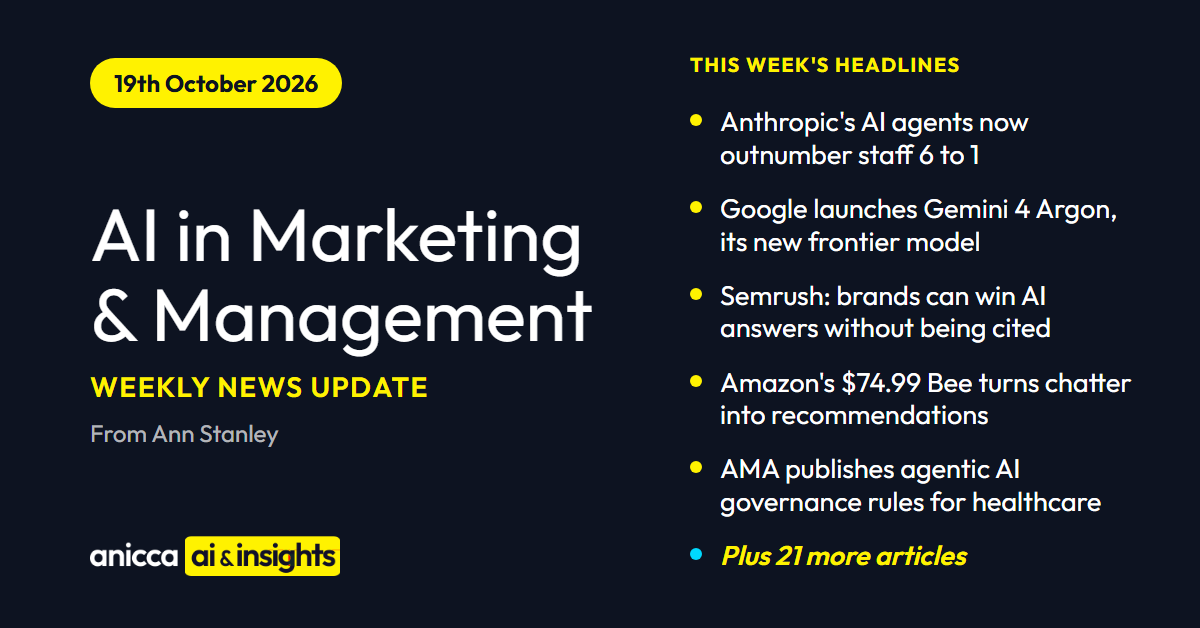
Anthropic’s AI Agents Outnumber Employees 6 to 1, and Brands Can Win AI Answers Without Being Cited
This week’s headline story: Anthropic published a remarkable internal study showing AI agents now outnumber employees 6 to 1 at the company, offering a glimpse of what AI-native organisations actually look like. Elsewhere, Google launched Gemini 4 Argon and a flurry of Google Ads updates including twice-monthly API releases and new channel prioritisation controls. Semrush research reveals brands can dominate AI answers without being cited, forcing a rethink of visibility measurement. And Amazon launched a $74.99 Bee wearable that turns overheard conversations into Amazon homepage recommendations, raising fresh questions about ambient commerce and privacy.
Table of Contents
- Gemini 4 Argon launches as Google’s new frontier model
- How employment is changing at Anthropic
- Redesigning source control at Anthropic
- Britain to get first look at new AI systems after White House U-turn
- Aneel Bhusri on refounding Workday for the AI era
- 11 of the best-funded GEO startups racing to win AI search
- Amazon’s $74.99 Bee wearable turns overheard conversations into Amazon recommendations
- OpenAI retires custom GPTs, pushes creators to ChatGPT Sites
- AI search is standing between brands and their customers: Semrush reveals mentions and citations now diverge
- Google Ads adds search terms and ad combinations report for AI Max
- Google Ads API moves to twice-monthly releases starting with v26
- New Google Ads channel prioritisation and budget controls
- October’s Demand Gen Drop focuses on data strength
- Google Ads for AI Mode & AI Overviews may show pharmaceutical products
- Google updates links in AI Mode & AI Overviews again, no click data forthcoming
- Chart: Etsy more visible on AI than all UK-owned retailers bar Tesco
- Companies rushed in on AI. Now some are pulling back
- AI will fail where managers are not ready
- The paradox at the core of the AI revolution: faster innovation, slower growth
- Getting real about AI: how AI agents are changing the economics of software engineering
AI in E-commerce, Retail and Agentic Commerce
- American Express launches Intent Intelligence framework for AI shopping agents
- Morrisons creates Chief AI Officer role
- Meg Whitman’s tech-led turnaround plan for Albertsons
AI for Other Sectors and Industries
- HEALTHCARE: AMA publishes governance framework for agentic AI in clinical care
- FINANCE: Manulife targets $1 billion from its new enterprise AI platform by 2027
- GOVERNMENT: UK unveils new AI cyber defence measures
AI News, Tech & Tools
Gemini 4 Argon launches as Google’s new frontier model
Source: blog.google | Koray Kavukcuoglu | 13 October 2026
Google has rolled out Gemini 4 Argon, its latest frontier model, to developers, enterprises, scientists and consumers. The release is positioned as Google’s hardest-reasoning model to date, with Koray Kavukcuoglu, SVP at Google DeepMind and Chief AI Architect, pitching it as the model to use for the most complex problems in research, enterprise workflows and consumer tasks.
The launch continues Google’s rapid cadence in a market where frontier model releases now land every few weeks. Argon slots in alongside OpenAI’s GPT-5 line and Anthropic’s Claude family, with Google increasingly emphasising scientific reasoning and multi-step tool use as its differentiators rather than raw benchmark scores.
Why it matters
If your marketing stack still defaults to a single model provider, Argon is a reminder to re-run your evals. Capability leadership has shifted at least four times in the last year, and the best model for your copy, research or analytics work six months ago is unlikely to be the best today. Build a quarterly model-review cadence into your AI governance, including head-to-head testing on your actual prompts rather than vendor benchmarks. The organisations extracting the most value right now are those treating model choice as a dynamic decision, not a procurement one.
How employment is changing at Anthropic
Source: anthropic.com | Nathan Wilmers, Regina Catipon, Maxim Massenkoff, Peter McCrory | October 2026
Anthropic has published an unusually candid study of its own workforce transformation. By August 2026, interactive AI agent hours outnumbered employee hours 6 to 1. Hiring for junior technical roles has slowed sharply, output per person has risen as employees adopt coding agents, and even non-technical staff would need half their work week just to read everything their Claude agents produce.
Hiring managers now prioritise autonomy and judgement over specific technical expertise. Employees describe facing “an army of Claudes” and spending growing time on “meta-work” like building visibility dashboards and monitoring agent pipelines. In a parallel engineering post, Anthropic revealed its daily code merges jumped from 2,500 in May to over 30,000 in September, forcing it to build Scion, an in-house replacement for git, in just five months.
Why it matters
This is the clearest look yet at what a genuinely AI-native organisation looks like, and the picture is not simply “do more with fewer juniors”. The real bottleneck becomes human attention and judgement. For CMOs and marketing directors, the lesson is that scaling AI inside your team will not just reduce headcount, it will reshape the work that remains. Expect to invest in orchestration tooling, review workflows and senior judgement roles, and expect graduate hiring plans to come under pressure before they come under axe.
Redesigning source control at Anthropic
Source: anthropic.com | Engineering at Anthropic
Anthropic’s engineering team detailed how it built Scion, an in-house version control system, to replace git in just five months. The trigger: code merges in its monorepo grew from 2,500 per day in May 2026 to over 30,000 in September, with Claude writing most of it. Git’s decentralised design, built for humans, could not keep up with a 100GB main-branch history and agents merging code around the clock.
Alongside Scion, Anthropic launched a new code review tool (Antique), code search, a source control IAM system and new workflows for landing large batches of reviewed code. The team frames it as a case study in how AI-era developer infrastructure differs fundamentally from human-scale tooling.
Why it matters
If your organisation is building anything with AI coding agents, assume the tools you rely on today will buckle sooner than you expect. The marketing analogue is already visible: creative review workflows, approval chains and asset management systems designed for human output volumes crack when AI starts generating hundreds of variants per campaign. Audit your current marketing operations stack now for the bottlenecks that will emerge when your team’s output multiplies tenfold.
Britain to get first look at new AI systems after White House U-turn
Source: telegraph.co.uk | 11 October 2026
The UK’s AI Safety Institute will regain pre-deployment access to new frontier AI systems from major US labs, following a White House policy reversal. The arrangement, which had been in doubt earlier this year, gives British researchers an early window to stress-test models before public release.
The move strengthens the UK’s claim to be a credible third pole in AI governance alongside the US and EU, and gives UK regulators and enterprises earlier sight of capabilities that will reach their markets within weeks of release.
Why it matters
For UK and Ireland marketers, this is more than diplomatic theatre. Earlier visibility of frontier models at the Safety Institute means UK-specific guidance, risk assessments and compliance frameworks are likely to arrive faster than in other jurisdictions. If your organisation operates under financial, health or public-sector scrutiny, align your AI procurement with the Institute’s published assessments to accelerate internal sign-off.
Aneel Bhusri on refounding Workday for the AI era
Source: fortune.com | Fortune Editors | 15 October 2026
Workday cofounder Aneel Bhusri, who returned as CEO in February 2026, told Fortune that AI has forced him to effectively re-found the company. “When AI showed up, all bets are off,” he said, framing the HR and finance software giant’s current rebuild as more fundamental than any prior platform shift.
Workday sits in a critical seam of enterprise AI: it holds the data about who works where, on what, and for how much. Bhusri’s bet is that embedding agentic AI into HR and finance workflows is more defensible than selling horizontal AI tools.
Why it matters
Enterprise SaaS incumbents are entering a dangerous phase where either they re-architect for agents or get disintermediated by them. For marketing leaders, watch which of your core platforms (CRM, MAP, analytics, DAM) are genuinely rebuilding versus bolting on AI features. The former will deliver compounding gains, the latter will be ripped out within 24 months.
11 of the best-funded GEO startups racing to win AI search
Source: adweek.com | Kendra Barnett
Adweek profiled 11 of the best-funded Generative Engine Optimisation (GEO) startups chasing the market for making brands visible in AI answer engines. According to Similarweb, roughly one in 10 online searches now runs through a standalone AI tool like ChatGPT or Claude rather than Google or Bing, and Google’s own AI Overviews are reshaping the rest.
The crop of startups includes brand monitoring tools, content optimisation platforms and dedicated AI-search analytics, with venture funding accelerating as enterprise budgets shift from traditional SEO toward AI visibility.
Why it matters
GEO is now a procurement decision, not a research project. If you have not evaluated at least two or three of these tools against your category, you are likely under-measuring the share of consideration already moving through AI. Pick a vendor that measures both mentions (brand named in the answer) and citations (your URL linked), because the Semrush research below shows these are increasingly different battles.
Amazon’s $74.99 Bee wearable turns overheard conversations into Amazon recommendations
Source: ppc.land | Luis Rijo | 15 October 2026
Amazon has launched two Bee devices: Bee Frontier, a $74.99 wrist or clip-on wearable that summarises conversations into notes, to-do lists and reminders, and Bee Eclipse, a card-sized $99.99 phone attachment coming soon. Both link to Alexa+ and Amazon.com, and the Amazon link lets products mentioned in conversation appear as recommendations on the Amazon homepage. A Bee Pro tier at $11.99 per month gates Alexa+ and the Amazon storefront integration.
The device turns ambient speech into shopping signals at a price point low enough for mass adoption. Privacy claims are heavy, but as PPC Land notes, the open question is whether those promises hold once Amazon sees the commercial value of the data.
Why it matters
This is the first mainstream consumer device explicitly designed to turn conversation into retail intent signals, and it is from the retailer with the most to gain. For brands, the implication is that product mentions in casual spoken context, “we’re nearly out of dish soap”, may begin influencing what shoppers see first on Amazon. Review your Amazon ad strategy, your Brand Store and your Rufus optimisation now, because ambient commerce is no longer theoretical.
OpenAI retires custom GPTs, pushes creators to ChatGPT Sites
Source: socialmediaexaminer.com | Michael Stelzner
OpenAI is retiring custom GPTs on 11 December 2026, and all GPT links will stop working. Marketers who used custom GPTs as lead magnets have two migration paths: move the instructions to a Skill (private only) or submit a plugin for public approval (no guarantee). The better option, per Social Media Examiner, is ChatGPT Sites, interactive public web pages that ChatGPT builds and hosts.
Sites remove the login friction of GPTs (visitors do not need a ChatGPT account), and the format supports quizzes, assessments, calculators and recommendation tools rather than just a blank chat box. Sites is in public beta on paid ChatGPT plans.
Why it matters
If any of your lead-gen funnel runs through a custom GPT, you have under eight weeks to migrate or lose the asset. More broadly, the move signals OpenAI’s shift from chat-first to interactive, task-oriented experiences, closer to apps than conversations. Marketers who build genuinely useful assessment tools on Sites will have a shareable, SEO-adjacent asset that converts better than a chat window ever did.
AI in Marketing
AI search is standing between brands and their customers: Semrush reveals mentions and citations now diverge
Source: thedrum.com | Maria Greaves | 13 October 2026
Semrush, now an Adobe company, has unveiled its AI Visibility Index 2026 at its Spotlight conference in London. The research measured brand performance across ChatGPT, Google AI Overviews, Google Gemini and Google AI Mode in the UK and US, covering 22 categories across seven monthly measurements from January to July 2026, using 2.5 million UK prompts per month and 25 million US prompts.
The headline finding: brands can dominate AI-generated answers while barely being cited as sources. Mentions (brand name in the answer) and citations (your URL linked) are becoming decoupled, and winning one does not guarantee the other. The research urges marketers to track both metrics separately and build distinct strategies for each.
Why it matters
Most marketing dashboards still track one AI visibility number, usually citations, because they look like clicks. That is now the wrong metric. A brand mentioned in a Gemini answer with no citation still shapes consideration, and often more decisively than a buried link. Rebuild your AI visibility reporting around two axes: share of answer (mentions) and share of citation (links), and run separate content strategies for each. PR, Wikipedia and third-party authority sites drive mentions; structured on-site content drives citations.
Google Ads adds search terms and ad combinations report for AI Max
Source: searchengineland.com
Google Ads has added a search terms and ad combinations report for AI Max campaigns, giving advertisers visibility into which queries triggered which ad variants. AI Max, Google’s AI-driven Search campaign type, has drawn criticism for the black-box quality of its matching and creative decisions, and this update addresses one of the loudest complaints from PPC teams.
The report is being rolled out alongside other reporting improvements including the recent extension of Conversion Lift to Search and Performance Max, and documentation around how AI Mode ads appear in Google’s AI responses.
Why it matters
Transparency in AI-driven campaigns is finally catching up with the automation. Agencies and in-house PPC teams should now insist on reviewing the search terms and ad combinations report monthly, both to spot irrelevant query matches draining budget and to feed learnings back into asset creation. If your Google Ads reporting pack does not yet include this view, update it this week.
Google Ads API moves to twice-monthly releases starting with v26
Source: searchengineland.com | Anu Adegbola
Google is doubling the Google Ads API release cadence to twice a month, starting with v26 in October 2026 followed by v26.1. The four major versions per year remain, with the additional releases being minor, non-breaking updates. Major versions still get roughly a year of support, so developers avoid more frequent migrations.
The faster schedule is explicitly designed to accelerate development of automated advertising tools, AI agents and campaign management workflows. API release blog posts and YouTube events are also moving to twice per quarter.
Why it matters
Faster API releases mean the gap between Google shipping a feature and your bid management platform or in-house tooling supporting it will shrink. For marketers running campaigns through third-party platforms, ask your vendor how quickly they adopt new API versions, because the gap between leading and lagging platforms is about to widen. For in-house teams building AI-driven campaign tooling, this cadence is a signal that Google views agentic ad management as the primary growth vector.
New Google Ads channel prioritisation and budget controls
Source: blog.google | Tal Akabas | 14 October 2026
Google Ads is rolling out channel prioritisation and budget allocation controls that let advertisers categorise channel groupings by priority and allocate budget to secondary channels for safer testing. The move answers a long-standing complaint about Performance Max and Demand Gen, where advertisers had little control over which network their spend actually hit.
Tal Akabas, Director of Product Management for Google Ads, framed it as the end of “all-or-nothing channel targeting”, allowing marketers to protect core performance while running controlled experiments on secondary placements.
Why it matters
This is a quiet but significant concession from Google. For over two years, the direction of travel was total black-box automation; now, advertisers get granular control back. Use it. Set your core, proven channels as primary and cap secondary channels at a small percentage of budget for incrementality testing. The marketers who treat this as a chance to run proper A/B tests, not just set-and-forget, will extract the most ROI.
October’s Demand Gen Drop focuses on data strength
Source: blog.google | 13 October 2026
Google’s October Demand Gen Drop centres on first-party data. The new Data Strength Uplift metric is launching in Google Ads to show the conversion gains driven by your data setup, Data Manager is expanding to Display & Video 360 and Google Analytics, and enhanced conversions will soon be available in DV360 and GA. Google’s own data shows advertisers using Google Tag Gateway see over 20% conversion uplift on average in Demand Gen.
Insurance platform The Zebra, cited in the announcement, implemented data strength improvements and reported a 16% increase in conversion volume and 19% increase in conversion value.
Why it matters
First-party data strength is now the single biggest controllable lever in Google Ads performance. If you have not audited your tag setup, server-side tracking and enhanced conversions implementation in the past six months, you are almost certainly leaving double-digit conversion volume on the table. Prioritise this before chasing new creative or audience strategies.
Google Ads for AI Mode & AI Overviews may show pharmaceutical products
Source: seroundtable.com | Barry Schwartz | 13 October 2026
Google confirmed to Adweek that it is testing standard text and Shopping ads in AI Mode and AI Overviews that include “certain pharmaceutical products”. No formal policy change has been announced, but the expansion marks the first time pharma brands have had ads placed inside Google’s AI responses.
The regulatory implications are significant given the strict rules around prescription drug advertising in the UK, EU and US, and the opacity of AI-generated answers makes compliance review notably harder than static ad copy.
Why it matters
Even if you are not in pharma, the signal is clear: Google is willing to open AI Mode ads to regulated categories. Expect financial services, gambling, legal and alcohol to follow. Marketers in regulated verticals should begin pressure-testing how their current ad copy and claims translate into AI-generated responses, because disclaimers and risk statements that work in a text ad may be stripped or paraphrased in an AI answer.
Google updates links in AI Mode & AI Overviews again, no click data forthcoming
Source: seroundtable.com | Barry Schwartz | 15 October 2026
Google has again revised how links appear in AI Mode and AI Overviews, increasing the number of links, placing some higher in responses, surfacing one or two “right web page” links for certain queries, expanding timely article carousels globally and testing links to Search profiles from creator and publisher names on videos. Despite the design changes, Google will not share click data from AI answers with publishers.
As Barry Schwartz notes, Google’s stated goal is driving more clicks to publishers, but the perceived reality in the publisher community is that these efforts continue to fall short of restoring the traffic AI responses displaced.
Why it matters
If you rely on organic traffic from Google, assume AI-driven traffic loss is structural, not a bug Google will fix. The strategic responses are the ones we have been writing about for months: build direct audience assets (email, app, community), focus on branded search and direct-type traffic, and measure brand mentions in AI responses as a leading indicator. Waiting for Google to restore the old click economy is not a plan.
Chart: Etsy more visible on AI than all UK-owned retailers bar Tesco
Source: retail-week.com
Retail Week’s chart of the week shows Etsy outranking every UK-owned retailer except Tesco in AI visibility measurements. The data underscores how US and global marketplaces are winning the race to be referenced inside AI shopping conversations in the UK market, even against established British high-street names.
The ranking draws on AI visibility indices that measure how often retailers are mentioned or recommended across ChatGPT, Gemini and Google’s AI answers for shopping queries from UK consumers.
Why it matters
UK retailers are losing the AI visibility race to global platforms with deeper product catalogues, richer reviews and more structured data. If you are a UK retail brand, benchmark your AI mention share against both direct competitors and the marketplaces hosting your products. The answer may be to invest in your own product content and PR authority, or to rethink your marketplace strategy entirely.
AI in Management
Companies rushed in on AI. Now some are pulling back
Source: theguardian.com | Taylor Telford | 13 October 2026
Meta has scaled back plans to replace staff with AI agents after discovering employees were spending growing time cleaning up errors and security issues, and is now rebuilding its middle-management ranks it thinned in 2023. Microsoft’s EVP Ryan Roslansky publicly warned of an “ocean of sameness” from AI-generated documents, and Walmart warehouse workers are being hit with false alerts and unreasonable AI-set targets. An Atlanta Fed working paper found 90% of executives say AI has yet to translate to productivity gains, and an Ernst & Young survey found 36% of senior AI executives at large companies regret the pace of their rollouts.
Johnny C Taylor Jr, CEO of the Society for Human Resource Management, told The Guardian that leaders feel they are “driving the truck and building it at the same time” and would, with hindsight, have adopted AI “in a more thoughtful, slow way”.
Why it matters
This is the counterweight to the Anthropic study. Most organisations are not Anthropic, and rushing to agent-first operations without the engineering culture, review infrastructure and senior judgement to catch errors is destroying value, not creating it. For marketing leaders, resist the pressure to announce headline AI headcount reductions. The sustainable play is to deploy AI into clear, measurable workflows with human review, measure productivity gains properly, and then make workforce decisions from evidence rather than board-level anxiety.
AI will fail where managers are not ready
Source: hrnews.co.uk | Editorial Team | 12 October 2026
HR News argues that AI adoption programmes are failing primarily at management level, not technology level. Line managers lack the training to redesign workflows around AI, to assess which tasks should and should not be delegated to agents, and to hold teams accountable when AI outputs go wrong. Without that management capability, pilots stall and tools go unused.
The piece sits alongside parallel coverage noting HR has largely bought into AI but struggles to create measurable value, pointing to a managerial skills gap as the primary blocker.
Why it matters
AI training budgets this year are overwhelmingly going to end users (prompt training, tool familiarisation). The missing investment is in middle managers, who need entirely different skills: workflow redesign, output quality assessment, ethical and compliance judgement, and team restructuring. If your 2027 L&D plan does not include a dedicated AI-for-managers programme, you are building on sand.
The paradox at the core of the AI revolution: faster innovation, slower growth
Source: fortune.com | Nicholas Gordon | 11 October 2026
Ming Lu, senior advisory partner at KKR and former executive chairman of KKR Asia Pacific, argues in Fortune that the AI revolution contains a paradox: the faster we innovate, the slower overall economic growth may become. His case rests on how AI compresses product cycles, destroys incumbents faster than new winners can scale, and concentrates returns in a handful of infrastructure providers.
The argument lands amid growing scepticism about the macroeconomic payoff of AI, with the Atlanta Fed noting most firms have yet to see productivity gains despite billions in investment.
Why it matters
For marketing and management leaders planning multi-year budgets, this is a reminder that the top-line market growth assumptions of 2024 and 2025 may need recalibrating. Plan for a world where your category grows more slowly, competitors appear faster, and the window to defend market share compresses. Investing in brand, loyalty and direct customer relationships, not just acquisition efficiency, is the hedge.
Getting real about AI: how AI agents are changing the economics of software engineering
Source: mckinsey.com
McKinsey Senior Partner Anita Balchandani interviewed Russell Kaplan, co-founder and President of Cognition, the company behind autonomous engineering agent Devin. Cognition recently raised $2 billion at a $48 billion valuation. Kaplan says Devin is now being used inside large enterprises as a co-worker in Slack, Jira and code repositories, with a growing share of Devin sessions triggered automatically rather than by a human.
The piece argues the real challenge for enterprises is not deploying the technology but rethinking how engineering work is prioritised, measured and governed when agents take on more autonomous responsibility.
Why it matters
The lessons from engineering apply directly to marketing operations. When agents can take on more autonomous work, the key management questions become: what work do we prioritise now that capacity is less constrained, how do we measure productivity when individual output is multiplied by agents, and who is accountable when an agent ships something wrong. Build the governance now, not after the first incident.
AI in E-commerce, Retail and Agentic Commerce
American Express launches Intent Intelligence framework for AI shopping agents
Source: digitalcommerce360.com | 16 October 2026
American Express published its Intent Intelligence framework on 13 October, setting out how card issuers can verify purchases made by AI shopping agents by recording a shopper’s purchase instructions before the agent transacts. The records help issuers detect fraud, approve payments and resolve disputes, including cases where an AI agent makes an ordering mistake rather than the customer.
Amex confirmed the framework has no live integrations yet; publishing it is an invitation to other payment and technology providers to adopt the approach. Luke Gebb, head of global innovation at Amex, said authorised purchase intent gives issuers “greater confidence that an agent is acting as a customer intended”.
Why it matters
Agentic commerce has a trust problem: when an AI agent buys the wrong thing, who pays? Amex’s framework is an attempt to solve the dispute question before it becomes a mass-scale consumer backlash. For retailers and brands, prepare now for a world where you can be shown proof that a shopper did (or did not) authorise an agent purchase. Your checkout, returns and dispute processes will need to accept and act on intent records within 18 months.
Morrisons creates Chief AI Officer role
Source: retailtechinnovationhub.com
UK grocery giant Morrisons has created a Chief AI Officer role, becoming one of the first major British supermarkets to establish AI leadership at C-suite level. The appointment featured as the most-read story on Retail Technology Innovation Hub, reflecting intense industry interest in how UK retailers are organising for AI.
The move follows a broader pattern of large UK organisations elevating AI accountability to board level, moving beyond the “head of data and AI” role that typically reported into technology or operations.
Why it matters
A dedicated CAIO signals that AI governance, strategy and value delivery are too important and too cross-functional to sit beneath the CTO or CDO. For marketing leaders, this changes who you partner with internally for AI initiatives. Where Morrisons leads, Tesco, Sainsbury’s and Asda are likely to follow within 12 months. If your organisation is still debating whether to create the role, the window to be a leader rather than a follower is closing.
Meg Whitman’s tech-led turnaround plan for Albertsons
Source: fortune.com | Phil Wahba | 13 October 2026
Former eBay and HP CEO Meg Whitman is bringing a tech-led turnaround approach to US grocery giant Albertsons, which pulled its financial forecasts mid-turnaround. Whitman’s early moves emphasise data, automation and AI-driven merchandising as the levers to compete against Walmart, Kroger and Amazon’s expanding grocery footprint.
The appointment underscores a broader pattern of traditional retailers recruiting technology-industry CEOs to drive AI transformation rather than promoting from within.
Why it matters
When grocery, one of the lowest-margin and most operationally complex retail categories, imports tech CEOs to lead AI transformation, it signals the depth of change expected. UK grocers watching Albertsons will be weighing similar moves. For brands selling into grocery, expect faster shelf-space decisions, more dynamic pricing, and more AI-driven promotional negotiations within 24 months.
AI for Other Sectors and Industries
HEALTHCARE: AMA publishes governance framework for agentic AI in clinical care
Source: healthcaredive.com | 15 October 2026
The American Medical Association has published a governance framework for agentic AI, systems that complete multi-step clinical tasks such as ambient documentation, diagnostics and patient monitoring without constant human oversight. The framework rests on a single principle, that evidence, authority, oversight and accountability must stay aligned as AI capability advances, and sets out four questions any clinical AI agent must answer: which clinical function it performs, what evidence shows it performs that function reliably and what happens when it fails, what it is permitted to do and under what conditions, and who is accountable for the risks and outcomes.
The framework lands against a widening adoption gap. A survey of 250 US healthcare leaders cited in the coverage found 28% have already deployed agentic AI tools and a further 44% are running pilots, but 72% said agentic AI tools are sometimes implemented without IT approval, and more than half flagged compliance violations and unauthorised access to patient data as major concerns. With no substantive federal AI regulation for healthcare in the US, 47 states introduced more than 250 AI bills affecting healthcare in 2025 alone, leaving industry bodies like the AMA to fill the gap.
Why it matters
Healthcare is usually the most risk-averse sector marketers work with, and this framework gives you a concrete accountability structure to borrow even outside clinical settings: name the function the AI performs, show your evidence it works, define what it is permitted to do, and assign a named owner for the outcomes. If you are running AI tools against any regulated or sensitive data, health, financial, legal, expect clients and procurement teams to start asking these same four questions.
FINANCE: Manulife targets $1 billion from its new enterprise AI platform by 2027
Source: insurancebusinessmag.com | 13 October 2026
Manulife has launched a proprietary enterprise AI platform that moves the insurer from building one-off AI tools to running AI as a shared capability across its global operations. Tools vetted once for security, risk and governance can now be reused in other markets without repeating the full approval process, which CEO Phil Witherington says lets the company “move beyond individual solutions to a shared enterprise capability.” The first tools live on the platform include a Singapore sales assistant, a multi-market intelligent document processing service, and Quick Quote in the US, which automates part of preliminary life insurance underwriting.
Manulife is targeting $1 billion in cumulative enterprise value from AI by 2027, having already booked $300 million by the end of 2025. The measure blends run-rate expense reductions, revenue uplift from AI-powered workflows, fraud reduction and what it calls “growth absorption”, handling more business without a matching rise in costs. The platform builds on a five-year partnership with Microsoft announced in July, under which Microsoft 365 Copilot has already rolled out to more than 30,000 employees, and follows Manulife ranking top for AI maturity among life insurers in the Evident AI Index for the second year running.
Why it matters
Manulife’s real innovation is not the AI itself, it is the reusable governance structure that lets a tool approved once get deployed in a new market without restarting compliance from scratch. If your business operates across multiple regions or brands, that is the template worth copying: build the approval process once, reuse the AI tool everywhere, and report the value in a single blended metric the board can actually track.
GOVERNMENT: UK unveils new AI cyber defence measures
Source: gov.uk | 12 October 2026
The UK government has announced a package of measures to protect the country against increasingly capable AI, covering frontier AI for cyber defence, possible stronger legal protections, and preparation for incidents involving autonomous AI agents. AI Minister Kanishka Narayan announced the measures at Imperial College London, saying he wants Britain to be “one of the hardest countries in the world to attack using artificial intelligence.” Two existing pilots using frontier AI to find and fix cyber vulnerabilities across government systems, which have already identified more than 1,000 potential weaknesses, will be extended and prepared for wider public-sector adoption.
The government will also examine whether the Cyber Security and Resilience Bill needs strengthening to cover AI threats, including how serious incidents involving AI agents, and near misses, get reported, and how to protect essential services such as hospitals and utilities against “AI loss of control”, where autonomous systems evade human oversight. The AI Security Institute is separately running evaluations of the latest generation of advanced AI models, and the government says it wants to support AI verification, checking that claims about how systems were developed and tested actually hold up, with more detail promised in the coming months.
Why it matters
This is the clearest signal yet that UK regulators are preparing specifically for incidents involving autonomous AI agents, not just chatbots, which matters directly for any business already running agentic workflows. If your AI agents touch customer data or make autonomous decisions, start documenting how you would detect, report and contain an incident now, before AI verification requirements turn today’s voluntary practice into tomorrow’s compliance checkbox.
Key Takeaways
- Anthropic’s internal AI agents now outnumber employees 6 to 1, and daily code merges grew from 2,500 in May to over 30,000 in September 2026, giving the clearest picture yet of an AI-native organisation.
- Semrush’s AI Visibility Index 2026, measuring 25 million US and 2.5 million UK prompts monthly, reveals brands can dominate AI mentions while barely being cited, requiring separate measurement and strategy for each.
- OpenAI retires custom GPTs on 11 December 2026; migrate lead-magnet GPTs to ChatGPT Sites or Skills now.
- Google Ads is shifting to twice-monthly API releases, adding search terms reporting for AI Max, launching channel prioritisation controls, and expanding Data Manager to DV360 and GA.
- Meta has reversed AI-driven headcount cuts after discovering clean-up costs; 90% of executives say AI has not yet delivered productivity gains, per Atlanta Fed research.
- Amazon’s $74.99 Bee Frontier wearable turns overheard conversation into Amazon homepage recommendations, launching ambient commerce at mass-market price points.
- American Express has published an Intent Intelligence framework to verify AI shopping agent purchases and resolve disputes before agentic commerce scales.
Frequently Asked Questions
How should I measure brand visibility in AI search now?
Track two separate metrics: share of mention (how often your brand name appears in AI answers) and share of citation (how often your URL is linked). Semrush, Profound, Peec AI and similar GEO tools can measure both, and strategies to grow each differ: mentions respond to PR and third-party authority, citations respond to structured on-site content.
What should I do before OpenAI retires custom GPTs on 11 December?
Audit every custom GPT in your marketing stack, especially those used as lead magnets or client-facing tools. Migrate the useful ones to ChatGPT Sites (public, no login required, better for lead gen) or to Skills (private, internal use). Do not wait, the migration takes longer than you think once you factor in testing.
Should we create a Chief AI Officer role?
If AI touches more than three functions in your business and you have more than one major AI initiative in flight, probably yes. The role is less about technical AI expertise and more about governance, cross-functional orchestration and value delivery. Morrisons and others moving this way are setting a pattern that will be mainstream in UK enterprise within 18 months.
Conclusion
This week’s stories cluster around a single theme: the gap between AI capability and organisational readiness is widening, and it is now the primary determinant of whether AI investment pays off. Anthropic shows what maximum readiness looks like (and the human-attention bottleneck it creates), while Meta, Microsoft and Walmart show what rushed deployment costs. In marketing specifically, the Semrush research reframes visibility measurement, Google’s product updates offer welcome transparency, and Amazon’s Bee signals the arrival of ambient commerce. Three actions for the next 30 days: audit your custom GPTs before December, split your AI visibility reporting into mentions and citations, and invest in middle-manager AI capability rather than just end-user training.
Need help adapting your AI marketing strategy? Contact the Anicca team for expert guidance.


Join the Thursday AI Club
A hands-on AI club for marketers and managers. Fortnightly sessions, 2-5pm UK: Hour 1 is an open Q&A on any AI question; Hours 2-3 split into a workshop track (for newbies) and an advanced track (live demos and deeper questions).
Led by Ann Stanley, Darren Wynn, James Allen.
Membership: £40/month or £400/year
This roundup is compiled from publicly available sources using AI-assisted research. While we review every article for accuracy, our analysis reflects our interpretation of the original reporting. We strongly encourage readers to click through to the original sources linked throughout this post for full context and detail. If you spot anything that needs correcting, please let us know.