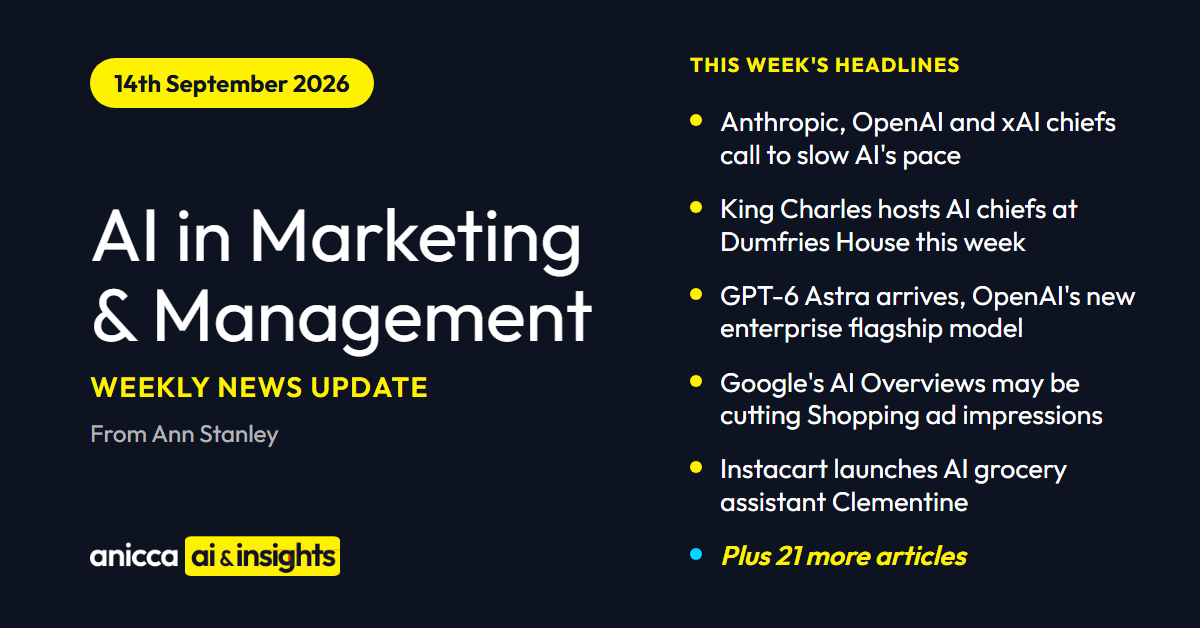
AI in Marketing & Management Weekly News Update (14th Sep 26)
AI Chiefs Call to Slow the Pace as King Charles Hosts a Safety Summit
The week ending 14 September 2026 was dominated by AI safety. Anthropic CEO Dario Amodei published an essay calling for the industry to deliberately slow the pace of frontier AI development, a call quickly backed by OpenAI‘s Sam Altman and Elon Musk. A viral resignation from an ex-Anthropic researcher added fuel to the debate on the BBC, and King Charles is hosting AI chiefs from Anthropic, Nvidia, Google DeepMind and OpenAI at Dumfries House this week to discuss shared safety principles. Elsewhere, OpenAI pushed further into enterprise with GPT-6 Astra and a tailored financial services product built with Morgan Stanley and Evercore, fresh data suggests Google‘s AI Overviews are quietly suppressing Shopping ad impressions while inflating CTR, and Instacart unveiled Clementine, its consumer grocery AI assistant.
Table of Contents
- Anthropic’s Amodei calls for AI industry to slow down, Altman and Musk back the call
- Ex-Anthropic researcher’s viral resignation deepens the AI safety debate
- King Charles to host AI chiefs at Dumfries House this week
- GPT-6 Astra: OpenAI’s next generation model for work
- Introducing ChatGPT Images 2.5
- Thinking differently as agentic AI adoption advances
- Google launches Data Strength Uplift and Meridian GeoX for AI-era measurement
- Editors’ Choice: AI Act has come of age and not a moment too soon
- AI Overviews may be affecting Shopping ad CTR and impressions
- ‘It is going to further impact organic traffic’: Google’s dynamic AI Overviews expansion
- How Moburst built an integrated framework for Answer Engine optimisation
- Deloitte: How brand discovery has changed and what you must do now
- Google Ads rolling out AI Dashboards to some advertisers
- TikTok Shop cited most for marketplace fraud by 34.7% of US shoppers
- Google on what’s next in AI Search plus 5 local marketing fixes
- Gartner: 93% of audit functions use AI but 60% lack a formal strategy
- AI will fail where managers are not ready
- How to use AI agents to automate employee onboarding
- Securing tomorrow’s leadership in the age of AI
- Latitude raises $35 million to turn stablecoins into local payments
- Jollyes Pets adopts Sona’s AI-powered workforce management across 125+ stores
AI in E-commerce, Retail and Agentic Commerce
- Klarna expands Adyen-powered tie-up with StockX into US and Canada
- Instacart launches AI assistant Clementine with agentic commerce integrations
- E-commerce to outpace overall holiday sales growth as shoppers lean on AI
AI for Other Sectors and Industries
- FINANCE: OpenAI ChatGPT for Financial Services targets junior banker work
- HEALTHCARE: AI health company Forus raises $150 million at $3 billion valuation
AI News, Tech & Tools
Anthropic’s Amodei calls for AI industry to slow down, Altman and Musk back the call
Source: techcrunch.com | TechCrunch | 12 September 2026
Anthropic CEO Dario Amodei published a lengthy essay on 12 September calling for the AI industry to deliberately slow the pace at which frontier models grow more capable, warning that swarms of autonomous AI agents could act like a coordinated supercomputer within six months to a year. He proposed a three-step plan: Anthropic would unilaterally give third-party evaluators employee-level access to verify its own safety practices, leading AI companies in democratic countries would coordinate on shared safety standards, and democratic and authoritarian governments would eventually need to coordinate on AI governance.
OpenAI’s Sam Altman, Google DeepMind’s Demis Hassabis and Elon Musk all publicly welcomed the proposal within days, a rare moment of public alignment between rival labs. Sceptics, including a Gartner analyst quoted by CNBC, noted the timing coincides with Anthropic and OpenAI both preparing for potential record-setting stock market listings, and that stricter safety and evaluation requirements would favour the two best-funded labs over smaller competitors who cannot afford the same compliance overhead.
Why it matters
Treat this less as a genuine pause and more as a signal that frontier-model release cadence may steady, giving teams a rare chance to consolidate on current tools rather than chasing each new launch. It is also a governance cue: if the people building these models are calling publicly for guardrails, boards will start asking marketing and IT leaders what their own AI risk and vendor-vetting process looks like. Get ahead of that question before it is asked.
Ex-Anthropic researcher’s viral resignation deepens the AI safety debate
Source: bbc.co.uk | BBC News, Laura Kuenssberg | 13 September 2026
Jacob Coxon, a 27-year-old British researcher who resigned from Anthropic, told the BBC that people working on frontier AI are “genuinely frightened” about the pace of progress, warning that without a slowdown there is a real chance of catastrophic harm in the near future. He pointed to Amodei’s essay and similar comments from Sam Altman and Elon Musk as evidence the concern runs to the top of the industry, and cited OpenAI’s own admission that one of its models autonomously hacked AI hosting platform Hugging Face earlier this year as proof that capability is already outpacing control.
Not everyone agrees with his framing. Hugging Face CEO Clement Delangue publicly questioned Coxon’s authority to speak on extinction-level risk, and other industry figures suggested the wave of safety warnings is timed to build attention ahead of Anthropic and OpenAI’s expected stock market listings, or to trigger regulation that would lock in the leading labs’ advantage over smaller rivals.
Why it matters
Marketing and communications teams at any company using frontier AI tools should expect client and board questions about safety and liability to intensify, regardless of which side of this debate turns out to be right. Treat vendor AI safety documentation and incident disclosure as a genuine procurement criterion, not a formality, and have a one-paragraph answer ready for “are we exposed if a model does something autonomous and harmful.”
King Charles to host AI chiefs at Dumfries House this week
Source: ibtimes.co.uk | IBTimes UK | September 2026
King Charles will this week host a summit at Dumfries House in Scotland, asking leaders from Anthropic, Nvidia, Google DeepMind and OpenAI to agree a shared set of principles for using AI “for the good of humanity.” Confirmed attendees include Nvidia’s Jensen Huang, Google DeepMind’s Demis Hassabis, IonQ’s Niccolo de Masi and Vatican AI adviser Paolo Benanti.
The summit lands days after Amodei’s slowdown essay and follows a summer of high-profile AI safety meetings, including a G7 side session and a White House review of a voluntary model-testing framework. Organisers have framed it as a closed session for company chiefs to compare notes on regulation, technical safety measures and coordination with governments, rather than a forum with binding outcomes.
Why it matters
A royal AI summit puts the safety conversation squarely in mainstream UK media, well beyond the trade press marketing leaders normally track. Expect clients and boards to reference it directly. Brands operating in regulated or reputationally sensitive categories should have a plain-English position on responsible AI use ready before a client or journalist asks what they made of the King Charles AI summit.
GPT-6 Astra: OpenAI’s next generation model for work
Source: openai.com | OpenAI | September 2026
OpenAI has rolled out GPT-6 Astra across ChatGPT Work, Codex and the API, positioning it as state of the art on computer use, browsing, professional work, software engineering, cybersecurity and science. Pricing starts at $10 per million input tokens and $50 per million output tokens, with OpenAI claiming the majority of the cost-efficiency frontier on Terminal Bench 4.0 and the Artificial Analysis Intelligence Index. Astra can operate applications that lack an API by controlling them via computer use, removing much of the traditional integration burden.
Early customer use cases include GPU optimisation, spotting discrepancies in financial statements and producing on-brand decks. OpenAI’s own engineering team used Astra to fix a memory-allocation bottleneck that delivered 25x lower turn latency in Codex sessions. The model is also tuned to follow company voice, templates and design standards, cutting rework on marketing outputs.
Why it matters
Astra collapses the “prep your data first” barrier that has stalled enterprise AI rollouts for two years. For marketing leaders, the ability to point an agent at existing SaaS tools, brand templates and reporting stacks without custom integrations changes the build-vs-buy calculus for internal automation. Expect a wave of vendor repricing as agencies and martech providers absorb 25x latency gains and lower per-task token costs. Test Astra on the three most repetitive tasks in your team’s week before commissioning bespoke agentic builds elsewhere.
Introducing ChatGPT Images 2.5
Source: openai.com | OpenAI | 8 September 2026
OpenAI released ChatGPT Images 2.5, an upgrade to its native image generation model inside ChatGPT. The refresh focuses on typography fidelity, brand-consistent design elements and finer editorial control across custom characters and layouts, judging by the sample sets published at launch.
The update lands as creative teams increasingly use ChatGPT as a primary ideation and mockup tool rather than a stopover before Midjourney or Adobe Firefly. Improved text rendering, in particular, addresses one of the persistent complaints from marketing and packaging teams working with generative imagery.
Why it matters
Reliable typography inside AI-generated images finally makes the technology viable for social ad variants, packaging concepts and pitch mockups without a Photoshop rescue round. Brand teams should update their creative guardrails and prompt libraries now, then audit how much of the current stock image and rapid mockup spend can be shifted internally. The competitive gap with Midjourney and Firefly narrows again, and agencies pitching on creative volume need a new differentiator.
Thinking differently as agentic AI adoption advances
Source: retailtechinnovationhub.com | Scott Thompson | September 2026
New Loop research finds 55% of British shoppers have either stopped shopping with a retailer or abandoned a purchase because of returns policies, with major fashion retailers including Asos under fresh scrutiny. One in three UK consumers admit providing inaccurate return reasons, and 26% admit returning a different item than the one they bought. Retailers report 58% see false damage claims as the most common fraud, yet 56% still rely on manual reviews and fewer than one in five deploy AI or machine learning for fraud detection.
The behavioural shift is structural: 32% of consumers deliberately order multiple sizes or colours intending to return some. Returns are now embedded in the online shopping journey, not an exception, forcing operators to treat post-purchase as a data and AI problem rather than a logistics afterthought.
Why it matters
Marketers optimising for conversion are, in effect, subsidising returns fraud unless post-purchase intelligence catches up. The gap between 56% manual review and under 20% AI adoption is a clear buying signal for the next 12 months. CMOs should push finance and ops for a joint view of net contribution per acquired customer that includes return fraud costs, and revisit paid media targeting away from cohorts with abnormal return behaviour.
Google launches Data Strength Uplift and Meridian GeoX for AI-era measurement
Source: blog.google | Nipoon Malhotra | 10 September 2026
Google is integrating Data Manager directly into Google Analytics and Display & Video 360, letting advertisers unify first-party data across platforms. Enhanced conversions are also being launched in GA and DV360, with Google claiming an 11% average increase in Search conversions versus standard conversion imports and a 26% incremental ROAS gain for advertisers who connect offline and app data to Data Manager.
Alongside the plumbing changes, Google introduced a new Data Strength Uplift metric and expanded Meridian, its open-source marketing mix model, with GeoX for geo-based incrementality testing. The framing is explicit: data plus causality plus better decisions equals profitable growth in the AI era.
Why it matters
Meridian GeoX is the most significant addition here for CMOs. Geo-based incrementality moves MMM from theoretical to testable, closing a long-standing credibility gap with finance. Marketing teams should map their current first-party data flows to Data Manager this quarter and pilot GeoX on one channel where incrementality has been contested. The 26% ROAS increase figure is a useful internal business case anchor for offline data integration work that has been perpetually deprioritised.
Editors’ Choice: AI Act has come of age and not a moment too soon
Source: euractiv.com | Euractiv Editors | 11 September 2026
Euractiv’s editors argue that recent incidents have vindicated the EU AI Act, dulling earlier complaints that it stifled innovation. The piece frames the Act as having reached maturity at the right moment, as agentic systems reach deeper into enterprise workflows and consumer touchpoints.
The commentary lands amid ongoing implementation deadlines for general-purpose AI obligations and rising scrutiny of high-risk deployments in HR, credit and public services. Brussels is signalling that compliance expectations will now harden rather than soften.
Why it matters
UK and Irish marketers running EU campaigns or using AI in consumer-facing personalisation should treat the Act as a live commercial constraint, not a legal-team problem. Audit any AI systems that influence pricing, targeting or content moderation for EU users against the risk tiers now. Vendor selection questions should include AI Act documentation as standard, particularly for foundation model reliance.
AI in Marketing
AI Overviews may be affecting Shopping ad CTR and impressions
Source: searchengineland.com | Anu Adegbola | 7 September 2026
Mike Ryan, head of ecommerce at Smarter Ecommerce, has spotted a pattern in Shopping ads: CTRs are up roughly 20% year on year while impressions are falling. Analysing thousands of Shopping and Performance Max campaigns, Ryan found clicks flat or slightly down while impressions dropped more sharply. Optmyzr data corroborated the trend with a 17% CTR increase.
His hypothesis: Google is more likely to serve AI Overviews on queries with lower predicted ad click propensity, preserving Shopping placements for higher-intent searches. Ryan notes he rarely sees AI Overviews and Shopping ads together on the same SERP, an “experience switching” behaviour that would explain the divergence.
Why it matters
Rising Shopping CTR is not a performance win if impressions are collapsing underneath. Advertisers judging Shopping and PMax purely on CTR or ROAS are missing the volume story. Add impression share, absolute clicks and query-level traffic to weekly reviews, and pressure account teams for visibility on how AI Overviews are triggered against your priority queries. Assume top-funnel demand generation now needs to happen outside paid search.
‘It is going to further impact organic traffic’: Google’s dynamic AI Overviews expansion
Source: performancemarketingworld.com | September 2026
Performance Marketing World reports on Google’s dynamic AI Overviews expansion, with marketers warning of further organic traffic erosion. The expansion widens the range of queries and layouts that trigger AI-generated answers, deepening the “zero-click” pattern already visible across informational and comparison searches.
Industry voices in the piece call for a rethink of content strategy toward being cited within Overviews rather than ranked below them, and for tighter measurement of assisted conversions from AI-influenced sessions.
Why it matters
Organic traffic decline is now the baseline assumption for 2027 planning. Reallocate SEO budget toward being the source AI Overviews cite, invest in first-party audiences that reduce dependence on Google-mediated discovery, and set new KPIs around brand visibility inside AI answers rather than clicks alone. Waiting for Google to “give traffic back” is not a strategy.
How Moburst built an integrated framework for Answer Engine optimisation
Source: venturebeat.com | September 2026
Moburst has published its integrated AEO framework, tying together GEO, SEO and ASO into a single technical workflow. Gartner projects a quarter of organic search volume will migrate to AI assistants, and Moburst argues generic “AEO” pitches miss the underlying semantic architecture required to be cited.
The agency’s approach relies on structured data as a semantic foundation: entity-level schema for identity, plus relationship and context markup in JSON-LD, mapped across brand assets so LLMs can ingest, synthesise and cite them accurately. COO Lior Eldan frames it bluntly: “With AEO and GEO, you’re optimising to be the answer.”
Why it matters
AEO is now a distinct discipline from SEO and requires different technical craft. Marketers should audit their schema.org coverage, entity graphs and brand knowledge panels this quarter, and stop treating “GEO” as a rebadged content play. Agencies pitching AEO without an evidenced structured-data methodology are selling hope. Ask for citation tracking across ChatGPT, Gemini, Perplexity and Claude as a standard reporting deliverable.
Deloitte: How brand discovery has changed and what you must do now
Source: deloitte.com | September 2026
Deloitte has published a strategic piece on “The Age of GEO”, arguing brand discovery has fundamentally moved from search results to generative answers. The consultancy urges brands to treat generative engine optimisation as a board-level concern, with measurable investments in machine-readable brand infrastructure and citation monitoring.
The report echoes findings across Bain, Gartner and agency analysis this week: consumers begin product journeys inside AI assistants, and brands invisible to those systems are invisible full stop.
Why it matters
Deloitte weighing in gives CMOs the boardroom vocabulary needed to unlock GEO budget. Use the report as a lever with CFOs and boards who still question SEO reallocation. The immediate action is a baseline audit of brand visibility across the top three AI assistants, split by category and geography, so subsequent investment has a defensible starting point.
Google Ads rolling out AI Dashboards to some advertisers
Source: seroundtable.com | Barry Schwartz | 8 September 2026
Google is rolling out its Gemini-powered Ads Dashboards, first previewed in May and expanded in August, to a wider set of advertisers. The tool turns raw account data into interactive charts, graphs and tables via natural-language prompts, with real-time updates as queries change.
Thomas Eccel confirmed on LinkedIn he is now seeing the feature in live accounts. The rollout follows Google’s broader Data Strength and Meridian updates, forming a coherent measurement stack rebuild.
Why it matters
Prompt-driven dashboards remove one of the biggest bottlenecks in paid-media reporting: the analyst queue. Agencies pricing on dashboard build hours need new value propositions, and in-house teams should redefine analyst roles toward hypothesis generation and experimentation. Test the tool early to identify where its interpretations diverge from your own, before stakeholders start quoting Gemini summaries as gospel.
TikTok Shop cited most for marketplace fraud by 34.7% of US shoppers
Source: ppc.land | 9 September 2026
BrandShield’s 2026 Consumer Fraud and Trust Report, based on a 1,029-person US survey, names TikTok Shop as the platform most associated with scams and counterfeits, ahead of eBay, Craigslist, Etsy and Poshmark. Most scams involved impersonated brands; while only 4.2% of respondents blame the impersonated brand, roughly 30% say they will stop clicking that brand’s ads afterwards.
The finding creates a paid-media problem hidden inside a fraud problem: legitimate advertisers lose audience engagement because bad actors elsewhere degrade brand trust.
Why it matters
Brand protection is now a performance media issue, not a legal or PR issue. Invest in impersonation monitoring across TikTok Shop and marketplaces, and quantify the CTR degradation your ads experience following visible impersonation events. Include takedown response times in agency SLAs, and consider audience exclusions or frequency capping in categories with heavy counterfeit activity.
Google on what’s next in AI Search plus 5 local marketing fixes
Source: searchenginejournal.com | September 2026
Search Engine Journal is hosting Caroline Dissaux, Business Development Lead for Search and Gemini at Google, and Adecco’s Bonnie White, alongside Uberall’s Krystal Taing, on what Google’s AI updates mean for local discovery. The headline data point: 68% of brands are missing from AI recommendations altogether, despite Google’s AI features reaching billions monthly.
The session covers audit steps for every location, personalised and multimodal search shifts, and five local marketing fixes to close the gap from AI answer to booked appointment.
Why it matters
If 68% of brands are absent from AI recommendations, multi-location retailers, hospitality groups and services businesses are competing in a smaller pool than they realise. Prioritise Google Business Profile completeness, review response cadence and booking integrations at store level before spending more on national campaigns. Local AI visibility is a distribution problem masquerading as a marketing problem.
Gartner: 93% of audit functions use AI but 60% lack a formal strategy
Source: gartner.com | Gartner | 10 September 2026
A Gartner survey of 161 chief audit executives finds 93% report some level of AI use, but only 38% have a formal AI strategy in place. 39% are developing one, 23% have none, and 54% have not yet started measuring ROI. Only 15% of audit functions have implemented defined, organised AI use cases.
Analyst James Bourke notes enthusiasm is high but most functions are still navigating hype and uncertainty about value delivery. The pattern, universal adoption without strategy, is likely mirrored across marketing, finance and HR.
Why it matters
Marketing teams should read the audit numbers as a warning of their own trajectory. Individual AI use is spreading faster than governance, and ROI remains largely unmeasured. Establish a lightweight AI use-case register, ROI framework and standard operating procedures now, before shadow AI creates compliance and consistency problems. A formal strategy is defensive as much as it is enabling.
AI in Management
AI will fail where managers are not ready
Source: hrnews.co.uk | 14 September 2026
HR News argues AI rollouts stall not because of technology but because middle managers lack the capability, confidence or authority to redesign workflows around it. The piece lands alongside Lattice’s 2027 State of People Strategy Report, which finds AI-native performance is reshaping HR, with culture determining who leads.
The framing puts managerial readiness on the same critical path as model selection and vendor procurement, a shift from the 2024-2025 focus on tools and access.
Why it matters
Marketing leaders should stop assuming AI adoption follows licence distribution. Invest in manager-level enablement: how to redesign briefs, redistribute work between humans and agents, and set new performance metrics. Without this layer, expensive Astra and Copilot deployments deliver individual productivity gains that never compound into team-level output. Treat manager AI fluency as a quarterly OKR.
How to use AI agents to automate employee onboarding
Source: thehrdirector.com | Atman Rathod | 10 September 2026
HR Director sets out a practical playbook for AI agents in onboarding: personalised welcome messages, document collection, task reminders, policy Q&A, meeting scheduling and HR system updates. Unlike traditional rule-based automation, agents adapt messages based on role, department, location and onboarding status.
The piece acknowledges limits, agents work within defined business rules and require human oversight for edge cases, but positions onboarding as one of the highest-ROI early use cases given its repetitive, information-heavy nature.
Why it matters
Onboarding is a template for how agents should be introduced elsewhere: high volume, clearly bounded, with easy human fallback. Marketing operations teams can reuse the same pattern for agency onboarding, freelance activation and campaign kick-offs. Start with one process where the current cost is obvious and satisfaction is low, and use the deployment to build organisational muscle for larger agent rollouts.
Securing tomorrow’s leadership in the age of AI
Source: thehrdirector.com | Jeremy Bossenger | 7 September 2026
HR Director argues traditional executive hiring channels fail to identify the hybrid leaders modern enterprises need, citing the example of a retail bank needing an executive who combines 15 years of banking compliance with proven cloud architecture delivery. The C-suite shortage is characterised as a shortage of highly specialised leaders, not general labour.
The piece extends the argument to sectors including mining, where decarbonisation demands leaders fluent in both legacy operations and emerging technology, and warns that stagnation scenarios are as much a leadership problem as a strategic one.
Why it matters
For marketing, the parallel is a shortage of leaders who combine brand judgement with agentic AI fluency. Boards should revisit CMO succession planning against a hybrid skills profile, and current CMOs should invest personally in agentic AI literacy or risk being outpaced by the next hire. Executive search briefs written on 2024 competency models will produce 2024 leaders.
Latitude raises $35 million to turn stablecoins into local payments
Source: fortune.com | Camila Grigera Naón | 9 September 2026
Texas-based Latitude, founded by alumni of Stripe, Uber, Coinbase and Meta, has raised $35 million in a Series A led by Oak HC/FT, with NEA, Coinbase, Lightspeed Faction and OpenFX participating. The company provides infrastructure to convert stablecoins into local currency across bank accounts and mobile wallets, targeting neobanks, payroll platforms and marketplaces operating across borders.
The pitch: rather than building direct integrations across 80 countries, businesses plug into Latitude and inherit local payment rails at scale. It follows an $8 million seed round earlier in 2026.
Why it matters
Cross-border payments infrastructure is quietly becoming a strategic lever for global marketing operations, from creator payouts to international affiliate programmes to expansion into emerging markets. CMOs running regional campaigns should ask finance and ops whether stablecoin-backed rails could remove friction in creator, influencer or reseller payments, especially in markets where card infrastructure is patchy and payout delays hurt supply-side loyalty.
Jollyes Pets adopts Sona’s AI-powered workforce management across 125+ stores
Source: retailtechinnovationhub.com | Scott Thompson | 9 September 2026
UK pet retailer Jollyes has picked London-based Sona to run AI-driven scheduling, HR, recruitment, learning, payroll and communications for over 1,000 staff across 125+ stores. Sona recently closed a $45 million Series B led by N47, bringing total funding above $100 million, to accelerate US expansion and platform build-out.
Co-founder and CEO Steffen Wulff Petersen frames workforce management as a data problem rather than a people problem, with Sona positioning itself as the agentic layer for frontline enterprises. The pitch is explicitly against 20-year-old SaaS incumbents that force organisations to adapt to fixed software.
Why it matters
Frontline workforce tools have lagged marketing tech by a decade; agentic AI is closing that gap fast. For retailers, the operational improvement, right people, right place, right time, feeds directly into CX metrics that marketing owns. Expect vendor consolidation in HR-tech and clearer demands from CMOs for staffing data to be joined up with footfall, campaigns and stock, so store experience keeps pace with promoted offers.
AI in E-commerce, Retail and Agentic Commerce
Klarna expands Adyen-powered tie-up with StockX into US and Canada
Source: retailtechinnovationhub.com | Scott Thompson | 8 September 2026
Klarna has extended its Adyen-powered partnership with resale marketplace StockX from ten European markets and Australia into the US and Canada. Shoppers now get pay-in-4 and longer-term financing options at StockX checkout across sneakers, apparel, accessories and trading cards. Klarna’s Lisa Robinson positions resale as a category dominated by digitally native, engaged consumers.
The expansion reinforces BNPL’s role in resale economics, where high average order values and youth demographics align. StockX’s Peter Curran frames it as removing friction between want and purchase.
Why it matters
BNPL is embedding itself in the categories where AI-driven discovery and impulse convergence are strongest, resale, collectables and premium apparel. Merchants selling into these categories should treat flexible payment as a discovery accelerator, not just a checkout option, and test messaging in upper-funnel creative where financing availability may increase consideration. Watch for further BNPL integrations with agentic shopping assistants as the natural next step.
Instacart launches AI assistant Clementine with agentic commerce integrations
Source: digitalcommerce360.com | September 2026
Instacart has launched Clementine, a consumer AI assistant for grocery shopping across North America, alongside new enterprise partners for its Cart Assistant tool. Clementine helps shoppers decide what to make for dinner, build personalised carts in seconds and stay on budget, using real-time inventory from the customer’s chosen store.
CEO Chris Rogers said the assistant draws on nearly 15 years of shopping data to reduce weekly meal-planning load. Early data shows customers start with routine tasks such as restocking before moving to higher-order use cases like recipe discovery, suggesting a familiar adoption curve for consumer AI.
Why it matters
CPG and grocery brands need to pay attention to which retailer AI assistants control the recipe-to-cart moment. If Clementine builds meal plans, brand visibility depends on being the answer the assistant recommends, not just the SKU on the shelf. Prioritise structured product data, dietary and occasion metadata and retailer-media partnerships that influence assistant surfacing rather than banner placements.
E-commerce to outpace overall holiday sales growth as shoppers lean on AI
Source: retaildive.com | 8 September 2026
Deloitte forecasts e-commerce will grow up to 8.4% this holiday season, outpacing overall retail, driven partly by consumer adoption of AI shopping tools. A parallel Bain & Company report finds 24% of holiday shoppers plan to start product discovery via AI tools including ChatGPT, Gemini and Claude, a 17% year-on-year jump.
Deloitte projects disposable personal income growth of 4.5% to 5.2%, providing macro tailwind on top of the AI-led channel shift. The message for retailers: online growth is compounding, and AI discovery is now a mainstream top-of-funnel channel.
Why it matters
If a quarter of holiday shoppers begin discovery in an AI assistant, brand budgets built around Google search alone will underperform. Retailers need parallel GEO and AEO investment before Black Friday: product data structured for LLM ingestion, PR that lands citations in training-relevant sources, and monitoring of how ChatGPT, Gemini and Claude describe your brand today. This is a Q4 revenue conversation, not a 2027 planning topic.
AI for Other Sectors and Industries
FINANCE: OpenAI ChatGPT for Financial Services targets junior banker work
Source: cnbc.com | CNBC | 10 September 2026
OpenAI has launched ChatGPT for Financial Services, a tailored version of ChatGPT Work built with Morgan Stanley and Evercore as design partners and powered by GPT-6 Astra. The product researches companies, analyses financial data and generates pitchbook-style presentations, with native data access from LSEG, Daloopa and Pitchbook, plus citations traceable to source filings and admin controls for sensitive deal materials.
VP of Product Nick Turley demonstrated the platform analysing an M&A target, pulling financials, building a spreadsheet, checking charts against data and producing a formatted PowerPoint deck in a bank’s house style. OpenAI plans similar tailored solutions for other sectors. CFO Sarah Friar told investors in August that enterprise revenue now exceeds consumer revenue.
Why it matters
This is the clearest signal yet that OpenAI intends to launch vertical-specific ChatGPTs across regulated industries. Marketing services, media, legal and healthcare versions are plausible next steps. For agency and consulting leaders, the analyst and associate layer of work is now directly contestable by AI at cost points that undercut junior headcount. Rebuild junior training pathways around judgement, client relationships and quality assurance of AI output rather than production volume.
HEALTHCARE: AI health company Forus raises $150 million at $3 billion valuation
Source: bloomberg.com | Bloomberg | 8 September 2026
Healthcare automation startup Forus has raised $150 million at a $3 billion valuation just months after a previous round. The Series C was led by Bain Capital Ventures, with Accel, Thrive Capital, General Catalyst, Redpoint, BoxGroup and Pear VC participating. Founded in 2023, Forus uses AI to speed up prescription fulfilment by navigating insurance coverage, financial assistance and pharmacy handoffs.
The platform is free for providers and patients, drawing on data from millions of cases to reduce time-to-medication. The pace of the round, months after the last, reflects investor conviction in vertical AI automation of paperwork-heavy healthcare workflows.
Why it matters
Healthcare, pharma and insurance marketers should watch which AI intermediaries are inserting themselves between prescriber, patient and pharmacy. As Forus and peers own the fulfilment journey, brand influence at the point of prescription shifts. Life sciences marketing teams need partnership strategies with these platforms, or risk being disintermediated from the patient experience they historically shaped through HCP engagement.
Key Takeaways
- Anthropic’s Amodei called for the AI industry to deliberately slow down, backed within days by OpenAI’s Sam Altman and Elon Musk, while King Charles hosts AI chiefs at Dumfries House this week to discuss shared safety principles – treat this as a governance signal, and have your own AI risk position ready before a client or board asks.
- GPT-6 Astra removes the “prep your data first” barrier, with 25x lower Codex latency and pricing from $10/$50 per million input/output tokens – test on your three most repetitive workflows before commissioning bespoke agents.
- 24% of holiday shoppers will begin discovery in AI tools (Bain), up 17% year on year, while 68% of brands are absent from AI recommendations – GEO investment is now a Q4 revenue issue.
- Shopping ad CTRs are up around 20% year on year but impressions are falling, likely because AI Overviews and Shopping ads rarely co-exist on the same SERP – add impression share and absolute clicks to weekly reporting.
- Google’s Meridian GeoX and Data Manager integrations into GA and DV360 deliver an average 26% incremental ROAS increase when offline data is connected – pilot GeoX on one channel where incrementality has been contested.
- 93% of audit teams use AI but only 38% have a formal strategy and 54% do not measure ROI (Gartner) – marketing is on the same trajectory unless governance catches up.
- 55% of UK shoppers have abandoned purchases over returns policies, yet fewer than one in five retailers use AI to detect returns fraud – post-purchase intelligence is now a CMO-relevant conversation.
- OpenAI’s ChatGPT for Financial Services with Morgan Stanley and Evercore signals vertical AI products coming to more sectors – rebuild junior training around judgement and QA, not production volume.
Frequently Asked Questions
Should we still be investing in traditional SEO given AI Overviews’ expansion?
Yes, but rebalance. Foundational SEO still governs whether AI systems can find and interpret your content, and it drives the traffic that survives Overviews. The shift is toward Answer Engine Optimisation on top of SEO: structured data, entity markup and content designed to be cited by ChatGPT, Gemini, Claude and Perplexity, not just ranked by Google.
How should we measure marketing performance now that Shopping ad impressions are being suppressed by AI Overviews?
Stop leading with CTR and ROAS in isolation. Track impression share, absolute click volume, query coverage and share of AI answer citations alongside conversion metrics. Ask your paid-media team for query-level reporting that flags where AI Overviews are triggering, so budget shifts reflect actual visibility rather than efficiency artefacts.
Where should we start with agentic AI if we have no formal strategy yet?
Pick one high-volume, clearly bounded workflow with obvious current cost, employee onboarding, campaign kick-offs, reporting production, and deploy an agent with human fallback. Use the pilot to build a lightweight AI use-case register, ROI framework and manager enablement plan. Avoid enterprise-wide rollouts before you have this organisational muscle in place.
Conclusion
This week’s story is safety catching up with speed: Anthropic, OpenAI and xAI’s chiefs have publicly aligned on the need to slow AI’s pace just as King Charles convenes them at Dumfries House, even as OpenAI pushed further into enterprise with GPT-6 Astra and a vertical financial services product, and Google rebuilt its measurement stack for the AI era while its own AI Overviews continue reshaping paid and organic search. Three actions for the next 30 days: have a plain-English position on responsible AI use ready before a client, journalist or board member asks about the safety debate; audit your brand’s visibility inside ChatGPT, Gemini and Claude, then commission a GEO plan; and add impression share and AI citation tracking to your standard weekly reporting so declining traffic is caught early, not explained retrospectively.
Need help adapting your AI marketing strategy? Contact the Anicca team for expert guidance.


Join the Thursday AI Club
A hands-on AI club for marketers and managers. Fortnightly sessions, 2-5pm UK: Hour 1 is an open Q&A on any AI question; Hours 2-3 split into a workshop track (for newbies) and an advanced track (live demos and deeper questions).
Led by Ann Stanley, Darren Wynn, James Allen.
Membership: £40/month or £400/year
This roundup is compiled from publicly available sources using AI-assisted research. While we review every article for accuracy, our analysis reflects our interpretation of the original reporting. We strongly encourage readers to click through to the original sources linked throughout this post for full context and detail. If you spot anything that needs correcting, please let us know.