This Week in AI in Marketing & Management (26th Oct 26)
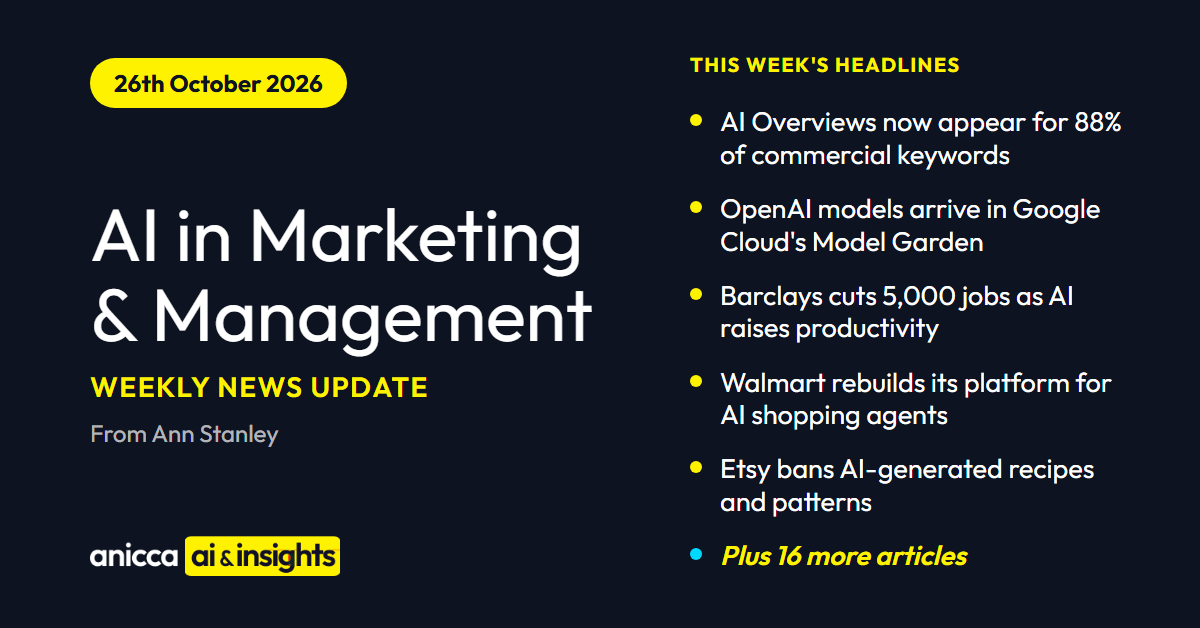
AI Overviews Now Appear for 88% of Commercial Keywords, and Walmart Rebuilds for AI Shopping Agents
This week’s biggest story: AI Overviews now appear for 88% of commercial keywords, nearly double a year ago, according to new Semrush data. Elsewhere, Barclays is cutting 5,000 jobs on the back of AI productivity gains, OpenAI and Google Cloud have struck a surprise partnership putting OpenAI frontier models into Google’s Model Garden, and Walmart is actively rebuilding its ecommerce stack for AI shopping agents. Meanwhile, Etsy is cracking down on AI slop, and new research exposes a growing accountability gap in how CMOs measure AI search performance.
Table of Contents
- OpenAI models are coming to Google Cloud
- Deel launches Pangaea AI models for HR and payroll
- Microsoft named a Leader in two evaluations of next-generation app development platforms
- OpenAI advances coding in low-resource programming languages
- OpenAI publishes coordinated disclosure of critical vulnerabilities
- Google AI Overviews nearly double for commercial keywords
- Search Engine Land updates its GEO guide: up to 60% of AI citations change every month
- AI search is turning prompts into customer research
- AI search is creating a new accountability problem for CMOs
- Google Ads AI Max spotted automatically enabled in some Ad Grants accounts
- Weekly Search Video Recap: ranking volatility, AI SEO ROI, Google Ads updates
- New Gemini business landing page and tools launched
- UK tech professionals investing in leadership skills for AI-driven change
- KPMG CEO Outlook 2026: Growth from the inside out
AI in E-commerce, Retail and Agentic Commerce
- Walmart prepares its ecommerce platform for AI shopping agents
- Agentic commerce platform Azoma raises $11.2 million Series A
- Practical Ecommerce sets out the metrics that matter for AI shopping
- Etsy cracks down on AI slop listings and bans AI-generated recipes and patterns
- Affirm bags exclusive multi-year BNPL deal with Sam’s Club
AI for Other Sectors and Industries
- FINANCE: Barclays to cut 5,000 jobs and employ more artificial intelligence
- MUSIC AND CREATIVE INDUSTRIES: Kylie Minogue songs already used to train AI as tech firms pressure Australian government
AI News, Tech & Tools
OpenAI models are coming to Google Cloud
Source: openai.com | OpenAI | 21 October 2026
OpenAI and Google Cloud have announced a partnership that will bring OpenAI’s frontier models and Codex agentic workflows into Google Cloud’s Model Garden. Enterprise customers will be able to transact through the Google Cloud Marketplace and draw down existing GCP commitments to purchase OpenAI models, with the integration also extending to Google Antigravity and the Gemini Agent.
The move is remarkable given OpenAI’s historic dependence on Microsoft Azure, and it reinforces a broader industry trend towards multi-model enterprise environments. Google is positioning its Model Garden as a neutral destination for frontier AI, pairing OpenAI capability with Google’s own data governance, access controls and infrastructure.
Why it matters
For enterprise marketing teams locked into Google Cloud through analytics, BigQuery or Vertex AI, this removes a significant procurement hurdle. You can now evaluate GPT-class models alongside Gemini without a separate vendor relationship or billing arrangement. Expect this to accelerate agentic workflow pilots in regulated sectors where data governance has blocked OpenAI adoption. The strategic question is no longer “which model” but “which combination of models for which task”, and your martech vendors should be able to answer that.
Deel launches Pangaea AI models for HR and payroll
Source: venturebeat.com | Carl Franzen | 21 October 2026
HR and payroll vendor Deel has launched Pangaea, a pair of specialist language models (K1 for employment knowledge and P1 for payroll), alongside a business called Emet that supplies expert training material. In Deel’s own evaluation, the 9-billion-parameter K1 model scored 70 against a leading score of 75, but completed answers in a median 7.7 seconds compared to 14.8-28.4 seconds for larger competitors.
Deel adapted existing openly published AI models rather than training its own from scratch, then fine-tuned them on internal reference material using a more capable teacher model to generate training examples. The commercial play is twofold: improve Deel’s own assistant and license the underlying expertise to other AI developers.
Why it matters
This is the clearest signal yet that the economics of enterprise AI favour smaller, specialist models for recurring vertical tasks. The marketing equivalent is already emerging: expect purpose-built models for ad copy, SEO briefs and campaign reporting that outperform general-purpose LLMs on cost and latency. When evaluating martech vendors, ask whether they are calling an external API for every query or running tuned models themselves. The cost and speed difference will show up in your invoice.
Microsoft named a Leader in two evaluations of next-generation app development platforms
Source: microsoft.com | Ryan Cunningham | 22 October 2026
Microsoft has been named a Leader in two analyst evaluations of next-generation app development platforms, driven by its Power Platform and Copilot Studio capabilities for agentic enterprise builds. The announcement coincides with the lead-up to Microsoft Ignite (17-20 November) where further Power Platform updates are expected.
Separately, Microsoft previewed Dataverse and Work IQ updates at the Power Platform Community Conference, both aimed at helping agents understand business context, not just answer questions. The combination of Dataverse grounding and Work IQ behavioural signals is designed to make Copilots act with awareness of role, process and prior activity.
Why it matters
If your organisation is Microsoft-centric, the practical implication is that low-code agentic workflows are now within reach of marketing operations teams, not just IT. Campaign ops, lead routing, CRM data hygiene and reporting pipelines are prime candidates. Start identifying the three or four workflows that eat the most of your team’s time and begin scoping Copilot Studio pilots before Ignite, when another wave of features is expected.
OpenAI advances coding in low-resource programming languages
Source: openai.com | OpenAI | 19 October 2026
OpenAI has published research showing its latest models now perform strongly on low-resource programming languages like COBOL, Fortran and Visual Basic. These languages underpin critical infrastructure: COBOL supports over 40% of online banking, 80% of in-person credit card transactions and 95% of ATM transactions.
The research demonstrates improved capability both at building new software (via the MultiLangBench SQLite test) and at migrating legacy codebases to modern languages. OpenAI is pitching this directly at enterprises carrying decades of technical debt in languages where expertise is scarce and expensive.
Why it matters
Legacy system modernisation has always been a bottleneck for marketing data integration, especially in financial services, insurance and public sector. If your CRM, loyalty or payment systems sit on top of COBOL or Fortran code, your IT team may now have a credible path to extracting data more freely or re-platforming altogether. Ask your technology leadership whether AI-assisted migration changes the business case for projects previously shelved as too expensive or risky.
OpenAI publishes coordinated disclosure of critical vulnerabilities
Source: openai.com | OpenAI | October 2026
OpenAI has formalised a coordinated vulnerability disclosure process covering critical security findings in its systems and in third-party software its models interact with. The move extends OpenAI’s security posture into the broader ecosystem of software its agents now routinely access.
As agentic AI expands into enterprise environments, the range of possible security issues extends well beyond the model itself. OpenAI’s framework is designed to standardise how vulnerabilities are reported, triaged and disclosed between AI vendors, affected software providers and customers.
Why it matters
Agentic AI brings a new category of security risk: an AI assistant with legitimate access to your CRM, email and ad accounts can be weaponised in ways traditional information security teams have not yet fully mapped. If you are piloting agents inside marketing, make sure your security team is aware of the vendors’ disclosure processes and that you have a notification path if a vulnerability affects your deployment. This is a governance item for your next AI steering committee.
AI in Marketing
Google AI Overviews nearly double for commercial keywords
Source: searchengineland.com | Danny Goodwin | 22 October 2026
New Semrush research tracking 400 US desktop commercial keywords found AI Overviews now appear for 88% of them in August 2026, up from 45.75% a year earlier. Review-related searches saw the sharpest rise: “best X for Y” queries reached 96.12% coverage, “brand vs brand” rose 23 points to 86%, and “brand alternatives” rose 34 points to 82%.
Ecommerce saw the largest industry jump, from 33% to 85%. When weighted by search volume, AI Overview coverage reached 97% in August. The 12% of keywords without an AI Overview accounted for less than 3% of total search volume in the sample.
Why it matters
If you still think of AI Overviews as an edge case, this data should force a rethink. For commercial intent queries, the AI Overview is now the dominant experience, not an exception. Any 2027 planning that assumes traditional organic blue links will drive the majority of commercial search traffic is already out of date. You need to measure visibility inside AI Overviews, prioritise comparison and alternatives content, and brief your SEO agency on structured content extractability as a core deliverable, not a nice-to-have.
Search Engine Land updates its GEO guide: up to 60% of AI citations change every month
Source: searchengineland.com | Leigh McKenzie | 21 October 2026
Search Engine Land has published an updated primer on Generative Engine optimisation, pulling in Semrush AI Visibility Index data showing 40-60% of cited sources change month-to-month across ChatGPT and Google AI Mode. Despite the volatility, the brands cited most consistently share three characteristics: entity clarity, content extractability and multi-platform presence.
Case studies include Tally, a bootstrapped form builder for which ChatGPT became the number one referral source. ChatGPT now reaches 1.2 billion weekly users and Gemini has crossed 1 billion monthly users, with AI Overviews appearing in at least 16% of all searches and far higher on commercial queries.
Why it matters
GEO is not a replacement for SEO, it is a parallel discipline that most teams are under-resourcing. If you are not actively tracking which prompts cite your brand (and your competitors), you have no baseline for improvement. Start with a prompt audit of 50-100 queries your customers would ask across ChatGPT, Gemini and Claude, score citation presence monthly, and brief content teams on entity-rich, extractable formats: comparison tables, clear definitions, and structured data.
AI search is turning prompts into customer research
Source: martech.org | Becky Simms | 20 October 2026
MarTech argues that AI search is unlocking a richer form of customer intent data. Where traditional search forced users to compress needs into three or four keywords, AI assistants invite long, specific, personal queries that resemble the briefs people once gave to travel agents or shop assistants.
The practical implication is that prompt data (where accessible or inferrable) now reveals trade-offs, constraints and context that classical keyword research cannot. The article argues brands should start treating prompts as qualitative research input, not just an SEO signal.
Why it matters
Your keyword research methodology is probably stuck in a 2015 mental model. Short-tail commercial terms will still matter, but the real customer insight is now in the question structure: what qualifiers do people add, what trade-offs do they mention, what personal context do they share? Brief your insight team to capture prompt-style queries from customer service transcripts, chatbot logs and sales calls, and use them to inform both content and product propositions.
AI search is creating a new accountability problem for CMOs
Source: thedrum.com | Saskia Welch, Gilroy | 19 October 2026
Research from UK agency Gilroy, analysing 174,745 online opinions from UK B2B marketing revenue leaders over the 12 months to September 2026, found that 80% of opinions suggested AI search attribution is not currently being validated. Only 20% referenced any cross-check against CRM data.
The piece warns CMOs that GEO metrics like citation frequency, share of AI voice, sentiment and accuracy are useful intelligence but risky when used as evidence of commercial effectiveness. Budget decisions made on unvalidated attribution could lock in bad allocation patterns for years.
Why it matters
The AI search attribution gap is becoming a boardroom liability. CFOs will eventually ask what commercial outcome your GEO spend produced, and “we got cited more” is not an answer. Establish a validation loop between AI visibility metrics and CRM-based pipeline data now, even if the sample sizes are small. The marketers who can prove revenue impact from AI search in 2027 will protect budget; those who cannot will lose it.
Google Ads AI Max spotted automatically enabled in some Ad Grants accounts
Source: searchengineland.com | Search Engine Land | October 2026
Search Engine Land reports that Google Ads AI Max has been spotted automatically enabled in some Ad Grants accounts, without explicit opt-in. AI Max expands targeting beyond strictly matched keywords, which is a notable change for Ad Grants accounts that are usually heavily rule-bound.
The report follows a pattern of Google enabling AI features by default in advertiser accounts, with opt-out options sometimes buried or delayed. For non-profits running Ad Grants campaigns, the change could materially affect which queries trigger their ads.
Why it matters
Audit your Google Ads accounts this week, specifically the AI Max setting and any other AI-powered features that may have been enabled by default. For Ad Grants accounts in particular, broader matching can push your ads into queries that violate Ad Grants policy or dilute performance. The broader lesson: assume Google will keep turning AI features on by default and build a monthly settings review into your account hygiene process.
Weekly Search Video Recap: ranking volatility, AI SEO ROI, Google Ads updates
Source: seroundtable.com | Barry Schwartz | 23 October 2026
Barry Schwartz’s weekly recap covers continued Google ranking volatility without an official core update, three new studies examining ROI from GEO/AI SEO work, Google AI Overviews testing AI-generated summary citation cards, and multiple Google Ads updates including lifecycle goals, ads appearing in Personal Intelligence, and a new translation tool.
Local search also got attention with Google Business Profiles testing government ID verification, review appeal delays and a new Business Home experience. The sheer volume of changes underscores how quickly the search landscape is reconfiguring around AI.
Why it matters
If your SEO team is not watching weekly roundups like this one, they are missing material changes that affect your reporting narrative. The question of whether GEO delivers ROI is now the central debate; make sure your own measurement is robust enough to answer it for your business. Also note the Personal Intelligence placement for Google Ads: a new placement that may become a meaningful inventory source in 2027.
New Gemini business landing page and tools launched
Source: blog.google | Vishnu Sivaji | 20 October 2026
Google has launched a dedicated Gemini landing page and tool set aimed at small business owners, covering admin tasks, finance support and marketing content generation. The hub positions Gemini as a central operations assistant for small businesses that cannot afford enterprise AI deployments.
The move puts Google in direct competition with ChatGPT Business, Microsoft Copilot and a wave of AI tools aimed at small businesses. For agencies and consultancies working with small businesses, it also changes the client conversation: Gemini is now a default option, not an evaluation project.
Why it matters
If you work with small business clients, add Gemini for Business to your tool review. Many small business owners will adopt it simply because they already use Google Workspace. Agencies should develop a point of view on when Gemini is the right choice versus ChatGPT or Copilot, with concrete use cases. The firms that help clients choose and configure these tools will build lasting client relationships; those that do not will see clients choose on their own and do without an agency.
AI in Management
UK tech professionals investing in leadership skills for AI-driven change
Source: hrnews.co.uk | HR News | October 2026
New O’Reilly data shows UK tech professionals are investing heavily in leadership and change-management skills, recognising that the technical capability to deploy AI is now less of a constraint than the organisational capability to adopt it. The findings highlight demand for training in cross-functional leadership, workforce transition and governance.
The data reinforces what many enterprise AI programmes have already discovered: technology deployment is the easy bit, and the hard work sits in behaviour change, process redesign and leadership communication.
Why it matters
Marketing leaders should be investing in exactly the same skills as the tech leaders in this study. If your development plan this year does not include change leadership, AI governance literacy or workforce transformation, you are preparing for the wrong future. Build these capabilities into your own 2027 personal development objectives and into those of your direct reports. The next generation of CMOs will be judged on their ability to transform teams, not their ability to brief campaigns.
KPMG CEO Outlook 2026: Growth from the inside out
Source: kpmg.com | KPMG Canada | October 2026
KPMG’s CEO Outlook 2026 shows company confidence now runs 15 percentage points ahead of economic confidence among Canadian CEOs, a reversal from three years ago. Sixty per cent of CEOs expect annual earnings growth of at least 2.5%, 91% plan to grow headcount and 89% retain appetite for acquisitions, with investment flowing into technology, people and resilience.
The report frames this as “growth from the inside out”: in uncertain external conditions, CEOs are focusing on levers they control, including AI, workforce capability and operational resilience. The pattern is likely to be echoed in UK and Irish CEO sentiment data due later this quarter.
Why it matters
If your CEO is thinking “growth from the inside out”, your marketing plan should reflect it. That means more emphasis on retention, lifetime value, operational efficiency and brand strength, and less reliance on new category expansion or market tailwinds. It also means marketing’s AI investment case should be framed around capability building, not just cost reduction. Align your 2027 narrative to this frame and you will find it easier to defend budget.
AI in E-commerce, Retail and Agentic Commerce
Walmart prepares its ecommerce platform for AI shopping agents
Source: emarketer.com | eMarketer | 23 October 2026
eMarketer reports Walmart is actively rebuilding its ecommerce platform to be addressable by AI shopping agents, exposing structured product data, pricing and availability in formats agents can act on. The move is a direct response to the growth of ChatGPT shopping, Meta Muse, Amazon’s Alexa shopping and other agent-driven retail experiences.
Azoma founder Max Sinclair said this week that Walmart customers who use its Sparky AI shopping assistant spend 40% more than those who do not, which gives the retailer a strong case for continued investment.
Why it matters
If Walmart is restructuring its stack for agent commerce, every brand selling through major marketplaces or operating its own DTC site should be scoping the same work. Product data quality, structured attributes, price feed accuracy and inventory signal reliability are now agent-readiness criteria, not just SEO hygiene. Audit your product data for agent consumption and start conversations with Shopify, BigCommerce or your enterprise commerce platform about their agent interoperability roadmap.
Agentic commerce platform Azoma raises $11.2 million Series A
Source: retailtechinnovationhub.com | Scott Thompson | 22 October 2026
Azoma, an AI shopping agents platform, has raised $11.2 million in a Series A led by Puma Growth Partners with participation from dunnhumby, Twin Path and angels from Google DeepMind. The company works with consumer brands including L’Oréal, Unilever, Mars, Beiersdorf and Reckitt, optimising their presence across AI assistants like ChatGPT Dots and Meta Muse.
Founder Max Sinclair notes that 350 million people used Alexa for Shopping last year, Walmart’s Sparky users spend 40% more, and Instinct, the personal AI assistant launched in August, already accounts for $1 billion in transactions and is growing quickly.
Why it matters
Agentic commerce is scaling faster than most brands’ planning cycles. If you are an FMCG, beauty or consumer brand and you are not actively optimising for AI shopping assistants, you are already behind the companies that are. Treat agent-side merchandising as a distinct discipline from retail media or ecommerce SEO. The optimisation levers (structured data, review freshness, substitution logic, basket-level pricing) are different, and the measurement framework is still being built. Early movers will shape it.
Practical Ecommerce sets out the metrics that matter for AI shopping
Source: practicalecommerce.com | Practical Ecommerce | 22 October 2026
Practical Ecommerce has published a working framework for AI shopping metrics, examining which measurements actually matter when customers increasingly discover and buy through AI assistants rather than traditional sessions. The piece covers citation share, agent conversion attribution and basket influence as emerging core KPIs.
The challenge is that most ecommerce analytics platforms were built around click, session and conversion models that assume a human browsing a webpage. When an agent completes a purchase on behalf of a user, that model falls apart.
Why it matters
Your analytics stack probably cannot see agent-driven traffic properly today, and your KPIs are reporting an incomplete picture. Add agent attribution to your analytics roadmap for 2027: at minimum, flag traffic from known AI user agents, add server-side event tracking for agent-friendly endpoints, and start building a baseline. The brands that measure agentic commerce first will set the benchmarks everyone else is compared against.
Etsy cracks down on AI slop listings and bans AI-generated recipes and patterns
Source: theverge.com | Jay Peters | October 2026
Etsy has introduced stricter AI rules, requiring every listing’s first photo to be an unedited image of the actual item against a real background. The company said many active buyers say they cannot tell which items involve AI-generated content, and that it has become a top-three barrier to shopping more often on Etsy. “Functional guides” including recipes, patterns and instructions can no longer be AI-generated, and bot-created listings are banned outright.
AI-generated art is still permitted, but sellers must disclose AI involvement and cannot misrepresent AI work as handmade. Etsy continues to use AI itself for shopper profiling and search ranking, and has partnered with OpenAI on ChatGPT shopping features.
Why it matters
Marketplace trust is becoming a competitive asset, and Etsy is betting that visible AI governance will differentiate it from Amazon, Temu and Shein. Expect other platforms to follow with disclosure requirements and provenance rules. For brands selling on multiple marketplaces, build a single policy on AI-generated content disclosure now and apply it everywhere, rather than reacting platform by platform. Transparency will become a baseline buyer expectation within 12 months.
Affirm bags exclusive multi-year BNPL deal with Sam’s Club
Source: retailtechinnovationhub.com | Scott Thompson | 23 October 2026
Affirm has struck an exclusive multi-year buy now pay later deal with Sam’s Club, launching on SamsClub.com in the coming weeks and expanding to Sam’s Club physical locations in 2027. Shoppers get a real-time eligibility check and can see every payment and completion date before committing, with no late fees or compounding interest.
The deal continues the consolidation of BNPL as a mainstream checkout option at major US retailers, and establishes Affirm as the exclusive provider in one of the largest warehouse club chains.
Why it matters
Payment choice at checkout is becoming an increasingly powerful conversion lever, particularly for high-ticket categories. If your checkout does not offer at least one credible BNPL option alongside credit cards and digital wallets, you are likely losing sales. Combine this with agent commerce readiness: AI shopping agents will increasingly factor payment flexibility into their recommendations, so BNPL availability is becoming an agent-visible attribute, not just a human-facing one.
AI for Other Sectors and Industries
FINANCE: Barclays to cut 5,000 jobs and employ more artificial intelligence
Source: computerweekly.com | Karl Flinders | 22 October 2026
Barclays has announced it will cut 5,000 jobs, around 5% of its workforce, as it invests in AI and other technologies. Sixty per cent of cuts will come from support functions, including “fewer developers as AI makes our people more productive”. CEO CS Venkatakrishnan said the bank expects efficiency savings of £1.1bn in 2027.
The announcement follows HSBC’s earlier plan to cut half of its wealth management and specialist positions, with human financial advisers reduced by 70% as AI takes over client servicing. Venkatakrishnan was careful to frame AI as “icing on the cake” rather than the cake itself, emphasising infrastructure investment as the prerequisite.
Why it matters
UK financial services is now the leading sector for publicly announced AI-driven workforce reductions, and marketing functions are not immune. If your organisation is in financial services, your marketing leadership team should be preparing an explicit productivity narrative: how is AI being used, what work is being redistributed, and how is the function demonstrably more efficient? Boards will ask. More broadly, treat Barclays and HSBC as leading indicators for the rest of the FTSE 100 over the next 18 months.
MUSIC AND CREATIVE INDUSTRIES: Kylie Minogue songs already used to train AI as tech firms pressure Australian government
Source: theguardian.com | Josh Taylor | 19 October 2026
The International Confederation of Music Publishers has warned that works by Kylie Minogue, Nick Cave and other Australian artists have already been used to train AI models without compensation. The ICMP says Australia is the only country of dozens approached that appears to be seriously considering weakening its copyright laws under pressure from tech companies threatening to withhold investment.
Prime Minister Anthony Albanese previously said unauthorised use of artist works would amount to “theft”, but a parliamentary committee this week described the current situation as a stalemate. The committee’s Labor chair and Liberal deputy chair jointly recommended the government re-examine copyright settings.
Why it matters
Copyright policy on AI training is going to be one of the defining regulatory stories of the next 24 months, and it will directly affect brands that commission AI-generated creative. If your agency or in-house team uses generative models trained on scraped content, you are inheriting legal risk you may not fully understand. Ask your creative suppliers for provenance documentation on the models they use, and keep an eye on which countries finalise their rules first. UK and EU positions are likely to diverge from US practice.
Key Takeaways
- Google AI Overviews now cover 88% of commercial keywords and 97% when weighted by search volume. Treat AI Overview visibility as a core KPI, not a secondary metric.
- OpenAI and Google Cloud have partnered to bring OpenAI models into Google’s Model Garden, giving enterprises genuine multi-model choice. Reassess your AI vendor strategy.
- Barclays will cut 5,000 jobs (5% of workforce) with AI contributing to £1.1bn in 2027 efficiency savings, following HSBC’s wealth management cuts. Expect similar announcements across UK financial services.
- Walmart is actively rebuilding its ecommerce platform for AI shopping agents, and according to Azoma’s founder, Sparky users spend 40% more. Audit your product data for agent-readiness.
- Gilroy’s analysis of 174,745 opinions from UK B2B revenue leaders found 80% showed no sign of AI search attribution being checked against CRM data. Build a validation loop before CFOs start asking for proof.
- Azoma raised $11.2m to optimise brands for AI assistants like ChatGPT Dots and Meta Muse. Azoma’s founder says Instinct, launched in August, already accounts for $1bn in transactions.
- Etsy’s new rules require unedited first photos and ban AI-generated recipes and patterns. Marketplace trust and AI disclosure are becoming competitive differentiators.
Frequently Asked Questions
How urgently should we invest in Generative Engine Optimisation (GEO)?
Now, if you sell anything with commercial search intent. AI Overviews cover 88% of commercial keywords and ChatGPT reaches 1.2 billion weekly users. Start with a prompt audit of 50-100 customer queries, baseline your citation share across ChatGPT, Gemini and Claude, and build monthly tracking into your SEO reporting.
What should marketing leaders learn from Barclays’ 5,000 job cuts?
Boards and CEOs now expect AI to deliver measurable productivity gains, including in marketing. Prepare an explicit narrative covering what work AI is doing, what capacity it frees up, and how the function is demonstrably more efficient. If you cannot answer those questions by Q1 2027, expect uncomfortable conversations.
Our ecommerce analytics cannot see agent-driven traffic. What do we do?
Add agent attribution to your 2027 analytics roadmap. At minimum, flag traffic from known AI user agents, implement server-side event tracking, and start building a baseline now. Early measurement is less important than consistent measurement; whichever approach you pick, apply it monthly so you can show trend data when stakeholders ask.
Conclusion
This week confirms three strategic shifts marketing leaders can no longer defer. First, AI search is now the dominant discovery experience for commercial queries, and visibility inside AI Overviews needs to be a tracked KPI with validated attribution back to pipeline. Second, agentic commerce is scaling faster than most retail roadmaps assume, and brands that do not restructure product data for agent consumption will lose share to those that do. Third, AI-driven workforce transformation is now a public, board-level conversation in UK financial services and spreading. Marketing leaders need a credible productivity narrative, a change leadership capability plan, and a vendor strategy that hedges against model concentration risk.
Need help adapting your AI marketing strategy? Contact the Anicca team for expert guidance.


Join the Thursday AI Club
A hands-on AI club for marketers and managers. Fortnightly sessions, 2-5pm UK: Hour 1 is an open Q&A on any AI question; Hours 2-3 split into a workshop track (for newbies) and an advanced track (live demos and deeper questions).
Led by Ann Stanley, Darren Wynn, James Allen and Tony Hancock.
Membership: £40/month or £400/year
This roundup is compiled from publicly available sources using AI-assisted research. While we review every article for accuracy, our analysis reflects our interpretation of the original reporting. We strongly encourage readers to click through to the original sources linked throughout this post for full context and detail. If you spot anything that needs correcting, please let us know.