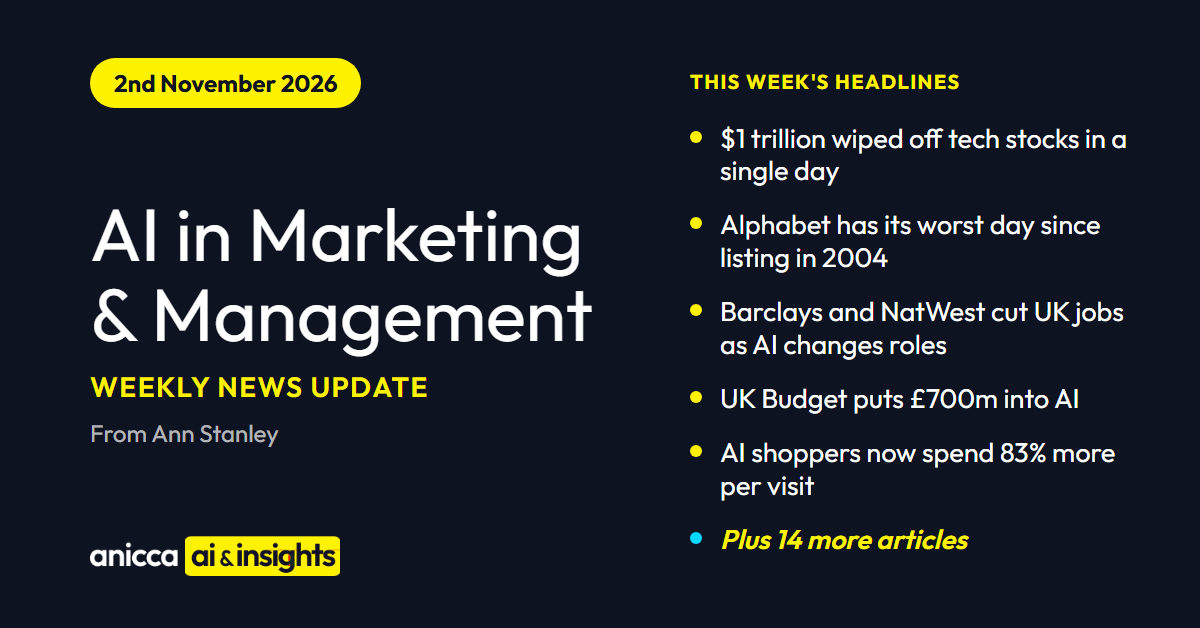
This Week in AI in Marketing & Management (2nd Nov 26)
AI Spending Fears Wipe $1 Trillion off Tech Stocks, as Barclays and NatWest Cut Jobs
Last week investors started asking when the money being poured into AI will pay back. On Thursday Alphabet had its worst day since it listed in 2004, losing around $500 billion in value, and on Friday more than $1 trillion was wiped off technology stocks as Intel fell 29%. For marketers, the most important detail sits inside Alphabet’s results: Google says searches are growing at their fastest rate in five years, but Search revenue barely moved from the previous quarter. In the UK, the effect of AI on jobs became much more concrete, with Barclays cutting 5,000 roles, NatWest cutting about 1,000 in three months and The Telegraph cutting up to 100 as it becomes an “AI-powered” publisher. The Autumn Budget put £700m into AI, Google confirmed ads in AI Mode reach the UK before the end of the year, and Adobe found that shoppers arriving from AI tools now spend 83% more per visit.
Table of Contents
- AI spending fears wipe more than $1 trillion off tech stocks in a single day
- Google launches Gemini 4 Carbon, its strongest model, but only to cyber defenders for now
- UK government met 137 businesses over AI datacentres, but no environmental groups
- Google searches grow at their fastest rate in five years, but Search revenue barely moves
- Adobe: AI-referred shoppers now generate 83% more revenue per visit
- Google takes ads in AI Mode to ten new countries, with the UK due before the end of 2026
- Google’s privacy update lets Gmail and Photos shape ads in AI Mode
- “Ghost citations”: when AI uses your content but leaves out your name
- Barclays cuts 5,000 jobs and NatWest about 1,000 in three months, as AI changes banking roles
- The Telegraph cuts up to 100 jobs as it aims to become an “AI-powered” business
- UK Budget: a £700m AI package for security, sovereign capability and jobs research
- Kaplan: HR leaders understand the AI skills gap but lack the budget to fix it
AI in E-commerce, Retail and Agentic Commerce
- McKinsey: more than half of consumers now use AI to shop
- Prada launches a ChatGPT shopping tool in the UK, US and Italy
- Etsy’s crackdown on AI listings brings buyers back for the first time in two years
AI for Other Sectors and Industries
- HEALTHCARE: Anthropic reports early progress using Claude to speed up drug development
- INSURANCE: KPMG finds only 11% of insurers can see a clear return on AI
- HR: CIPD finds three-quarters of UK people professionals have had no AI training
AI News, Tech & Tools
AI spending fears wipe more than $1 trillion off tech stocks in a single day
Source: nbcnews.com | Steve Kopack | 30 October 2026
Source: share-talk.com | 30 October 2026
Technology shares lost more than $1 trillion in value on Friday 30 October. The Nasdaq 100 fell 3.4%, its steepest one-day fall since mid-June, leaving it close to 10% below its record, and the Philadelphia semiconductor index dropped 7.2%. Intel fell 29%, its worst day on record, after forecasting lower profit and sales, while AMD, Arm, Qualcomm and Marvell fell around 10% and AI cloud providers CoreWeave and Nebius fell more than 10%. The day before, Alphabet lost around $500 billion in value, and Amazon said it now expects around $220 billion of capital spending in 2026, with “meaningfully more” in 2027.
It was the second sharp fall in a week. On 22 October the Nasdaq Composite fell 2.6% after Meta raised its 2026 spending forecast to $135 billion to $145 billion. NBC News reports that some companies have tightened their AI usage budgets and others are questioning the benefit of their AI investment. London fared better because the FTSE 100 is dominated by banks, oil, pharmaceuticals and miners rather than chipmakers, closing the week 0.4% higher, although UK technology shares Computacenter and Polar Capital Technology Trust each fell 6% and analyst Dan Coatsworth called it an “AI reality check”.
Why it matters
Investors are now asking the question every board will soon ask its marketing team: what is the return on all this AI spending? The fall in share prices does not mean the tools will disappear, but it does mean the large AI companies are under pressure to make more money from customers, through higher prices, more advertising and fewer free features. Expect AI subscription and usage costs to rise, and expect more ads inside AI tools. Now is a good time to list every AI tool your team pays for, what it costs, and what it has actually saved or earned, so you can answer the return question before someone else asks it.
Google launches Gemini 4 Carbon, its strongest model, but only to cyber defenders for now
Source: venturebeat.com | Carl Franzen | 28 October 2026
Google has announced Gemini 4 Carbon, just 15 days after Gemini 4 Argon became widely available. Independent evaluator Artificial Analysis puts Carbon first on its Intelligence Index v5.0 with 59 points, ahead of Claude Opus 5.5 on 58, GPT-6 Astra on 57 and Argon on 50. Google says Carbon leads 15 of the 17 benchmarks in its announcement, with particular strength in cybersecurity: 88.2% on SEC-bench Pro for finding vulnerabilities and 71.0% on CWE-bench for patching them.
Access is the catch. Carbon is initially available only to selected cyber defenders through Google’s Fairwind Program, with a wider release promised “as soon as possible”. Introductory pricing matches Argon at $2 per million input tokens and $10 per million output tokens, although a footnote confirms these will later double. VentureBeat also notes that independent testing found a higher hallucination rate than Argon on one factual-knowledge test.
Why it matters
The top spot in AI models has now changed hands several times this autumn, and the gaps between the leaders are a point or two on an index. For marketing teams, that means there is little value in waiting for a clear leader or rebuilding work around each new release. Choose tools that let you switch the underlying model, test new releases against your own real tasks before moving anything, and pay attention to accuracy as well as headline scores. A model that is cleverer on paper but invents more facts is a poor trade for content and reporting work.
UK government met 137 businesses over AI datacentres, but no environmental groups
Source: theguardian.com | Aisha Down | 27 October 2026
An investigation by the non-profit Spotlight on Corruption, based on 40 freedom of information requests to 18 government bodies, found that ministers and senior officials met 137 businesses while developing the UK’s “AI growth zones” datacentre policy, but only two community groups and no environmental organisations. It also found 38 ministers, senior civil servants and special advisers moved into roles at AI companies between July 2024 and September 2026, nine of them from the Department for Science, Innovation and Technology.
Opposition to large datacentres is growing, from Brick Lane in east London to Auchtertool in Fife, and MP Chi Onwurah warned that the government needs far greater community input if the policy is to keep public support.
Why it matters
The energy and environmental cost of AI is moving from a technical footnote to a public and political issue in the UK. Brands that talk loudly about sustainability while scaling AI use will increasingly be asked to reconcile the two. It is worth knowing roughly how much AI processing your marketing operation now uses, which suppliers host it and where, so that you have a straight answer when a customer, journalist or board member asks.
AI in Marketing
Google searches grow at their fastest rate in five years, but Search revenue barely moves
Source: ppc.land | Luís Rijo | 29 October 2026
Alphabet’s third-quarter results showed Google Search revenue up 12% year on year to $63.35 billion, its slowest growth since the second quarter of 2025. Compared with the previous quarter it rose by just $79 million, or 0.1%, even though Sundar Pichai said search query growth is “the highest it’s been in the last five years”. Google gave no figures for paid clicks or cost per click, and Pichai described the priority as “the best Search user experience, followed by monetization”.
Investors reacted badly to the wider picture. Advertising revenue of $82 billion came in below the $83.4 billion analysts expected, capital spending reached $51.4 billion in the quarter, and free cash flow was negative at minus $9.1 billion. Alphabet shares fell as much as 13% on 29 October, their worst day since the company listed in 2004, and the chief financial officer said spending will “increase significantly in 2027”. Google Cloud was the bright spot, with revenue up 103% to $30.7 billion.
Why it matters
More searches but flat Search revenue means Google is earning less per search, at least for now, as more people use AI Overviews and AI Mode instead of clicking ads. Google is under strong pressure to fix that, which is exactly why ads in AI Mode are arriving in the UK this quarter and why AI Max and Performance Max keep expanding. Expect Google to push advertisers harder towards its automated, AI-led campaign types. Keep an eye on your own cost per click and impression share over the next few months, and make sure you can see which search terms and placements your money is actually buying.
Adobe: AI-referred shoppers now generate 83% more revenue per visit
Source: searchengineland.com | Danny Goodwin | 29 October 2026
New Adobe data shows that visitors arriving at US retail websites from AI tools generated 83% more revenue per visit than non-AI visitors in September, and converted at a 90% higher rate. They also spent 73% more time on site, viewed 25% more pages and added products to their baskets at a 53% higher rate. AI-referred traffic grew 71% year on year in September, and is up 1,772% since Adobe started tracking it in October 2024.
The turnaround is striking. In August 2025, AI visitors converted at a 9% lower rate than everyone else, and revenue per visit was only level by September 2025. Adobe, which analysed more than 1 trillion visits across 100 million products, now forecasts AI traffic growth of 159% on Thanksgiving, 95% on Black Friday and 88% on Cyber Monday.
Why it matters
For the past year the standard objection to investing in AI visibility has been that the traffic is small and does not convert. That argument no longer holds. AI-referred visitors arrive having already compared options, so they buy more often and spend more. Set up a separate channel for AI referrals in GA4 now, so you can see their conversion rate and revenue per visit before Black Friday, and make sure your best-selling product pages are clear enough for AI tools to recommend with confidence.
Google takes ads in AI Mode to ten new countries, with the UK due before the end of 2026
Source: techcrunch.com | Lauren Forristal | 28 October 2026
Google is scaling ads in AI Mode in Australia, Canada, India, Kenya, Malaysia, New Zealand, Nigeria, Pakistan, the Philippines and Singapore, with Brazil, Mexico and the United Kingdom planned for the fourth quarter of 2026. In the US it is also launching multi-turn ads that can appear in follow-up questions within AI Mode, labelled as “Sponsored”. Google says click-through rates on sponsored product listings in AI Mode are already similar to organic listings.
The announcement came on Alphabet’s third-quarter earnings call, alongside the slowdown in Search revenue covered above. Sundar Pichai said queries in AI Mode are three times longer than traditional searches, and one in five involves voice, images or documents.
Why it matters
UK advertisers have a window of a few weeks to prepare. AI Mode queries are longer and more conversational, so the advertisers who appear will be those with detailed product feeds, clear landing pages and broad matching that can respond to a full question rather than a short keyword. Review your Shopping feed titles and descriptions, check your Performance Max and AI Max settings, and agree with your agency how you will report AI Mode results separately once they appear.
Google’s privacy update lets Gmail and Photos shape ads in AI Mode
Source: searchenginejournal.com | Brooke Osmundson | 27 October 2026
Google has updated its privacy policy so that content from Gmail, Google Photos and Google Drive can influence personalised ads when users connect those apps to Search or Gemini. The change took effect on 16 October and mainly applies to people who opt in to Personal Intelligence, which lets AI Mode draw on things like flight confirmations and past purchases. Google has started testing AI Mode ads for these users.
Google says advertisers will not get access to anyone’s inbox or photo library, ads are matched to summaries and inferences rather than raw content, and sensitive categories such as health and religion remain excluded. Users can opt out through My Ad centre or by disconnecting the apps.
Why it matters
This is a significant shift in how AI search ads will be targeted, and it moves personalisation from what someone types to what Google infers about their life. Advertisers will not see the data, but they will see the effects in who their ads reach. Expect privacy questions from customers and regulators, particularly in the UK and EU, and keep your own first-party data and consent records in good order, because platform-side personalisation will not replace them.
“Ghost citations”: when AI uses your content but leaves out your name
Source: searchengineland.com | Marcus Miller | 29 October 2026
Search Engine Land looks at “ghost citations”, where an AI answer links to your page as a source but never mentions your brand in the answer itself. Kevin Indig, who coined the term, analysed 3,981 domain appearances across ChatGPT, Gemini, AI Overviews and AI Mode with Semrush and found 61.7% were citations with no brand mention, while only 13.2% were both cited and named. A separate Writesonic study of 16 million brand appearances put the rate at around 40%, rising to 49% in Google AI Mode.
Marcus Miller argues the fix is positioning: make your brand inseparable from the answer by naming your own research, putting your brand in the same sentence as your claims and owning a distinctive idea that AI connects to you.
Why it matters
A citation without a mention does little for brand awareness, yet most AI visibility reports count it as a success. When you track AI search, record mentions and citations separately, and look closely at the answers where you are cited but not named. Those are the pages where a small change, such as a named study, a branded framework or a clear statement of who you are, could turn invisible help into recognition.
AI in Management
Barclays cuts 5,000 jobs and NatWest about 1,000 in three months, as AI changes banking roles
Source: humanresourcesonline.net | Tracy Chan | 22 October 2026
Source: share-talk.com | 30 October 2026
Barclays used its third-quarter results on 22 October to confirm it will cut about 5,000 jobs this year, around 5% of its global workforce of roughly 93,000. About 1,000 roles have already gone, with the rest due by the end of the year. Around 60% of the cuts fall in support functions, including software developers, with UK retail operations also a focus, and the bank expects to save more than £1.1 billion in 2027. Chief executive C.S. Venkatakrishnan said: “We will employ AI at scale. But AI is the icing on the cake, not the cake.”
A week later, NatWest’s results showed it had cut about 1,000 jobs in the three months to September, taking its total for 2026 to about 1,400. Chief executive Paul Thwaite said AI is creating new technology roles while reducing the need for others. NatWest’s AI assistant Cora has already handled 52,000 credit card queries, and NatWest shares fell 8.8% on the day over its interest income outlook. Share Talk also reports that HSBC is planning cuts in its UK financial advice business.
Why it matters
UK banks are among the country’s largest employers of office staff, and they are now openly linking job cuts to AI and technology investment. Barclays is careful to say AI is only part of the story, but the roles affected, support functions, developers and customer service, are exactly the kinds of work AI tools are taking on in every sector, including marketing. If you manage a team, be honest with people about which tasks are changing, invest in retraining before roles are cut rather than after, and make sure your own AI plans are measured on what they improve, not only on what they remove.
The Telegraph cuts up to 100 jobs as it aims to become an “AI-powered” business
Source: pressgazette.co.uk | Alice Brooker | 23 October 2026
The Telegraph has started consultation on up to 100 job cuts, almost four months after Axel Springer completed its takeover in June. The comment and analysis teams are reported to be merging with features and lifestyle, with cuts also reported on the culture, fashion and sport desks. In a staff memo, Hulshoff Pol set out the ambition to turn The Telegraph from a leading British newspaper into “a global, AI-powered” premium media and intelligence business, using AI, data and technology to reinvent the reader experience.
Future revenue will focus on video, audio, puzzles, events, business-to-business services, licensing and commerce. The cuts come in the same month that Metro proposed 60 job cuts and BBC News announced plans to cut around 100. Ipsos iris data shows The Telegraph’s UK online audience fell 11% year on year to 15.4 million in August, with time spent down 18%.
Why it matters
UK publishers are losing readers as more people get their news and answers from AI tools, and they are responding by restructuring around AI themselves. That affects marketers in two ways. Media owners will push new formats, video, audio, events and commerce partnerships, to replace falling page views, so expect new sponsorship and partnership offers. And if your PR and content strategy depends on coverage in national titles, the number of journalists available to write about you is falling, so original data and ready-to-use expert comment will matter more than ever.
UK Budget: a £700m AI package for security, sovereign capability and jobs research
Source: gov.uk | HM Treasury | 24 October 2026
Source: marketingweek.com | Emily Manock | 28 October 2026
Chancellor John Healey used the 28 October Autumn Budget to set out what Technology Magazine reports as a £700m AI package. Measures trailed by HM Treasury include £120m for the AI Security Institute, £165m for a National AI Biosecurity Initiative, £60m for a National Cyber Shield using agentic AI, £10m a year to study how AI will reshape jobs and industry, AI chip design capability in Edinburgh and a new AI Centre of Excellence in Manchester. Technology Magazine adds £140m for a Sovereign AI Unit, £40m for investigating incidents involving autonomous AI agents and £30m for local adoption partnerships in the North.
For marketers, Marketing Week highlights the wider business measures: the small business rate relief threshold rises from £12,000 to £18,000, an extra £20.4bn goes to the National Wealth Fund and British Business Bank, and the government launched a Digital and Technologies Jobs Plan on 21 October to improve digital skills for young people.
Why it matters
The direction is clear even if the totals vary between reports: the government is investing in AI safety and security, and in understanding what AI will do to jobs, rather than in adoption grants for individual businesses. The dedicated funding to investigate incidents involving AI agents is a signal that agent governance is coming. If your team is already using AI agents with access to customer data, ad accounts or email, document what each agent can do and who is accountable for it now, before guidance turns into requirements.
Kaplan: HR leaders understand the AI skills gap but lack the budget to fix it
Source: hrnews.co.uk | HR News | October 2026
New UK research from Kaplan, based on 1,000 employees, 600 HR and learning professionals and 600 directors and C-suite leaders, found 94% of HR and L&D leaders say they understand the workforce capability their AI strategy needs, but 36% lack the budget, authority or both to deliver it. Ownership is disputed: 44% of C-suite respondents say AI capability belongs to IT, while only 11% name HR.
The gap shows up on the ground. A third of employees say they have been asked to use AI without enough training, and while 80% of staff describe themselves as confident using AI, HR leaders estimate only 37% are genuinely proficient. Just 35% of employees say their organisation has given structured AI training to a significant part of the workforce.
Why it matters
The gap between 80% self-reported confidence and 37% real proficiency should worry any manager relying on AI-assisted work. Agree who owns AI skills in your business, give that person a budget, and test proficiency on real tasks rather than asking people how confident they feel. Marketing teams are often the heaviest AI users in a company, so they are a good place to start.
AI in E-commerce, Retail and Agentic Commerce
McKinsey: more than half of consumers now use AI to shop
Source: mckinsey.com | Elizabeth Silliman, Jack Trotter and Kelsey Robinson | 28 October 2026
McKinsey’s Agentic Commerce Consumer Survey of around 21,000 consumers in 11 markets, including the UK, found that more than 50% of consumers now use AI for shopping. In the US, the rate at which AI users completed a purchase using AI rose 70% on last year. For AI users, AI search is three times more influential than traditional search, and stand-alone tools such as ChatGPT and Gemini are used up to twice as much as retailers’ own AI assistants during the journey, although the gap closes at checkout.
McKinsey’s conclusion for chief marketing officers is that agentic commerce is not just another channel but “the new engine of e-commerce”, and it warns that most companies are not yet equipped to meet the demand.
Why it matters
Put this alongside Adobe’s revenue figures and the case is hard to ignore: AI tools are now where a large share of shopping decisions are made, and the shoppers they send are worth more. Most brands still spend almost nothing on understanding how they appear in those tools. Start with your top 20 products: ask ChatGPT, Gemini and Google AI Mode the questions your customers ask, record who is recommended, and fix the product information gaps that are keeping you out.
Prada launches a ChatGPT shopping tool in the UK, US and Italy
Source: retailgazette.co.uk | Yasmeen Louis | 28 October 2026
Prada has worked with Accenture Song and DaVinci Commerce to launch a ChatGPT tool that lets shoppers explore products, discover the brand and find store information through conversation. The pilot runs in the UK, US and Italy and draws only on Prada’s own brand sources. Prada describes it as a first for a luxury fashion house.
Prada Group digital director Laura Campanella called conversational experiences “a natural evolution of traditional e-commerce”, while Accenture’s Alessandro Diana described them as “a new front door for product discovery”.
Why it matters
Luxury brands are usually the most protective of how and where they appear, so Prada choosing to build inside ChatGPT is a strong signal. The important detail is that the tool only uses Prada’s own content, which keeps control of tone, pricing and product facts. Any brand considering a ChatGPT app should start by making sure its own product data and brand content are complete and accurate, because that is what the AI will repeat to customers.
Etsy’s crackdown on AI listings brings buyers back for the first time in two years
Source: fortune.com | 29 October 2026
Etsy reported its first rise in quarterly active buyers for two years, along with the strongest growth in active sellers since 2024. Revenue rose 11% to $692.5 million, beating expectations, and gross merchandise sales grew 9% to $2.65 billion. Active buyers had fallen from around 93 million in 2023 to 86.5 million at the end of 2025, as AI-generated art and bot-created listings eroded trust.
Chief executive Kruti Patel Goyal, appointed at the start of 2026, has required most listings to include an unedited product photo against a real background and expanded AI disclosures. At the same time, Etsy is using AI to improve search, detect rule-breaking listings and help sellers write listings and manage stock.
Why it matters
Last week we covered Etsy’s new AI rules. This week there is early evidence they are working, and it has shown up in revenue. The lesson goes beyond marketplaces: buyers notice when content feels mass-produced, and trust is commercially valuable. Use AI behind the scenes to help customers find things and to remove poor-quality content, but be careful about using it to replace the human, authentic parts of your brand that customers chose you for.
AI for Other Sectors and Industries
HEALTHCARE: Anthropic reports early progress using Claude to speed up drug development
Source: anthropic.com | 27 October 2026
Anthropic’s life sciences team has published results from research partnerships with six organisations developing new medicines, including Bristol Myers Squibb, Generate Biomedicines and Divergence Labs. At Generate, scientists used Claude Code to design a component for CAR T-cell cancer therapy that was about 70% shorter than the standard version and, in lab tests, allowed immune cells to make around ten times as many cancer-detecting receptors. At Divergence Labs, Claude generated around 35,000 antibody designs for a new food allergy treatment in about a month, largely autonomously.
Anthropic has also started its own drug discovery programmes, including for rare childhood forms of muscular dystrophy, and plans to scale the work up substantially.
Why it matters
The point Anthropic makes applies well beyond medicine: the bottlenecks are spread across the whole process, not concentrated in one clever step. The biggest gains came from putting AI to work on many ordinary tasks, from planning to documentation. The same is true in marketing. Rather than hunting for one transformational use case, map every stage of a campaign and look for the slow, repetitive steps AI could take on.
INSURANCE: KPMG finds only 11% of insurers can see a clear return on AI
Source: kpmg.com | KPMG China | October 2026
KPMG’s global research with insurance leaders found that 77% believe failing to respond to AI will damage their competitiveness within five years, and more than two-thirds say moving too slowly is now a bigger risk than moving too fast. Yet only 18% have a clear view of how AI supports their strategy, 11% claim a strong data foundation, 8% rate their workforce as highly proficient with AI, and 11% say their view of AI’s return on investment is very clear.
KPMG argues insurers are mostly using AI to make existing processes more efficient, rather than redesigning products, customer experiences and business models, and that 45% leave AI ownership with the technology function alone.
Why it matters
Those figures will sound familiar to anyone who has watched AI projects stall in other sectors: high ambition, weak data, low skills and no agreed way to measure value. Before launching the next AI initiative, decide how its return will be measured and who in the business, not just in IT, owns the result. Without that, even successful pilots struggle to secure further investment.
HR: CIPD finds three-quarters of UK people professionals have had no AI training
Source: thehrdirector.com | Dionne Lee | 1 November 2026
The CIPD HR Pulse 2026 report, published on 27 October and based on 883 UK people professionals, found that 75% have received no training to apply AI in their role and 22% have never used AI tools at work. Among those who do use it, 61% complete tasks faster and around half report better-quality work, but 37% question the accuracy of AI outputs and only 14% rely on it to make decisions.
Writing in theHRD, Talking Talent’s Dionne Lee warns that removing junior HR roles to gain efficiency could damage the profession’s future, because early-career staff learn judgement by sitting in on real meetings and difficult conversations.
Why it matters
The warning about junior roles applies to marketing too. If AI takes over the entry-level tasks where people traditionally learned the job, such as first drafts, reporting and research, businesses need to design new ways for junior staff to build judgement, or they will find a shortage of experienced people in a few years.
Key Takeaways
- More than $1 trillion was wiped off technology shares on 30 October, and Alphabet lost around $500 billion the day before, as investors questioned the return on AI spending. Expect AI tool prices and advertising inside AI tools to rise.
- Google searches are growing at their fastest rate in five years, but Search revenue rose just 0.1% on the previous quarter. Watch your cost per click and expect a harder push towards AI-led campaign types.
- Barclays is cutting 5,000 jobs this year and NatWest cut about 1,000 in three months, with both linking the changes to AI and technology investment.
- The Telegraph is cutting up to 100 jobs to become an “AI-powered” publisher, as UK newsrooms shrink and online audiences fall.
- The UK Budget includes a £700m AI package, with £120m for the AI Security Institute and dedicated funding to investigate incidents involving AI agents. Document what your AI agents can access.
- Google is taking ads in AI Mode to ten new countries, with the UK planned for the fourth quarter of 2026. Review Shopping feeds and campaign settings now.
- Adobe data shows AI-referred shoppers generate 83% more revenue per visit and convert 90% more often than other visitors. Track AI referrals as their own channel in GA4 before Black Friday.
- Kaplan finds 80% of UK employees feel confident with AI, but HR leaders think only 37% are genuinely proficient, and the CIPD finds 75% of UK people professionals have had no AI training.
Frequently Asked Questions
Does the tech stock sell-off mean the AI bubble has burst?
Not necessarily. Investors are questioning how quickly the very large sums being spent on AI data centres will pay back, but demand for AI is still growing fast: Google Cloud revenue more than doubled and Google says search queries are growing at their fastest rate in five years. For businesses, the more likely effect is that AI companies push harder to make money from customers, through higher prices and more advertising.
Is AI behind the UK job cuts at Barclays and NatWest?
Partly. Barclays says the 5,000 cuts follow years of technology investment and that AI is “the icing on the cake, not the cake”, while NatWest says AI is creating some technology roles and reducing the need for others. The roles most affected are support functions, software development and customer service.
When will ads in Google AI Mode reach the UK?
Google says it plans to expand ads in AI Mode to the United Kingdom, Brazil and Mexico in the fourth quarter of 2026, after launching in ten other countries this week. Detailed product feeds and clear landing pages will matter most, because AI Mode queries are around three times longer than traditional searches.
What does the UK Budget mean for businesses using AI?
Most of the £700m package goes on AI security, sovereign capability and research into AI’s effect on jobs rather than direct grants to businesses. The funding to investigate incidents involving AI agents suggests closer scrutiny is coming, so businesses using AI agents should document what those agents can access and who is responsible for them.
Conclusion
Last week AI stopped being judged on promise and started being judged on return. Investors wiped more than $1 trillion off technology shares because they want to see the AI spending pay back, Google’s results showed that more searches no longer automatically mean more Search revenue, and UK employers from Barclays and NatWest to The Telegraph cut jobs as they reorganise around AI. At the same time, the demand side is strong: Adobe shows AI-referred shoppers are now the most valuable visitors on retail sites, and McKinsey shows more than half of consumers already shop with AI. Three priorities stand out: work out the return on every AI tool you pay for before your board asks, prepare your Google Ads accounts for ads in AI Mode and rising costs, and invest in training your people so that AI changes their jobs rather than simply removing them.
Need help adapting your AI marketing strategy? Contact the Anicca team for expert guidance.


Join the Thursday AI Club
A hands-on AI club for marketers and managers. Fortnightly sessions, 2-5pm UK: Hour 1 is an open Q&A on any AI question; Hours 2-3 split into a workshop track (for newbies) and an advanced track (live demos and deeper questions).
Led by Ann Stanley, Darren Wynn, James Allen and Tony Hancock.
Membership: £40/month or £400/year
This roundup is compiled from publicly available sources using AI-assisted research. While we review every article for accuracy, our analysis reflects our interpretation of the original reporting. We strongly encourage readers to click through to the original sources linked throughout this post for full context and detail. If you spot anything that needs correcting, please let us know.