AI in Marketing & Management (27th Apr 26)
By Ann Stanley | 26 April 2026 | 21 min read
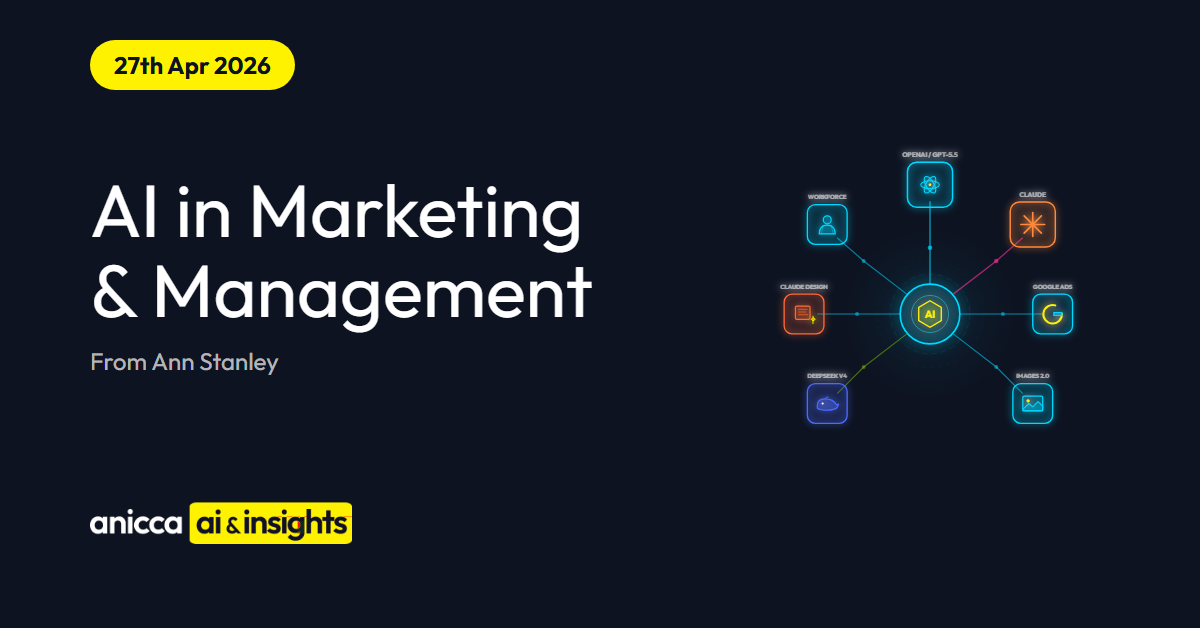
AI in Marketing & Management (26 April 2026): OpenAI Launches GPT-5.5 and ChatGPT Images 2.0, Anthropic Secures $65bn from Amazon and Google, DeepSeek V4 Lands, and Claude Goes Inside Freshfields
This was the busiest week in AI for months. Amazon and Google have both committed fresh capital to Anthropic, taking the combined backing close to $65 billion of new investment and infrastructure. Anthropic also signed a landmark deal with global law firm Freshfields, the first publicly announced rollout of a frontier AI model into a Magic Circle firm’s core workflows. China’s DeepSeek released V4 on Huawei silicon at one-tenth the price of frontier US models. OpenAI countered with GPT-5.5, ChatGPT Images 2.0, and a free clinician version of ChatGPT. Google quietly rewrote half of its Ads Advisor playbook. And Rishi Sunak warned that AI is hollowing out entry-level jobs in law, accountancy and creative industries.
Table of Contents
- Amazon and Google both back Anthropic in a $65 billion week
- Claude Design, one week on: hype, scepticism and a 7% Figma stock drop
- DeepSeek V4 closes the gap on a Huawei-powered stack
- OpenAI launches GPT-5.5 with three variants and 60% fewer hallucinations
- ChatGPT Images 2.0 lands with 2K resolution and proper multilingual text
- ChatGPT Voice arrives in Apple CarPlay
- Semrush launches a Brand Visibility Framework as AI search rewrites discovery
- Google Ads Advisor gets safer, faster and more agentic
- AI Overviews click-through rates show early signs of recovery
- AI shopping in Japan and the rising conversion metric
- From the Anicca blog: pushing content from Claude Code straight into WordPress
- Sunak warns AI is hollowing out the entry-level jobs market
- HBR: companies that augment beat companies that automate
- Half of UK executives expect AI to cut jobs within a decade
- Legal: Freshfields deploys Claude across global operations
- Manufacturing: SAP launches end-to-end supply chain AI agents at Hannover Messe
- Healthcare: OpenAI launches ChatGPT for Clinicians and HealthBench Professional
AI News, Tech & Tools
Amazon and Google both back Anthropic in a $65 billion week
Source: anthropic.com and cnbc.com | 20 and 24 April 2026
Amazon announced on 20 April that it will invest up to a further $25 billion in Anthropic on top of the $8 billion already committed, with $5 billion landing immediately and up to $20 billion tied to commercial milestones. In return, Anthropic has committed to spending more than $100 billion on Amazon Web Services over ten years, and is securing up to 5 gigawatts of training and deployment capacity, including new Trainium2 capacity coming online in the first half of 2026. The deal was struck at a $350 billion pre-money valuation.
Four days later, Google reportedly committed up to a further $40 billion in parallel, giving Anthropic two hyperscaler patrons rather than one. The combined effect is roughly $65 billion of fresh capital and infrastructure inside a seven-day window. Anthropic now has the runway to release enterprise tooling at OpenAI’s cadence while Amazon and Google have both bought a meaningful stake in its future.
Why it matters
The strategic shift for marketers is to stop treating “AI” and “ChatGPT” as the same thing. Two model families now anchor the enterprise stack with very different commercial DNA. Expect Claude to keep showing up inside the platforms you already pay for (Salesforce Einstein, ServiceNow Now Assist, Microsoft Copilot, AWS Bedrock-powered apps) rather than as a competing chat product. If your AI strategy still implies “we use ChatGPT”, it needs rebuilding before procurement asks for an alternative.
Claude Design, one week on: hype, scepticism and a 7% Figma stock drop
Source: adweek.com, theregister.com and anthropic.com | 17-24 April 2026
Claude Design only launched on 17 April, and we covered the announcement in last week’s roundup. The reason it earns another mention is that the industry reaction in the seven days since has been bigger than the launch itself. Adweek positioned it as a serious play for marketing assets, decks and UIs. The Register went straight for the throat with a “because who needs designers?” headline. Figma’s share price dropped 7% within hours of a single tweet about the launch, after Anthropic’s Chief Product Officer resigned from Figma’s board three days earlier.
Anthropic confirmed that Canva, Datadog and Brilliant are inside the closed beta, building product mockups, wireframes, pitch decks and marketing content. The take that has resonated most among working designers is that Claude Design is the first AI design product that “understands intent, not just instructions”, with a 30-year design veteran reporting a working design system, including colours, typography, components and spacing tokens, built in fifteen minutes.
Why it matters
Claude Design will not replace your senior brand designer. It will quietly absorb a meaningful chunk of the work currently going to junior designers, freelancers and procurement-budgeted graphic-design suppliers. If your agency or in-house team has positioned itself on “we make pretty things faster than the client can”, that pitch needs rewriting now.
DeepSeek V4 closes the gap on a Huawei-powered stack
Source: techcrunch.com | TechCrunch | 24 April 2026
One day after the Amazon-Anthropic deal, China’s DeepSeek released a preview of V4, its long-awaited new flagship. V4 comes in Pro and Flash variants, both mixture-of-experts, both with one-million-token context windows. DeepSeek says V4 Pro Max beats OpenAI’s GPT-5.2 and Google’s Gemini 3.0 Pro on standard reasoning benchmarks but falls marginally short of GPT-5.4 and Gemini 3.1 Pro. Pricing is the headline: V4 Flash costs $0.14 per million input tokens and $0.28 per million output, undercutting frontier US labs by roughly an order of magnitude.
The under-reported angle is the hardware. V4 is supported in part by Huawei chips, materially reducing DeepSeek’s reliance on Nvidia. That is the first credible signal that a Chinese training and inference stack can produce something within touching distance of frontier performance.
Why it matters
For UK and EU marketers, the practical question is governance. If your procurement team is comfortable with US clouds but cautious about Chinese models on cost grounds, you are about to be having that conversation more often. Worth piloting on internal research and content drafting before any customer-facing deployment.
OpenAI launches GPT-5.5 with three variants and 60% fewer hallucinations
Source: openai.com, cnbc.com and venturebeat.com | 23 April 2026
GPT-5.5 launched on 23 April in three variants: standard, GPT-5.5 Thinking and GPT-5.5 Pro. The headline benchmarks are strong: 88.7% on SWE-bench Verified, 82.7% on Terminal-Bench 2.0, and OpenAI claims 60% fewer hallucinations than GPT-5.4. VentureBeat called it “no potato”, with GPT-5.5 narrowly beating Google Gemini 3.1 Pro on standard benchmarks.
The variant worth attention is GPT-5.5 Pro. OpenAI explicitly positions it as strong on business, legal, education and data-science workloads, and as of 24 April it is in the API. It is rolling out to Plus, Pro, Business and Enterprise users in ChatGPT and Codex.
Why it matters
OpenAI has now closed the gap on the workloads where Anthropic has been winning enterprise procurement (long coding tasks, document-heavy analysis, professional-services use cases). If you ran pilots six months ago that picked Claude for those reasons, the comparison test is worth re-running this week. Parity is the new baseline.
ChatGPT Images 2.0 lands with 2K resolution and proper multilingual text
Source: venturebeat.com and wired.com | 21 April 2026
OpenAI released ChatGPT Images 2.0 on 21 April, a much bigger step forward than the version number suggests. The model adds thinking-powered image generation, near-perfect multilingual text rendering (the Achilles heel of every prior generation), up to 2K resolution via the API, and the ability to produce up to eight coherent images from a single prompt without losing consistency between them.
Multilingual text rendering means a single prompt can produce on-brand visuals in English, French, German, Japanese and Arabic without redoing the typography in Photoshop. Eight-image consistency means a full set of carousel slides or product variations from one brief.
Why it matters
This is the moment image generation crosses from “useful for ideation” to “production-ready for output”. The hidden cost-line item this kills is third-party stock imagery. The hidden risk is brand-control governance: when anyone in your team can generate publishable images in seconds, your brand guidelines become enforcement bottlenecks. Plan for that before, not after, the deluge.
ChatGPT Voice arrives in Apple CarPlay
Source: mashable.com | Mashable | 26 April 2026
ChatGPT Voice is now available via Apple CarPlay, which means UK drivers can talk to ChatGPT through their car’s existing interface without installing anything. CarPlay handles the integration, so any iPhone-paired vehicle gets the new capability automatically.
This is voice AI being absorbed into operating systems users already use, rather than asking them to adopt a new app. Expect Android Auto to follow within weeks.
Why it matters
Any brand investing in voice search optimisation should now treat in-car listening sessions as a serious surface, not a curiosity. The conversational query patterns from a car commute differ materially from desktop or mobile search, and they will start showing up in your GA4 referrer data within months.
Semrush launches a Brand Visibility Framework as AI search rewrites discovery
Source: thenextweb.com | The Next Web | April 2026
At Adobe Summit, Semrush announced its Brand Visibility Framework, a strategic model for measuring how brands are discovered across traditional search engines, AI-generated answers and autonomous AI agents. The framework introduces “Agentic Search Optimisation” as a new operational discipline, drawing on a database of more than 213 million LLM prompts.
The numbers behind it are sobering: organic click-through rates have dropped 61% on queries with AI Overviews, 62% of brands are completely invisible to generative AI, and Semrush’s own AI product revenue has grown 850% to $38 million ARR. All of this lands while Semrush awaits completion of its $1.9 billion acquisition by Adobe.
Why it matters
This is the most important framework launched in our space this year. It gives brands a vocabulary for measuring something they could only guess at before. If you are not yet tracking your share of voice inside ChatGPT, Claude, Gemini and Perplexity answers, you are flying blind on roughly half of your discovery surface.
AI in Marketing
Google Ads Advisor gets safer, faster and more agentic
Source: blog.google, searchengineland.com, searchenginejournal.com and seroundtable.com | 22-24 April 2026
Google had a big week in Ads Advisor. The 24 April announcement covers three new safety and speed updates: a content-policy guardrail layer, a faster preflight check before changes go live, and an improved escalation path when the AI is uncertain. Search Engine Land and Social Media Today have additional context on the agentic safety features.
In parallel, Google made call recording the default for AI lead calls, and launched AI-qualified call conversions, which use AI to grade lead calls against your conversion criteria automatically. Five Ads Advisor stories in one week is a lot, and the pattern is unmistakable.
Why it matters
Google is normalising AI as the default operator of paid-search accounts, with humans moving up to oversight, brand and budget. If you still have an account where every change goes through a human optimiser, you are now the exception, not the rule. Plan your team’s role descriptions accordingly.
AI Overviews click-through rates show early signs of recovery
Source: searchengineland.com | Search Engine Land | April 2026
A new Search Engine Land study shows AI Overviews click-through rates are starting to recover from the steep drops seen through 2025. The recovery is not enough to reach pre-AIO levels, but the trajectory matters. Two factors look like they are driving it: AIO answers are getting longer and citing more sources, and users are increasingly clicking through to verify rather than trusting the AI summary outright.
Why it matters
The strategic read for SEO teams is that the worst of the AIO traffic shock has now happened. Plan for a new normal that is somewhere between half and three-quarters of pre-AIO traffic, depending on query type. Stop modelling for further declines and start modelling for stabilisation.
AI shopping in Japan and the rising conversion metric
Source: dhl.com and digitalcommerce360.com | April 2026
DHL profiled the future of AI-powered customer experience in Japan, where retailers are using conversational agents that span chat, voice and in-store kiosks. The integration depth is the interesting part: Japanese retailers are putting the same AI assistant in front of the customer through every surface (web, mobile, store, support) rather than running separate stacks per channel.
Digital Commerce 360 ties this to a quietly important trend. AI-mediated sessions are starting to outperform standard sessions on order value and basket size. If you have an AI-driven product finder or chat assistant on your site, your benchmark is moving up.
Why it matters
The integration model coming out of Japan is the one to watch. UK retailers running separate AI stacks per channel will end up rebuilding to a unified architecture within twelve months. Plan the unification now, while the cost of doing it is still measured in months of work rather than years of accumulated debt.
From the Anicca blog: pushing content from Claude Code straight into WordPress
Source: anicca.co.uk | Ann Stanley | April 2026
This week we published Publishing Content to WordPress with Claude Code Skills and the REST API (Part 1), a marketer’s guide to pushing a finished blog post from Claude Code to WordPress as a draft via the WordPress REST API and Claude Skills. The post walks through the exact workflow we use to push our weekly AI marketing blogs onto anicca.co.uk, ready for final review and publishing.
The upload step alone saves about an hour per blog, which at two blogs a week is two hours back every week. The blog you are reading now was published using exactly this skill.
Why it matters
This only works inside Claude Code (via Claude Desktop or Cursor), because consumer products like ChatGPT, Claude.ai and Gemini cannot call the WordPress REST API or access your local drive. If you have been wondering where Claude Code fits into a marketing workflow rather than a development workflow, this is one concrete answer. Part 2 will cover featured-image upload and Yoast metadata.
AI in Management
Sunak warns AI is hollowing out the entry-level jobs market
Source: hrgrapevine.com | HR Grapevine | 24 April 2026
Former UK Prime Minister Rishi Sunak, now a senior adviser to Anthropic and Microsoft, warned this week that AI is “flattening” the entry-level jobs market for young workers. The data Sunak cited is striking: World Economic Forum figures show US entry-level job postings have fallen 35% in 18 months, with the British Chambers of Commerce flagging a parallel UK decline. Roles in law, accountancy and creative industries are most affected, because employers are automating junior tasks rather than backfilling them.
Sunak’s policy proposal is to abolish employer National Insurance over time, replacing the lost revenue with higher taxes on corporate profits, on the grounds that the current payroll tax is now actively tilting hiring decisions away from human workers.
Why it matters
This is the most credible warning we have heard from a senior UK political figure on AI’s labour-market effects. For agency leaders and ecommerce hiring managers, the operational point is that the talent pipeline you assumed would be there in two years’ time is shrinking now. Plan succession differently.
HBR: companies that augment beat companies that automate
Source: hbr.org | Harvard Business Review | 15 April 2026
Harvard Business Review published a sharp piece on AI augmentation versus AI automation. The argument: leaders are quietly choosing between two strategies, using AI to cut headcount and improve the bottom line (automation), or using AI to grow the top line through more capable people (augmentation). Automation strategies show early gains. Augmentation wins long-term because a company’s success is determined by how people feel about their work, whether they meaningfully engage with new tools, and whether top talent stays.
Nvidia’s Jensen Huang offered a tidy reframing of the same question on 22 April: “You will not lose your job to AI. You will lose it to a colleague who uses AI.”
Why it matters
The piece is a useful counterweight to the “AI replaces jobs” narrative dominating boardroom conversations. It also lines up uncomfortably well with Sunak’s data on entry-level decline. Augmenters will be hiring fewer people but paying them more. Automators will be hiring fewer people, full stop.
Half of UK executives expect AI to cut jobs within a decade
Source: heygotrade.com | HeyGoTrade | April 2026
A new survey found that half of UK executives expect AI to cut jobs in their organisation within ten years, with the largest expected reductions in administrative, customer-service and middle-management roles. The finding confirms what most people already suspect, but the timeframe is the part to pay attention to.
Why it matters
A decade is short enough to plan for, long enough that the changes will be gradual rather than abrupt. The practical implication for marketing leaders is that the org chart you sign off in 2027 will look materially different by 2031. Start sketching the 2031 version now, while you still have time to retrain rather than restructure.
AI for Sectors and Industries
Legal: Freshfields deploys Claude across global operations
Source: lawyer-monthly.com | Lawyer Monthly | April 2026
The most consequential sector story of the week is the Freshfields and Anthropic deal. Freshfields, one of the Magic Circle firms, will deploy Claude across its global operations and contribute legal expertise to help Anthropic build tools for drafting, contract review and due diligence. In return, Freshfields gets early access to new capabilities and a hand in shaping how the systems are built.
Lawyer Monthly’s coverage focuses on the liability question: when a Claude-drafted clause is wrong, who carries the risk? The answer is unsettled, and it will be settled the hard way through case law over the next two years.
Why it matters
This is the first publicly announced deployment of a frontier AI model into the core workflows of a Magic Circle firm. The bar for using AI inside high-stakes professional services has just moved by a substantial margin. Expect Big Four firms, top-tier consultancies and large agency groups to follow within months, and your own procurement team to find the Freshfields move cited back at them.
Manufacturing: SAP launches end-to-end supply chain AI agents at Hannover Messe
Source: news.sap.com | SAP Newsroom | 20 April 2026
At Hannover Messe 2026 (20-24 April), SAP unveiled a wave of agentic AI tooling for end-to-end supply chain orchestration. AI agents now connect design, planning, procurement, manufacturing, logistics, service and asset management. SAP’s new Production Planning and Operations Agent lets planners release production orders using natural language while the agent automatically validates material availability, capacity and scheduling constraints.
The numbers behind manufacturing AI adoption show why Hannover Messe matters this year: predictive AI adoption rose 12 percentage points to 48% in 2026, AI for supply chain planning rose 19 points to 35%, and process optimisation rose 11 points to 36%.
Why it matters
Manufacturers are visibly moving from pilots to production. For marketing teams in industrial brands, the implication is that your buyers are now being trained on AI-mediated buying journeys via their own ERP systems. If your sales material still treats AI as something to consider for “the future”, it is already out of date.
Healthcare: OpenAI launches ChatGPT for Clinicians and HealthBench Professional
Source: openai.com | OpenAI | 23 April 2026
On 23 April, OpenAI launched ChatGPT for Clinicians, a free version of ChatGPT for verified US physicians, NPs, PAs and pharmacists. The product offers free access to advanced models for complex clinical questions, the ability to turn workflows like referral letters and prior authorisations into reusable skills, clinical search with cited answers, deep research across medical journals, and continuing medical education credits earned through use.
Alongside it, OpenAI published HealthBench Professional, an open benchmark for real clinician chat tasks. The benchmark numbers are extraordinary: physicians rated 99.6% of GPT-5.4’s responses inside ChatGPT for Clinicians as safe and accurate, and the system outperforms base GPT-5.4, all other OpenAI and external models, and human physicians on the benchmark tasks.
Why it matters
OpenAI is not claiming to replace doctors. It is claiming that doctors using this product perform better than doctors not using it. Expect the same framing (“clinicians plus AI beats clinicians alone”) to appear shortly in legal, financial advice, accounting and HR tooling. The Freshfields deal sits in exactly this frame.
Key Takeaways
- Anthropic now has the runway to compete with OpenAI on enterprise. Roughly $65 billion of fresh capital and infrastructure from Amazon and Google, plus 5GW of compute, means Claude will keep showing up wherever you do enterprise marketing.
- The China challenger is real this time. DeepSeek V4 on Huawei silicon at one-tenth the price puts a credible alternative on the procurement table for the first time.
- Search visibility now needs measuring across LLMs, not just Google. Semrush’s Brand Visibility Framework gives you the vocabulary, and Adobe’s acquisition will probably make it the default.
- Google Ads is becoming an AI-operated platform. Five Ads Advisor updates in one week is the loudest signal yet that humans are moving up to oversight.
- Frontier AI is now inside the most regulated professions. Freshfields on Claude, OpenAI inside clinical workflows, SAP inside factory operations. The deployment bar has moved.
Frequently Asked Questions
What does Anthropic’s $65 billion week actually mean for me as a marketer?
It means Claude will keep showing up inside the platforms and tools you already pay for, including Salesforce Einstein, ServiceNow Now Assist, Microsoft Copilot, and any vendor built on AWS Bedrock, with capability that matches OpenAI. The mental model shift is to stop treating “AI” and “ChatGPT” as the same thing. Two model families now anchor the enterprise stack and most of your vendors are picking one. Find out which.
Should I run pilots on DeepSeek V4 for cost reasons?
Run the comparison test, with eyes open on the procurement question. V4 Flash at $0.14 per million input tokens is roughly an order of magnitude cheaper than the frontier US models, and it has a one-million-token context window. The catch is governance: V4 is partly trained on Huawei chips and operates under Chinese jurisdiction. UK and EU buyers will want a clear data-residency story before going beyond non-sensitive workloads.
With GPT-5.5 Pro now strong on business, legal and data-science workloads, should I switch from Claude?
Re-test, but do not switch by default. Six months ago Anthropic had a clear lead on long-context document analysis and agentic coding. GPT-5.5 Pro has narrowed that gap. The right discipline is to set up a paired evaluation on three or four of your highest-value internal workflows and rerun the comparison this week. Anthropic’s incentive after the Amazon and Google deals is to keep matching OpenAI’s pace, so expect parity to be the new baseline.
What is the practical implication of the Freshfields-Anthropic deal for non-legal companies?
It moves the AI deployment bar. If a Magic Circle law firm with the highest-stakes liability exposure has decided Claude is safe to put inside contract drafting and due diligence, the “AI is too risky for our workflows” objection has lost most of its force in marketing, finance, HR and operations. Expect your own procurement and risk teams to find the Freshfields move cited back at them within weeks.
Conclusion
This week was Anthropic’s distribution-and-money week, in the same way last week was its product week. Amazon and Google have collectively committed up to $65 billion in fresh capital and infrastructure, DeepSeek has thrown up a credible China challenger at one-tenth the price, and OpenAI has released GPT-5.5, ChatGPT Images 2.0 and a free clinician version of ChatGPT. Inside professional services, the news that mattered most was Freshfields rolling out Claude across its global operations and OpenAI publishing a benchmark on which GPT-5.4 outperforms human physicians.
The practical priorities for marketing leaders are clear. Stop treating AI and ChatGPT as the same thing. Run a real comparison test on your highest-value workflows now that GPT-5.5 Pro and Claude Opus 4.7 have closed in on each other. Get a brand visibility framework live so you can measure how often your brand appears inside LLM answers, not just inside Google. And take Sunak’s warning on entry-level jobs seriously when you plan next year’s headcount, because the talent pipeline you assumed would be there in two years’ time is shrinking now.
Need help adapting your AI marketing strategy? Contact the Anicca team for a no-obligation conversation.
Three Ways to Go Deeper
1. Read the Claude Code C-Suite Guide
If your AI strategy needs a rethink in light of Anthropic and OpenAI both reaching enterprise scale this month, the Claude Code C-Suite Guide is the practical companion. It walks through Claude Code, Skills, Routines and the agentic workflows now powering daily work at Anicca, with screenshots and step-by-step setup. Read the Claude Code C-Suite Guide.
2. Join Thursday AI Club
Free weekly sessions hosted by the Anicca team for marketers and business leaders adopting AI. Two-hour live formats: Q&A then Workshop, or Show-and-Tell with member demos. Join Thursday AI Club to become a member.
3. Get help with your AI marketing strategy
If your team needs a hand with measuring brand visibility across LLMs, comparing Claude and GPT-5.5 Pro on your own workflows, or planning headcount in light of the entry-level jobs decline, the Anicca team can help. Contact Anicca Digital for a no-obligation chat.
This roundup is compiled from publicly available sources using AI-assisted research. While we review every article for accuracy, our analysis reflects our interpretation of the original reporting. We strongly encourage readers to click through to the original sources linked throughout this post for full context and detail. If you spot anything that needs correcting, please let us know.

Thursday AI Club
A hands-on AI club for marketers and managers. Fortnightly 3-hour sessions: Hour 1 is an open Q&A on any AI question; Hours 2-3 split into a workshop track (for newbies) and an advanced track (live demos and deeper questions).
Led by Ann Stanley, James Allen.
Membership: £40/month or £400/year
Join the Thursday AI Club →