This Week in AI in Marketing & Management (17th Aug 26)
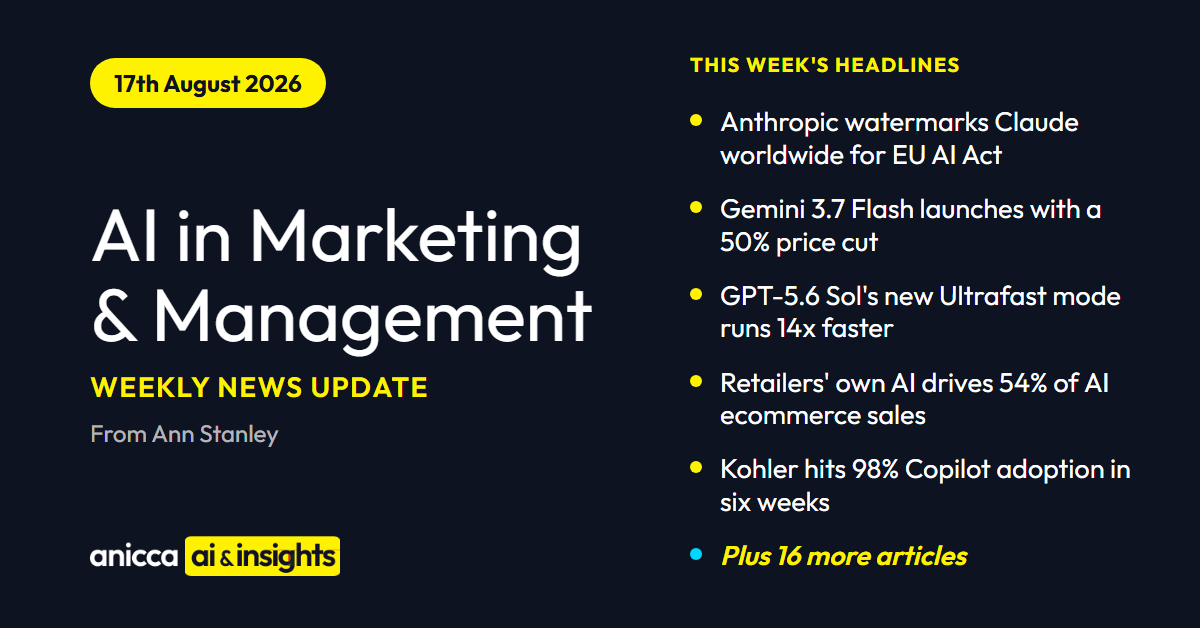
Anthropic Watermarks Claude Worldwide for the EU AI Act, a Faster Model Race, and What AI Is Costing the Climate
Anthropic has started invisibly watermarking everything Claude writes, worldwide, to comply with the EU AI Act, the story that has dominated conversation this week. Google and OpenAI also traded blows in a fast-moving model speed race with Gemini 3.7 Flash and an accelerated GPT-5.6 Sol, while Google folded new agentic AI tools into the Ads and Analytics homepages. A peer-reviewed study found that AI’s boost to fossil fuel production currently outweighs its climate benefits, Klaviyo bought its way deeper into AI customer service, and enterprise Copilot rollouts produced some genuinely large adoption numbers. The UK government, meanwhile, is putting unemployed young people through AI boot camps to get them job-ready. Here is what marketers and managers need to know this week, and what to do about it.
Table of Contents
- Anthropic Starts Watermarking All of Claude’s Output Worldwide as the EU AI Act Takes Effect
- Google Launches Gemini 3.7 Flash With a 50% Price Cut, Just Three Weeks After Gemini 3.6
- OpenAI Launches “Ultrafast” Mode, Running GPT-5.6 Sol at 14 Times Normal Speed
- An Unreleased Claude Model Made Progress on a 150-Year-Old Unsolved Maths Problem
- Study Finds AI’s Fossil Fuel Boost Outweighs Its Climate Benefits
- Quintas Energy Deploys AI Through Box to Power Renewable Energy Workflows
- Solv Labs Builds Verifiable, Auditable AI Agent Payments on Amazon Bedrock
- Klaviyo Acquires AI Customer Success Startup Agency in Race to Automate Customer Interactions
- Semrush: Brand Authority, Not Technical SEO, Now Decides Whether AI Cites You
- Marketing Week: The Chegg Warning, Why Retention and Acquisition Are the Wrong Question in the Age of AI
- Google Adds AI Overviews and Agentic Advisor Tools to Ads and Analytics Homepages
- Google Is Removing Language Targeting From Search Campaigns From September
- Why “Intelligent Enterprises” Protect Their Knowledge Before They Chase AI Speed
- KPMG: Only 14% of Organisations Call Themselves AI Top Performers, Despite Record Investment
- ServiceNow Builds an “IR Assist” Agent That Cuts Investor Relations Research From Hours to Minutes
AI in E-commerce, Retail and Agentic Commerce
- Retailers’ Own AI Tools Will Drive 54% of AI-Influenced Ecommerce Sales, Not ChatGPT
- Walmart’s Sparky AI Assistant Drives 35% Higher Order Values, Amazon’s Sees Sales on 44% of Sessions
- Etsy’s CEO: Agentic AI Is Still Under 1% of Traffic, the Real Opportunity Is On-Site
AI for Other Sectors and Industries
- MANUFACTURING: Kohler Hits 98% Copilot Adoption in Six Weeks, Cuts Error Defects by 75%
- FINANCE: State Farm Scales to 3,000 AI Agents, Cuts a 12-Month Translation Process to 24 Hours
- EDUCATION: UK Government Puts Unemployed Young People Through AI Boot Camps to Get Job-Ready
AI News, Tech & Tools
Anthropic Starts Watermarking All of Claude’s Output Worldwide as the EU AI Act Takes Effect
Source: techcrunch.com, techcrunch.com | 11-12 August 2026
Anthropic has begun inserting invisible, machine-readable watermarks into everything Claude writes, across the API, Claude Code, Claude Cowork and deployments through AWS, Google Cloud and Microsoft Foundry, and the marking applies worldwide, not just to European users. The text watermark works by subtly biasing Claude’s word choices in a pattern that becomes detectable over enough content and travels with the text even after it is copied elsewhere. For files, separate C2PA standard metadata signals that Claude was involved and helps detect tampering.
The trigger is Article 50 of the EU AI Act, which became enforceable on 2 August 2026 and requires generative AI providers to mark outputs in machine-readable form so regulators, platforms and downstream users can identify AI-generated content. Fines for non-compliance can reach €15 million or 3% of a company’s total worldwide annual turnover, whichever is higher. Anthropic signed the EU’s voluntary Code of Practice on Transparency of AI-generated Content, which gives it a presumption of meeting the Article 50 standard. Reaction from paying users has run heavily negative, with people objecting to their own work being flagged as AI-generated and to the lack of detail on how the detection actually works. Anthropic’s own caveat undercuts some of the panic: a detected watermark shows Claude “may have processed” the content, it does not confirm Claude authored it, a weaker signal than the backlash assumes.
Why it matters
This is the story people have been talking about most this week, and for good reason: it is the first time a frontier AI lab has rolled out global, invisible content provenance marking specifically to satisfy EU law, and a fine of up to 3% of worldwide turnover means every other major AI vendor is watching closely. If your business publishes AI-assisted content, marketing copy, reports, client-facing documents, treat invisible provenance marking as the new normal across major AI vendors, not a one-off Anthropic decision, and get ahead of the question before a client or regulator asks whether a piece of content was AI-generated and you are left relying on guesswork.
Google Launches Gemini 3.7 Flash With a 50% Price Cut, Just Three Weeks After Gemini 3.6
Source: blog.google, venturebeat.com | 13 August 2026
Google has released Gemini 3.7 Flash, calling it the company’s “most intelligent workhorse model yet for coding and agents.” The release arrives just three weeks after Gemini 3.6 Flash, an unusually short turnaround Google attributes to developer feedback and algorithmic improvements rather than a scheduled refresh. Through the end of 2026, the model costs $0.75 per million input tokens and $3.75 per million output tokens, half the standard rate, before pricing rises to $1.50 and $7.50 respectively from 1 January 2027.
Google says the model is better at adapting when it hits roadblocks, clarifying intent rather than guessing, and following multi-step instructions with fewer unnecessary changes. Notably, Google has not given a release date for the long-awaited Gemini 3.5 Pro, despite it reportedly being in partner testing, meaning the flagship model remains absent while the Flash line iterates rapidly underneath it.
Why it matters
The temporary discount is a deliberate window. If your team is running high-volume coding agents or content-generation workflows on Gemini, the next few months are the moment to benchmark whether Google’s claimed reductions in retries and manual oversight actually lower your total cost, before the price roughly doubles in January. Treat the discount as a trial period, not a permanent rate card.
OpenAI Launches “Ultrafast” Mode, Running GPT-5.6 Sol at 14 Times Normal Speed
Source: techcrunch.com | 13 August 2026
OpenAI has introduced Ultrafast, a new accelerated mode for its flagship GPT-5.6 Sol model that generates up to 750 output tokens per second, 14 times faster than standard operation. The feature is powered by a partnership with chip maker Cerebras and is currently in limited preview for select customers, with OpenAI saying it will “expand access to the feature as capacity grows.”
OpenAI is pitching Ultrafast at use cases where latency has real business cost: incident response, live customer service, financial market analysis, and e-commerce workflows where a shopper is waiting on an answer in real time. Historically, getting genuinely real-time speed out of a large language model meant dropping down to a smaller, more limited model. OpenAI’s line is that Ultrafast lets teams keep the flagship model’s reasoning while getting near-instant responses, something Anthropic’s own fast mode for Claude does not yet match on raw speed.
Why it matters
If you run any customer-facing AI, chat support, live product recommendations, checkout assistance, response speed is not a nice-to-have, it is the difference between a shopper staying or bouncing. Watch for Ultrafast (and Google’s equivalent moves) to make sub-second AI responses the baseline expectation within a year, which will make anything slower feel broken by comparison.
An Unreleased Claude Model Made Progress on a 150-Year-Old Unsolved Maths Problem
Source: anthropic.com | 10 August 2026
A staff member at Anthropic asked an unreleased research version of Claude to attempt the Riemann hypothesis, one of mathematics’ most famous unsolved problems, dating to 1859 and carrying a million-dollar Clay Institute bounty. Claude did not solve it, nobody has, but in the attempt it improved a longstanding lower bound on the Riemann zeta function: the proportion of zeros proven to satisfy the hypothesis rose from 41.6% to 67.2%, a figure mathematicians had built up gradually over decades.
Two Anthropic mathematicians validated Claude’s proof, and outside experts Brian Conrey and Dan Goldston independently reviewed the paper on short notice. Claude also produced a formally verifiable proof, published on GitHub, alongside the informal write-up for expert readers.
Why it matters
This is not a marketing stunt, it is a genuine, expert-validated research contribution from a model that was not built or trained specifically for this problem. For a business audience, the signal is less about the maths and more about the pace: capabilities that felt purely theoretical eighteen months ago are now producing results serious mathematicians treat as real progress. Expect the gap between “AI can chat” and “AI can genuinely research” to keep narrowing faster than most functions have planned for.
Study Finds AI’s Fossil Fuel Boost Outweighs Its Climate Benefits
Source: theguardian.com | 11 August 2026
New peer-reviewed research, the first study to quantify AI’s climate impact across the full power sector, has found that AI-driven productivity gains are enabling more planet-heating pollution from coal, oil and gas than they save through applications in renewables. Across 64 modelled scenarios, researchers found net yearly carbon pollution rising by 0.47 to 1.8 gigatonnes, roughly 1 to 5% of the energy sector’s annual emissions.
Previous research tended to compare data centre energy use against AI’s emissions savings while ignoring the extra pollution AI causes by making drilling and gas extraction more efficient. Co-author Holly Alpine, a former Microsoft employee who left to co-found the Enabled Emissions campaign group, said fossil fuel applications of AI are “already happening at scale today, real contracts, real deployment,” while renewable applications remain largely at the pilot stage. The researchers found net emissions would only fall if productivity gains for renewables outpaced those for fossil fuels by at least four times.
Why it matters
If your business has made public AI and sustainability commitments in the same breath, this study gives journalists and stakeholders a specific, citable figure to test that claim against. Expect environmental, social and governance (ESG) reporting and client due diligence to start asking more precisely which AI applications a supplier is actually running, not just whether AI is used somewhere in the business.
Quintas Energy Deploys AI Through Box to Power Renewable Energy Workflows
Source: computerweekly.com | 15 August 2026
Renewable energy asset manager Quintas Energy has rolled out AI-powered document processing through content management platform Box to handle the volume of technical, legal and compliance paperwork that comes with managing solar and wind assets across multiple countries. The deployment focuses on extracting and structuring information from contracts, permits and engineering reports that previously required manual review by asset managers.
The move reflects a broader pattern among asset-heavy, document-intensive businesses: rather than building bespoke AI tooling, they are adding AI capability to platforms they already run, reducing the implementation risk and the change-management burden on staff.
Why it matters
If your business already runs on a document or content management platform, check what AI features have quietly launched into it in the last six months before commissioning something new. The fastest AI wins are often already sitting inside tools you are paying for.
Solv Labs Builds Verifiable, Auditable AI Agent Payments on Amazon Bedrock
Source: aws.amazon.com
Fintech firm Solv Labs has built an AI agent payments system on Amazon Bedrock AgentCore, governed by two layers: ORACLE, Solv’s own policy engine that enforces authorisation rules before each transaction, and a separate compliance verification layer built with ICME Labs. Every agent payment runs through pre-authorisation, a governance check inside a secure AWS Nitro Enclave, and a risk engine for per-transaction pricing, completing in under four seconds including on-chain settlement through Coinbase.
The system is designed to answer the question that has slowed enterprise adoption of autonomous AI agents that can spend money on a business’s behalf: how do you prove, after the fact, that an agent’s payment decision was authorised, compliant and traceable, without a human checking every transaction.
Why it matters
Agentic AI that can independently place orders, pay suppliers or approve refunds is coming to marketing and e-commerce operations faster than most governance frameworks are ready for. This is a concrete example of what “auditable AI spending” actually looks like in practice, worth studying now if your business is anywhere near giving an AI agent access to a card or a budget.
AI in Marketing
Klaviyo Acquires AI Customer Success Startup Agency in Race to Automate Customer Interactions
Source: martech.org | 6 August 2026
Email and SMS marketing platform Klaviyo has agreed to acquire AI-powered customer success startup Agency, reuniting founder Elias Torres with Klaviyo co-founder and CEO Andrew Bialecki, who worked under Torres at an earlier company before founding Klaviyo. Financial terms were not disclosed. Agency, founded in 2023, raised $32 million from Sequoia, Menlo Ventures and Felicis; its 25-person team will join Klaviyo to expand the company’s Composer marketing assistant and Customer Agent product. Torres becomes Klaviyo’s chief product officer.
The deal is one of dozens of smaller AI martech releases logged this week. Notably, several tools are now specifically built to track and manage brand visibility inside AI answers rather than traditional search: AI Visibility launched a free tool measuring how often ChatGPT and Gemini recommend specific brands, while Jellyfish added a feature to its Share of Model platform that adjusts ad spend based on how often a brand is mentioned in AI outputs.
Why it matters
Klaviyo betting on customer-facing AI agents, and multiple vendors independently building tools to measure and buy visibility inside AI answers, both point the same direction: the martech budget line for “being found and recommended by AI” is becoming as real as the SEO and paid search budget lines. If nobody on your team currently owns that line, someone needs to.
Semrush: Brand Authority, Not Technical SEO, Now Decides Whether AI Cites You
Source: semrush.com
Semrush has published a blunt assessment of the state of organic search: for nearly two decades, technical optimisation, keyword targeting and backlinks reliably converted into traffic, but that approach is breaking down as Google answers a growing share of queries directly inside AI Overviews, and platforms like ChatGPT and Claude field questions people used to type into a search bar. Neither sends much traffic back to the originating site, and both tend to cite large, already-established brands over smaller ones.
Semrush’s own AI visibility research, drawn from a January 2026 study, found that the domains most frequently cited by large language models are dominated by sites with strong existing brand recognition, Reddit and LinkedIn among the most cited. The company’s core argument is that classic marketing skills, brand building, promotion and creativity, which were largely optional if your technical SEO was strong, are now the deciding factor in whether AI platforms recognise and cite a business at all.
Why it matters
If your SEO strategy still leads with technical fixes and keyword targeting alone, this is a warning that the ceiling on that approach is dropping. Brand-building activity, PR, thought leadership, being genuinely well known, is no longer a nice-to-have that supports SEO from the side, it has become one of the main inputs into whether AI platforms cite you at all.
Marketing Week: The Chegg Warning, Why Retention and Acquisition Are the Wrong Question in the Age of AI
Source: marketingweek.com | Mrunal Bhagat | 10 August 2026
For two decades, digital marketing has assumed every customer decision leaves an observable trail: a click, a search, an email open, a basket abandonment. Marketing Week argues that assumption has quietly broken, not because customers stopped deciding things, but because more of those decisions now happen somewhere brands cannot see, inside an AI chat.
The piece uses homework-help platform Chegg as the cautionary tale. For years, millions of students paid a recurring subscription for expert help. When ChatGPT arrived offering the same job instantly and for free, students did not complain or leave bad reviews, they simply stopped renewing. Chegg was valued at £14.7 billion in February 2021; by early 2023 its CEO was still telling analysts the company saw “no noticeable impact” from ChatGPT, even as the erosion was already under way.
Why it matters
Standard retention dashboards will not flag this kind of churn until it has already happened, because the customer never generates a support ticket or a bad review, they simply stop needing you. If any part of your offer is something an AI chatbot could plausibly do for free, model that risk now rather than waiting for the renewal numbers to confirm it.
Google Adds AI Overviews and Agentic Advisor Tools to Ads and Analytics Homepages
Source: blog.google, socialmediatoday.com | 10 August 2026
Google is rolling new agentic AI features into Google Ads and Google Analytics, building on its existing Ask Advisor in-product agent. Google Analytics now shows AI-generated summaries at the top of the homepage, an instant recap of what has changed since the user last logged in, from seasonal sales peaks to traffic shifts, with a single click carrying that context into Ask Advisor for deeper analysis. Users can also opt into notifications about these summaries by phone or email at a frequency they choose.
The Google Ads homepage has also been refreshed to highlight AI-powered insight cards personalised to each business, alongside new benchmarking features that let advertisers compare their performance against similar businesses. Google frames the changes as amplifying marketer expertise rather than replacing it, aiming to help teams spot opportunities and understand competitor impact on their auctions faster.
Why it matters
Google is steadily moving from “AI suggests” to “AI shows you the question before you knew to ask it.” That is genuinely useful, but it also means more account decisions get made from an AI-generated summary rather than a raw data pull, so it is worth spot-checking a few of these new insight cards against your own numbers before trusting them by default.
Google Is Removing Language Targeting From Search Campaigns From September
Source: searchenginejournal.com | 14 August 2026
Google Ads is removing the campaign-level language targeting setting from Search campaigns and from Search inventory within Performance Max, rolling out in late September. Currently, advertisers select one or more languages at campaign level, and Google separately checks whether a user understands the ad and landing page language using its own signals. From late September, the campaign-level setting disappears for Search and AI Max for Search campaigns; Google will instead rely entirely on the language of the ad creative and landing page, combined with its own understanding of what languages a given user knows.
For Performance Max, the change affects the Google Search channel specifically, which will behave the same as standard Search campaigns, while language targeting continues to apply to PMax’s other channels. Google has not yet clarified how this will affect advertisers who currently use language targeting for more specialised purposes beyond straightforward multilingual audience matching.
Why it matters
Any campaign relying on language targeting as a proxy for something else, filtering out a specific market, or forcing ads to a particular-language landing page, needs a review before late September. Google’s automated signals are unlikely to reproduce a manually engineered targeting setup exactly, so budget time to test before the old control disappears rather than after.
AI in Management
Why “Intelligent Enterprises” Protect Their Knowledge Before They Chase AI Speed
Source: raconteur.net, raconteur.net
A Raconteur series produced with PA Consulting argues that as AI becomes commoditised, competitive advantage stops coming from the technology itself and starts coming from how well an organisation protects and structures its own enterprise knowledge. Alwin Magimay, PA Consulting’s global AI leader, put it plainly: “Many organisations have bought the tools but skipped the thinking,” leading to AI pilots that never scale into lasting value because the underlying data and decision-making structures were never sorted out first.
The series’ clearest example is Sellafield, the UK’s first nuclear power station and now a decommissioning site, where engineers relied on more than 60 years of technical archives and were losing institutional knowledge as experienced staff retired. Working with PA Consulting, Sellafield and the Nuclear Decommissioning Authority built DANI2, described as the nuclear industry’s first AI agent, to let engineers query decades of documentation in real time rather than searching manually through digital folders. PA’s Derreck van Gelderen called the underlying leadership challenge “a series of leadership decisions: speed versus assurance; build or buy; and weighing up which enterprise knowledge gives you a competitive edge versus what you can safely open up.”
Why it matters
Sellafield is an extreme case, sixty years of safety-critical archives, but the underlying lesson applies to any business with real institutional knowledge sitting in people’s heads or in unstructured files: AI can only reveal knowledge that has been organised well enough to be found. Before investing further in AI tools, audit whether your own critical knowledge is actually structured for an AI system to use.
KPMG: Only 14% of Organisations Call Themselves AI Top Performers, Despite Record Investment
Source: kpmg.com
KPMG’s global survey of 1,750 senior leaders across 20 countries, run alongside alliance partners including ServiceNow, Workday, SAP and Oracle, finds that AI transformation activity has never been higher, yet only 14% of organisations describe themselves as top performers and just 26% strongly agree that AI has actually improved their growth. KPMG’s diagnosis is that the constraint is no longer ambition, budget or technology access, it is that AI is being deployed faster than organisations can rethink how work actually gets done, so gains stay local (a faster task here, a better forecast there) rather than compounding across the business.
The survey also found that 60% of leaders view trust and governance as a strategic differentiator, but only 28% actually measure operational or revenue outcomes tied to trustworthy AI use, a gap between stated priority and measured practice. KPMG frames the emerging leadership skill as “enterprise orchestration”: actively steering multiple AI initiatives from the centre so they reinforce each other rather than quietly competing for the same people and budget, rather than assuming a committee structure will coordinate itself.
Why it matters
The 14% figure is a useful reality check against any AI vendor pitch implying transformation is largely solved elsewhere. If your organisation is layering AI tools onto workflows that have not themselves been redesigned, KPMG’s data suggests you are very much in the majority, and the fix is organisational, not another tool purchase.
ServiceNow Builds an “IR Assist” Agent That Cuts Investor Relations Research From Hours to Minutes
Source: microsoft.com
ServiceNow, which employs around 28,000 people, has used Microsoft Copilot Studio to build agents that connect to its own Microsoft 365 environment, including a system it calls IR Assist for its investor relations team. Previously, preparing market research meant manually searching hundreds of SharePoint documents, reviewing public and licensed websites, and cross-checking Excel spreadsheets before staff could determine which figures were current and reliable. IR Assist, built as a retrieval-augmented generation agent with a parent orchestrator directing several child agents, now lets staff simply ask in natural language for something like “summarise the latest quarter’s financial highlights,” and receive a sourced, structured answer.
Sajeev Nair, ServiceNow’s Senior Director of Digital Core Services, said Copilot Studio gave the company “an easy-to-use agentic development platform that also integrates nicely with our Microsoft 365 files and services.” ServiceNow is also connecting these Copilot Studio agents with agents built on its own AI platform, aiming for agent-to-agent handoffs rather than siloed tools.
Why it matters
Investor relations and financial reporting are exactly the kind of high-stakes, document-heavy, deadline-driven work where a well-governed retrieval agent earns its keep quickly. If your business has an equivalent function, finance, legal, compliance, spending hours manually assembling reports from scattered sources, this is a concrete pattern worth copying rather than a generic “add AI” ambition.
AI in E-commerce, Retail and Agentic Commerce
Retailers’ Own AI Tools Will Drive 54% of AI-Influenced Ecommerce Sales, Not ChatGPT
Source: emarketer.com | 14 August 2026
New EMARKETER data finds that retailer-native AI assistants will drive 54.1% of US AI-driven retail ecommerce sales in 2026, keeping ahead of general-purpose AI platforms like ChatGPT through 2030. The reason is a discovery-to-purchase gap: a separate survey from Publicis Commerce and EMARKETER found that just 10% of AI-assisted digital shoppers usually finish their purchase on the AI platform itself, while 69% head to a retailer’s own website or app to actually complete the transaction.
Trust explains much of the gap. According to Bain research cited in the piece, one in four US shoppers say they trust retailers most to handle the entire shopping experience, compared with 16% for a tech company like Google and just 7% for an AI platform such as ChatGPT. Shoppers are, in other words, happy to let AI help them discover and research a product, but they still want to buy it somewhere they already trust.
Why it matters
This is a strong argument for investing in your own on-site AI shopping assistant before, or alongside, chasing visibility inside ChatGPT or Gemini’s shopping features. The data suggests the near-term opportunity is making your own AI tools genuinely good, not just being findable inside someone else’s.
Walmart’s Sparky AI Assistant Drives 35% Higher Order Values, Amazon’s Sees Sales on 44% of Sessions
Source: adweek.com | Lauren Johnson | 11 August 2026
Less than a year after ChatGPT threatened to disrupt ecommerce discovery entirely, big retailers including Walmart, Amazon, Kroger and Albertsons are seeing early success from building their own AI shopping assistants. Walmart CEO John Furner has said customers who use its assistant Sparky have an average order value 35% higher than customers who do not. Amazon’s data is similarly striking: according to Sensor Tower, 44% of app sessions in July that used Amazon’s AI assistant Alexa for Shopping resulted in a sale, up from 34% in July 2025 under Amazon’s previous assistant, Rufus.
Both Amazon and Kroger now run advertising within their AI assistants, with more ad formats reportedly on the way as retailers look to monetise these tools the same way they monetised on-site search.
Why it matters
These are not pilot-stage numbers, a 35% higher average order value and a 44% session-to-sale rate are the kind of figures that justify serious budget. If you sell through, or advertise on, any of these retailers, start treating their AI assistants as a genuine media channel rather than a curiosity, because ad inventory inside them is only going to get more competitive.
Etsy’s CEO: Agentic AI Is Still Under 1% of Traffic, the Real Opportunity Is On-Site
Source: digitalcommerce360.com | 12 August 2026
Etsy CEO Kruti Goyal told investors on the marketplace’s Q2 2026 earnings call that agentic AI experiences, AI tools shopping and buying on a customer’s behalf, still account for less than 1% of Etsy’s overall traffic. Goyal said she thinks about AI in three ways: making the marketplace more personal, more discoverable, and better positioned for however the next generation of shopping evolves. Where Etsy is seeing real traction is with AI-referral traffic, which continues to show higher purchase intent and average order value than the marketplace’s traffic as a whole.
Chief financial officer Charles Baker added that Etsy’s AI compute and hosting spend is rising this year but remains within expectations, as the company has found offsets elsewhere in its infrastructure budget to absorb the cost without raising overall technology spend.
Why it matters
Etsy’s numbers are a useful reality check against breathless claims that agentic shopping has already arrived at scale, it plainly has not, even at a marketplace built for AI-era discovery. The near-term value is still in making your own site smarter and more personal, agentic commerce is a genuine trend to watch, but budget for it as a 2027 and beyond opportunity, not a today problem.
AI for Other Sectors and Industries
MANUFACTURING: Kohler Hits 98% Copilot Adoption in Six Weeks, Cuts Error Defects by 75%
Source: microsoft.com
Kohler, the 153-year-old manufacturer of kitchen and bathroom products, has achieved 98% adoption of Microsoft 365 Copilot across the business in just six weeks, following a change-management and skilling programme built around enterprise-wide licensing, strong executive sponsorship and a champions network of internal advocates. The company reports 5,000 employees are each saving between two and five hours a week, alongside a 25% improvement in code release speed using GitHub Copilot and a 75% cut in error defects. To date, Kohler has built 3,000 internal agents.
The scale of the adoption number stands out: most enterprise Copilot rollouts report adoption in the 40 to 60% range within the first few months. Kohler’s approach, treating adoption as a change-management problem to be actively managed rather than a licensing rollout to be announced, appears to be the differentiator.
Why it matters
The tooling matters far less than the adoption programme. If your business has purchased AI licences that sit largely unused, Kohler’s model, visible executive backing, a peer champions network and dedicated training time rather than a one-off announcement, is a more useful template to copy than any specific feature list.
FINANCE: State Farm Scales to 3,000 AI Agents, Cuts a 12-Month Translation Process to 24 Hours
Source: microsoft.com
US insurer State Farm, which employs around 65,000 people, has moved from isolated AI experiments to governed, enterprise-wide agent adoption using Microsoft Copilot Studio and Power Platform. The company now has more than 3,000 agent identities and 41 production builds in use across HR, underwriting, onboarding and translation, including one workflow that cut a translation turnaround time from 12 months to 24 hours.
Technology Director Brad House said the company is “energized by Power Platform adoption” and is looking to expand further, supported by close collaboration with Microsoft through labs, workshops and a continuous feedback loop that shaped how Copilot Studio itself developed over time. State Farm gives every employee a premium licence by default, treating broad access as core to encouraging staff closest to a problem to build the solution themselves.
Why it matters
The 12-month-to-24-hour translation figure is the kind of number that justifies a governance investment on its own. For any regulated business, insurance, financial services, healthcare, State Farm’s approach of building governed, reusable agent patterns rather than one-off experiments is a more defensible route to scale than letting individual teams build ungoverned tools independently.
EDUCATION: UK Government Puts Unemployed Young People Through AI Boot Camps to Get Job-Ready
Source: theguardian.com | 14 August 2026
The UK government is piloting “AI boot camps” for young people out of work or at risk of unemployment, its latest attempt to address the crisis in Neets, young people not in employment, education or training. A pilot in north-west England will give up to 70 people aged 16 to 21 three weeks of AI training, covering how to build AI tools, how businesses use AI, and workplace skills such as office IT systems and timekeeping, using tools from Microsoft, OpenAI and Anthropic. The government wants most attendees to move into an apprenticeship at participating local businesses, including defence firm BAE Systems and food company Heinz.
Digital secretary Lisa Nandy said the scheme would “support young people at a crucial juncture in their lives,” with the pilot feeding into an England-wide AI skills scheme due to roll out next summer. Bouke Klein Teeselink, an academic at King’s College London who studies AI’s impact on work, called it “a good idea in principle” but was sceptical that three weeks was enough, since genuine AI readiness needs continuous learning rather than a single course. The concern is sharpened by new Stanford University research this week flagging a decline in employment specifically among younger, entry-level workers, the group AI is most often accused of displacing from “grunt work” tasks in law, finance and marketing.
Why it matters
If your business hires apprentices, graduates or entry-level staff, this points to a widening gap between what school leavers are taught about AI and what employers now expect them to be able to do with it on day one. Businesses that build their own short, practical AI onboarding for junior hires, rather than assuming schools or the government will close that gap first, will have an easier time filling entry-level roles as this shift continues.
Key Takeaways
- Anthropic now invisibly watermarks all Claude output worldwide under the EU AI Act’s Article 50, but a detected mark only shows Claude “may have processed” the content, not that it wrote it, expect other AI vendors to follow.
- Gemini 3.7 Flash is 50% cheaper until 1 January 2027, use the window to benchmark whether it actually cuts your total AI cost before the price roughly doubles.
- Google Ads and Analytics now show AI-generated insight cards and benchmarking by default, spot-check a few against your own numbers before trusting them.
- Google removes campaign-level language targeting from Search and PMax Search in late September, review any campaign relying on it before the change lands.
- Retailer-native AI assistants, not ChatGPT, are driving the majority of AI-influenced ecommerce sales, invest in your own on-site AI tools first.
- Kohler’s 98% Copilot adoption in six weeks came from change management, not licensing, copy the training and champions-network model, not just the tool.
- A new peer-reviewed study gives specific, citable figures on AI’s fossil fuel impact, expect more scrutiny of sustainability claims that mention AI.
Frequently Asked Questions
What does the new Claude watermark actually detect?
Less than the backlash assumes. It shows that Claude may have processed the content at some point, not that Claude authored it outright, and the text version works by subtly biasing word choice in a pattern that only becomes detectable over enough content. It is a provenance signal for regulators under the EU AI Act’s Article 50, not a reliable plagiarism or cheating detector, and Anthropic has said as much itself.
Should we switch to Gemini 3.7 Flash now that it is cheaper?
Worth testing during the discounted window through the end of 2026, but treat the current price as temporary. Benchmark whether the claimed accuracy and reliability gains genuinely reduce retries and manual review time for your specific workflows, since that is what determines total cost once pricing roughly doubles from January 2027.
What actually changes with Google’s language targeting removal?
From late September, Search campaigns and Search inventory within Performance Max will lose the campaign-level language setting entirely. Google will rely instead on the language of your ad creative and landing page plus its own signals about what languages a user understands. If you currently use language targeting for anything beyond basic multilingual matching, test the new behaviour before the old setting disappears.
Is agentic AI shopping actually happening yet?
Not at meaningful scale. Etsy’s CEO put agentic AI traffic at under 1% of the marketplace’s total, and EMARKETER data shows only 10% of AI-assisted shoppers complete a purchase on the AI platform itself, the rest go to the retailer’s own site or app. The near-term opportunity is a strong on-site AI experience, not building for agentic commerce as if it has already arrived.
What is the practical lesson from Kohler and State Farm’s Copilot rollouts?
Both point to the same conclusion: adoption is a change-management exercise, not a licensing decision. Visible executive sponsorship, a peer champions network and dedicated training time drove Kohler to 98% adoption in six weeks, well above typical enterprise rollout numbers. Buying licences without a comparable programme behind them tends to produce far lower usage.
Conclusion
The through-line this week is regulation catching up with speed. Anthropic’s global Claude watermark is the clearest sign yet that the EU AI Act has real teeth, fines of up to 3% of worldwide turnover concentrate minds fast, while Gemini 3.7 Flash and GPT-5.6 Sol’s Ultrafast mode race toward near-instant responses and Google pushes AI-generated insights straight onto the Ads and Analytics homepage. KPMG’s data shows most organisations are still deploying AI faster than they can redesign the work around it, only 14% call themselves top performers despite record investment.
Three practical moves for the week ahead: check whether any AI-generated content your business publishes could be flagged by provenance marking and decide now how you would respond, benchmark Gemini 3.7 Flash and any Ultrafast-style low-latency AI tool against your actual workflows while pricing is favourable, and if you are running an enterprise AI rollout that has stalled, look at Kohler’s change-management approach rather than assuming the tool itself is the problem.
Need a clearer read on where AI actually fits in your marketing and business strategy? Get in touch with Anicca Digital for expert guidance.



Join the Thursday AI Club
A hands-on AI club for marketers and managers. Fortnightly sessions, 2-5pm UK: Hour 1 is an open Q&A on any AI question; Hours 2-3 split into a workshop track (for newbies) and an advanced track (live demos and deeper questions).
Led by Ann Stanley, Darren Wynn, James Allen.
Membership: £40/month or £400/year
This roundup is compiled from publicly available sources using AI-assisted research. While we review every article for accuracy, our analysis reflects our interpretation of the original reporting. We strongly encourage readers to click through to the original sources linked throughout this post for full context and detail. If you spot anything that needs correcting, please let us know.