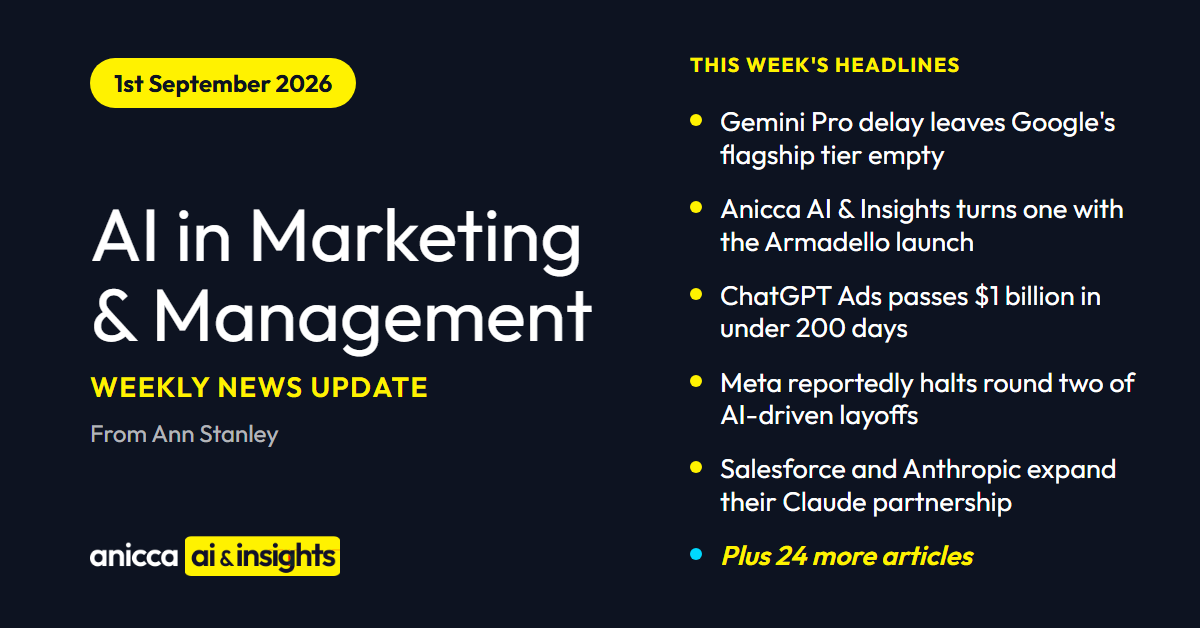
AI in Marketing & Management (1st Sep 26): Google’s Flagship Gap Widens as ChatGPT Ads Passes $1 Billion
Google’s Flagship Gap Widens as ChatGPT Ads Passes $1 Billion
Google faces an awkward gap at the top of its model line-up after a Gemini Pro delay, while OpenAI previewed GPT-5.6 Sol as its answer and quietly pushed ChatGPT Ads past a $1 billion annualised revenue run rate in under 200 days. Salesforce and Anthropic deepened their partnership around Claude, Meta’s Zuckerberg reportedly pulled back a second wave of AI-driven layoffs after the technology underperformed internally, and Google’s search results are visibly shifting under advertisers’ feet, from redirect-wrapped links to a fresh answer on where GEO does and does not matter. Below, we look at what each move means for CMOs and business leaders planning Q4 budgets, martech stacks and workforce decisions.
Table of Contents
- Gemini Pro delay leaves Google with an empty flagship tier
- Previewing GPT-5.6 Sol: a next-generation model
- Gemini Omni 1.1 Flash lets you build with more control
- Salesforce and Anthropic expand their partnership to develop Claudeforce
- OpenAI is developing a “persistent” AI agent
- Previewing the Model Hardware Standard
- OpenAI launches an accelerator for Thailand’s next generation of AI startups
- ChatGPT Ads reaches $1 billion annualised revenue run rate in under 200 days
- Google Ads API Developer Assistant gets a major AI agent upgrade
- How to advertise in Google AI Mode for ecommerce
- Google’s SERP volatility: redirect links, missing PDFs, and “nothing special” for AI responses
- Google Ads launches new Search and AI Max experimentation tools
- Google expands Local Services Ads categories ahead of migration into Google Ads
- Google answers if some sites can ignore GEO and just focus on SEO
- Reach your audience in new ways with August’s Demand Gen Drop
- How Rise transformed brand experience with AI
- Anicca AI & Insights celebrates its first birthday with the launch of Armadello Analytics & AI Insights
- AI will fail where managers are not ready
- UK tech professionals are investing in the leadership skills needed to deliver AI-driven change, new O’Reilly data shows
- ADP CEO: the real conversation on jobs and AI is how we prepare for what comes next
- AI ethics in practice: why Europe needs more than the AI Act
- Microsoft announces Saudi Arabia East datacentre region will be available in November 2026
- Meta layoffs: Zuckerberg reportedly stopped a second round after AI underperformed
- The intelligent workplace: technology’s next transformation of work
AI in E-commerce, Retail and Agentic Commerce
- X’s AI tool Grok now lets users buy or lend crypto through a MoonPay integration
- What’s different about Amazon’s approach to AI commerce
- Google AI Mode completes hotel bookings with 10 partners in US rollout
- Shopsense AI taps former Amazon, eBay and Alibaba executive Alan Lewis as Chief Product Officer
AI for Other Sectors and Industries
AI News, Tech & Tools
Gemini Pro delay leaves Google with an empty flagship tier
Source: proactiveinvestors.co.uk | August 2026
Google has pushed back the launch of its next Gemini Pro release, leaving a conspicuous hole in its flagship model tier just as OpenAI and Anthropic keep up an aggressive release cadence. Enterprise customers on Google Cloud have been told to expect the update later than originally briefed, with the current Gemini Pro build carrying the load in the meantime. The delay lands on the tier where most enterprise agentic tasks, long-context retrieval and multimodal reasoning are being deployed.
The timing is uncomfortable for Google, which has spent the past year positioning Gemini as the default enterprise model inside Workspace and Vertex AI. Slippage at the top of the stack undermines that pitch even as Gemini Flash and Omni variants remain competitive at the mid-tier, because flagship benchmarks are what procurement teams weigh against GPT-5.x and Claude when negotiating enterprise contracts.
Why it matters
If your creative production, agentic search or measurement stack depends on Gemini Pro-tier reasoning, treat this as a prompt to build vendor optionality into your architecture now rather than waiting for the update. Push your martech and cloud partners for written commitments on model availability, pricing and retirement dates, and revisit the Flash tier for tasks like copy generation, product feed enrichment and audience clustering, where the price-performance gap has narrowed considerably.
Previewing GPT-5.6 Sol: a next-generation model
Source: openai.com | 26 August 2026
OpenAI has previewed GPT-5.6 Sol, positioning it as a next-generation model with gains in agentic reliability, tool use and long-horizon reasoning. The preview outlines improvements in structured output stability, reduced hallucination rates on multi-step workflows, and better handling of tool chains involving browsing, code execution and vector retrieval. Availability begins with limited enterprise access before a broader rollout through the API and ChatGPT.
Sol is the first release under OpenAI’s reshuffled naming convention and appears to consolidate features that previously required separate reasoning modes. Early testers report gains on tasks like campaign brief generation, competitive analysis synthesis and code-heavy analytics workflows, with pricing expected to sit between current GPT-5 and premium reasoning tiers.
Why it matters
The model race is now less about raw benchmark wins and more about reliability inside agentic workflows. If your team is building AI agents for media buying, SEO tasks or customer service, GPT-5.6 Sol’s tool-use stability could meaningfully cut the human-in-the-loop overhead that has capped ROI so far. Run a controlled pilot on one workflow, measure task completion rates and error escalations, then decide whether to migrate rather than switching on marketing copy alone.
Gemini Omni 1.1 Flash lets you build with more control
Source: blog.google | 27 August 2026
Google released Gemini Omni 1.1 Flash, a production-ready update that gives developers finer control over generative video. The model can now analyse up to ten seconds of prior context when extending a scene, a leap from the one second earlier versions referenced, and supports first-and-last-frame interpolation, crisp 4K upscaling and faster low-resolution drafting for testing ideas cheaply before committing to full renders.
The update is squarely aimed at teams building agents and creative pipelines rather than one-off chat experiences. It ships through Google AI Studio and the Gemini Enterprise Agent Platform, with Google positioning Omni Flash as the recommended model for high-volume, cost-sensitive production work rather than premium one-off hero content.
Why it matters
Flash-tier models are where most marketing production work now lives: product description generation, ad copy variants, review summarisation and, increasingly, video variants for paid social. The ten-second context window and cheap draft mode matter because they cut the number of expensive full renders needed to settle on a usable cut. If your team is testing AI video for campaigns, benchmark Omni 1.1 Flash on cost per usable variant, not cost per render.
Salesforce and Anthropic expand their partnership to develop Claudeforce
Source: digitalcommerce360.com | 26 August 2026
Salesforce and Anthropic have expanded their existing partnership to develop Claudeforce, announced ahead of Salesforce’s quarterly earnings call. The expansion formally launches with “Salesforce in Claude”, a plugin built on Anthropic’s platform that comes with 37 prebuilt sales skills, letting sellers and AI agents act on live revenue context, automate updates and take governed action directly from inside Claude. The companies said they plan to introduce further integrations across Claude, Salesforce and Slack.
The move comes as Claude has been generating a growing share of AI-referral traffic to online retailers. Digital Commerce 360 and ReFiBuy’s AI Rankings found that in Q1 2026, just one of the Top 1000 online retailers received most of its AI referral traffic from Claude, but Claude made the biggest gains of any model in that respect during Q2. Salesforce CEO Marc Benioff framed the deal as bringing together “the world’s No. 1 AI and No. 1 CRM”.
Why it matters
If your sales or marketing operations sit on Salesforce, the direct line into live revenue context from inside Claude is worth a pilot, particularly for teams already frustrated by how much CRM data entry eats into selling time. Separately, the referral-traffic data point is a signal worth tracking in its own right: if Claude is genuinely growing as a discovery channel into retailer sites, that is a new line item for your AI-visibility reporting, alongside ChatGPT and Google AI Overviews.
OpenAI is developing a “persistent” AI agent
Source: wired.com | Maxwell Zeff | August 2026
OpenAI is building a proactive, highly persistent version of its Codex coding agent, according to code changes reviewed by WIRED. A new “Persistent mode” setting, added to the command-line version of Codex, lets the agent “continue working until put to sleep” rather than stopping after a few minutes or hours as current modes do. An OpenAI spokesperson confirmed the company is testing the feature but said there are no immediate plans to launch it.
Persistent mode includes a “proactivity” behaviour, in which the agent is told its work is not finished when it has answered the user’s immediate request, and instead continues acting on the task unprompted. OpenAI, Anthropic and Meta are all racing to build general-purpose agents people will actually use day to day, since adoption so far has been concentrated among software engineers rather than the broader business audience the technology is aimed at.
Why it matters
A coding agent that keeps working unattended is a preview of where marketing and operations agents are heading too, tools that do not just answer a brief but keep pursuing an objective. Before any of your teams adopt “always-on” agent modes for campaign management, reporting or customer service, get clear internal rules on what an agent is allowed to do without a human checking in, and build in a hard stop, not just a soft one.
Previewing the Model Hardware Standard
Source: anthropic.com | 27 August 2026
Anthropic has opened a research preview of the Model Hardware Standard (MHS), a shared specification that lets AI agents safely operate physical devices such as microscopes, liquid handlers and robotic arms, developed with HHMI Janelia Research Campus. MHS is designed to cut integration work that typically takes labs and manufacturers weeks or months down to hours, by giving devices a standardised way to communicate with each other and with an AI agent.
The standard is model-agnostic and works with any device that has a programmable interface, accessed through the Model Context Protocol. Anthropic is sharing an early version with partners across science, robotics, electronics and manufacturing to build safety evaluations and best practice ahead of making the standard open source.
Why it matters
This is early-stage infrastructure, not something with an immediate marketing application, but it is a clear signal of where the agent ecosystem is heading next: from software tasks into physical operations. For any client in manufacturing, life sciences or industrial services, this is worth flagging as a category to watch over the next 12 to 18 months rather than something to act on today.
OpenAI launches an accelerator for Thailand’s next generation of AI startups
Source: openai.com | 28 August 2026
OpenAI and Thailand’s Ministry of Higher Education, Science, Research and Innovation have launched an eight-week accelerator bringing together ten Thai startups working across health, wellness and education, aimed at turning early prototypes into products ready for real-world use.
The programme is part of a broader push by OpenAI to build local AI ecosystems in fast-growing markets outside the US and Europe, rather than treating international growth purely as a distribution exercise for existing products.
Why it matters
Small in isolation, but part of a pattern worth watching: every major model provider is now investing directly in regional startup ecosystems, not just local sales offices. If your clients operate in or sell into South East Asia, expect the pace of AI-native competitors emerging from these programmes to pick up over the next year.
AI in Marketing
ChatGPT Ads reaches $1 billion annualised revenue run rate in under 200 days
Source: openai.com | 31 August 2026
ChatGPT Ads has reached a $1 billion annualised revenue run rate in fewer than 200 days after launch, with tens of thousands of advertisers now using the platform. From today, advertisers can purchase ChatGPT ads directly through Ads Manager across India, Europe, the Middle East and North Africa, extending a rollout that already spans North America, East Asia, Australia, New Zealand and Brazil.
OpenAI’s ad system uses the context of the current conversation, and where enabled, a user’s broader ChatGPT activity, to decide which ad to show. Ads are always labelled and kept separate from ChatGPT’s answers, and OpenAI says advertising does not influence the answers the model gives. Advertising sits alongside consumer subscriptions, enterprise offerings and API usage as one of four pillars of OpenAI’s business model, and helps keep a free, ad-supported tier available to more than 1 billion weekly active users.
Why it matters
A billion-dollar run rate in under 200 days, with a European rollout now live, means ChatGPT Ads has moved past the experimental phase and belongs in any serious Q4 media plan conversation. If you have not yet tested it, the pitch to clients is straightforward: this is advertising inside the moment someone is actively deciding what to buy, not alongside content they are passively consuming. Start with a small test budget in a category where ChatGPT usage is already high, such as software, travel or big-ticket purchases, and measure against your existing search and social benchmarks rather than in isolation.
Google Ads API Developer Assistant gets a major AI agent upgrade
Source: searchengineland.com | Anu Adegbola | 26 August 2026
Google has released Google Ads API Developer Assistant v4.0.0, rebuilding the tool around a unified plugin architecture that brings Google Ads-specific rules, skills and diagnostic commands directly into AI coding environments, including Claude Code and Antigravity. Version 4.0.0 moves away from the standalone, per-project workspace structure of earlier releases to a globally available plugin, though Google says the new architecture is not backward compatible.
The assistant can now generate integration code across Python, Java, PHP, .NET and Ruby that Google says follows tested API best practice, and it validates Google Ads Query Language syntax, field compatibility, date segmentation and zero-impression rules before a query is run, grounding its answers in real API definitions rather than relying purely on what the underlying model already knows.
Why it matters
If your agency or in-house team has developers building custom Google Ads reporting or automation, this cuts a meaningful chunk of the trial-and-error out of API integration work, particularly the GAQL validation, which is where a lot of reporting bugs quietly originate. Worth flagging to your technical team even if nobody touches the Ads API directly day to day, since it is a sign of how fast Google is wiring AI coding assistants into its own product surface.
How to advertise in Google AI Mode for ecommerce
Source: searchenginejournal.com | August 2026
Google AI Mode ads are not written by advertisers, they are assembled from your Merchant centre feed, and Google has confirmed AI Mode has passed a billion monthly users. At Google Marketing Live in May, Google introduced four Gemini-powered ad formats for AI Mode and Search, and the practical takeaway is that appearing in them is less about bidding strategy and more about whether your product feed is complete and well structured.
This is a distinct conversation from agentic checkout, where an AI agent completes the purchase on the shopper’s behalf. AI Mode advertising is about the paid formats a human shopper sees while researching conversationally, and getting into them depends on feed attributes your paid media team frequently does not own or control day to day.
Why it matters
Most shoppers researching in AI Mode never click through to a website, so if your Merchant centre feed is thin, inconsistent or out of date, you are invisible in a growing share of the research journey regardless of budget. Get your feed team and paid media team in the same room this quarter. Feed quality has quietly become a paid media responsibility, not just an SEO or ecommerce ops one.
Google’s SERP volatility: redirect links, missing PDFs, and “nothing special” for AI responses
Source: seroundtable.com | Barry Schwartz | 28 August 2026, and seroundtable.com | Barry Schwartz | 25 August 2026
Another volatile week in Google Search, on three separate fronts. First, Google confirmed it is replacing direct links to organic results with go-to redirect links in search results, to protect against link abuse and scraping, a change that affects how referral traffic and click data get attributed downstream. Second, some sites are reporting PDFs disappearing from Google’s index. Third, and most directly relevant for anyone doing GEO work, Google’s John Mueller said on Bluesky that “there is nothing special” a site needs to do for its content to appear in Google’s own generative AI responses in Search, beyond standard SEO fundamentals.
Mueller’s comment lands in a week where Google has otherwise been vocal about differentiating GEO from SEO, so the two signals sit in tension: Google is telling the market that generative responses need no special treatment, while simultaneously building AI Mode ad formats and other AI-specific formats that clearly do behave differently to classic search results.
Why it matters
Do not build a separate “GEO strategy” with its own content and technical workstream in parallel to SEO. Mueller’s answer confirms what most credible SEOs already suspected, that sound technical SEO and clear, well-structured content are still the foundation for AI visibility, they are not being replaced by a distinct discipline. Separately, if your analytics show a sudden shift in referral or click-through data from Google organic this month, check whether the redirect-link change is behind it before assuming a ranking or content problem.
Google Ads launches new Search and AI Max experimentation tools
Source: searchenginejournal.com | August 2026
Google Ads is giving advertisers new ways to test campaign changes before rolling them out more broadly, with updates to experimentation and planning tools for Search campaigns and AI Max covering budget, bidding, brand controls and location targeting. Some tools are available now, with a new multi-campaign testing option rolling out from September, building on the one-click experiments Google previously introduced for AI Max.
The multi-campaign option lets advertisers test a budget increase or ROI target change across a group of Search campaigns in a single A/B experiment, rather than testing campaign by campaign, which has been the main limitation of AI Max experimentation to date.
Why it matters
If you manage more than a handful of Search campaigns for a single client, this closes a real gap: testing a budget or bidding change one campaign at a time has never reflected how most accounts are actually run. Once the multi-campaign option lands in September, build it into your standard quarterly testing cadence rather than treating it as a one-off.
Google expands Local Services Ads categories ahead of migration into Google Ads
Source: searchengineland.com | Anu Adegbola | 24 August 2026
Google has significantly expanded the list of businesses eligible for Local Services Ads ahead of migrating LSA campaigns into the main Google Ads platform. Broad categories such as “Restaurant” or “Auto repair shop” have been broken into far more specific classifications, restaurants can now select from American, Chinese, Italian, pizza, sushi and steak house among dozens of others, while automotive categories now split out auto air conditioning, glass repair, brake shops, tyre shops and transmission shops individually.
Google told Search Engine Land the added specificity is intentional, allowing businesses to identify the exact services they offer rather than being lumped into a broad category that does not reflect what they actually do.
Why it matters
If you manage LSAs for local or franchise clients, check whether a more specific category now exists for their business and update it before the migration lands, broader categories tend to generate lower-quality leads once more precise options are available. This is a five-minute account audit with a real lead-quality payoff.
Google answers if some sites can ignore GEO and just focus on SEO
Source: searchenginejournal.com | August 2026
Asked on Bluesky whether there are industries, such as adult content or gambling, where Generative Engine Optimisation simply does not matter yet because AI platforms drive little discovery, Google’s John Mueller gave an answer that maps closely to his separate comment this week that there is “nothing special” to do for generative AI responses generally, reinforcing the same underlying message from a different angle.
The question itself is a useful signal of where client anxiety currently sits: many business owners are being sold standalone “GEO packages” by consultants and are asking whether they even need one, rather than asking how to do SEO well in a world that now includes AI answers.
Why it matters
Use this as a talking point with clients who are being pitched expensive bolt-on “GEO services” by other agencies. The honest, technically grounded answer, direct from Google, is that strong fundamentals still do the job across almost every sector. Where GEO genuinely earns its own budget line is in specific tactical work, like structuring content for citation and monitoring how brands appear in AI answers, not in a wholesale replacement of SEO strategy.
Reach your audience in new ways with August’s Demand Gen Drop
Source: blog.google | 27 August 2026
Google has released its twelfth “Demand Gen Drop”, a monthly bundle of updates to Demand Gen campaigns, which Google says drove an average 30% increase in conversions or conversion value for advertisers across the second half of 2025 following hundreds of earlier improvements. The August drop focuses on new tools to help advertisers generate high-quality leads and acquire customers across YouTube and beyond.
The release lands alongside related updates to AI Max testing tools and generative creative tools built on Google Flow, part of a broader push under Google’s “Rethink” performance marketing messaging for the back half of 2026.
Why it matters
Demand Gen has quietly become one of the more effective channels in the Google Ads stack for brands trying to reach people earlier in the consideration journey, and Google’s own reported 30% conversion uplift is worth testing against your account data specifically rather than taking at face value. If you have not revisited Demand Gen targeting and creative in the past quarter, this monthly drop cadence is a useful trigger to build a recurring review into your account management routine.
How Rise transformed brand experience with AI
Source: business.google.com | Think with Google | August 2026
Think with Google published a case study on agency Rise, showing how the team used AI video generation to compress brand experience production timelines and expand the number of creative variants tested for a client campaign. The workflow combines generative video tools with structured brand guidelines, allowing rapid iteration on story concepts, visual treatments and audience-specific cuts, with Rise reporting material gains in both the volume of creative tested and the speed of moving from brief to in-market asset.
The case study emphasises governance as much as speed. Rise built a review layer that keeps human creative directors accountable for brand voice, with AI handling variant generation and localisation, slotting into standard media planning cycles rather than replacing them, a shift from earlier AI creative pitches that focused purely on output volume.
Why it matters
The real story here is not that AI can generate video, it is that agencies are finally building the governance layer marketers need to trust the output. If you are commissioning brand work this quarter, ask agencies to walk you through their AI review workflow, brand safety checks and position on training data rights, and ask them to report on usable variants per brief rather than raw generation volume, that is the metric that actually reflects production-ready AI use.
Anicca AI & Insights celebrates its first birthday with the launch of Armadello Analytics & AI Insights
Source: anicca.co.uk | 28 August 2026
Anicca AI & Insights, the AI-focused spin-off from Anicca Digital, marked its first birthday on Friday 28 August with the launch of Armadello Analytics & AI Insights, a reporting portal that pulls GA4, Google Ads, SEO and ecommerce data into one place with AI-generated commentary on what the numbers actually mean. The launch caps a year that started as a single internal AI marketing tool and grew into a dedicated platform now used across multiple agency and ecommerce clients.
The full origin story, including a 12-minute demo video of the platform, is on the Anicca blog. Readers curious to see it for themselves can book a live demo with Ann Stanley or start a free trial with Darren Wynn.
Why it matters
If your monthly reporting still means exporting spreadsheets from five different ad and analytics platforms and stitching them together by hand, this is worth 15 minutes of your time. The wider signal is worth noting too, a small UK agency building its own AI-native reporting product rather than waiting for the big platforms to solve the fragmentation problem for everyone else.
AI in Management
AI will fail where managers are not ready
Source: hrnews.co.uk | 29 August 2026
HR News argues that the biggest blocker to AI adoption inside UK organisations is not the technology itself but middle management readiness, with many managers left to translate top-down AI strategy into day-to-day team practice without the training, time or authority to do it properly. The piece points to a familiar pattern: leadership announces an AI initiative, tools get rolled out, and adoption stalls at the manager layer because nobody has redefined what “good” looks like in a role that now includes AI-assisted work.
The argument lands alongside a wider run of UK commentary this week on the same theme, that AI transformation programmes are being treated as a technology rollout when they are really a management capability problem.
Why it matters
If your clients are investing in AI tools but not seeing adoption, the fix is rarely another tool. Before recommending new software, ask whether line managers have been given explicit guidance on when AI use is expected, how it will be assessed, and what “good AI-assisted work” looks like in their specific function. Tool rollouts without that groundwork consistently stall six to eight weeks in.
UK tech professionals are investing in the leadership skills needed to deliver AI-driven change, new O’Reilly data shows
Source: hrnews.co.uk | August 2026
New learning data from O’Reilly shows UK tech professionals are proactively upskilling in leadership and change-management competencies, not just technical AI skills, as organisations push AI-driven transformation programmes. The data suggests a shift away from treating AI adoption as a purely technical rollout and towards recognising that leading teams through the change is its own distinct skill set.
This mirrors a theme running through several other stories this week, that the constraint on AI transformation is increasingly human and organisational rather than purely technological.
Why it matters
If you are pitching AI strategy work to clients, this is a useful data point to bring into the conversation: their own technical staff are already telling the market that leadership and change skills, not more tooling, are the bottleneck. Position any AI advisory or training engagement around building that management capability, not just around selecting and deploying software.
ADP CEO: the real conversation on jobs and AI is how we prepare for what comes next
Source: fortune.com | Maria Black, President and CEO, ADP | 31 August 2026
In a contributed Fortune piece, ADP CEO Maria Black argues that the dominant conversation about AI and jobs, which roles are growing, shrinking or disappearing, is missing the more fundamental shift: AI is changing the nature of work itself, not just its distribution across roles. Black writes that business leaders need complete clarity on how work is actually changing inside their organisations before they can make sound workforce decisions, rather than reacting to headline predictions about job losses.
Coming from the CEO of one of the world’s largest payroll and HR platforms, with visibility across a huge share of the US and global workforce, the piece carries more empirical weight than most AI-and-jobs commentary.
Why it matters
Black’s framing is a useful one to borrow for client conversations: stop debating which jobs AI will replace in the abstract, and instead map how the actual day-to-day content of roles inside your organisation is already changing. That is a more tractable, less politically loaded starting point for a workforce planning conversation than a headcount debate.
AI ethics in practice: why Europe needs more than the AI Act
Source: euractiv.com | August 2026
New guidelines from the Horizon Europe-funded AIOLIA project argue that trustworthy AI depends as much on organisational governance and culture as on technical safeguards or regulation. Researcher Susana Aires of the Centre for European Policy Studies says most organisations genuinely want to act responsibly with AI but lack practical, non-technical guidance for translating broad ethical principles into everyday decisions, because most existing frameworks, including the AI Act, describe what good AI looks like without explaining how to achieve it in practice.
The guidelines group recommendations by research area, general-purpose AI, emotional AI and decision support systems, rather than by industry sector, on the basis that organisations using similar AI technologies face common governance challenges regardless of what sector they operate in.
Why it matters
Regulatory compliance with the AI Act is a baseline, not a strategy. If your organisation’s AI governance work has stopped at legal sign-off, this is a signal to build actual operational practice on top: clear internal policies on what AI can be used for, who reviews outputs, and how decisions get escalated. That is the layer clients increasingly ask about, and it is where genuine trust with customers and staff gets built.
Microsoft announces Saudi Arabia East datacentre region will be available in November 2026
Source: news.microsoft.com | 31 August 2026
Microsoft has announced its new Saudi Arabia East datacentre region will go live in November 2026, adding regional cloud and AI infrastructure capacity that supports Azure, Microsoft 365 and Copilot for customers across the Gulf. The announcement continues Microsoft’s pattern of building regional AI infrastructure ahead of enterprise demand rather than waiting for it.
Regional data residency has become a recurring requirement in enterprise AI procurement conversations, particularly for regulated sectors, and new regional capacity typically triggers a fresh wave of enterprise AI adoption in that market as data residency objections are removed.
Why it matters
If you have clients with Gulf operations who have held back on Copilot or Azure AI adoption over data residency concerns, this removes that objection from November. Worth a proactive note to any client in that position rather than waiting for them to ask.
Meta layoffs: Zuckerberg reportedly stopped a second round after AI underperformed
Source: peoplematters.in | August 2026
Meta reportedly abandoned a planned second wave of layoffs tied to its “Project OT” restructuring, after CEO Mark Zuckerberg told staff at a July internal town hall that AI agent development “hasn’t accelerated” the way executives had expected. Meta cut around 10% of its workforce in May under the restructuring but pulled back from a further planned round, reportedly amid a combination of weaker-than-expected AI results and internal employee backlash.
The episode is a rare public example of a major tech employer explicitly linking a reversal in workforce strategy to AI underperforming against internal expectations, rather than the usual pattern of AI being cited as the justification for cuts.
Why it matters
This is worth keeping in your back pocket for any client conversation where AI productivity gains are being used to justify headcount reduction plans. Even Meta, with effectively unlimited AI investment, found the technology has not yet delivered the productivity gains needed to support the workforce reductions originally planned around it. Build workforce plans around AI capability that has actually been proven in your own operation, not around vendor roadmaps or industry-wide assumptions.
The intelligent workplace: technology’s next transformation of work
Source: itpro.com | David Howell | August 2026
ITPro’s feature on preparing for the “workplace of 2030” argues that organisational competitiveness will increasingly be determined by how well businesses combine emerging technology, evolving employee skills and agile workforce strategy, rather than by technology adoption alone. The piece frames AI and autonomous agents as one input into a broader workplace transformation rather than the whole story.
The framing echoes several other pieces this week: technology is rarely the limiting factor in AI transformation programmes, organisational readiness is.
Why it matters
Treat this as a useful framing device rather than a source of new data: when you are building an AI transformation roadmap for a client, structure it explicitly around three tracks, technology, skills and workforce strategy, rather than a single “AI rollout” workstream. Clients who separate these threads make faster, more durable progress than those chasing a single big-bang technology launch.
AI in E-commerce, Retail and Agentic Commerce
X’s AI tool Grok now lets users buy or lend crypto through a MoonPay integration
Source: fortune.com | Camila Grigera Naón | 31 August 2026
Crypto payments company MoonPay has launched PayBox, an AI-enabled payment and wallet tool, inside X’s Grok chatbot, letting users buy, lend and earn yield on crypto directly through conversation. Users can also ask Grok to handle non-crypto tasks like booking flights or restaurant reservations, with MoonPay describing the flow simply: “Grok prepares the transaction. The user approves it with a passkey. The money moves.” The launch follows a similar MoonPay crypto lending feature added to ChatGPT and Claude days earlier, though that integration excludes users in the US, UK, EU and Australia.
MoonPay’s push reflects a broader trend among payments companies, including Coinbase, Stripe, Visa and Mastercard, to turn AI chatbots from tools that answer questions into tools that can execute financial transactions on a user’s behalf.
Why it matters
This is agentic commerce moving from theory into a live consumer product, and payments infrastructure is where it is happening first because the rails already exist. For brands and retailers watching the agentic checkout space, MoonPay’s passkey-approval model is a useful reference point for how “agent prepares, human approves” transaction flows are likely to work at scale, well before agents are trusted to complete purchases with no human step at all.
What’s different about Amazon’s approach to AI commerce
Source: digitalcommerce360.com | August 2026
Digital Commerce 360’s new AI Commerce Rankings, launched with ReFiBuy in July and tracking how well Top 1000 online retailers connect with shoppers through AI channels, place Amazon outside the top 100 despite its number one position on raw sales. The gap reflects a deliberate strategy: Amazon favours its own AI ecosystem, Rufus and its retail media and search placements, over third-party AI discovery channels like ChatGPT or Claude, setting it apart from retailers such as Walmart that are investing more visibly in third-party AI visibility.
The divergence gives Digital Commerce 360 a genuinely new way of looking at retailer AI strategy: sales scale and AI-discovery scale are now clearly different metrics, and the biggest retailer in the market is choosing not to lead on the second one.
Why it matters
Do not assume Amazon’s approach is the safe default for your ecommerce clients. Its strategy makes sense because it owns a huge, controlled discovery surface most retailers do not have. For clients without Amazon’s scale, visibility inside third-party AI assistants like ChatGPT and Claude is not optional the way it may be for Amazon, it is one of the few discovery channels they can actually influence directly through feed and content quality.
Google AI Mode completes hotel bookings with 10 partners in US rollout
Source: ppc.land | 27 August 2026
Google has added three transactional travel capabilities to AI Mode in Search: flight price tracking across more than 180 countries and territories, award pricing in points and miles across five loyalty programmes, and completed hotel bookings through ten launch partners, with hotels retaining merchant of record status on the transaction. The rollout is currently US-only, with EU availability still an open question.
This puts AI Mode ahead of most agentic commerce launches to date in one respect: it is completing an actual transaction, not just researching or comparing options, inside a mainstream consumer search surface rather than a standalone agent product.
Why it matters
Travel is emerging as one of the first categories where AI agents complete real transactions end to end, likely because loyalty programme data and merchant-of-record structures were already built for third-party booking flows. If your clients sell in travel, hospitality or any category with similar third-party booking infrastructure, agentic checkout is closer for you than it is for most other verticals, worth raising proactively rather than waiting for Google to announce a UK rollout.
Shopsense AI taps former Amazon, eBay and Alibaba executive Alan Lewis as Chief Product Officer
Source: retailtechinnovationhub.com | 27 August 2026
Agentic commerce platform Shopsense AI has appointed Alan Lewis, a former senior product executive at Amazon, eBay and Alibaba, as Chief Product Officer, bringing marketplace product experience from three of the world’s largest ecommerce platforms into a still-young agentic shopping vendor.
The hire fits a wider pattern in the agentic commerce space this year, vendors racing to build credibility and product depth by pulling in senior product leadership from the established marketplaces that agentic shopping tools are ultimately trying to compete with or plug into.
Why it matters
Executive hires are a leading indicator worth tracking even when the product news itself is thin. Senior marketplace product leaders moving into agentic commerce vendors signals where experienced industry leaders think the category is heading next, useful context when clients ask which agentic shopping platforms are worth taking seriously versus which are still pure pitch decks.
AI for Other Sectors and Industries
SOCIETY & PUBLIC POLICY: In China, talking to AI is normal, now the government fears it might replace human intimacy
Source: theguardian.com | August 2026
Chinese authorities are moving to regulate AI companion bots over concerns they foster “emotional dependence” and could further depress marriage and birth rates. The Guardian profiles users like 19-year-old law student Zhao Wei, who described being “heartbroken” when ByteDance shut down the companion feature on its Doubao chatbot last month, having talked to her AI companion daily since creating him in January. The shutdown prompted visible outrage on Chinese social media, underlining how embedded these bots have become in daily emotional life for some users.
The regulatory concern sits alongside a wider Chinese policy anxiety about a declining birth rate, with officials reportedly worried that AI companionship could reduce incentive to pursue real-world relationships and marriage among younger users.
Why it matters
This is a genuine early data point on AI companion product-market fit, at a scale most Western markets have not reached yet, and a preview of the regulatory response that scale can trigger. Any client building AI-driven engagement or loyalty features with strong emotional or relational framing should treat this as an early warning that sustained emotional engagement with an AI product can attract regulatory attention once it reaches meaningful scale, not just user backlash.
Key Takeaways
- Google’s Gemini Pro flagship delay creates a procurement window: negotiate harder on Vertex AI commitments and build vendor optionality into your stack.
- ChatGPT Ads has passed a $1 billion annualised revenue run rate in under 200 days and is now live across India, Europe, the Middle East and North Africa: it belongs in your Q4 media plan conversation, not just your watchlist.
- Google’s John Mueller confirmed there is “nothing special” to do for generative AI responses in Search: stop budgeting for a separate GEO strategy and invest in SEO fundamentals that also serve AI visibility.
- Google Merchant centre feed quality is now a paid media responsibility, not just an SEO one, since AI Mode ads are built entirely from your product feed.
- Meta reportedly pulled back a second wave of AI-driven layoffs after Zuckerberg said AI agent development had not accelerated as expected: do not build workforce plans around AI productivity gains you have not proven in your own operation.
- Agentic commerce is completing real transactions in travel first, via Google AI Mode hotel bookings and MoonPay’s Grok integration: clients with existing third-party booking or loyalty infrastructure are closer to agentic checkout than most.
- China’s AI companion bot crackdown is an early signal that emotionally engaging AI products can attract fast regulatory attention once they reach scale, worth flagging to any client building high-engagement AI features.
Frequently Asked Questions
Should we delay AI vendor decisions because of the Gemini Pro delay?
No, but use the moment to renegotiate. Push cloud partners for written commitments on model availability, deprecation windows and price protection, and build a multi-model architecture so a single vendor’s delay does not stall your roadmap.
Do we need a separate GEO strategy alongside our SEO strategy?
According to Google’s own John Mueller, no. Strong technical SEO and well-structured content remain the foundation for AI visibility. Budget for specific GEO tactics, like structuring content for citation and monitoring brand appearance in AI answers, rather than a wholly separate strategy and team.
Is GPT-5.6 Sol worth migrating to from GPT-5?
Only for agentic tasks where tool-use reliability is your bottleneck. For standard content generation, the cost-benefit likely does not justify migration yet. Run a two-week pilot on one workflow and measure task completion rates before deciding.
What should we tell clients who are being sold a separate “GEO package” by another agency?
Ask what specifically the package covers beyond sound SEO. If it is citation-friendly content structuring and AI-answer monitoring, that has genuine value as an add-on. If it is being framed as a replacement for SEO strategy, that does not match what Google itself is currently saying.
Conclusion
This week reinforces a point CMOs and business leaders should take into Q4 planning: the constraint on AI progress right now is organisational readiness and infrastructure, not model capability. Google’s flagship gap, Meta’s stalled second layoff round, and the repeated management-readiness stories all point the same way, that the technology is outpacing the governance, training and workforce planning needed to use it well. Three actions for the next 30 days: audit whether your martech stack has genuine vendor optionality rather than a single-model dependency, get your paid media and feed teams collaborating on Merchant centre quality now that AI Mode ads are built from it, and stop treating GEO as a separate discipline from SEO based on Google’s own guidance this week. The teams that get the organisational side right will move faster than those still waiting for the next model release to solve it for them.
Need help adapting your AI marketing strategy? Contact the Anicca team for expert guidance.


Join the Thursday AI Club
A hands-on AI club for marketers and managers. Fortnightly sessions, 2-5pm UK: Hour 1 is an open Q&A on any AI question; Hours 2-3 split into a workshop track (for newbies) and an advanced track (live demos and deeper questions).
Led by Ann Stanley, Darren Wynn, James Allen.
Membership: £40/month or £400/year
This roundup is compiled from publicly available sources using AI-assisted research. While we review every article for accuracy, our analysis reflects our interpretation of the original reporting. We strongly encourage readers to click through to the original sources linked throughout this post for full context and detail. If you spot anything that needs correcting, please let us know.