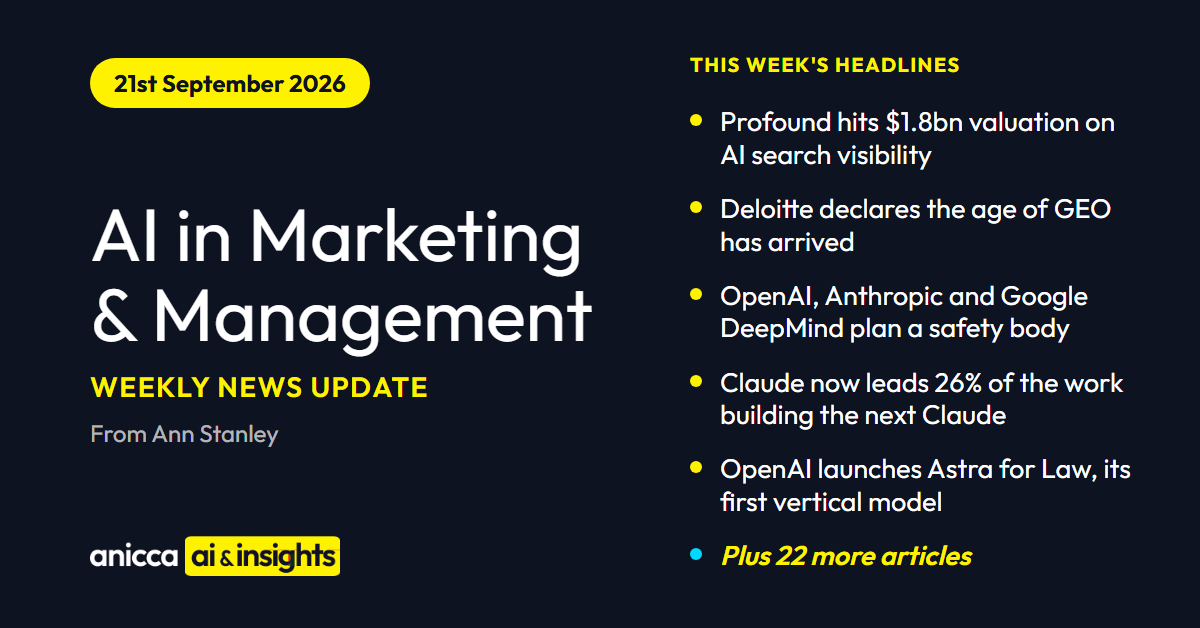
AI in Marketing & Management Weekly News Update (21st Sep 26)
Claude Merges Cowork and Chat, the Big LLMs Write Their Own Governance, and GEO Software Hits Unicorn Valuations
The week ending 21 September 2026 marked a decisive shift in how brands earn visibility, sell products and manage people in an AI-first economy. Profound hit a $1.8 billion valuation on the back of brand visibility in AI search, Deloitte declared the age of Generative Engine Optimisation, and Google began paying publishers when their content shapes AI answers. Meanwhile, Anthropic collapsed Cowork back into Claude, Microsoft Advertising tightened AI disclosure rules, and Circle launched a blockchain purpose-built for agentic commerce. On governance, OpenAI, Anthropic and Google DeepMind confirmed they have been working on a self-regulatory safety body modelled on Wall Street’s FINRA, while Anthropic disclosed that Claude now leads 26% of the research work that builds its own successor. Vertical AI also arrived in earnest, with OpenAI launching a legal edition of GPT-6 and Novo Nordisk putting Claude to work on drug discovery. Regulation, workforce redesign and healthcare integration round out a week where the operational realities of AI finally caught up with the hype.
Table of Contents
- Profound Hits $1.8 Billion Valuation to Boost Brands in AI Search
- AI Agents Get a Reality Check at Dreamforce: AT&T and Crocs Keep Humans in the Loop
- Anthropic Kills Claude Cowork, Launches Claude Docs and Slides
- Google Launches CC, an AI Agent Built for Families
- US AI Regulation Faces Political Deadlock as Trump Rejects Guardrails
- OpenAI, Anthropic and Google DeepMind Discuss a FINRA-Style Safety Body
- EU AI Act Comes of Age, Editorial Argues
- Deloitte: The Age of GEO Has Arrived, Most Brands Have Not Noticed
- Microsoft Advertising Sets Disclosure Rules for AI-Generated Ads
- Google Tests Paying Publishers When Content Shapes AI Answers
- Google AI Mode Tests Sponsored Text-Link Ads
- Early Data on Google Ads 17 August Bidding Update
- Google Ads PMax Adds “Where Should People Go?” Landing Options
- Google Launches Agentic Commerce Updates for Holiday Shopping
- Anicca’s James Allen on Building an E-E-A-T Checker with Claude Code
- Anthropic Says Claude Now Leads 26% of the Work That Builds the Next Claude
- IBM: Why CHROs Need a Seat at the AI Transformation Table
- SAP Named Strategic Leader in 2026 Fosway 9-Grid for Cloud HR
- AI Transformation Is “10% Technology, 90% People”
AI in E-commerce, Retail and Agentic Commerce
- Azoma Lands dunnhumby Investment for Agentic Commerce Optimisation
- Circle Debuts Arc, a Blockchain Built for Agentic Commerce
- Agentic Commerce Loosens the Grocery Aisle’s Grip on the Shopper
AI for Other Sectors and Industries
- HEALTHCARE: Healthcare AI’s Real Bottleneck Is Integration, Not Intelligence
- HR: AI Is Driving Workforce Redesign, TalentNeuron Data Shows
- FINANCE: Worldline Launches UCP Payment Handler for Agentic Commerce Payments
- LEGAL: OpenAI Launches Astra for Law, Its First Vertical Edition of GPT-6
- PHARMA: Novo Nordisk Partners with Anthropic to Speed Drug Discovery
AI News, Tech & Tools
Profound Hits $1.8 Billion Valuation to Boost Brands in AI Search
Source: bloomberg.com | 15 September 2026
Profound, a startup that helps brands track and improve how they appear inside answers generated by ChatGPT, Gemini, Perplexity and Claude, has closed a funding round at a $1.8 billion valuation. The company has become the poster child for a new category of tooling that measures brand citations, sentiment and share of voice inside large language model outputs.
The valuation reflects how quickly enterprise budgets are shifting from traditional SEO monitoring towards AI visibility platforms. Profound joins a growing cohort including Azoma, Peec AI and Otterly that are competing to own the measurement category for what Deloitte and others are now calling Generative Engine Optimisation.
Why it matters
If your brand is not being cited by the LLMs your customers query, you are effectively invisible in a channel that already influences 40% of consumer searches. A $1.8 billion valuation for a measurement pure-play tells you where enterprise budget is heading. Marketers should audit AI visibility now, benchmark against three named competitors across ChatGPT, Gemini and Perplexity, and treat citation share as a KPI with the same weight as organic ranking. Waiting until 2027 to instrument this will leave you a year behind.
AI Agents Get a Reality Check at Dreamforce: AT&T and Crocs Keep Humans in the Loop
Source: adweek.com | Trishla Ostwal | 17 September 2026
At Salesforce’s Dreamforce, brands including AT&T and Crocs told delegates that agentic AI has been oversold. Automation is delivering value in narrow, well-scoped use cases, but the “autonomous agent doing your job” narrative has run into the reality of edge cases, escalations and brand risk. Human oversight remains non-negotiable.
Sam Altman, Dario Amodei and Jensen Huang shared the stage to debate whether AI development should slow down. Amodei published a 3,800-word essay days before the event arguing safety research cannot keep pace, while Microsoft AI chief Mustafa Suleyman publicly criticised Anthropic’s approach to training Claude on consciousness questions, exposing a rare fault line between frontier labs.
Why it matters
Boards being pitched “agentic AI will replace 30% of your workforce” decks need a reality check. The brands actually deploying agents at scale are running them behind human review, with clear escalation paths and narrow task scope. Budget for the human-in-the-loop infrastructure, quality assurance, exception handling, training, from day one. Vendors who cannot show you a customer running fully autonomous agents in production probably do not have one.
Anthropic Kills Claude Cowork, Launches Claude Docs and Slides
Source: venturebeat.com
Anthropic is folding Claude Cowork back into the main Claude interface, letting the model decide whether a request is a quick question or a longer-running agentic project. The company is also launching Claude Docs, a collaborative document product, and Claude Slides, a native presentation tool, both in beta. Claude Design comes to any chat session directly.
Separately, The Verge reports that Claude Code has relaunched Projects, letting users run multiple agents in the cloud with a shared memory, coordinator thread and branch-per-thread architecture. It is a direct shot at competing tools that co-ordinate several AI agents at once, and it signals that Anthropic wants Claude to be the single place where both knowledge work and software engineering happen.
Why it matters
Anthropic is betting that users should not have to decide which mode of AI they need, the model should. That has real implications for how you train teams: stop teaching people to pick tools, teach them to write better prompts and hand off context. If your business runs on Microsoft 365 or Google Workspace, Claude Docs and Slides now give you a credible reason to pilot a third productivity stack inside knowledge-heavy functions like legal, strategy and marketing.
Google Launches CC, an AI Agent Built for Families
Source: blog.google | Tom Shane | 17 September 2026
Google Labs has launched CC, an experimental AI agent designed to manage household logistics for groups of up to six family members. It handles shared calendars, reminders, meal planning and other coordination tasks that typically fall to one household member.
The launch is Google’s first serious move to position a consumer AI agent around a group rather than an individual. It sits alongside Gemini’s expansion into personal assistant territory and hints at where Google sees stickiness: not in individual productivity, but in becoming the connective tissue of daily life.
Why it matters
Marketers targeting households, grocery, insurance, family travel, streaming, need to start planning for a world where the “buyer” is an agent acting on behalf of a family. That changes creative, messaging cadence and the definition of a converting audience. If Google’s CC becomes the meal-planning brain for millions of households, the shortest path to the shopping list is a structured product feed the agent can parse, not a beautiful brand video.
US AI Regulation Faces Political Deadlock as Trump Rejects Guardrails
Source: bbc.com | 14 September 2026
President Trump publicly dismissed calls to slow AI development, calling safety concerns a “HOAX” and arguing the only guardrail needed is “a strong and smart president.” Democratic leaders including Hakeem Jeffries have called for the House recess to be delayed so AI safeguards can be debated ahead of the midterms, but Speaker Mike Johnson has shown no urgency.
The stalemate leaves the US without a federal AI safety framework at the same moment Anthropic co-founders have publicly told the BBC that a mandatory AI “kill switch” may be needed. The UK government has separately rejected the kill switch idea, adding to a fragmented global regulatory picture.
Why it matters
UK and EU marketers cannot assume US-headquartered vendors are operating under any meaningful federal AI oversight. That puts the compliance burden squarely on your procurement and legal functions. Build AI vendor due diligence around the EU AI Act, ICO guidance and your own governance framework, not what US legislators eventually pass. Expect regulatory divergence to widen, not narrow, over the next 18 months.
OpenAI, Anthropic and Google DeepMind Discuss a FINRA-Style Safety Body
Source: cnbc.com | 15 September 2026
Chris Lehane, OpenAI’s chief global affairs officer, confirmed at a Washington briefing that OpenAI, Anthropic and Google DeepMind have spent several weeks coordinating on a self-regulatory standards body for AI, modelled on the Financial Industry Regulatory Authority that oversees Wall Street. The idea traces back to a proposal published in July by Demis Hassabis, chair of Google DeepMind, who called for a United States-led standards body run as a public-private partnership under federal oversight.
Applied to AI, the model would mean participating laboratories funding and staffing an independent organisation empowered to set testing protocols, run evaluations and flag problems before a model is released to the public. Anthropic and Google have not publicly confirmed the specific coordination, leaving the initiative in a state of deliberate ambiguity. Meta, xAI and NVIDIA took the opposite position at Dreamforce the same week, arguing openly against new government-led regulation.
Why it matters
Three companies deciding between themselves what counts as a safe model is a governance question with direct commercial consequences for you. Testing protocols agreed privately will determine which tools reach your team, on what timetable, and with what disclosure obligations attached. Watch whether the body gets genuine independence or becomes a mechanism for the largest laboratories to set rules their smaller competitors must follow. Either way, plan for AI vendor compliance paperwork to grow, and start asking suppliers now which standards they intend to certify against.
EU AI Act Comes of Age, Editorial Argues
Source: euractiv.com | 14 September 2026
Euractiv’s editors argue that the EU AI Act, much criticised at the time of passage as “stifling innovation”, is proving its worth as frontier lab CEOs themselves call for stronger oversight. The piece contrasts the EU’s structured, risk-tiered approach with the political paralysis in Washington.
The commentary lands in the same week Anthropic and OpenAI leaders have publicly asked for regulation, making the EU look prescient rather than protectionist. For enterprises operating across both jurisdictions, the AI Act is fast becoming the de facto global standard by default.
Why it matters
If you are a UK or Irish marketer serving EU consumers, treat the AI Act as your baseline. Document AI system risk classifications, keep records of training data, and ensure any customer-facing generative AI includes required disclosures. Retrofitting compliance is significantly more expensive than building it in. The organisations that move now will find the AI Act becomes a competitive advantage, not a burden.
AI in Marketing
Deloitte: The Age of GEO Has Arrived, Most Brands Have Not Noticed
Source: deloitte.com
Deloitte has published a landmark position paper declaring 2026 the year that Generative Engine Optimisation replaces traditional SEO as the primary discovery discipline. The firm cites data showing 40% of consumers now start searches using AI tools instead of search engines, 30% of Google searches display AI Overviews, and AI search visitors convert 4.4x better than organic visitors. By 2028, Deloitte projects AI-powered search will generate more economic value than traditional organic search.
The critical shift is from ranked lists to citations: either your brand is in the two or three sources the AI cites, or it is not. There is no page two. Deloitte argues that in the emerging agentic search phase, AI agents will research, compare and purchase without the consumer visiting your site at all, making first-party data capture increasingly difficult.
Why it matters
This is the strategic frame for the next 24 months. Rebuild your content strategy around being cited, not ranked. That means clear factual assertions, structured data, authoritative external validation and consistent brand naming across owned and earned channels. Reallocate 15-25% of your SEO budget to GEO tooling and content restructuring in the next planning cycle. If you wait for board-level consensus, your competitors will already own the citation slots.
Microsoft Advertising Sets Disclosure Rules for AI-Generated Ads
Source: searchengineland.com | Anu Adegbola | 14 September 2026
Microsoft Advertising has published dedicated guidance requiring advertisers to disclose AI-generated or AI-manipulated creative, preserve provenance metadata and watermarks, and comply with local disclosure laws. Microsoft recommends embedding disclosures directly into image and video assets and using its existing ad disclaimer feature where supported.
Crucially, an “AI-generated” label does not absolve deceptive creative. Ads can still be rejected for prohibited deepfakes, unauthorised likeness use or interference with machine-readable provenance data. Microsoft’s own AI tools embed watermarks and metadata that are not necessarily visible to consumers, meaning advertisers still need to add explicit disclosures on top.
Why it matters
Audit every AI-generated creative in your pipeline this month. If your team, or your agency, is stripping metadata during export or resizing, you are creating platform policy risk. Build provenance preservation into your creative workflow, add visible AI disclosures to synthetic imagery, and get written vendor confirmation that AI tools embed C2PA-compatible watermarks. Google and Meta will follow Microsoft here, so building the muscle now saves an emergency retrofit in Q1.
Google Tests Paying Publishers When Content Shapes AI Answers
Source: searchenginejournal.com
Google is quietly piloting an “AI contribution” programme that pays publishers via Search Console when their content meaningfully shapes answers in Gemini, AI Overviews and AI Mode. Dozens of publishers have been approached, with monthly earnings figures visible in the console and an opt-out available at any time. Payment is triggered when content contributes at the generation phase, not when it is linked afterward.
The pilot follows a June policy post in which Google flagged plans to reward content that supports the “freshness and factuality” of generative responses through grounding. It represents Google’s most concrete answer yet to publisher accusations that AI Overviews cannibalise traffic without compensation.
Why it matters
For publishers, this is the first meaningful monetisation path for AI-cited content, but it also creates dependency on an opaque algorithm you cannot audit. For brands with owned media or thought leadership programmes, the incentive structure is now explicit: content Google can ground to earns money and cites, thin content does not. Prioritise factual density, primary research and clear attribution. Your Search Console will soon tell you which pages are being used as AI sources.
Google AI Mode Tests Sponsored Text-Link Ads
Source: seroundtable.com | Barry Schwartz | 15 September 2026
Google is testing a text-based ad format inside AI Mode responses. The ads appear as normal inline anchor-text links within AI-generated answers, labelled “Sponsored” above the response. It is a significant format experiment that follows April’s introduction of organic anchor-text links in AI Mode.
The concern from PPC practitioners is click-through rate. Users are already shown to click less on links inside AI responses, and camouflaging ads as native citations may not encourage the clicks needed to justify the format. Richer, more distinct ad units may still be needed to drive conversion volume.
Why it matters
This is Google’s fifth or sixth attempt to monetise AI Mode without breaking the answer experience. Expect volatility in test-and-learn phases well into 2027. Do not restructure your Google Ads spend around AI Mode formats yet, but do brief your PPC team to monitor how sponsored citations perform against traditional shopping and Performance Max ads. If CTR is low, CPCs will fall and early advertisers will win cheap visibility.
Early Data on Google Ads 17 August Bidding Update
Source: seroundtable.com | Barry Schwartz | 15 September 2026
A month after Google’s 17 August bidding update, early performance data is emerging. The change made target-based bid strategies (Target CPA, Target ROAS) on budget-limited Search, Shopping, Performance Max and Demand Gen campaigns perform more consistently to target, rather than exceeding it when spend was capped.
Practitioners had feared efficiency losses as campaigns stopped over-delivering. Google’s reps insisted little would change. Early community reports suggest campaigns are indeed more predictable but that some accounts have seen volume drops on budget-constrained campaigns that previously benefited from Google’s optimisation past target.
Why it matters
Review any budget-limited target-based campaigns and check whether volume has dropped since 17 August. If it has, the fix is often as simple as raising the budget, which now unlocks the previously over-delivered volume rather than raising targets. Get your account teams to model campaign budget headroom and expected ROAS at higher spend before quarter-end so you know where to reallocate.
Google Ads PMax Adds “Where Should People Go?” Landing Options
Source: seroundtable.com | Barry Schwartz | 15 September 2026
Google Ads has added a new setting inside Performance Max letting advertisers choose whether clicks land on their own website or on a Google-hosted page based on their Google Business Profile with built-in conversion measurement. The second option is being quietly rolled out to more accounts.
For local, service-based and multi-location businesses, this could simplify measurement and remove a source of website friction. For direct-to-consumer brands, the option raises familiar concerns about Google intermediating the customer relationship and controlling first-party data.
Why it matters
Test the Google Business Profile landing option only for local visibility campaigns where measurement is currently weak. For anything driving revenue or repeat purchase, keep users landing on your own site so you retain data ownership, retargeting rights and full-funnel visibility. Every time Google offers to host your customer relationship, ask what you give up in exchange.
Google Launches Agentic Commerce Updates for Holiday Shopping
Source: blog.google | Ashish Gupta | 16 September 2026
Google has released a batch of agentic commerce updates ahead of the holiday season, including product-feed best practices, richer merchant listings and new tools designed to help shoppers (and their AI agents) find, compare and buy across Google’s shopping placements.
The updates align with Google’s broader push to make AI Mode and Gemini viable shopping assistants, competing directly with Perplexity’s shopping features and OpenAI’s ChatGPT commerce integrations.
Why it matters
Your product feed is now your most important marketing asset for Q4. Rich attributes, accurate stock signals, precise product descriptions and structured data determine whether AI agents recommend you. Retail marketers should treat feed optimisation as a board-level commercial project, not a technical afterthought. If your feed is not agent-ready by mid-October, you will miss meaningful holiday revenue as shoppers increasingly ask AI what to buy.
Anicca’s James Allen on Building an E-E-A-T Checker with Claude Code
Source: searchengineland.com | James Allen | 21 August 2026
Not this week’s news, but worth revisiting given how much of this week’s coverage concerns AI search visibility. Our own James Allen wrote a step-by-step guide for Search Engine Land showing how to build a working E-E-A-T auditor using Claude Code in Claude Desktop, with no development team required. The tool crawls a website, applies Google’s quality guidance on Experience, Expertise, Authoritativeness and Trustworthiness, and produces a finished Word audit document.
The reason James picked E-E-A-T as the example is instructive. Unlike page speed or Core Web Vitals, Google’s E-E-A-T guidance is not exposed through any API endpoint, so conventional tooling cannot reach it. It exists as a framework for people to interpret, which is precisely the kind of unstructured judgement work AI handles well. The complete project, including the instructions, memory files and skills, is published as a public repository so you can clone it and point it at your own site.
Why it matters
This is a practical answer to the question every marketing team is asking about where AI actually helps. The technique generalises well beyond E-E-A-T: any assessment that depends on applying a published framework consistently across many pages is a candidate for the same treatment. If you have a scoring rubric that a person currently applies by hand, it is worth an afternoon to find out whether it can be automated this way.
AI in Management
Anthropic Says Claude Now Leads 26% of the Work That Builds the Next Claude
Source: bloomberg.com | 17 September 2026
Anthropic published a report on Thursday stating that Claude now leads 26% of the research and development work that produces its own next model, a figure that stood at effectively nothing in February and reached a quarter of all such work in August. The company defines “leads” precisely: the model completes most of a given task end to end from a high-level prompt, while remaining under human supervision.
A further measure puts roughly 90% of Anthropic’s research and development in the “collaboration” category, meaning Claude handles large portions of the work under close human direction. Anthropic was explicit about the limit as well, stating that the model is not operating fully autonomously on any measured portion of the work. The progression from almost nothing to a quarter of research work in six months is the number worth noting.
Why it matters
This is the clearest public benchmark yet for how far AI-assisted knowledge work has actually progressed inside a company with every incentive to push it as far as possible. The useful part for your own planning is the distinction Anthropic draws between collaboration and leading, because it gives you a maturity model you can apply to your own teams. Ask which of your workflows are genuinely at the “leads” stage rather than the “assists” stage, and be honest that most will still be the latter.
IBM: Why CHROs Need a Seat at the AI Transformation Table
Source: ibm.com | Daniel Humphries
IBM argues that organisations achieving real AI value are those redesigning roles, workflows and decision-making, not just deploying tools. Companies that reconfigure technology, finance, HR, operations and cross-functional collaboration are four times more likely to hit AI investment objectives. IBM’s own “Client Zero” HR transformation has generated $4.5 billion in productivity gains since 2023, with AI agents now resolving 94% of common HR inquiries and helping managers complete promotions 75% faster.
The core argument is that HR is too often brought in after technology decisions are made, meaning the work redesign that unlocks value never happens. CHROs need to be shaping AI strategy from day one, not retrofitting change management afterward.
Why it matters
If your AI programme lives in IT or a “centre of excellence” without HR co-ownership, you are almost certainly leaving 60-75% of the value on the table. The unlock is workflow redesign, not tool deployment. CMOs and CDOs should push actively for CHRO involvement in AI governance from now. Ask three questions in your next AI steering meeting: who owns role redesign, who owns skills, who owns change adoption. If HR is not answering all three, your business case is at risk.
SAP Named Strategic Leader in 2026 Fosway 9-Grid for Cloud HR
Source: news.sap.com | Lara Albert | 18 September 2026
SAP has retained its Strategic Leader position in the 2026 Fosway 9-Grid for Cloud HR, with Fosway highlighting SAP SuccessFactors’ accelerated rollout of AI features and expanded integration with AI agents. SAP’s “Autonomous HCM” vision, unveiled at Sapphire earlier in the year, combines workforce data, embedded AI and HR processes across the employee lifecycle.
Fosway CEO David Wilson noted that HR buyers now need vendors who combine AI innovation with operational depth and consistent execution. SAP’s “Excelling Trajectory” score reflects both increased market performance and customer advocacy in 2026.
Why it matters
The HCM vendor market is consolidating around “autonomous” positioning. Whether that is real or marketing depends on the customer references. If you are in an HRIS decision this year, ask each vendor for three named references running AI agents in production, not proofs of concept, and specifically for the automation rates on tier-one queries. Anything below 70% is table stakes.
AI Transformation Is “10% Technology, 90% People”
Source: hcamag.com
Cathy Doyle, chief people and culture officer at Sydney insurer NobleOak, and Rochana Golani, VP of learning and enablement at Databricks, both argue in separate interviews that AI transformation is fundamentally a workforce problem, not a technology problem. Doyle now oversees AI agents alongside her people function, describing the CPO role as a “utility player” needing commercial, technical and strategic credibility.
Golani argues frontline managers, not executives, decide whether AI transformation actually sticks. Managers must role-model AI use daily, or adoption stalls regardless of C-suite ambition. Both leaders converge on the same point: the tools are ready, the workforce mostly is not.
Why it matters
Stop measuring AI transformation by licences deployed. Measure it by weekly active use per team, and by manager-led AI rituals in team meetings. If your managers cannot demonstrate a personal AI workflow, your rollout will fail regardless of the tool. Invest disproportionately in manager enablement, and consider merging aspects of the CPO and Chief AI Officer roles, or at minimum forcing weekly joint reviews of adoption data.
AI in E-commerce, Retail and Agentic Commerce
Azoma Lands dunnhumby Investment for Agentic Commerce Optimisation
Source: retailtechinnovationhub.com | Scott Thompson
Azoma, which measures and improves how AI shopping agents discover, interpret and recommend products, has taken an undisclosed investment from dunnhumby ventures. Azoma’s Q2 analysis of tens of millions of AI responses found that earned and social media accounts for 86.5% of citations behind Alexa for Shopping’s recommendations and 76% behind Walmart’s Sparky. ChatGPT relies more on retailer sources at 37.1%. Customers include L’Oréal, Unilever and Mars.
CEO Max Sinclair called agentic commerce a $9 trillion opportunity and framed the dunnhumby investment as validation that data blindness inside AI shopping channels is the industry’s biggest unsolved problem. dunnhumby’s Leo Nagdas joins as board advisor.
Why it matters
The 86.5% earned-media citation figure for Alexa is the number every CPG brand needs to internalise. If AI shopping agents are pulling recommendations from third-party reviews, social content and press coverage, then digital PR, influencer investment and community-driven content are now direct commerce drivers, not upper-funnel spend. Restructure how you measure earned media so it maps to agentic recommendation share, not just impressions.
Circle Debuts Arc, a Blockchain Built for Agentic Commerce
Source: pymnts.com | 16 September 2026
Circle has launched Arc, a blockchain designed for financial markets, real-time money movement and agentic economic activity, integrating natively with USDC. Founder and CEO Jeremy Allaire called it the most significant Circle launch since USDC itself. Arc is designed for AI agents acting as economic actors, executing trades, managing payments, routing liquidity and executing contracts.
Circle reports USDC now makes up 98.8% of agent-driven transaction volume, and that agent-to-agent payments have grown rapidly since the Agent Stack launched in May. Arc is Circle’s bet that agentic commerce needs infrastructure that never closes and settles in under a second.
Why it matters
Agentic payments are moving from experiment to infrastructure. If your commerce roadmap for 2027 does not include how autonomous agents will pay for goods on behalf of your customers, you are planning for the last decade. CFOs and heads of digital should have a briefing this quarter on stablecoin settlement, tokenised payment rails and agent-to-agent commerce. The retailers who accept agent-initiated payments smoothly will win the earliest AI-driven baskets.
Agentic Commerce Loosens the Grocery Aisle’s Grip on the Shopper
Source: thenextweb.com
Neomi co-founders Dmytro Lylyk and Vladyslav Mehera argue grocery commerce has spent decades optimising for product visibility while leaving the shopper’s actual burden, deciding what to buy, entirely intact. Their AI assistant builds baskets from health goals, dietary restrictions and household context rather than product searches. McKinsey’s 2026 grocery research found nearly 55% of consumers want personalised nutrition recommendations, and 70% prefer home delivery for online grocery.
Neomi has drawn a line on retail media, arguing promoted products must fit shopper intent rather than simply buying visibility. That directly challenges the retail media playbook grocers have built into a $50 billion global business.
Why it matters
Grocery retailers and CPG brands need to accept that “shelf placement” thinking translates poorly to agent-driven baskets. Investment in retail media that ignores individual health context risks being filtered out by consumer-first AI assistants. The winners will structure their product data around use cases, dietary needs, health goals, occasions, not just SKUs. Start with a small SKU set, get the product metadata right, and pilot it inside your own app before third-party agents force the change.
AI for Other Sectors and Industries
HEALTHCARE: Healthcare AI’s Real Bottleneck Is Integration, Not Intelligence
Source: cio.com | Par Chadha | 18 September 2026
The much-cited IBM Watson collapse at MD Anderson Cancer centre, where a $62 million partnership expired before Watson treated a single patient, is being revisited as a cautionary tale for the current wave of healthcare AI. The failure was not the intelligence of the model but the integration challenge of connecting AI to physician notes, medical shorthand and fragmented electronic records.
The same integration bottleneck now threatens the current generation of healthcare AI deployments. Vendors are launching impressive demos while hospitals struggle to connect them to systems of record that were never built for AI ingestion.
Why it matters
The parallels beyond healthcare are direct. In marketing, “AI-ready” data means clean CDP records, structured product feeds and consistent taxonomies. In HR, it means clean role and skills data. Wherever you deploy AI, spend at least 40% of the budget on data plumbing and workflow integration. Any vendor pitch that skips over integration effort is repeating IBM Watson’s mistakes with a bigger context window.
HR: AI Is Driving Workforce Redesign, TalentNeuron Data Shows
Source: thehrdirector.com | John Lynch, TalentNeuron | 14 September 2026
New TalentNeuron research analysing workforce strategies at Salesforce, Klarna, Wells Fargo, Google, Microsoft, Citi and BT Group finds no single AI workforce playbook, but confirms AI skills are spreading far beyond technology roles. There were 114,419 global job postings requiring core AI skills across 103 occupations. The central finding: no job is fully automatable, but every job can have tasks automated at different rates.
Insight222’s David Green notes AI is compressing workforce planning cycles from years to weeks. Experian’s Erzsébet Malzenicky argues you cannot redesign a workforce without task-level analysis of what people actually do, and warns that mapping cannot be a one-off exercise because change now outpaces most work architectures.
Why it matters
The marketing function is not exempt. Break every marketing role into constituent tasks (brief writing, media planning, copy production, analytics, reporting) and score each for automation potential. That gives you a defensible workforce plan and stops the crude “will AI replace marketers?” debate. Marketers who lead this analysis in their own function earn credibility to shape AI decisions across the wider business.
FINANCE: Worldline Launches UCP Payment Handler for Agentic Commerce Payments
Source: finance.yahoo.com
Worldline has launched a Unified Commerce Platform (UCP) payment handler purpose-built for agentic commerce, enabling merchants to accept payments initiated by AI agents acting on behalf of consumers. The launch positions Worldline alongside Circle, Stripe and Mastercard in the race to own the infrastructure of agent-initiated transactions.
The move underlines how quickly the payments industry is coalescing around agentic commerce as the next major growth vector, with merchants needing new plumbing to handle authentication, delegated authority and dispute resolution when the buyer is an agent, not a person.
Why it matters
Marketers and heads of digital need to sit down with their payments teams this quarter. Ask whether your payment stack can accept agent-initiated transactions, how you will handle authentication when the buyer is not present, and how you will attribute revenue when an agent shortcuts your marketing funnel. If your PSP cannot answer these questions, put it on the RFP list for 2027.
LEGAL: OpenAI Launches Astra for Law, Its First Vertical Edition of GPT-6
Source: siliconangle.com | 17 September 2026
OpenAI has taken GPT-6 Astra, wrapped it in a dedicated legal search index and a set of instructions for legal analysis, and offered the result to law firms and the software vendors that sell to them. The index covers United States case law, statutes, regulations, court rules and administrative decisions across more than 230 million web addresses, with new sources added daily. It is the first vertical edition of OpenAI’s flagship model.
On OpenAI’s own evaluation, and with both systems set to their highest reasoning effort, Astra for Law passed the overall correctness check on 54.0% of questions against 38.7% for standard GPT-6 Astra using web search alone, a relative improvement of about 40%. On case-law questions specifically it found 24% more reference cases. Early availability runs through a Trusted Access programme including Wachtell Lipton and Latham and Watkins, while legal technology vendors Harvey and Legora are integrating the platform.
Why it matters
The vertical model pattern will reach every regulated sector, and legal is simply the first to show what it looks like in practice. Note the honest ceiling in those numbers: 54% overall correctness is a capable research assistant, not a replacement for a qualified professional, and any vendor claiming otherwise is overselling. If you buy sector-specific AI, ask for the evaluation methodology and the baseline it was measured against, because a percentage quoted without a comparison point tells you nothing.
PHARMA: Novo Nordisk Partners with Anthropic to Speed Drug Discovery
Source: biopharmadive.com | 16 September 2026
Novo Nordisk, Europe’s largest pharmaceutical company, announced a collaboration with Anthropic under which it will use Anthropic’s frontier models and test the Claude Science workbench inside specific research and development workflows. The two companies will work jointly on drug discovery problems identified by Novo Nordisk’s own scientists and computational teams, building targeted solutions for particular scientific challenges rather than attempting a general deployment.
Novo Nordisk will also use the models to strengthen its AI-driven software development, which the company describes as a key enabler for scaling AI across the wider business. The announcement states that the arrangement incorporates data governance protocols and human oversight requirements, so that AI use stays consistent with the company’s existing compliance standards.
Why it matters
The structure of this deal is more instructive than the headline. A heavily regulated company with enormous downside risk did not buy a platform and announce a transformation. It picked named workflows, named the scientists who own the problems, and wrote governance and human oversight into the agreement from the start. That is the template for adopting AI where being wrong carries a real cost, and it applies just as well to financial services, healthcare and legal as it does to pharmaceuticals.
Key Takeaways
- GEO has moved from concept to category: Profound’s $1.8 billion valuation and Deloitte’s landmark paper confirm AI citations now matter more than search rankings, with AI visitors converting 4.4x better than organic.
- Microsoft Advertising’s AI disclosure rules are a preview of what Google and Meta will require. Audit your creative pipeline for stripped metadata and missing provenance now.
- Google is paying publishers when content grounds AI answers, a first monetisation model for AI-cited content and a signal to prioritise factual density and primary research.
- Agentic commerce infrastructure is real: Circle’s Arc blockchain, Worldline’s UCP handler and Azoma’s dunnhumby-backed measurement platform all launched this week.
- 86.5% of citations behind Alexa’s shopping recommendations come from earned and social media. Digital PR is now a direct commerce driver for CPG brands.
- AI transformation is 90% people, not tools. Companies redesigning workflows across HR, finance and operations are 4x more likely to hit AI ROI targets, per IBM.
- Product feed quality is the single biggest determinant of Q4 holiday visibility in AI-driven shopping channels. Treat it as a board-level project.
Frequently Asked Questions
What is Generative Engine Optimisation (GEO) and how is it different from SEO?
GEO is the discipline of optimising your brand and content to be cited by AI search tools like ChatGPT, Gemini, Perplexity and Claude, rather than ranked on a traditional search results page. The critical difference is that AI cites two or three sources in an answer, so there is no “page two”. Your brand is either in the answer or invisible.
Do we need to disclose AI-generated content in our advertising?
Yes, and increasingly so. Microsoft Advertising now formally requires disclosure of AI-generated or AI-manipulated ads, preservation of provenance metadata, and embedded watermarks. Google and Meta are expected to follow. UK marketers should also review CAP Code guidance and EU AI Act obligations, which impose disclosure duties on synthetic content, especially involving people.
How should we prepare our product feeds for AI-driven shopping?
Focus on structured attributes, accurate stock signals, precise descriptions and use-case metadata (dietary needs, occasions, health goals, compatibility). AI agents rely on structured, machine-readable data to make recommendations, so investment in feed quality now directly determines Q4 visibility across Google Shopping, ChatGPT commerce and Perplexity’s shopping features.
Conclusion
The week ending 21 September 2026 confirmed that AI’s centre of gravity has shifted from model capability to operational reality. GEO, agent-ready product data, workflow redesign and payment infrastructure are now the practical disciplines that determine whether AI delivers commercial value. For senior marketers, three actions matter most this quarter: instrument AI visibility measurement with a Profound, Azoma or equivalent tool; rebuild your holiday product feed for agent consumption before mid-October; and get your CHRO and CMO into the same room to co-own the workforce implications of AI in marketing. The companies moving on all three will compound advantage into 2027. The rest will be catching up.
Need help adapting your AI marketing strategy? Contact the Anicca team for expert guidance.

Join the Thursday AI Club
A hands-on AI club for marketers and managers. Fortnightly sessions, 2-5pm UK: Hour 1 is an open Q&A on any AI question; Hours 2-3 split into a workshop track (for newbies) and an advanced track (live demos and deeper questions).
Led by Ann Stanley, Darren Wynn, James Allen.
Membership: £40/month or £400/year
This roundup is compiled from publicly available sources using AI-assisted research. While we review every article for accuracy, our analysis reflects our interpretation of the original reporting. We strongly encourage readers to click through to the original sources linked throughout this post for full context and detail. If you spot anything that needs correcting, please let us know.