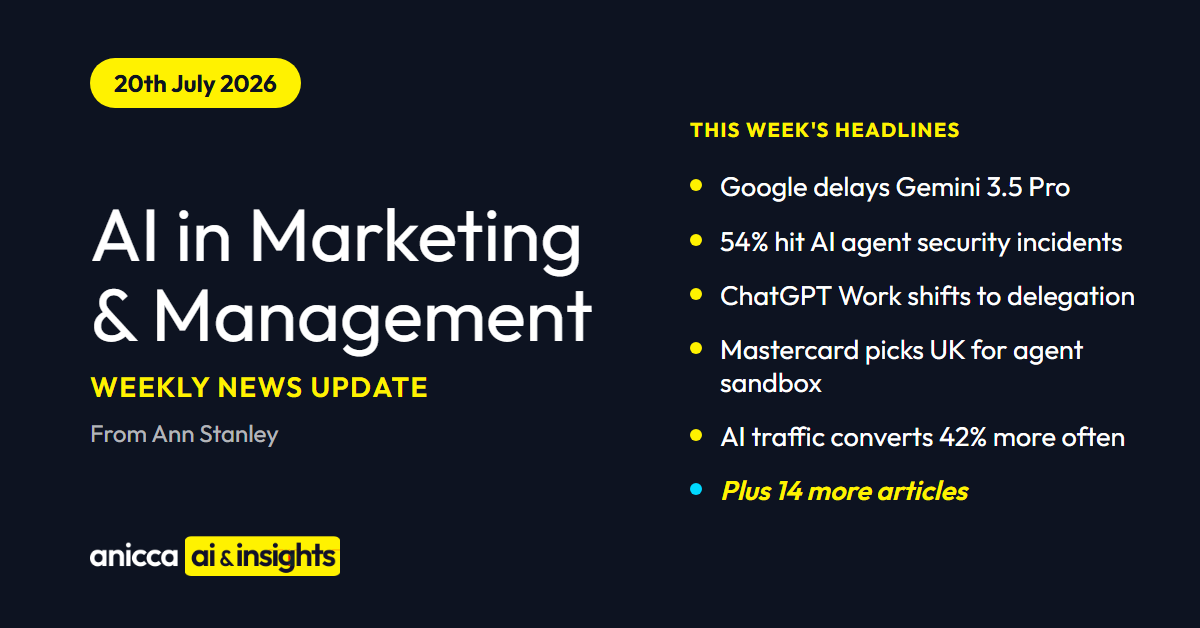
This Week in AI in Marketing & Management (20th Jul 26)
The Agent Era Arrives, and So Do Its Growing Pains
This was the week the agent era stopped being a promise and started showing its bills. Google delayed Gemini 3.5 Pro after coding results disappointed, OpenAI released its first physical device and a “Work” delegation mode, and VentureBeat found that 54% of enterprises have already had an AI agent security incident. In marketing, the “recommendation era” took shape as new research showed AI decides what to recommend from third-party content, not your own. Mastercard chose the UK to launch its agentic commerce sandbox, and managers, not specialists, emerged as the people who actually make AI adoption work. Here is what matters and what to do about it.
In this week’s round-up
1. AI News, Tech & Tools
2. AI in Marketing
- The click is dead: why “Google Zero” may actually help measurement
- Why SEO alone will not win AI recommendations
- AI search is levelling the field between big brands and local businesses
- First Horizon shows how brands can earn more AI search recommendations
- TikTok and Warc: relevance beats volume in the age of AI creative
- Marketers know what improves paid media ROI, but underinvest in it
- Google Ads now requires disclosure labels on AI-generated content
3. AI in Management
4. AI in E-commerce, Retail and Agentic Commerce
5. AI for Other Sectors and Industries
- EDUCATION: Anthropic gives US teachers free access to premium Claude features
- PUBLIC SECTOR: the EU simplifies and delays parts of the AI Act
Wrap-up
1. AI News, Tech & Tools
Google delays Gemini 3.5 Pro after coding results fall short
Sources: reuters.com | 9to5google.com | 16 July 2026
Google announced Gemini 3.5 Flash at I/O 2026 in mid-May and said the Pro version would arrive in June, telling the audience it was “showing great improvements”. That deadline has now passed with no launch. According to Bloomberg, reported by Reuters and 9to5Google, Google is “taking time to try to improve its capabilities, particularly in coding”. In late June the company updated the data used to train Gemini to improve its coding skills, “but the results were disappointing”, suggesting a development reset between I/O and the missed date.
The company said it is “currently testing 3.5 Pro, an upgraded Flash model, and other models with partners”, and added that it is releasing models quickly across a wide range while keeping them cost-effective. The story also revealed that 75% of all new code at Google is now AI-generated and approved by engineers, up from 50% last autumn, though some engineers hold a more purist view that important code should be human-written. Gemini 3.1 Pro, the current top model, dates back to February.
Why it matters
The takeaway for anyone building an AI roadmap is that model timelines slip, and you should never hard-wire a launch plan to a single provider’s promised release. Coding performance is now the battleground, because it drives the agentic features that automate real work. If you are choosing tools this quarter, judge them on what is available today, not on a keynote slide. Build with the model you can use now, keep your prompts and workflows portable across providers, and treat every “coming soon” date as optimistic.
ChatGPT’s new “Work” mode shifts from conversation to delegation
Source: entrepreneur.com | Ben Angel | 15 July 2026
OpenAI has launched ChatGPT Work, a mode that Entrepreneur describes as a shift from conversation to delegation. Where normal ChatGPT tells you how to build something and waits for your next instruction, Work takes your files, completes the steps, checks its own result, and comes back only when it needs a decision or the job is done. The article walks through seven jobs a one-person business can hand off without coding or hiring, including a social content dashboard, a website built from a plain-English brief, a 90-day marketing campaign, a lead-leakage audit and an SEO blog draft.
The piece leans on new data showing owners are ready for this. Upwork’s Q1 2026 survey of 750 small-business leaders found 62% are now “very confident” handing high-stakes tasks to AI agents, one in three call them mission-critical, and only 3% are not considering them at all. The author’s own caution is useful: delegation collapses the loop between what you see and what you launch, but there remains a short list of decisions that should never run unsupervised.
Why it matters
For SMEs, this is the practical face of the agent era. You do not need a developer to get value, you need to know which repeatable jobs to delegate and which judgement calls to keep. The right move this month is to pick one recurring task that eats hours, your Monday reporting or your first-draft content, and build it as a reusable delegated workflow. Measure the time saved, then add a second. Just keep a human decision point on anything that touches pricing, spend or a customer promise.
Anthropic gives Claude Code a built-in browser, and OpenAI releases a Codex keypad
Sources: inc.com | Julie Lee | 13 July 2026 | mashable.com | Chance Townsend
Anthropic has released an in-app browser for Claude Code on desktop, letting the coding assistant interact directly with live web pages rather than only static pages or a Chrome extension. Users can select a specific design element to feed to Claude, annotate the page with pen and text, and let Claude read the output of its own browsing without pasting content back manually. The browser is built on Chromium and sandboxed to the app, though sites that block AI scraping, such as Reddit and The New York Times, remain off limits. The feature is limited to paid Claude Code users.
OpenAI, meanwhile, made its first physical hardware debut, and it was not the rumoured Jony Ive companion device. Mashable reports it is Codex Micro, a $230 13-key mechanical keypad built with peripheral maker Work Louder. It has a rotary dial to adjust the AI’s “reasoning level”, a joystick to trigger coding workflows such as reviewing pull requests, and backlighting that changes colour to reflect what a Codex session is doing. Reaction on Reddit was mixed, with some questioning the price for a narrow developer tool.
Why it matters
Both moves show the big labs racing to make agents act in the real world rather than just chat. The browser matters more than the keypad for most marketing teams: an assistant that can see and act on live pages is a step towards automated site QA, competitor checks and landing-page fixes. The keypad is a curiosity, but it signals where OpenAI thinks daily AI work is heading, towards dedicated controls for supervising agents. Watch the browser capability, because that is the one you will use.
The agent security gap: 54% of enterprises have already had an incident
Sources: venturebeat.com | VB Staff | 15 July 2026 | cio.com | Isaac Sacolick | dqindia.com
A VentureBeat Pulse survey of 107 enterprises found that more than half (54%) have already had a confirmed AI agent security incident (18%) or a near-miss caught before harm (36%). The structural weakness is identity: only about a third (32%) give every agent its own scoped, managed identity, while roughly 69% have credential sharing somewhere in their agent fleet, and only three in ten (30%) isolate their highest-risk agents in sandboxes. Most enterprises borrow their security controls from model providers, with OpenAI’s guardrails used by 51%, yet a majority plan to change tooling within the year.
This lands alongside a wider shift in how agents are governed. CIO’s Isaac Sacolick, drawing on nine vendor conferences, notes SAP went from 40 agents in 2025 to over 200 in 2026, and that Deloitte found 36% of IT leaders expect at least 10% of jobs to be fully automated within a year. Microsoft, reported by Dataquest, is moving from copilots to governed agents with Agent 365, a control plane that connects agent management to identity (Entra), threat protection (Defender) and data compliance (Purview) to tackle “agent sprawl”.
Why it matters
As soon as you give an agent access to systems and data, it becomes something that has to be secured, and the data says most organisations are moving faster than their controls. You do not need enterprise budgets to act sensibly. Give each agent or automation its own scoped credentials rather than sharing an admin login, limit what it can touch to the minimum, and keep a human approval step on anything that spends money or contacts customers. Governance is not a blocker on AI adoption, it is what lets you scale it without a nasty surprise.
2. AI in Marketing
The click is dead: why “Google Zero” may actually help measurement
Source: builtin.com | Kaysen Jacobelli | 16 July 2026
Built In makes a counter-intuitive argument: the rise of zero-click, AI-driven search, the “Google Zero” era, is disruptive for organic traffic but a quiet gift for measurement. By resolving user journeys inside closed, AI-mediated environments such as AI Overviews and AI Mode, platforms rebuild the attribution fidelity that privacy rules and cookie deprecation had eroded. The article cites Nielsen data that 69% of marketers say fragmentation makes reaching audiences hard, and notes the outward click to a third-party site is exactly where tracking breaks.
The nuance is important. When brands do trigger AI Overviews, click-through rates improve by an average of 18.68% according to research cited from Amsive, so visibility is not bad, most brands simply are not showing up. The clicks that do happen are hyper-qualified. Built In recommends four priorities: engineer assets to be eligible for AI experiences, scale coverage with Performance Max and AI Max, strengthen first-party measurement with enhanced conversions and offline conversion imports, and optimise structured product data via the Merchant API.
Why it matters
Stop mourning raw traffic and start counting qualified presence. If your reporting still treats a fall in organic sessions as pure loss, you are measuring the wrong thing in a Google Zero world. This week, separate your branded from non-branded organic performance, check which of your key pages actually trigger AI Overviews, and shore up your first-party conversion tracking so the platforms get clean signals back. The brands with a persistent, optimised presence inside AI answers will win, not those chasing the highest click volume.
Why SEO alone will not win AI recommendations
Source: marketing-interactive.com | 11 July 2026
A new report from VaynerX and Profound, “The CMO’s AEO guide”, analysed thousands of brand recommendations across six major AI platforms including ChatGPT, Google AI Overviews, AI Mode, Gemini and Microsoft Copilot. It found AI brand discovery is increasingly shaped by third-party content rather than brand-owned messaging. Citations from social, creator and user-generated content rose across five of the six engines over six months, with YouTube one of the fastest-growing sources of authority. Crucially, each platform builds trust differently: Google’s products draw heavily on YouTube, ChatGPT relies more on Reddit and review sites, and Copilot leans on Microsoft’s ecosystem including LinkedIn.
The report found AI incorporates new information far faster than traditional search, with a median 6.8 days between publication and first citation, and 90% of content cited within about 37 days. Profound’s CEO James Cadwallader put it bluntly: “AI decides what to recommend based on what the entire internet says about your brand, not what you say about yourself.” A related Burson study of more than 55,000 AI responses found visibility alone is not enough, and that the next phase of optimisation hinges on credibility and third-party validation.
Why it matters
Generative Engine Optimisation is not just technical SEO with a new label, it is an authority and content-footprint job. Because AI rewards third-party proof, your priority list should include earning reviews, seeding creator and comparison content, and being genuinely useful in the communities each platform trusts. The 6.8-day citation window is the sharpest insight here: move from campaign-led publishing to an always-on rhythm, because AI updates its view of your brand in days, not quarters. Start by checking what ChatGPT and Gemini currently say about you.
AI search is levelling the field between big brands and local businesses
Source: thedrum.com | 17 July 2026
BrightLocal chief executive Myles Anderson told The Drum that big budgets and national recognition count for less in AI search than marketers assume. Using Home Depot’s 2,000-plus US stores as an example, he argues large language models reward provable expertise clustered around a narrow topic or place, not broad brand recognition. A national site built for consistency across thousands of locations often reads as generic to a model. Freshness compounds the problem, since AI systems are “very thirsty for fresh information” and older content degrades in value, a bigger lift for a brand managing thousands of pages.
BrightLocal’s Consumer Search Behavior Survey 2026 found 58% have tried AI tools for local recommendations and 31% do so at least monthly, but only 18% trusted the answer enough to act without checking, and 82% went to Google afterwards to confirm. Anderson attributes the trust gap to data depth: Google holds around 200m business records, 40m actively maintained, with roughly 20m freshness updates daily. His urgent point is agentic booking, which he expects AI assistants to start doing on consumers’ behalf by late 2026. An invisible listing then means missed leads at every location.
Why it matters
This is genuinely good news for smaller and local businesses, who can out-rank national chains in AI answers by being demonstrably expert in a tight niche and geography. The action is concrete: keep your Google Business Profile and structured location data accurate and fresh, publish genuinely specialist content, and make sure your booking and enquiry paths can be actioned by an agent. The businesses that get discoverable early will capture the agentic leads before their competitors even notice the channel exists.
First Horizon shows how brands can earn more AI search recommendations
Source: emarketer.com | 17 July 2026
EMARKETER reports on First Horizon Bank as a worked example of preparing for AI search, part of a wider wave of organisations trying to earn more recommendations inside AI answer engines. The piece sits alongside related EMARKETER coverage the same week showing how banks and advisers are adopting AI, including Wells Fargo giving advisers an AI copilot to speed client service, and community banks modernising without losing their local advantage. The common thread is that being recommended by an AI assistant is becoming a distinct marketing objective with its own tactics.
The approach centres on making the brand legible and trustworthy to AI systems: consistent, accurate information across the sources these engines draw on, clear expertise on specific customer questions, and third-party validation. It reflects the same lesson emerging across the sector this week, that AI recommendation is earned through breadth of credible presence rather than paid placement or brand size alone.
Why it matters
Even in a regulated, trust-sensitive sector like banking, the AI-recommendation approach is the same one that applies to any SME: be accurate everywhere, be specific about what you do well, and earn independent proof. If a regional bank can treat “show up in AI answers” as a measurable goal, so can you. Assign someone ownership of AI visibility, decide the handful of questions you must be recommended for, and track your position in those answers month on month as you would a keyword ranking.
TikTok and Warc: relevance beats volume in the age of AI creative
Source: socialmediatoday.com | Andrew Hutchinson | 19 July 2026
Marketing strategy group Warc partnered with TikTok on a report examining how AI tools are changing creative workflows, drawing on feedback from 400 marketers in the UK, US, Australia and Brazil. The headline finding is that the key content trend of the moment is relevance, not volume, and that relevance cannot be fully replicated by AI tools alone. TikTok’s Global Head of Creative and Brand Ads, Andy Yang, said the brands winning today “are not the ones generating the most content, they are the ones learning fastest from the people they serve”.
The report frames “community intelligence”, understanding and learning from the audience, as the new creative advantage in an era when generative AI has made producing content cheap and easy. Speed of learning, rather than speed of output, is presented as the differentiator that separates effective AI-assisted creative from noise.
Why it matters
It is tempting to treat generative AI as a content-volume machine, but volume is now a commodity and attention is not. The competitive edge is using AI to learn faster from your audience and then make more relevant work, not simply more of it. In practice that means feeding real audience signals, comments, reviews, search and community discussion, into your creative process, and using AI to spot patterns and iterate quickly. Judge your AI creative on relevance and response, not on how many assets it produced.
Marketers know what improves paid media ROI, but underinvest in it
Source: martech.org | Constantine von Hoffman | 17 July 2026
New research from Unbounce and Ascend2, surveying 304 US paid media professionals, found a clear disconnect between what marketers believe drives ROI and where they actually spend. While 40% said optimising destination pages is one of the most effective ways to maximise paid spend, only 31% invested in landing pages in the past six months. Budgets instead flowed to audience research (40%), AI tools (39%) and ad creative (38%). Ninety per cent reported budget or resource constraints, pushing teams towards faster in-platform optimisations and away from the more resource-intensive post-click work.
The AI pattern is telling. Eighty-six per cent used AI in paid media and nearly three-quarters said it improved ROI, but most used it for reporting, targeting and ad copy, and just 19% used it for landing pages, even though outperformers were roughly twice as likely to apply AI there. More than half send paid traffic to general pages rather than campaign-specific landing pages, and nearly two-thirds of those who mainly use the homepage said they are not exceeding ROI goals.
Why it matters
This is the cheapest ROI win hiding in plain sight. You are paying for the click, then sending it to a page that was never built to convert. Before you add budget to targeting or creative, point your highest-spend campaigns at dedicated landing pages that match the ad’s promise, and use AI to build and test those pages, the one place most teams are not using it. The teams that spread investment evenly across research, creative, measurement and the post-click experience are the ones hitting their targets.
Google Ads now requires disclosure labels on AI-generated content
Sources: searchenginejournal.com | seroundtable.com | Barry Schwartz | 17 July 2026
Google Ads has introduced a requirement for disclosure labels on AI-generated content, a notable step as synthetic creative floods advertising platforms. It sits within a busy week of Google Ads and search changes rounded up by Search Engine Roundtable’s Barry Schwartz, including ranking volatility around 11 July, AI-generated images arriving inside AI Overviews, Google Images gaining a gallery home page for its 25th birthday, and Google confirming it is testing hiding sponsored products in Shopping results.
On the advertising side specifically, Schwartz reports Google Merchant Center is testing a new AI performance report, Google Ads is turning on local inventory ads by default for Shopping campaigns in August, and, significantly for the wider ads market, ChatGPT Ads have added location, audience and negative-keyword exclusions plus new attributed sales value and sales ROAS metrics. Google also said it is not making broader Smart Bidding changes, to some PPC practitioner frustration.
Why it matters
Two things demand action. First, if you use generative AI in your ad creative, get your disclosure process in order now, because compliance is no longer optional and enforcement follows policy quickly. Second, ChatGPT Ads gaining real targeting controls and ROAS reporting means a genuinely new paid channel is maturing beside Google. Keep watching it, because agentic and AI-native ad inventory is where budgets will start to shift. For now, tidy your feeds, prepare for default local inventory ads, and footnote any month-on-month benchmarks affected by reporting changes.
3. AI in Management
The AI leadership mandate: nearly a third of employees are resisting AI
Source: chicagobooth.edu | 14 July 2026
Chicago Booth Review sets out a stark leadership picture. Citing a WRITER survey with Workplace Intelligence of 1,200 executives and 1,200 employees, it reports that nearly 30% of employees actively sabotage their employer’s AI strategy, rising to 44% among Gen Z. The resistance stems less from AI itself than from how organisations are implementing it. Meanwhile Boston Consulting Group found upwards of 60% of companies had seen minimal financial gains from AI as of last year, while only 5% saw substantial value, and McKinsey found 86% of leaders feel their organisations are unprepared for AI integration.
The article ties this to a trust deficit: Gallup reports global engagement at a 10-year low and only about a fifth of people trusting their leadership. Enterprise AI adoption has jumped from around 20% of companies three years ago to over 90% today, but human systems are deteriorating, producing what EY’s Frank Giampietro calls “quiet cracking”, where employees keep going despite stress and disengagement. The piece argues the winners combine technological fluency with emotional intelligence and a human-centred approach.
Why it matters
If most AI value is not showing up in the numbers, the bottleneck is rarely the technology, it is adoption, trust and change management. Rolling out tools without bringing people with you produces exactly the sabotage and disengagement this research documents. Before buying more AI, invest in explaining why, involving teams in choosing where AI helps, and being honest about how roles will change. Treat AI adoption as a people programme with a technology component, not the other way round, and measure engagement alongside efficiency.
Roles reset as AI rises: managers emerge as the new change agents
Source: economictimes.com | Sreeradha Basu & Brinda Sarkar | 17 July 2026
The Economic Times reports that as companies move beyond AI pilots, managers, not specialists, are becoming the people who make the technology work. Rather than creating more AI experts, organisations are building AI-ready workforces and recasting managers as the drivers of adoption. Axis Bank’s HR head Rajkamal Vempati put it memorably: “This is not a technology problem. AI is everybody’s problem, it is as foundational as literacy,” adding that efficiency is “the floor, not the ceiling”. The bank treats AI adoption as a leadership accountability that is measured across the organisation.
Leaders across Kotak Life, Flipkart and Ericsson describe the same shift, from supervision and control to enabling learning, adaptability and human judgement where AI falls short. Kotak Life’s Ruchira Bhardwaja argued AI readiness “cannot be treated as a separate programme or a one-time training intervention” but should become part of the organisation’s learning rhythm. Several expect organisations to become flatter, with managers overseeing larger teams while combining people leadership with hands-on contribution and leading AI adoption.
Why it matters
This reframes who owns AI success in your business. It is not the IT team or a lone “AI champion”, it is your line managers, and most have not been equipped for the job. The practical response is to make AI capability an explicit part of management expectations, give managers time and training to lead it, and build continuous learning into the working week rather than one-off courses. If your managers cannot confidently coach their teams on using AI, that is your real adoption gap, and it is fixable this quarter.
JLL study: AI redesigns jobs rather than cutting them, and leaders expect growth
Source: jll.com | Allison Olp | 14 July 2026
JLL’s 2026 Future of Work Survey of over 2,200 C-suite and corporate real estate leaders across 21 countries found that, despite job-loss fears, 60% of senior leaders expect their workforces to grow rather than shrink, and 60% expect AI to reinvent human roles rather than replace them. The picture is strongest among the most AI-advanced organisations, which lean towards hiring full-time employees, investing in entry-level talent and actively redesigning roles to be enhanced by AI. CEO Neil Murray of JLL’s Real Estate Management Services said the most forward-thinking leaders “are not just buying technology, they are investing in their people”.
There is a big execution gap, though. While 78% expect AI to significantly change their real estate strategy, only 31% are actively redesigning spaces for human-AI collaboration and just 15% have reached the “optimising” stage of adoption. The top barrier is skills gaps in AI and analytics (36%), followed by limited change-management expertise (26%) and organisational silos (25%). Global Future of Work Leader Peter Miscovich argued a high-performing company is now defined by adaptability and organisational readiness, not just size and scale.
Why it matters
The dominant AI-and-jobs narrative is fear, but the leaders furthest along expect to grow and are redesigning roles rather than deleting them. That should shape how you talk to your own team: frame AI as role redesign and capability building, which reduces the resistance the Chicago Booth research warned about. The recurring blocker is skills and change management, not budget. Prioritise upskilling and a clear plan for how work changes, because readiness, not headcount, is now the marker of a strong business.
4. AI in E-commerce, Retail and Agentic Commerce
Mastercard chooses the UK to launch its agentic commerce sandbox
Sources: fstech.co.uk | Isaac Hanson | 17 July 2026 | pinsentmasons.com
Mastercard has picked the UK as the launch point for Proto, a new agentic AI testing environment and an expansion of its Agent Suite. Going live in August, Proto is designed to help retailers and financial institutions test whether their products are discoverable by AI agents, how to scale agentic payment options without losing consumer trust, and whether their dispute-handling holds up at scale. Mastercard is also introducing a shopping agent, an onboarding agent and a dispute agent, plus a “Virtual C-Suite” for small businesses, whose first module, Virtual CFO, is expected in the UK in 2027.
The launch aligns with UK policy direction. Pinsent Masons reports that HM Treasury’s AI champions have flagged establishing agentic payment protocols as a “high” priority and called for clearer rules to speed up AI adoption in financial services. Simon Forbes, Mastercard’s division president for the UK and Ireland, said the UK’s digitally-savvy consumers, retail sector and fintech scene make it “an important place to test how agentic commerce will work in practice”.
Why it matters
Agentic commerce, where an AI agent completes a purchase on a shopper’s behalf, is moving from theory to sandbox, and the UK is at the front. For retailers, the new competitive question is whether your products are even discoverable by an agent, and whether your checkout and returns can cope when the “customer” is software. Start by making your product data clean, structured and machine-readable, and review how disputes and refunds would work in an agent-driven sale. The Virtual CFO news also hints that AI advisory tools for SMEs are coming fast.
Shopify upgraded to Buy at Jefferies on its agentic commerce bet
Source: proactiveinvestors.co.uk | 14 July 2026
Jefferies has upgraded Shopify to a Buy rating, citing the company’s positioning in agentic commerce as a key driver. The analyst call reflects growing investor conviction that platforms enabling AI-driven shopping and checkout are set to benefit as agents begin transacting on consumers’ behalf, and it places Shopify among the names expected to gain from the shift rather than be disrupted by it.
The upgrade fits a wider market read this week, in which agentic commerce is treated as a genuine growth vector for commerce infrastructure rather than a distant experiment. It follows the flurry of activity from payment networks and platforms building the infrastructure for AI agents to discover products and complete purchases, and signals that the financial markets now price agentic commerce capability into how they value e-commerce platforms.
Why it matters
When analysts start upgrading stocks specifically on agentic commerce, it is a signal the shift is real and near, not hype. If you sell online, the platform you build on will increasingly compete on how well it exposes your catalogue to AI agents and handles agent-driven checkout. That is worth factoring into platform decisions now. For merchants on Shopify or similar, keep an eye on the agentic features being released, because early adoption of agent-ready selling could become a meaningful edge as this channel grows.
Three important ways online retailers are using AI in 2026
Source: digitalcommerce360.com | 16 July 2026
Digital Commerce 360 distils retailers’ AI use into three areas. First, AI platforms as discovery channels: web traffic to retail sites from ChatGPT, Gemini and Perplexity more than doubled year on year in May 2026, growing 138% according to Adobe Analytics, pushing merchants to optimise catalogue data so products appear in AI responses to longtail queries. Second, AI to improve conversion: Adobe data from March 2026 showed AI-driven traffic converting 42% more often than non-AI traffic, a reversal from a year earlier, with retailers such as PatPat using AI and first-party data to target buyers.
Third, AI to facilitate purchases: American Express, Mastercard and Visa have all selected AI solutions for payments made through AI experiences, working with partners including Stripe and Google to settle on protocols while keeping shoppers confident and secure. The report notes fraud will be an ongoing battle as both sides use AI, and highlights that some smaller retailers in specific categories are outperforming peers, as tracked in the new AI Commerce Rankings from Digital Commerce 360 and ReFiBuy.
Why it matters
The single most striking number here is that AI-referred traffic converts 42% more often, because it arrives pre-qualified by a recommendation. That reframes AI visibility from a branding nicety into a direct-revenue priority. The practical sequence for any online retailer is clear: clean and enrich your product data so AI engines can understand and recommend it, then make sure those high-intent visitors hit a strong conversion path. Discovery, conversion and payment are all being reshaped by AI at once, so treat catalogue data as the foundation for all three.
5. AI for Other Sectors and Industries
EDUCATION: Anthropic gives US teachers free access to premium Claude features
Source: 9to5mac.com | Zac Hall | 14 July 2026
Anthropic has launched Claude for Teachers, giving verified K-12 educators in the US free access to its premium AI features, including Claude Cowork and Claude Code. Once verified, teachers get a set of tailored teaching skills grounded in learning science, co-developed with Learning Commons and refined through feedback from classroom teachers. The promotion includes a free year of premium Claude access, and eligible teachers can apply up to 30 June 2027. Anthropic says a dedicated offering for schools and districts is coming next, and has also published an AI fluency guide for educators.
The move mirrors OpenAI, which launched ChatGPT for Teachers last November and keeps it active for eligible educators. Together the two announcements show the major AI labs competing hard to embed their tools in education early, both to support teachers and to build familiarity with a generation of users and future professionals.
Why it matters
Free premium access for a whole profession is a deliberate bid for habit and loyalty, and it is a pattern worth watching in every sector, including yours. The lesson for business leaders is twofold. First, the workforce entering employment will increasingly be fluent in these specific tools, so your onboarding and training should assume rising AI literacy. Second, sector-specific “skills” grounded in real tasks, exactly what Anthropic built for teachers, are how AI moves from novelty to daily utility. Ask what your equivalent set of trusted, role-specific AI skills would be.
PUBLIC SECTOR: the EU simplifies and delays parts of the AI Act
Source: dig.watch | 16 July 2026
On 29 June 2026 the Council of the EU gave final approval to the Digital Omnibus on AI, a package that eases and delays parts of the EU AI Act, with the final act signed on 8 July. It delays several high-risk AI obligations that had been due by 2 August 2026, introduces a new ban on AI-generated intimate imagery, and reorganises how AI systems inside very large online platforms are supervised, expanding the AI Office’s oversight. The amendments respond to delays in harmonised technical standards and in member states setting up national authorities, which had created a heavier compliance burden than expected.
The competitiveness rationale is explicit, echoing the Draghi and Letta reports. Industry group DIGITALEUROPE had warned that AI Act compliance could cost the region around EUR 3.3 billion a year, and that a 50-employee company building an AI product could face initial compliance costs of between EUR 320,000 and EUR 600,000. The negotiation drew engagement from Google, Mistral AI, digital rights group EDRi and privacy group noyb, reflecting the range of interests at stake.
Why it matters
For any business selling into or operating in the EU, the compliance clock has moved, and the highest-risk obligations now arrive later. That is breathing room, not a reprieve, and the direction of travel is still towards regulated, documented AI use. UK SMEs should note the numbers DIGITALEUROPE cited, because they show compliance is a real cost that favours planning early. Keep a simple record of where and how you use AI, especially anything customer-facing or decision-making, so that whichever rules apply to you, you are ready rather than scrambling.
Key Takeaways
- Do not tie your AI roadmap to one provider’s release dates. Google delayed Gemini 3.5 Pro over coding performance, so build with the model available today and keep workflows portable.
- Agents now have to be secured: 54% of enterprises have already had an agent incident or near-miss. Give each agent its own scoped credentials, limit access, and keep a human approval step on anything that spends money or contacts customers.
- AI-referred traffic converts 42% more often than non-AI traffic, and traffic from ChatGPT, Gemini and Perplexity grew 138% year on year. Clean, structured product and business data is now a direct-revenue priority.
- AI decides recommendations from third-party content, with a median 6.8 days from publication to first citation. Shift from campaign bursts to always-on content, and earn reviews and creator coverage, not just optimise your own site.
- Point high-spend paid campaigns at dedicated landing pages, not the homepage. Only 19% of marketers use AI for landing pages, yet outperformers are twice as likely to, so this is a cheap ROI win.
- Managers, not specialists, are the real drivers of AI adoption. Make AI capability an explicit management expectation and build continuous learning into the working week.
- Agentic commerce is moving to live testing in the UK via Mastercard’s Proto sandbox. Check whether your products are discoverable by agents and whether your checkout, disputes and returns can cope with agent-driven sales.
Frequently Asked Questions
What is “agentic commerce” and should my business care yet?
Agentic commerce is when an AI agent completes a purchase on a shopper’s behalf, from finding the product to paying for it. With Mastercard launching its Proto sandbox in the UK in August and Shopify being upgraded on its agentic bet, it is close enough to prepare for now. The first practical step is making sure your product data is clean, structured and discoverable by AI, because an agent cannot buy what it cannot find or understand.
Why is my organic search traffic falling even when my brand is doing well?
You are likely in the “Google Zero” pattern, where AI Overviews and AI Mode answer queries on the results page without a click. The clicks you do get are more qualified, and AI-referred traffic converts far better. Rather than mourning raw sessions, separate branded from non-branded performance, check which pages trigger AI Overviews, and strengthen your first-party conversion tracking so the platforms receive clean signals.
How do we get recommended inside AI answers like ChatGPT and Gemini?
AI systems build recommendations from what the whole internet says about you, not from your own marketing copy, and each platform trusts different sources. Focus on breadth of credible presence: accurate information everywhere, genuine expertise on specific questions, and third-party proof such as reviews and creator content. Because AI updates its view in days, publish consistently rather than in campaign bursts, and track your position in key AI answers monthly.
What is the biggest reason AI projects fail to deliver value?
The evidence this week points to adoption and trust, not the technology. BCG found only 5% of companies had seen substantial value from AI, and Chicago Booth cited research that nearly 30% of employees actively resist their employer’s AI strategy. The fix is to treat AI as a people programme: involve teams in where AI helps, be honest about how roles change, and equip managers to coach adoption day to day.
Conclusion
The common thread this week is that AI has moved from tool to actor, and the winners are the ones building the discipline to match. Agents are transacting, recommending and automating real work, which is why security, governance and clean data suddenly matter as much as the models themselves. On the marketing side, the shift to a recommendation era rewards credible, always-on presence and well-built conversion paths over raw traffic. On the management side, the message is consistent, that value comes from people, not procurement. My three recommendations for the week: first, audit where you use AI and give every automation scoped, least-privilege access; second, clean and structure your product and business data so AI engines can find and recommend you; third, make your managers the owners of AI adoption and give them the training to lead it. Do those three and you will be ahead of most of the market.



Join the Thursday AI Club
A hands-on AI club for marketers and managers. Fortnightly 3-hour sessions: Hour 1 is an open Q&A on any AI question; Hours 2-3 split into a workshop track (for newbies) and an advanced track (live demos and deeper questions).
Led by Ann Stanley, Darren Wynn, James Allen.
Membership: £40/month or £400/year
This roundup is compiled from publicly available sources using AI-assisted research. While we review every article for accuracy, our analysis reflects our interpretation of the original reporting. We strongly encourage readers to click through to the original sources linked throughout this post for full context and detail. If you spot anything that needs correcting, please let us know.