This Week in AI in Marketing & Management (9th Nov 26)
AI Stocks Tumble After Democrats Sweep the US Midterms, and the Sell-off Reaches London
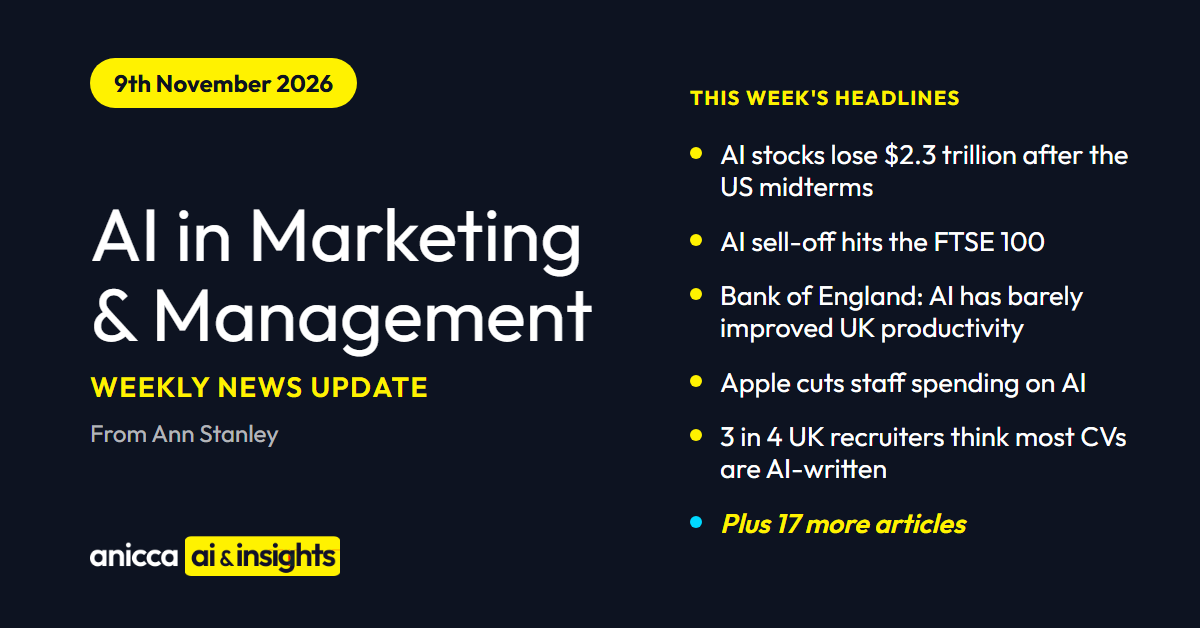
Last week the US midterm elections hit AI stocks hard. Democrats took control of both houses of Congress, helped by strong opposition to new data centres, and on Thursday the Nasdaq 100 fell 6.3%, wiping $2.3 trillion off its value. On Friday the sell-off reached London, where the FTSE 100 fell as much as 2.4% and ended the week lower, with BT the worst performer. Apple, Accenture and Revolut are all cutting what their staff spend on AI, even as OpenAI halved its GPT-6 prices. In the UK, the Bank of England raised interest rates to 4% and found AI has barely improved productivity, three in four recruiters now believe most CVs are written by AI, and Adobe forecasts a record £28.5bn Christmas online, with traffic from AI assistants up 214%.
Table of Contents
- Democrats sweep the US midterms and $2.3 trillion is wiped off AI stocks in a day
- The AI sell-off reaches London and the FTSE 100 ends the week lower
- OpenAI launches GPT-6 Sol and Luna with 50% price cuts
- Gemini Omni 1.2 Flash: 15-second video and 30% price cut
- Claude adds Personal Finance tool with Plaid bank connectivity
- Microsoft brings Claude in Copilot inside the EU Data Boundary
- Brand mentions and AI memory, not backlinks, decide which brands AI recommends
- Google AI Mode now showing up to four ads per query
- Google AI Mode now books home services directly
- ChatGPT ads skew to research prompts in beauty, travel and toys
- Google Ads will extend the Performance Max channel report to Search and Shopping in 2027
- CIPD Annual Conference 2026: AI, talent and workforce transformation
- KPMG CEO Outlook: AI is a skills challenge, not just a tech one
- Apple cuts staff AI budgets as employers rein in AI costs
- Fearing AI disruption, white-collar workers are quitting their jobs
- AI speeds up UK recruitment, but three in four recruiters now distrust CVs
AI in E-commerce, Retail and Agentic Commerce
- Amazon’s Alexa for Shopping goes conversational via SMS
- UK Christmas online spending to hit record £28.5bn as AI referrals surge 214%
- Lidl is growing fast on the UK high street, but can it keep shoppers in the age of AI agents?
AI for Other Sectors and Industries
- FINANCE: Bank of England raises rates to 4% and finds AI has barely improved UK productivity
- HEALTHCARE: NHS trials an AI phone assistant to carry out patient check-ups
- EDUCATION: Google will turn off Search for pupils at schools that keep its AI switched off
AI News, Tech & Tools
Democrats sweep the US midterms and $2.3 trillion is wiped off AI stocks in a day
Sources: theguardian.com | nbcnews.com | bbc.co.uk | bloomberg.com | bloomberg.com | ft.com
Wall Street first welcomed the result. On Wednesday 4 November, the day after the vote, US stocks had their best day since August, according to the Financial Times, as investors were relieved that the result was quick and clear. The mood changed on Thursday. The Nasdaq 100 fell 6.3%, wiping $2.3 trillion off its value, and the S&P 500 fell 4.4%, both their worst days since President Trump’s tariff announcements in April 2025. The broader Nasdaq Composite fell 5.5% into “correction territory”, more than 10% below its record. Chip and storage companies were hit hardest: SanDisk fell 22%, Western Digital 17% and Nvidia 9.2%, while Wall Street’s “fear index” jumped 61%. On Friday Japan’s Nikkei fell 6% and South Korea’s Kospi dropped 8% at the open, triggering a temporary trading halt.
The trigger was the scale of the Democratic victory. The party now controls both houses of Congress, and NBC News reports that hundreds of newly elected candidates pledged to rein in AI data centres, including Texas governor-elect Gina Hinojosa, who campaigned for a moratorium in the largest data centre market in the US. The BBC points to a Gallup poll showing 71% of Americans would oppose a data centre in their community, more than oppose a nuclear power station. Bloomberg reports that candidates backing stricter AI oversight did well, helped by Public First, a group part-funded by Anthropic co-founder Dario Amodei, which put more than $63 million into the campaign. Prices recovered a little on Friday, but the S&P 500 still ended the week 2.7% lower, its biggest weekly fall since April 2025. Ed Yardeni of Yardeni Research described it as “an AI bubble losing some air very, very rapidly” rather than one bursting.
Why it matters
This is a story about who pays for data centres and how quickly new computing power gets built. President Trump can veto federal AI laws, so the bigger risk sits with states and local permits, where opposition is growing on both sides of politics. Slower building and tighter rules would keep AI costs higher for longer, and the big AI firms are already under pressure to show investors more revenue, through more ads in AI answers, higher subscription prices and usage limits. Do not build 2027 marketing budgets on the assumption that AI tools only get cheaper. Keep contracts short and keep some budget flexible.
The AI sell-off reaches London and the FTSE 100 ends the week lower
Sources: Reuters via finance.yahoo.com | telegraph.co.uk | ii.co.uk | businesscloud.co.uk | theguardian.com
London first moved the other way. On Wednesday the FTSE 100 rose 1.6% to 10,807 as investors bought banks and miners, with Barclays, HSBC and Standard Chartered all higher and gold up 3% to more than $4,000 an ounce, interactive investor reports. Shares with US exposure fell: BAE Systems dropped on uncertainty over US defence spending, and Computacenter, until this week the best performer in the FTSE 100 this year, fell again on fears for the AI build-out. On Friday the US sell-off arrived. The FTSE 100 fell as much as 2.4% before closing 1% lower at 10,673.94, down 0.5% on the week, while the FTSE 250 fell 0.8% and Europe’s STOXX 600 fell 1%. BT was the biggest faller, down 6.4%, with The Telegraph reporting concerns that its cost-saving programme could be undermined, and AstraZeneca and GSK also fell as investors questioned how much they will gain from AI in drug discovery.
“While London’s stock market is relatively light on technology and AI-adjacent companies, if institutional investors are swept up in a risk-off sentiment reversal, it’s unlikely to escape unscathed,” said Jason Hollands of Bestinvest. He pointed to Data Center Watch figures showing 45 US data centre projects across 27 states, worth about $68 billion, were blocked or delayed in the second quarter alone. The Telegraph reports the sell-off has also hit Anthropic’s planned stock-market listing, which had been aiming for a value of around $1.5 trillion, with some major investors now seeing about $1 trillion as more realistic. The UK data centre push continues, however. On Tuesday Drax agreed a deal with Brookfield and Radiant to build a data centre of more than one gigawatt at its North Yorkshire power station site, which it says could attract more than £20bn of investment, and its shares rose almost 9%. Andy Burnham said investment in AI would remain a priority for the Government.
Why it matters
For most UK businesses the direct effect is small, because the FTSE 100 holds few technology companies. The indirect effects matter more. Many people hold US technology shares through ISAs and workplace pensions, and Lloyds reported this week that house prices fell at the fastest annual pace in a year, so consumer confidence going into Christmas is fragile. The second effect is on the AI tools UK teams rely on. Anthropic and OpenAI are both preparing to list, and a lower valuation puts more pressure on them to grow revenue from customers. Review which AI subscriptions your business depends on, and how you would cope with a price rise or new usage limits.
OpenAI launches GPT-6 Sol and Luna with 50% price cuts
Source: openai.com | 5 November 2026
OpenAI has expanded its GPT-6 family with Sol and Luna, two cost-efficient siblings to the flagship GPT-6 Astra launched earlier in the month. Sol input pricing drops to $2 per million tokens (from $4) and output to $10 (from $20), while Luna comes in at $0.10 input and $0.50 output, both representing 50% cuts versus the GPT-5.6 promotional rates. OpenAI says Sol at xhigh effort outperforms Claude Opus 5 at max effort on AutomationBench at just 9% of the cost per task.
The models bring Astra’s advances in professional work, factuality, coding and computer use to faster inference tiers, with improved caching for agents and long conversations. OpenAI is positioning Sol and Luna as the practical workhorses for everyday enterprise automation, where cost-per-task economics increasingly dictate which workflows actually get deployed at scale.
Why it matters
The AI cost curve is now bending faster than most procurement cycles. A 50% price cut at the mid and low tiers means agentic workflows that were marginally uneconomic six months ago are now firmly in positive ROI territory. Marketing teams running content pipelines, personalisation engines, or always-on customer support bots should revisit their build-versus-wait decisions this quarter. If your business case was borderline at $4/$20 pricing, it is probably worth approving at $2/$10, and the competitive window for early movers is shrinking.
Gemini Omni 1.2 Flash: 15-second video and 30% price cut
Source: blog.google | Anish Nangia | 5 November 2026
Google has made Gemini Omni 1.2 Flash generally available across the Gemini API and Google Cloud, increasing native clip length from 10 to 15 seconds and dropping pricing 30% to $0.07 per second for 720p video. The release adds multi-turn conversational editing, so creators can refine individual details without regenerating the whole clip, and improved reference adherence to keep faces, garments, packaging typography and brand colours consistent across camera angles.
The workflow pitch is clear: draft at 360p or 720p, fix details with follow-up edits, then upscale winning clips to 1080p or 4K. Duration can be specified in one-second increments from 3 to 15 seconds, enough for a full social ad spot in a single generation. The update is available through Google Vids and Gemini for business.
Why it matters
Fifteen seconds is the social ad sweet spot, and brand consistency has been the single biggest blocker to using generative video in paid campaigns. With reference adherence improved and conversational editing eliminating costly regenerations, the unit economics of video creative testing are shifting fast. Performance teams running Meta, TikTok and YouTube campaigns should pilot Omni 1.2 for variant production, benchmarking cost per approved asset against current agency or production-house rates. The firms that industrialise this workflow in Q1 2027 will have a meaningful creative-testing advantage.
Claude adds Personal Finance tool with Plaid bank connectivity
Sources: zdnet.com | techcrunch.com | theverge.com
Anthropic has launched Personal Finance in Claude, a dedicated mode that connects to bank and credit card accounts via Plaid with read-only access. Users can ask Claude to categorise spending, flag duplicate charges, explain terms like APR, and model affordability for upcoming purchases. Access covers bank name, account type, last four digits, balances, credit limits and up to two years of transactions. Conversations inside the Personal Finance hub are not used to train models. The feature is rolling out in beta to Pro, Max and Ultra plans in the US, catching up to ChatGPT Finances which launched in May.
Anthropic emphasises that Claude cannot move, manage or invest money, and the product carries no ads or sponsored recommendations. The launch follows Anthropic’s vertical expansion with Claude for Legal and Claude for Financial Services earlier this year.
Why it matters
When two frontier labs independently build the same consumer vertical, it signals where attention and intent are migrating. Personal finance queries are a leading indicator for mortgage, insurance, investment and card advertising, categories that have historically paid Google handsomely for mid-funnel traffic. If Claude and ChatGPT absorb this consideration behaviour, financial services marketers need an AI visibility strategy before the next renewal cycle, not after. Start auditing how your brand appears in these assistants for category-defining questions.
Microsoft brings Claude in Copilot inside the EU Data Boundary
Source: microsoft.com | Charles Lamanna | 5 November 2026
Microsoft has announced that Anthropic’s Claude models in Microsoft Copilot will be processed inside its EU Data Boundary, its commitment to store and process Microsoft 365 data within the EU and the European Free Trade Association (EFTA). By the end of 2026, organisations in the EU and EFTA will be able to use Claude across Copilot, including Copilot Cowork, with their data processed in the same region where it is already stored. Until now, European customers had to choose between using Claude and keeping Microsoft’s regional data commitments.
Claude already powers Copilot Chat, Copilot in the Microsoft 365 apps, Copilot Cowork and Copilot Code. In the EU and EFTA the setting is switched off by default, and administrators can turn it on for everyone or for selected users and groups. Organisations already using Claude in Copilot do not need to do anything, because processing will move into the boundary automatically. Microsoft says customer data is not used to train the underlying AI models.
Why it matters
This removes one of the main reasons regulated businesses and public sector bodies in Europe have kept Claude switched off. Note that the announcement covers the EU and EFTA and does not mention the UK, which is in neither. UK organisations using Copilot should ask Microsoft where their Claude requests are processed before they switch it on for sensitive or client data, and should not assume the EU commitments apply to them.
AI in Marketing
Brand mentions and AI memory, not backlinks, decide which brands AI recommends
Sources: searchengineland.com | marketingdive.com | searchengineland.com
An Ahrefs study of 75,000 brands found that brand mentions across the web correlate with being cited in Google AI Overviews at 0.664, roughly three times as strongly as backlink count (0.218). Branded anchor text (0.527) and branded search volume (0.392) also beat Domain Rating (0.326) and referring domains (0.295). Separate research from GeoSurge, covering 13,281 AI-generated searches, found that when an AI model splits a question into its own web searches, it searches for brands it already remembers from training about three times as often as brands it does not (55.7% against 17.4%). If your brand is not in the model’s memory, its live web search is unlikely to find you.
Three other studies question how much traffic this visibility delivers. Marie Haynes found ChatGPT sessions were just 0.62% of Google organic visits in her sample, and The SEO Works measured organic search as 39 times larger than AI assistants. Nick LeRoy argues in Search Engine Land that the numbers are right but the expectation is wrong: AI answers shape which brands people discover and consider, but they are not a direct-response channel.
Why it matters
Together these studies point the same way. Visibility in AI answers is earned through brand reputation: press coverage, reviews, discussion on forums such as Reddit, and specific, factual content on your own site. Link building alone will not get you there. Measure GEO (generative engine optimisation, getting your brand mentioned in AI answers) as brand investment, by how often AI assistants cite and recommend you, and agree that with your board before 2027 budgets are set, rather than promising it will replace lost Google clicks.
Google AI Mode now showing up to four ads per query
Sources: seroundtable.com | ppc.land
Google is now showing up to four ads in AI Mode responses for a single query, up from the typical one to three. The move follows Google’s earnings-call commitment to show more ads more often in AI Mode, and comes alongside the planned rollout of multiturn ads on follow-up queries in the US. Google appears to be aggressively monetising AI Mode to offset weaker click monetisation in traditional search.
Combined with Adthena’s report counting roughly 175,100 paid placements inside Google AI Overviews and AI Mode across five holiday categories from June to September, and 204,489 ChatGPT ad placements over the same period, the paid landscape inside AI answers is scaling fast. PPC Land notes that in the example seen, all four advertisers, HubSpot, Yext, Siteimprove and an agency, were selling services to help brands appear in AI answers, and Google has not said how widely the four-ad layout runs.
Why it matters
Expect CPC inflation and auction dynamics to shift as AI Mode inventory expands. Existing Search, Shopping and Performance Max campaigns are already eligible to serve in AI answers with no separate opt-in, so review your negative keyword lists and brand exclusions to control where you appear. Holiday campaigns should assume meaningful share of impressions will appear inside AI answers, and creative needs to make sense in that condensed format.
Google AI Mode now books home services directly
Source: searchengineland.com | Danny Goodwin | 4 November 2026
Google AI Mode now offers direct links to book home services through Angi, Thumbtack, Housecall Pro and Jobber in the US, with ServiceTitan to follow, Google’s Robby Stein has announced. Stein described using AI Mode when a sewer line backed up at his home: it compared local prices, checked reviews and recommended plumbers based on his situation, and he then booked one who came and fixed the problem.
Google has not explained how AI Mode chooses or ranks service providers. It is also not clear whether a business has to use one of the booking partners to be recommended, or where the customer completes the booking. The feature is US-only for now.
Why it matters
For local service businesses, AI Mode is starting to act as the person who chooses the tradesperson, not just the place where people search. Price, reviews and availability decide the recommendation, and the customer may never visit your website. UK trades and local service businesses should prepare before it arrives here: keep Google Business Profile reviews, prices and opening hours up to date, and make sure the directory and booking platforms you use show the same information.
ChatGPT ads skew to research prompts in beauty, travel and toys
Source: searchenginejournal.com | Matt G. Southern | 5 November 2026
Adthena’s Holiday AI Paid Search Report counts 204,489 ChatGPT ad placements across five holiday categories from June to September 2026, with most ads in beauty, travel and toys appearing on research prompts rather than transactional ones. On Google’s AI features, apparel dominated with roughly 111,000 placements and consumer electronics with 55,000, while travel, beauty and toys trailed significantly. US AI Overview appearances rose 89% year on year, with UK/EU up 160% and Australia up 536%.
The data suggests AI ad placement is still finding its category fit. High-consideration categories like travel and beauty cluster on research prompts, while high-volume transactional categories like apparel capture more placements overall.
Why it matters
Category-specific AI ad behaviour has real implications for bid strategy and creative. If your brand sits in beauty, travel or toys, your AI exposure is concentrated in research-stage queries where intent is softer and conversion windows longer. Factor that into attribution models and creative messaging. UK and European retailers should note the 160% rise in AI Overview appearances, holiday peak will see materially more AI mediation of shopping journeys than last year.
Google Ads will extend the Performance Max channel report to Search and Shopping in 2027
Source: seroundtable.com | Barry Schwartz | 5 November 2026
Google has updated its help document on Performance Max channel definitions to say the channel breakdown will be available for standard Search and Shopping reports in 2027. At present the channel definitions only appear in the Performance Max channel report and the Demand Gen channel report. The change was first spotted by Hana Kobzová of PPC News Feed.
Kobzová also flagged a change in Google’s placement codes, which replace the old general ‘x’ code with specific codes such as ‘m’ for Maps, ‘gm’ for Gmail and ‘dsc’ for Discover. Advertisers who use these codes in GA4, CRM systems or other analytics tools need to update their filters, or traffic may be wrongly labelled.
Why it matters
Advertisers have long asked to see where Search and Shopping ads actually appear, including inside AI Overviews and AI Mode, and this is a step towards that. The practical job is more urgent than the 2027 date suggests: check now whether your reports, GA4 filters or CRM rules depend on the old ‘x’ placement code, so that traffic from Maps, Gmail and Discover is labelled correctly.
AI in Management
CIPD Annual Conference 2026: AI, talent and workforce transformation
Sources: peoplemanagement.co.uk (day one) | peoplemanagement.co.uk (day two)
The CIPD conference in Manchester highlighted a consistent message on AI adoption: technology alone will not deliver change. Paula Allerton, head of apprenticeships at HMRC, warned that automating entry-level tasks risks “automating the development” that gives junior staff career foundations. Graeme Burns, former AI people lead at Nationwide, said assessing proposals against organisational purpose eliminated 50% of potential use cases, cautioning against AI adoption as a “one off” initiative.
James Faulconbridge, professor of management at Lancaster University, pressed for a culture of continuous learning so organisations can “adapt and adopt” as the technology evolves. Combined with employment-rights reforms described by Hannah Ball of Howes Percival as the biggest she has seen in 17 years, HR leaders are navigating AI transformation and regulatory upheaval simultaneously.
Why it matters
The Nationwide filter is the practical takeaway: screen every AI use case against your organisational purpose and kill the ones that fail, no matter how technically impressive. For UK HR and marketing leaders, the entry-level question is strategic, not operational. If AI removes the tasks that build institutional knowledge, you break your five-year talent pipeline. Design learning paths that preserve development, not just output, and document the thinking so it survives personnel changes.
KPMG CEO Outlook: AI is a skills challenge, not just a tech one
Source: kpmg.com
KPMG’s 2026 CEO Outlook finds 80% of UK CEOs say AI integration has made them rethink the skills needed for entry-level roles, and 85% are redesigning roles, career paths and team structures to reflect human-AI collaboration, up from 71% in 2025. Every UK CEO surveyed said they are adapting longer-term workforce strategy in response to AI. The share hiring new talent with AI capabilities jumped to 77%, up from 58% in 2025.
Half of UK CEOs (50%) are communicating openly with employees about AI’s impact on roles, and 45% are providing role-specific training over the next 12 months. KPMG’s Paul Henninger warned that technology access alone will not deliver change: structured learning, internal champions and clear ownership are essential.
Why it matters
Competition for AI-capable talent is increasing and most UK organisations are now competing for the same scarce profiles. Marketing leaders who have not built an AI capability map for their function will find themselves outbid and outmanoeuvred. Define the AI-fluent roles you need in the next 18 months, identify internal candidates for reskilling, and lock in training budgets before Q1 2027. Waiting for external hires alone is a losing strategy.
Apple cuts staff AI budgets as employers rein in AI costs
Source: telegraph.co.uk | James Titcomb | 5 November 2026
Apple has cut its engineers’ daily AI spending limit from $300 to $200, according to Bloomberg, and is reported to be considering a further cut to $100, with non-technical staff dropping from $100 a day to $25. The limits apply to “tokens”, the units AI providers charge for, and are among the first changes made by John Ternus, who took over from Tim Cook as chief executive in September. Apple is still pushing staff to use more AI, just more cheaply.
Apple is not alone. Revolut, Britain’s most valuable tech start-up, said this week it had saved substantial sums by moving staff from expensive frontier AI models to cheaper Chinese models running on its own servers, and Accenture last month stopped some staff spending more than $29 a month on AI. Uber and Tesla have also cut back, and Microsoft and Meta have reduced their use of Claude. The Telegraph reports that sales growth at Anthropic slowed in the third quarter, a reversal from earlier this year, when some companies encouraged staff to spend heavily on AI.
Why it matters
AI spend is becoming a cost line that needs managing, like travel or software licences. Most teams do not need the most powerful model for every task, and the price gap between the top and middle tiers is large, as OpenAI’s GPT-6 Sol and Luna pricing this week shows. Set a monthly AI budget per team, choose a cheaper default model for routine work such as summaries and first drafts, and keep the expensive models for analysis and complex work where they clearly produce better results.
Fearing AI disruption, white-collar workers are quitting their jobs
Source: theguardian.com | Amelia Penniman | 6 November 2026
White-collar professionals are leaving established careers because they expect AI to change or remove their jobs, The Guardian reports. When AI researcher Mrinank Sharma left Anthropic earlier this year, his resignation letter warning of a world “in peril” was viewed 15.3 million times, and he went on to study poetry. Workers in technology, public relations and consulting describe similar decisions. Vanessa Hsia left public relations after almost ten years to study comparative literature, saying tasks such as pitching journalists by email were already being automated, and content marketer Hanna Horvath left her editing job at Bankrate to work freelance.
The economic data does not yet show mass job losses. The Economist estimates AI has created about one million US jobs, against around 200,000 job cuts attributed to it. But 71% of Americans expect AI to mean fewer jobs over the next 20 years, according to the Pew Research Center, and that expectation is changing decisions now. A software engineer at a large technology company told The Guardian that the career he had for ten years is “kind of fundamentally gone”.
Why it matters
Marketing, PR and content roles are among those people feel most exposed in, and the risk for employers is not only job cuts but losing good people who decide to leave first. Silence makes this worse. Managers should explain how AI will change each role, which tasks will be automated, and what new skills the business will pay to develop, so that the people you most want to keep can see a future in the team.
AI speeds up UK recruitment, but three in four recruiters now distrust CVs
Sources: peoplemanagement.co.uk | cnbc.com
Three in four (75%) UK recruiters believe most of the CVs and candidate profiles they see are written by AI, according to a survey of 483 recruiters by TestGorilla, and only 15% would take a candidate’s word that they can do the job. Checking whether candidates really have the skills on their CVs is now the top hiring challenge (49%), ahead of a shortage of skilled candidates (43%). 73% of recruiters spend an hour or more on a single candidate before they trust them, and 45% of those who say AI has made finding candidates faster have seen no improvement in their confidence that they have the right person.
At the same time AI is making the process faster. A Bullhorn survey of nearly 300 UK and Ireland recruiters found 37% say AI has made screening between 26% and 50% faster, and Adecco says its AI recruitment agents in the UK save around 15% of the time spent on recruitment. CNBC reports this is putting agency fees under pressure. “If a recruitment agency is simply finding CVs and forwarding them to employers, AI is making that service increasingly difficult to justify,” said David Berwick of Stockport-based Adria Solutions.
Why it matters
AI has made applications easier to write and harder to trust, so the CV is losing its value as evidence. For marketing roles, a polished CV and cover letter now tell you very little. Add a short, practical task that reflects the actual job, such as reviewing a campaign or writing a brief, and ask candidates to explain decisions they made personally. If you use recruitment agencies, expect fee negotiations to change as AI takes over the screening work.
AI in E-commerce, Retail and Agentic Commerce
Amazon’s Alexa for Shopping goes conversational via SMS
Sources: ppc.land | retaildive.com
Amazon has begun inviting a subset of US customers to shop by text message through Alexa for Shopping, with the contact appearing on phones as “Alexa Shopping”. Once a customer accepts terms and links a phone number, the assistant can search products, compare options, build carts, complete purchases and send delivery updates entirely within SMS. Rollout will reach millions more in the coming weeks. Separately, Amazon has added more than 100 new Alexa for Shopping functions including subscription management, registry editing and billing enquiries. Over 400 million customers have used the tool in the past 12 months, and CEO Andy Jassy told analysts US customers using Alexa for Shopping are spending 50% more per order than those who do not.
Amazon has stayed silent on how advertising will work in text replies. A text reply has room for only a few products, so whichever items Amazon’s system recommends get almost all the attention. The move runs directly into the holiday peak.
Why it matters
Conversational commerce via SMS is a different game from search advertising. With only a handful of products shown per reply, visibility becomes winner-takes-most, and the ranking signals Amazon uses, likely blending relevance, price, Prime eligibility and historical purchase data, will determine entire categories’ fortunes. Brands selling on Amazon should check how their listings appear in conversational assistants, prioritise subscribe-and-save enrolment, and prepare for a world where the first product mentioned gets the sale. This is the shape of agentic commerce arriving in prime time.
UK Christmas online spending to hit record £28.5bn as AI referrals surge 214%
Sources: retailgazette.co.uk | performancemarketingworld.com
Adobe forecasts UK online Christmas spending will hit a record £28.52bn between 1 November and 31 December, up 6.2% year on year, with Q4 ecommerce sales reaching £40bn. Black Friday alone is expected to generate £1.24bn (up 7.1%), and the four-day Cyber Weekend £4.05bn, with Cyber Monday set to exceed £1bn in daily spend for the first time. Discounts will rise from 12% in early November to 25% across Cyber Weekend. Traffic from generative AI platforms to UK retail websites is forecast to soar 214% year on year during November and December, up from a 111% increase in September.
Clothing basics are expected to see a 215% surge during Cyber Week versus pre-season levels, with sales of the highest-priced product category growing more than 13% as shoppers use discounts to trade up. Social and influencer channels will also rise, with social revenue share up 24%.
Why it matters
A 214% jump in AI-platform referrals to retail sites means AI assistants are no longer an edge channel for holiday shopping, they are a material source of qualified traffic. UK retailers who have not set up AI visibility tracking, product-feed optimisation for AI assistants, and conversational-commerce readiness will underperform peers through peak. Audit your feed quality, structured data and brand coverage in ChatGPT, Gemini and Claude this week, not after Black Friday. The channel is scaling faster than most forecasts predicted.
Lidl is growing fast on the UK high street, but can it keep shoppers in the age of AI agents?
Source: internetretailing.net | Dennis Claus, APPLY | 6 November 2026
Lidl’s latest results show UK sales up 10.8% to £13bn, with plans to open more than 50 new stores. Writing in InternetRetailing, Dennis Claus of APPLY asks whether a store-first discounter can keep that growth as AI makes it easier for shoppers to find the best deal anywhere. Research from Rithum found more than a third (36%) of shoppers have already used AI to help buy groceries, although handing over the whole weekly shop to an AI agent is still some way off.
Lidl is unusual among the big UK grocers because it does not offer online grocery shopping in Britain. Its digital offer centres on the Lidl Plus app, which gives discounts, points and rewards for shopping in store. Claus argues the question is whether people will still choose to visit Lidl’s stores or app, or will instead let an agent shop the best deal for them across every retailer.
Why it matters
AI shopping agents compare prices for a living, which is good news for discounters on price and bad news for any retailer whose products and offers are not visible to them. Store-led retailers should make sure their product ranges, prices and promotions are published in a form AI assistants can read, and give shoppers a reason to come directly, such as app-only rewards, that an agent cannot easily replicate.
AI for Other Sectors and Industries
FINANCE: Bank of England raises rates to 4% and finds AI has barely improved UK productivity
Sources: telegraph.co.uk | theregister.com | ppc.land
The Bank of England raised Bank Rate by 0.25 percentage points to 4% on 5 November, by a vote of 8-1, mainly because of rising energy prices, with inflation at 3.5% in September. Its Monetary Policy Report also looked closely at AI. Firms responding to the Bank’s Decision Maker Panel estimate AI has raised their productivity by only around 0.5% over three years, which the Bank says works out at about 0.1 to 0.2 percentage points a year since early 2024. Even in the sectors most exposed to AI, such as information and communications, productivity growth has not risen above its pre-pandemic average.
Yet AI-related activity accounts for just under a fifth of UK economic growth since the start of 2026. The Bank says this comes from companies building and selling AI rather than from businesses becoming more productive by using it: “The contribution to growth from AI to date appears to reflect activity in the upstream development and implementation of AI technologies rather than broader gains from their adoption elsewhere in the economy.” Firms report almost no overall effect on jobs so far, although some are less inclined to hire new staff or replace people who leave, and demand for AI memory chips is pushing up the cost of imports from Asia.
Why it matters
This is the most authoritative UK evidence yet that buying AI is not the same as getting value from it, and it arrives in the same week as the US sell-off and Apple’s cuts to staff AI budgets. Boards will increasingly ask what their AI spending has produced. Before you renew or add AI tools, write down the specific task each one improves and how you will measure it, such as hours saved, faster turnaround or more output per person, and check it after three months.
HEALTHCARE: NHS trials an AI phone assistant to carry out patient check-ups
Source: telegraph.co.uk | 5 November 2026
The NHS is trialling an AI voice assistant called Dora Care to carry out telephone follow-up appointments for patients with osteoporosis, a condition affecting 3.5 million people in the UK. Dora takes a medical history, then calls patients after 16 weeks and again after a year to ask about medication, side effects and any new falls or fractures, and shares a summary with a doctor that flags any concerns. Staffing shortages mean only 32% of eligible patients currently receive a follow-up appointment after 16 weeks.
The trial is led by Ufonia with the University of York and Newcastle University, starting at University College London Hospitals and expanding to more London hospitals in the coming months, and could later cover diabetes, heart failure and COPD. Dora has already been used to follow up cataract patients. Researchers studied how human doctors show empathy, including what they say, how and when, and designed those behaviours into Dora’s conversations. Taking part is optional and is in addition to normal NHS care.
Why it matters
This is a practical example of AI taking on routine work that is not being done at all because of staff shortages, rather than replacing existing staff. The design work on tone and empathy is the interesting part for any business considering AI voice agents for customer calls. If you are planning a voice agent, start with a narrow, repetitive call type, design how it should sound before choosing the technology, and make sure a person reviews anything it flags.
EDUCATION: Google will turn off Search for pupils at schools that keep its AI switched off
Sources: bmmagazine.co.uk | theguardian.com
Google will switch off Gemini, Gemini in Classroom and Google Search by default on school pupil accounts, and schools will have to turn them on. Schools that keep AI switched off will also lose Search, because Google is not offering a version of Search without AI. “Search and A.I. are deeply integrated,” Chris Phillips, Google’s vice president for education, told The New York Times. Schools can turn Search on while leaving the Gemini app off, but Search will always include AI Overviews and AI Mode, which Google says will offer step-by-step guided learning rather than quick answers to homework.
The reaction in the US was strong. New York City’s mayor Zohran Mamdani said Google was “trying to use its monopoly power to force AI into our public schools”, and Senator Bernie Sanders called it extortion. The changes take effect in early 2027. Google has not said whether the new defaults will apply to schools outside the US.
Why it matters
Beyond schools, this is the clearest statement yet from Google that AI is now part of Search itself, not an optional extra. There will not be an AI-free version of Google. For marketers that settles any doubt about whether to plan for AI Overviews and AI Mode: they are how Google Search works from now on. UK schools and trusts using Google Workspace for Education should watch for whether the change reaches the UK and plan their AI policy now.
Key Takeaways
- After the US midterms the Nasdaq 100 lost $2.3 trillion in a day and the S&P 500 had its worst week since April 2025: plan 2027 AI budgets for price rises and new rules, not only falling costs.
- The sell-off reached London: the FTSE 100 fell as much as 2.4% on Friday and ended the week down 0.5%, BT fell 6.4%, and Anthropic’s planned listing may now be valued nearer $1 trillion than $1.5 trillion.
- Apple has cut engineers’ daily AI budgets from $300 to $200 and Accenture capped some staff at $29 a month: set AI budgets per team and use cheaper models for routine work.
- The Bank of England found AI has raised UK productivity by only about 0.5% in three years, even though AI accounts for nearly a fifth of UK growth this year: write down what each AI tool should improve, and measure it.
- GPT-6 Sol and Luna cut API prices by 50% and Gemini Omni 1.2 Flash cuts video pricing by 30%, so business cases that were borderline six months ago may now work.
- Branded web mentions correlate three times more strongly with AI Overview citations (0.664) than backlink counts (0.218), so move some SEO budget towards PR and brand mentions.
- Google AI Mode now shows up to four ads under one answer and, in the US, books home services directly: keep reviews, prices and listings up to date.
- UK Christmas online spending is forecast to reach a record £28.5bn, with traffic from AI assistants up 214%: check how your products appear in AI answers before Black Friday.
- 75% of UK recruiters believe most CVs are written by AI: add a short practical task to every marketing hire.
Frequently Asked Questions
Should the AI stock sell-off change our marketing plans?
Not directly. The tools you use today still work, and OpenAI cut its prices this week. The bigger risk is what follows: if US data centre building slows and AI companies come under pressure to show revenue before listing, expect more ads in AI answers, higher subscription prices and tighter usage limits, so keep 2027 budgets flexible and avoid long contracts priced on today’s rates.
Should we prioritise GEO investment if AI traffic is less than 1% of organic?
Yes, but measure it differently. Treat GEO (generative engine optimisation, getting your brand mentioned in AI answers) as brand investment, measured by how often AI assistants cite and recommend you, not by referral traffic. The Ahrefs and GeoSurge data show AI assistants shape which brands people consider before they click, so being visible there protects future sales even when it does not drive direct visits.
How should we prepare for conversational commerce like Alexa for Shopping?
Check your product listings for the signals AI assistants use to choose products: clear specifications, structured attributes, fast delivery, strong reviews and subscribe-and-save enrolment. When only three products appear in a text reply, being the one recommended matters more than being searchable, so check how your products appear in AI assistants today.
Conclusion
Last week AI was judged by voters, investors and the Bank of England. Democrats swept the US midterms helped by opposition to data centres, more than $2 trillion came off US technology shares in a single day, and the sell-off reached the FTSE 100 by Friday. The Bank of England found AI has so far done little for UK productivity. Large employers including Apple and Accenture are now limiting what their staff spend on AI, and UK recruiters say AI has made CVs harder to trust. Demand is still strong: OpenAI halved its GPT-6 prices, Google is adding ads and bookings to AI Mode, and AI referrals to UK retailers are forecast to rise 214% this Christmas. Three priorities stand out: set clear AI budgets for each team and use cheaper models where they are good enough, check how your brand and products appear in AI answers before Black Friday, and talk openly with your people about how their roles will change, so that you keep the best of them.
Need help adapting your AI marketing strategy? Contact the Anicca team for expert guidance.


Join the Thursday AI Club
A hands-on AI club for marketers and managers. Fortnightly sessions, 2-5pm UK: Hour 1 is an open Q&A on any AI question; Hours 2-3 split into a workshop track (for newbies) and an advanced track (live demos and deeper questions).
Led by Ann Stanley, Darren Wynn, James Allen and Tony Hancock.
Membership: £40/month or £400/year
This roundup is compiled from publicly available sources using AI-assisted research. While we review every article for accuracy, our analysis reflects our interpretation of the original reporting. We strongly encourage readers to click through to the original sources linked throughout this post for full context and detail. If you spot anything that needs correcting, please let us know.