Organic CTR by Position in 2026: Is a Page One Ranking Worth Less?
Many marketers are seeing the same puzzle: rankings look stable, or even better, yet organic traffic is down. We wanted to know whether a page one position is simply worth less than it used to be, and if so, where the clicks have gone.
To find out, we compared Google Search Console data for more than 8,300 non-brand search queries across six UK websites, over the same seven weeks in 2025 and 2026. Four are ecommerce retailers, one is a lead-generation business, and one does both. We then cross-referenced their keywords with rank-tracking data showing which search results carry AI Overviews, product grids, and other features.
A page one ‘blue link’ ranking on Google is worth less than it was a year ago. Across the sites we studied, the same non-brand search in the same position earned about 11% fewer clicks this autumn than in autumn 2025.
Key findings
- A page one ranking delivers 10–20% fewer clicks than in 2025. Comparing the same queries at the same position, CTR fell about 11% overall.
- The results varied widely. Like-for-like CTR ranged from a 36% fall on one retailer to a 62% rise on another.
- Rankings held steady, but clicks fell. Five of the six sites lost non-brand clicks, even though most kept their average position.
- Product grids are taking the most clicks on ecommerce searches. Where a product grid appears, CTR is now around 60% lower than at the same position without one. In 2025 there was no clear difference.
- AI Overviews matter less than expected on their own, but being cited in one helps. Where an AI Overview cites the site or names the brand, CTR is about 30–40% higher than on keywords where the AI Overview leaves the site out.
- Commercial research searches lost the most. Searches like “best…” or comparisons fell about 20%, while searches ready to buy held steady.
- Lead generation service pages appear to be holding their clicks. This is an early pattern from two sites, not yet a firm finding.
How we did it
- Sites: six UK websites in home and garden, building materials, sports equipment, DIY hardware and professional services. Four sell online, one generates leads and one does both.
- Dates: 20 September to 8 November 2026, compared with the same dates in 2025. This window starts after Google stopped supporting the
num=100search parameter in mid-September 2025, so neither year is distorted by it. - Non-brand only: we removed every search containing a brand name, so the results reflect competitive searches rather than people looking for a company they already know.
- Like-for-like: our main measure compares the same query in both years, only where its average position moved by one place or less. That separates a change in what a ranking is worth from a change in the ranking itself.
- Results-page features: for about 1,400 queries, we matched Search Console data to rank-tracking data showing whether the results page had an AI Overview, a product grid, People Also Ask boxes, ads or a local map pack, and whether the site was cited in the AI Overview.
Organic CTR by position: 2025 vs 2026
Across page one, the same query at the same position earned 10–15% fewer clicks than a year ago. Beyond page one, CTR was roughly unchanged.
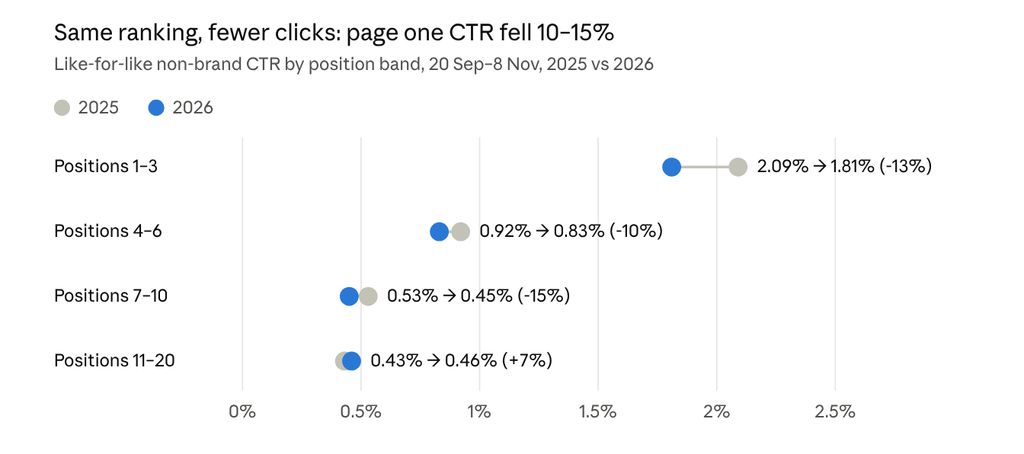
These CTRs are lower than typical industry benchmarks. These are non-brand ecommerce and service searches, where shopping results, ads and map packs sit above the organic listings. No single position changed enough to be statistically clear on its own, but every page one band fell, and the overall like-for-like fall was 11%.
Rankings held steady, but clicks fell
The drop in traffic is not explained by lost rankings. On four of the six sites, non-brand average position moved by about one place or less between the two periods.
The choice of dates matters here. In mid-September 2025, Google stopped supporting a search parameter that rank trackers used to load 100 results at once (Search Engine Land). Comparisons that straddle that change make average positions look better than they really are, so both of our periods start after it.
Even so, clicks fell. On a non-brand basis, five of the six sites lost organic clicks, by 3% to 31%, and one gained 22%. One retailer is the clearest example: its non-brand impressions were flat and its average position improved slightly, yet its clicks fell 20%.
Where the clicks went: product grids, People Also Ask and AI Overviews
Product grids, not AI Overviews, show the clearest link to lost clicks on ecommerce searches. We compared each feature’s CTR effect at the same position in 2025 and 2026. The keywords and results-page features are the same in both years.
| Feature on the results page | CTR effect, 2025 | CTR effect, 2026 |
|---|---|---|
| Product grid | −6% | −62% |
| People Also Ask | −2% | −28% |
| AI Overview | +6% | −12% (not significant) |
| Site cited in the AI Overview* | +4% | +28% |
| Brand named in the AI Overview* | +1% | +36% |
*Compared with other keywords that have an AI Overview. Figures allow for position and for differences between sites.
- Product grids: these sit on 62–95% of the tracked keywords for the ecommerce sites. Their effect only appears in 2026, which suggests shoppers now click products in the grid instead of the organic listings below it. Whilst this is still classed as an organic click, it does take the click away from traditional ‘blue’ links.
- AI Overviews: Google’s AI Overviews appear on most tracked keywords, so few keywords without one were left to compare. The 2026 penalty was clear on only one retailer, at −36%. Wider research points the same way: the Pew Research Center found people clicked a traditional search result on 8% of visits that showed an AI summary, against 15% of visits without one.
- Being cited: citation counts most. Sites ranking in the top 10 for a keyword were cited in its AI Overview 39–64% of the time, so strong rankings and citations tend to go together. We explain why in how generative engine optimisation is redefining digital authority.
Which searches lost the most clicks
Short, broad searches and commercial research lost the most clicks, while searches from people ready to buy held up. All figures are like-for-like CTR changes at the same position.
| Search type | Like-for-like CTR change |
|---|---|
| One or two words, e.g. a product category name | −25% |
| Commercial research, e.g. “best…” or comparisons | about −20% |
| Three words | −7% |
| Ready to buy, e.g. “buy…” or “…price” | about −3% |
| Four or more words | −2% |
The pattern fits the product grid finding. Short product searches are where Google shows the most shopping results, so the organic listing is pushed furthest down. Longer, more specific searches still send traffic to the page that best matches them.
Blog and guide content was hit harder than product and category pages. On the three sites with established blogs, blog clicks fell 34–51%, while product and category pages changed by between −35% and +15%.
Ecommerce vs lead generation
On the two sites with lead generation pages, service and local pages kept their clicks, while ecommerce pages mostly lost them. Treat this as an early pattern: only two sites are involved, and their click volumes are too small for a reliable CTR comparison.
- Service pages: on both sites, clicks held within 1% of last year, even though impressions fell by half or more.
- Online shop pages: on the site that does both, these lost 35% of their clicks over the same period.
- AI Overviews: these appear on 97% of the tracked keywords for the lead generation site, which are mostly informational. When it ranks in the top 10, it is cited about as often as the ecommerce sites are.
One possible reason is that local and service searches show a map pack and ads rather than a product grid. Someone looking for a supplier still needs to visit a website to make an enquiry.
How to protect your organic traffic
- Report on non-brand clicks, not average position. Average position is easily distorted, as the 2025 reporting change showed. Clicks per query at a stable position show whether a ranking is still paying off. Good analytics and measurement make this easier to track.
- Compete in the product grid, not just the blue links. On ecommerce searches, the grid is now where most clicks go. Keep your product feed, merchant listings, prices, reviews and stock data complete and competitive, and add product structured data to your pages. Our guide to optimising free product listings covers the essentials, and Google Shopping ads can secure a place in the grid for the searches that matter most.
- Aim to be cited in AI Overviews. Citation is linked with about a third more clicks. Clear, factual answers on pages that already rank in the top 10 give you the best chance. That is the focus of generative engine optimisation (GEO), and our free AI search and GEO audit shows where you are cited today.
- Target longer, more specific searches. Searches of four or more words held their CTR, while one- and two-word searches lost a quarter.
- Re-think informational content. Blog traffic fell hardest. Content now needs to earn a citation or answer something an AI summary cannot, rather than simply rank. We cover this in more depth in SEO in a zero-click world.
- Expect to rank higher for the same traffic. With CTR down 10–20%, a ranking needs to climb roughly a place to deliver last year’s clicks.
If your rankings are holding but your traffic isn’t, our ecommerce SEO and SEO teams can help you find out where the clicks are going. Get in touch to talk it through.
Frequently asked questions
What is a good organic CTR by position in 2026?
In our non-brand sample, positions 1–3 averaged about 1.8%, positions 4–6 about 0.8% and positions 7–10 about 0.45%. These are lower than most published benchmarks because they exclude brand searches and cover ecommerce and service searches, where shopping results, ads and maps sit above the organic listings.
Why has my organic traffic dropped when my rankings haven’t?
The same ranking now earns fewer clicks. Across our sample, a query at the same position got about 11% fewer clicks than a year earlier, mainly because product grids, People Also Ask boxes and AI Overviews take clicks before searchers reach the organic results.
Do AI Overviews reduce organic clicks?
In our data, keywords with an AI Overview had about 12% lower CTR at the same position, though the difference was not statistically significant. Being cited in the AI Overview mattered more: cited keywords had about 28% higher CTR than uncited ones.
Did Google’s num=100 change affect Search Console data?
Yes. After Google stopped supporting the parameter in mid-September 2025, reported impressions fell and average positions appeared to improve. Avoid comparing periods either side of that change.
Caveats
- Small sample: six sites is a small sample, and the results differed a lot between them. Your own site may sit anywhere in that range.
- Partial query data: Search Console exports list only the top queries. These covered 30–46% of each site’s clicks, and queries Google hides for privacy are excluded.
- Results-page features: the rank-tracking data shows which features each search has now, not which it had in 2025. Results on features are links, not proof of cause.
- AI Overview controls: AI Overviews appeared on most tracked keywords, so few keywords without one were left to compare against.
- Lead generation: the comparison rests on two sites with low click volumes. We’d like to test it on more lead generation sites.
- Average position is a blend: Search Console reports the average position of a site’s highest-ranking URL for each query, across all devices, locations and days. A query averaging position 5 may rank 2nd for some searches and 9th for others.
- Competing pages: when more than one of a site’s pages competes for the same query, the page that ranks can change without the average position moving. In our sample, keywords flagged as having competing pages lost more CTR (−17%) than those without (−1%).
- Features counted as positions: AI Overview links and product grid items are given a position too, so average position is not the organic rank a searcher sees. Search Console positions also sat a median of about four places lower than rank-tracker positions for the same keywords, so the two shouldn’t be compared directly.
- What our method controls: comparing each query only with itself, and only when its position moved by one place or less, reduces these effects but cannot remove them.