This Week in AI in Marketing & Management (23rd Nov 26)
Anthropic Lists on the Nasdaq as the AI Sell-Off Wipes Out the Year’s Gains
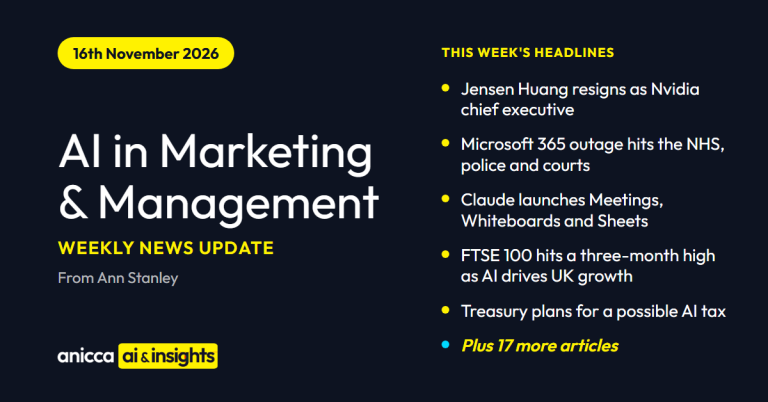
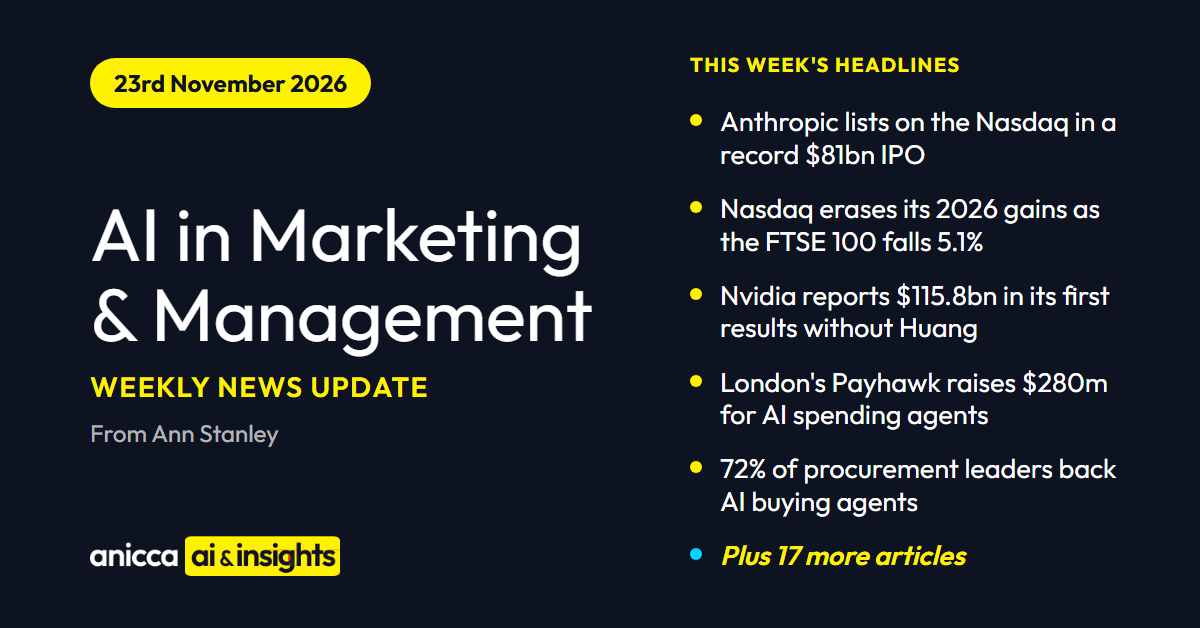
Last week Anthropic, the company behind Claude, became a public company in the biggest share sale in history, raising $81.3bn at $83 a share. The shares rose 17% on their first day, then fell 9% on the second as a sell-off in technology shares spread around the world. By Friday the Nasdaq had erased all its gains for 2026, Nvidia had fallen 14% in a day despite reporting $115.8bn of quarterly revenue, and the FTSE 100 had its worst week since the start of the Iran war. Away from the markets, Microsoft explained what caused its global outage, Satya Nadella said every job will become about managing AI agents, and research showed ChatGPT quietly changing which websites it cites. This week we also cover business-to-business buying by AI agents: London’s Payhawk raised $280m, Visa completed a B2B payment made by an AI agent, and a survey found 72% of procurement leaders would let agents place orders, although fewer than 1% do so today.
Table of Contents
- Anthropic lists on the Nasdaq in the biggest share sale in history
- The Nasdaq wipes out its 2026 gains and the FTSE 100 has its worst week since the Iran war began
- Nvidia reports $115.8bn of revenue in its first results without Jensen Huang
- Google launches Gemini 4 Neon, a fast model priced below its larger rivals
- Claude Data switches on for Enterprise customers, with shared live figures and approved calculations
- Microsoft explains the three faults behind its global Microsoft 365 outage
- ChatGPT quietly changes which websites it cites, and news sites lose out
- A search expert falls for a scam phone number shown in Google’s AI Overviews
- Advertisers can now manage Meta ad campaigns in plain English through AWS Quick
- B2B buyers are starting to shortlist suppliers with AI agents, and vague product pages will not make the list
- Satya Nadella explains why Microsoft offered 60,000 staff the chance to leave
- Eight in ten employees say AI makes them more productive, but only 37% of companies see it in profit
- AI helps developers finish 21% more tasks, but time spent checking its work rises 91%
- Holiday Extras shows how UK teams use always-on AI assistants that work before they are asked
AI in E-commerce, Retail and Agentic Commerce
- London’s Payhawk raises $280m to build finance software where AI agents handle company spending
- 72% of procurement leaders would let AI agents place orders, but fewer than 1% do so today
- Visa and Lianlian complete a B2B payment made by an AI agent with its own card details
- Paramount Liquor rebuilds its B2B wholesale website in six weeks with one engineer and AI agents
- Amazon plans to collect data on every product in the world so AI shopping agents choose Amazon
AI for Other Sectors and Industries
- FINANCE: McKinsey warns banks there is no grace period this time, as customers adopt AI faster than any technology before
- HEALTHCARE: OpenAI adds AI agents that work across hospital software to ChatGPT for Healthcare
- EDUCATION: Imperial College London and Luxembourg launch an AI and digital assets programme for finance professionals
AI News, Tech & Tools
Anthropic lists on the Nasdaq in the biggest share sale in history
Sources: theguardian.com | aljazeera.com | forbes.com.au | theguardian.com
On Wednesday 18 November Anthropic, the company behind Claude, priced its shares at $83, above the $70 to $78 range it had set the week before. It sold 980 million shares and raised $81.3bn, the largest initial public offering in history, overtaking SpaceX’s listing in June. Trading began on the Nasdaq on Thursday 19 November under the ticker ANT, after Dario and Daniela Amodei rang the opening bell.
The shares opened at $111.50, 34% above the offer price, then drifted back through the afternoon and closed at $97.17, still about 17% up. More than 600 million shares changed hands in the first 90 minutes, according to CNBC. The second day was harder: on Friday the shares fell 9% to $88.30, close to the $83 offer price, as a wider sell-off in technology shares took hold (see the next story).
The prospectus gives a rare look inside an AI company. Revenue grew from $41m in 2023 to $386m in 2024 and $4.585bn in 2025, but Anthropic reported a net loss of $104bn in the first nine months of 2026. It has committed $110bn to Amazon and at least $121.3bn to Google for computing power, and Amazon and Alphabet own nearly 11% and nearly 10% of the company respectively. About 90 pages of the 300-page filing set out risks, including that advanced AI could pose “catastrophic or existential risks to humanity”. In a statement on X, Dario Amodei said: “We will not bend to either business or political pressure.”
Why it matters
For businesses that use Claude, Anthropic is now a public company with shareholders, quarterly results and a very large loss to close. That brings more openness, which helps with supplier checks, but it also brings pressure to raise prices and tighten usage limits over time. Review your Claude plans and contracts now, keep a second AI supplier tested so you can move work if terms change, and watch the first quarterly results for any change to pricing.
The Nasdaq wipes out its 2026 gains and the FTSE 100 has its worst week since the Iran war began
Sources: theguardian.com | ft.com | aljazeera.com
The week started badly and ended worse. On Monday 16 November the Nasdaq 100 fell 2.7% as traders waited for Nvidia’s results, which the Financial Times called a big test of the AI boom. On Thursday, the day Anthropic began trading, the Nasdaq fell 2.2%, the Dow 2.19% and the S&P 500 1.8%, with AMD down 7.72% and Nvidia down 3.3%.
On Friday 20 November the Nasdaq Composite erased all its gains for 2026 and closed 5% below its level on 1 January, while the Dow and the S&P 500 closed in correction territory, meaning 10% or more below their recent highs. The Wall Street Journal estimated that the Nasdaq lost about $4tn in value during the week. Nvidia fell 14% on Friday after California served it with a subpoena in an investigation into whether its advanced chips reached China, and the memory chip makers SanDisk and Micron fell 14% and 12%.
The UK did not escape. The FTSE 100 fell 5.1% over the week, its biggest weekly fall since the start of the Iran war, and reached a five-month low on Friday. Europe’s Stoxx 600 had its biggest weekly loss since March 2025, and Asian markets had their worst week since 2020: Japan’s Nikkei fell 5%, South Korea’s Kospi 5.5% and SoftBank 14.5%. Chris Beauchamp of IG suggested Anthropic could be “draining market liquidity”, as investors sell other shares to buy the new one, and Daniela Hathorn of Capital.com said the mood had moved “from buying the dip towards questioning whether the correction has further to run.”
Why it matters
Investors are now openly asking whether the money being spent on AI will earn a return, and that question affects every business, not only technology companies. When AI suppliers are under pressure to show profits, prices tend to rise and smaller suppliers get bought or close. UK pensions and savings are also exposed through the global funds they hold. The practical response is the same as in any uncertain market: measure what your AI tools actually deliver, avoid long lock-in contracts with suppliers you have not tested, and make sure every AI project has a clear business case.
Nvidia reports $115.8bn of revenue in its first results without Jensen Huang
Sources: thehill.com | bloomberg.com
On Tuesday 17 November Nvidia reported revenue of $115.8bn for July to September, up 20% on the previous quarter and 103% on a year earlier. Data centre revenue, which comes mostly from AI chips, was $107.6bn, and Nvidia expects about $130bn in the final quarter of the year. “Our momentum is real,” said Colette Kress, the interim chief executive, on her first results call in charge.
Huang, who resigned the previous Thursday after reports of his affairs, including one reportedly with an alleged Chinese spy, issued his first statement on the same day. He said he had made “serious mistakes” and offered to return as chief executive if the board decided that was in the company’s interest. A source told The Hill the board is not considering it. The new chair, Harvey Jones, said the board is looking at internal and external candidates, and on Wednesday Bloomberg reported that Nvidia’s recruitment firm, Heidrick & Struggles, had approached Arm’s chief executive, Rene Haas.
The shares rose slightly after the results, to about $158, still more than $80 below last month’s record high of $243.37, before falling 14% on Friday in the wider sell-off.
Why it matters
Demand for AI chips is still growing fast, which tells you the large technology companies are still spending heavily on AI. But strong results were not enough to reassure investors while the leadership question and the China investigation remain open. For businesses, the message is that the cost and availability of AI tools still depend on a handful of suppliers, so it is worth keeping track of who your AI providers rely on and building some flexibility into contracts.
Google launches Gemini 4 Neon, a fast model priced below its larger rivals
Source: blog.google | Koray Kavukcuoglu | 18 November 2026
On Wednesday 18 November Google released Gemini 4 Neon, which it describes as frontier-level intelligence with fast completion of whole tasks across software engineering, knowledge work and science. Google says Neon ranks third overall on the Artificial Analysis Intelligence Index, an independent comparison of AI models, behind larger and slower models, and second on the Vals Index. It also reports Neon’s lowest rate yet of made-up answers in its internal testing.
Neon costs $3 per million tokens of input and $15 per million tokens of output (a token is roughly three-quarters of a word), with a 95% discount on repeated input. It can read up to one million tokens at once, enough for several long reports, spreadsheets or recordings in a single request. It is available in the Gemini API, in Gemini for business, and for Google AI Pro and Ultra subscribers in the Gemini app.
Why it matters
The leading AI companies are now competing hard on price for capable models, which is good news for any business paying for AI by usage. Neon’s very large input size suits document-heavy work such as reviewing contracts, tenders or research reports. If you already use Gemini for business, test Neon on one of these tasks against the model you use today and compare the quality and the cost.
Claude Data switches on for Enterprise customers, with shared live figures and approved calculations
Sources: support.claude.com | beri.net
Claude Data, the renamed Claude Dashboards that Anthropic launched on 10 November, turned on by default for Enterprise customers last week unless an administrator had already chosen a setting. Anthropic’s help centre gives the date as 20 November. It connects Claude to company data, including data warehouses such as Amazon Redshift, BigQuery, Databricks and Snowflake, and apps such as Salesforce, and answers questions in plain English. Each chart shows the query behind it and when its data was last refreshed.
Answers can now come in four formats: a dashboard, a scrolling data story, a short narrated video, or a written analysis. Two features for teams are in beta. Certified queries let a data team approve the official calculation behind a figure, such as revenue or customer numbers, so Claude reuses it and the chart carries a badge. Live sharing lets colleagues see a dashboard’s live figures through the owner’s connection, even if they do not have access to the source data themselves. Both are switched on by default for Team plans and off by default for Enterprise plans.
Why it matters
Different departments working from different versions of the same figure is one of the most common reporting problems in any business, and certified queries are a direct answer to it. Live sharing needs more care: it means someone can see data they would not normally have permission to see. Before switching it on, agree who owns each key figure and who is allowed to share what, and write that down.
Microsoft explains the three faults behind its global Microsoft 365 outage
Source: computing.co.uk
Microsoft has published its first findings on the outage that took down Outlook, Teams, Copilot, OneDrive and SharePoint around the world on 12 and 13 November, disrupting NHS hospitals, police forces and courts in the UK. Charles Lamanna, who leads Copilot, agents and platforms at Microsoft, said in a post on X that three problems combined, and that Microsoft was “deeply sorry”.
The first was a hidden fault in gateway software, the servers that route traffic into Microsoft 365. It came from a fix released in July that caused no trouble for three months, because Microsoft’s tests ran on older, lower-specification hardware and missed how it behaved on newer servers under heavy load. The second was a sudden increase in traffic: about 15 hours before the outage, Teams switched to the main gateway as designed, but Exchange Online relied on the same gateway, adding load at the worst moment. The third was reduced server capacity. Microsoft said each problem could have been handled on its own, but together they were much harder to stop.
Why it matters
Large outages rarely have a single cause, which is why they are so hard to prevent. For businesses, the useful lesson is to plan for the failure rather than the cause: know which work stops when email, Teams or Copilot are down, and agree a second way to contact staff and clients. If a supplier outage cost you money, ask your Microsoft partner whether service credits apply under your agreement.
AI in Marketing
ChatGPT quietly changes which websites it cites, and news sites lose out
Source: searchengineland.com | Anna Crowe | 16 November 2026
Research from Generative Pulse, which tracks more than 40 million AI answers, found that ChatGPT sharply reduced how often it cites news publishers, without any announcement from OpenAI. Journalism’s share of ChatGPT’s citations fell from about 33% in January to 22% by September, in two steps, in April and July, and citations of the Associated Press, TIME and The Atlantic dropped within days of 9 July, the day of a model launch. Claude and Gemini changed very little.
When the same 102 questions were put to ChatGPT in April and again in September, government and charity sources rose from 10% to 35% of its citations, brands’ own websites from 14% to 20%, and journalism fell from 28% to 22%. The author, Anna Crowe, compares this to Google’s core updates, which change rankings without warning. She works for Muck Rack, which publishes the research, and notes that it measures AI models directly rather than the apps customers use, so it shows the direction of change rather than exact figures.
Why it matters
Every new AI model can change which sources it trusts, so a business that is cited today may not be cited next month. The encouraging finding is that brands’ own websites gained share, which rewards clear, factual pages about your products and services. Check monthly which of your pages AI assistants cite, and treat a sudden change after a model launch the way you would treat a Google core update.
A search expert falls for a scam phone number shown in Google’s AI Overviews
Source: searchengineland.com | Andrew Shotland | 20 November 2026
Andrew Shotland, an experienced search consultant, described how he searched Google for the customer support number of Vanguard, the investment company, and called the number shown in an AI Overview, the AI-written summary at the top of Google’s results. The person who answered asked for verification details, claimed his personal information had been stolen, then put him through to a fake “Bank of America” fraud team. He only discovered the scam the next morning when he called Vanguard directly, and froze his accounts before any money was taken.
He argues that Google should never show customer support numbers or similar information for “Your Money or Your Life” searches, Google’s own term for topics such as money and health where wrong answers can cause real harm, unless it is certain they are correct. His advice: do not call customer support numbers taken from AI.
Why it matters
If AI summaries can show a scammer’s number for a large investment company, they can do the same for your business. Search for your own company’s phone number and contact details in Google and in AI assistants, make sure your website shows them clearly and consistently, and tell customers where to find your official contact details. Banks, insurers and other regulated businesses should treat this as a customer protection issue, not only a marketing one.
Advertisers can now manage Meta ad campaigns in plain English through AWS Quick
Source: aws.amazon.com | 21 November 2026
Amazon Web Services has added a Meta ads connector to AWS Quick, its AI assistant for business data. It uses Meta’s MCP server, a standard way for AI assistants to connect to other software, so that advertisers can create, manage and analyse Facebook and Instagram campaigns by typing requests in plain English.
Quick can also combine Meta campaign data with a company’s own data, such as stock levels, customer lifetime value and in-store sales, to build dashboards, documents, slide decks and automated workflows. AWS gives the example of an apparel brand whose analysts currently export reports, merge spreadsheets and rebuild the same presentation every week, then go back into Ads Manager to change campaigns by hand.
Why it matters
This is another sign that managing advertising is moving from the ad platform’s own screens into general AI assistants, where ad results can sit next to sales, stock and profit data. That makes it easier to judge campaigns on business results rather than platform figures alone. Before giving any AI assistant permission to change live campaigns, set clear spending limits and decide which changes need a person’s approval.
B2B buyers are starting to shortlist suppliers with AI agents, and vague product pages will not make the list
Source: martech.org | Tanya Thorson | 17 November 2026
According to G2’s 2026 Buyer Behavior Report, 61% of B2B software buyers use or plan to use AI agents in their purchasing, mainly to compare costs, research options and build shortlists of suppliers. Tanya Thorson writes in MarTech that the first contact between a business buyer and a supplier may now happen through an AI agent, for example a procurement leader asking an agent to compare supply chain software on features, integrations, implementation time and total cost.
She argues that words such as “innovative” and “scalable” tell an agent very little. What it needs is information it can find and compare: which systems the product works with, which problems it solves, how implementation affects existing processes, and evidence of results from case studies and customer reviews. The problem, she says, is that this information is often spread across product pages, case studies and technical documents that use inconsistent language.
Why it matters
B2B buying is becoming agent-led faster than many marketers expect, and agents reward facts over slogans. Review your main product or service pages as if an AI agent were comparing you with three competitors: are integrations, prices or pricing models, timelines and proof of results easy to find and stated in the same way everywhere? If not, that is a quick and inexpensive fix that also helps human buyers.
AI in Management
Satya Nadella explains why Microsoft offered 60,000 staff the chance to leave
Source: techcrunch.com | 18 November 2026
Speaking at the DealBook Summit on Wednesday 18 November, Microsoft’s chief executive Satya Nadella explained why the company offered voluntary redundancy to 60,000 employees in October instead of making another round of compulsory job cuts. He said the reason was AI, but not AI replacing people. Microsoft is reorganising so that everyone uses AI to do their work, and their jobs become about directing it. The offer was made “to make sure that at least everyone felt like they had agency in making choices.”
He gave the example of the team that builds Cowork, the AI agent inside Microsoft 365 apps: just 11 developers who have mastered AI. “They build a software factory that builds the product. They don’t build the product,” he said. He expects every employee eventually to become a manager of AI agents rather than the person doing the work directly, and said that change will happen “in all jobs”.
Why it matters
This is one of the clearest statements yet from a large employer about how AI changes jobs: fewer people doing tasks directly, more people directing AI that does them. Offering people a choice, rather than simply cutting jobs, is a more humane way to manage that change and protects trust with the staff who stay. Managers in businesses of every size should start thinking now about which roles will become mainly about directing AI, and what training those people need.
Eight in ten employees say AI makes them more productive, but only 37% of companies see it in profit
Source: fortune.com | Louisa Loran | 16 November 2026
Writing in Fortune, Louisa Loran, who led strategic business transformation at Google, points out that 80% of employees say AI makes them more productive, yet only 37% of organisations see any effect on profit. For nearly two in three organisations, the value people feel has not yet reached the bottom line.
She argues the problem is not a lack of data but a reluctance to act on it. Many of the constraints holding value back are past decisions that have hardened into rules, and people have the power to change them. Her example is an airline partner that built a system to plan crew, aircraft, passengers and ground staff together, treating only legislation, capacity and safety as fixed and everything else as open to change.
Why it matters
Time saved by individuals only becomes profit when the business changes how work is organised, for example by taking on more clients with the same team or removing steps from a process. When you review AI projects, ask what has actually changed in the process, not only how much time people say they have saved. List the rules and habits in your own business that exist only because they always have, and test which ones AI now makes unnecessary.
AI helps developers finish 21% more tasks, but time spent checking its work rises 91%
Source: cio.com
An article in CIO looks at why the returns from AI in software development are less clear than the investment suggests. Accenture reports that 82% of senior executives are increasing AI investment, but research from Bain & Company found that AI coding tools help developers complete roughly 21% more tasks while the time spent reviewing their output rose 91%.
As engineers produce more code, senior developers face longer review queues, and AI can also produce long specifications and documents that take time to check. The article argues that technology leaders should measure the whole process, including review, rework and errors, rather than how quickly the first draft is produced.
Why it matters
The same pattern applies well beyond software: AI can produce first drafts of reports, proposals and campaigns very quickly, but someone still has to check them. If that checking falls on your most senior people, the business can end up slower, not faster. Measure AI projects from start to finish, and make sure the time needed for review is planned and shared rather than left to a few experienced staff.
Holiday Extras shows how UK teams use always-on AI assistants that work before they are asked
Source: openai.com
OpenAI has published a case study on Holiday Extras, the UK travel company that sells airport parking, hotels, lounges and transfers, and its use of dots, OpenAI’s personal AI assistants in ChatGPT that can carry out work without being prompted each time.
The day after Holiday Extras launched a new feature in its app, Liam Thompson, its vice president of AI innovation, received a report on how it was performing without asking for one: his assistant had noticed the launch, pulled the figures from the company’s Google BigQuery data and sent the results. “I was really happy when Beast said, ‘Here you go,’ and I didn’t even have to ask him,” he said. The company says one animation task has gone from days of work to about ten minutes, and Thompson talks to his assistant for two hours a day, including talking through upcoming meetings on his commute.
Why it matters
This is a glimpse of how management work is changing: AI assistants that watch for events, gather the figures and brief managers before a meeting, rather than waiting to be asked. It is a case study published by OpenAI, so treat it as an example of what is possible rather than independent evidence. A good first step for any team is to pick one regular report that someone builds by hand each week and test whether an AI assistant can prepare it automatically.
AI in E-commerce, Retail and Agentic Commerce
London’s Payhawk raises $280m to build finance software where AI agents handle company spending
Sources: businesscloud.co.uk | techcrunch.com
Payhawk, the London-based spend management company, has raised $280m (£213m) at a valuation of $2bn (£1.5bn). The round was led by Growth Equity at Goldman Sachs Alternatives, every existing investor took part, and Payhawk has now raised more than $515m in total.
Payhawk says it will use the money to build a finance system for the AI era in three parts: AI agents that do financial work, payment systems that let those agents handle money safely, and controls that set what agents are allowed to do and when a person must make the decision.
Why it matters
Business purchasing and expenses are one of the first areas where AI agents are being trusted to spend real money, and investors are backing UK companies to lead it. For finance directors, the important part is the third one: controls over what an agent may buy, up to what amount, and when a person must approve. If you are reviewing expenses or purchasing software, ask suppliers how their AI agents are controlled and audited, not only what they can do.
72% of procurement leaders would let AI agents place orders, but fewer than 1% do so today
Source: finance.yahoo.com | 17 November 2026
Coupa, which sells spend management software, surveyed 600 procurement, finance, supply chain and IT executives worldwide for its State of Agentic Procurement Report. It found that 72% would let AI agents create or update transactions such as purchase orders, yet fewer than 1% say an agent does that work today. Agents currently handle about 4% of procurement work, and leaders expect that to triple within a year.
The biggest barrier is data, not the AI: 29% named data quality or connecting systems as the main obstacle, against 17% for the accuracy of agents. Safeguards make the difference: 94% want a complete audit trail and 90% want set approval limits, and almost half of those who first ruled agents out would allow them with clear safeguards. Trust is much higher for agents built into a purchasing platform (45% very confident) than for general AI tools (12%), and 86% of procurement leaders expect agents to make their roles more strategic. The report is Coupa’s own research, published as a paid press release.
Why it matters
B2B buying by AI agents is coming, but slowly and with strict rules, which gives suppliers time to prepare. For sellers, that means making sure your product data, prices and stock levels are accurate and easy for buyers’ systems to read, because an agent will skip suppliers whose data it cannot trust. For buyers, start by cleaning supplier and product data and agreeing approval limits before switching on any purchasing agent.
Visa and Lianlian complete a B2B payment made by an AI agent with its own card details
Sources: techedt.com | au.finance.yahoo.com
At the Singapore Fintech Festival on 18 November, Visa and the payments company Lianlian DigiTech said they had completed Asia Pacific’s first live business-to-business purchase using payment card details issued specifically to an authorised AI agent. The agent, LianLian XWorker, bought office supplies using a secure stand-in for the card number (a token) obtained through Visa Intelligent Commerce Connect, and paid within spending controls set by the business.
The companies also launched the LianLian XCard, a business card for small and medium-sized firms that supports payments by authorised AI agents when linked to a LianLian XPay wallet.
Why it matters
Giving an AI agent its own card details, with its own limits, is a safer approach than letting it use an employee’s card, because the business can see and control exactly what the agent spends. Visa and Mastercard are building these systems for B2B purchasing as well as consumer shopping. Businesses that sell to other businesses should check with their payment provider when their checkout will accept payments from AI agents.
Paramount Liquor rebuilds its B2B wholesale website in six weeks with one engineer and AI agents
Source: drinkstrade.com.au | 19 November 2026
The Australian drinks wholesaler Paramount Liquor has rebuilt its entire business-to-business wholesale platform from scratch in six weeks, using a single engineer overseeing autonomous AI agents. Its previous website, launched only a year ago, took 15 full-time developers two years to build.
The work was led by Maxim Ellison, chief technology officer of Visualr, the AI and e-commerce agency that Paramount co-owns. He said customer experience, security and testing of every feature remained the priority, and that the safety checks were kept under human control throughout. Because the business now owns the whole platform, it can develop it as one system rather than checking every change against other companies’ software.
Why it matters
B2B websites are often expensive to change because they depend on many connected systems, such as trade pricing, account management and ordering. This example suggests AI agents can cut the time and cost of a rebuild dramatically, as long as experienced people control the testing and security. If your trade website is due for an update, it is worth asking your agency or developers how they would use AI agents, and how they would check the result.
Amazon plans to collect data on every product in the world so AI shopping agents choose Amazon
Source: retail-week.com | 16 November 2026
Amazon executives are concerned that AI shopping agents could send customers to other websites with more complete product data, Retail Week reports, citing an internal document seen by Reuters. Amazon’s answer is a project called World Product Graph, which would gather data on virtually every product for sale in the world, whether or not Amazon stocks it, so that shoppers never need to leave its site.
Why it matters
AI shopping agents choose where to buy based largely on the quality of product information, and Amazon is planning to hold the most complete version of it. For retailers and brands, the lesson is that complete, accurate product data on your own website and in your product feeds is now as important as price. Check that your product pages include full specifications, sizes, compatibility and stock information, so agents have no reason to look elsewhere.
AI for Other Sectors and Industries
FINANCE: McKinsey warns banks there is no grace period this time, as customers adopt AI faster than any technology before
Source: mckinsey.com
McKinsey’s Global Banking Annual Review 2026 argues that banks have always been able to adopt new technology at their own pace, partly because their older customers were also slow to change. That is no longer true: customers of all ages are adopting AI faster than any technology in history. “This time, there is no grace period,” the report says.
It argues that the benefits of AI will go to the banks that act with precision and speed, and that banks need to execute much faster to match the pace of AI development.
Why it matters
Financial services firms, including smaller lenders, insurers and advisers, are used to long technology cycles, and this report says those days are over. Customers now expect AI-assisted service, and they will compare their bank with the AI assistants they use every day. Firms in regulated sectors should be running carefully controlled AI pilots now, rather than waiting until the picture is clearer.
HEALTHCARE: OpenAI adds AI agents that work across hospital software to ChatGPT for Healthcare
Source: openai.com
OpenAI has added computer-use agents to ChatGPT for Healthcare. These agents operate the software healthcare teams already use by reading screens, clicking and typing, so they can move information between systems that do not connect to each other, for example to prepare documents, coordinate care or complete administrative tasks.
OpenAI has also improved its clinical search, which finds, assesses and cites medical evidence, and added more than 20 new plugins that connect ChatGPT to other healthcare systems.
Why it matters
Much of the administrative burden in healthcare comes from copying information between systems that were never designed to work together. Agents that can operate existing software could reduce that burden without waiting for systems to be replaced, but they also need very careful controls over patient data. Healthcare providers, including private clinics, should start with low-risk administrative tasks and involve their data protection lead from the start.
EDUCATION: Imperial College London and Luxembourg launch an AI and digital assets programme for finance professionals
Source: itbrief.co.uk | 19 November 2026
Imperial College London and Luxembourg’s Ministry of Finance have launched an education programme on AI and digital assets for leaders and professionals in Luxembourg’s financial services sector. The programme, called Luxembourg Imperial Growth Horizons for Talent (LIGHT), will be delivered by Imperial Business School and Imperial Lifelong Learning, and covers the use of AI in finance as well as digital assets, including regulation and tokenisation. It is part of a wider agreement between the two over several years.
Why it matters
Governments and universities are now treating AI skills for working professionals as national economic policy, not only as training for students. For UK businesses, it is another reminder that competitors in other countries are investing in AI skills for their existing staff. Check whether your sector body, local university or professional institute offers short AI courses, and build them into your training budget for next year.
Key Takeaways
- Anthropic raised $81.3bn at $83 a share in the biggest listing in history; its shares closed 17% up on day one, then fell 9% on day two. Review your Claude plans and keep a second AI supplier tested.
- The Nasdaq erased all its 2026 gains and the FTSE 100 fell 5.1% in a week, its biggest weekly fall since the Iran war began: investors are questioning whether AI spending will pay off, so make sure every AI project has a clear business case.
- Nvidia reported $115.8bn of revenue in its first results without Jensen Huang, but its shares still fell 14% on Friday: strong demand for AI chips is not calming investors while leadership and China questions remain open.
- Claude Data is now on by default for Enterprise customers, and certified queries let a data team approve the official version of each figure: agree who owns your key figures before switching on live sharing.
- Microsoft traced its global outage to three faults that combined: plan for the next outage by knowing which work stops and how you will contact staff and clients.
- ChatGPT cut the share of its citations going to news sites while brands’ own websites gained: check monthly which of your pages AI assistants cite.
- A search expert was scammed by a phone number shown in Google’s AI Overviews: check what Google and AI assistants show as your business’s contact details.
- Satya Nadella says every job will become about managing AI agents, while research shows only 37% of companies see AI in their profits: measure what has changed in the process, not only the time saved.
- B2B buying by AI agents is starting: 61% of software buyers use or plan to use agents, 72% of procurement leaders would let them place orders, and Payhawk and Visa are building the payment controls. Make your product data, prices and proof of results easy for agents to compare.
Frequently Asked Questions
Does Anthropic becoming a public company change anything for Claude users?
Not immediately. Your plans, data settings and contracts stay the same. Over time, a public company has to show investors a path to profit, and Anthropic reported a net loss of $104bn in the first nine months of 2026, so prices and usage limits are more likely to rise than fall. The upside is more openness: quarterly results and filings will tell you much more about the supplier you rely on. Review your plans once a quarter and keep a second AI supplier tested.
Should we pause AI projects because of the stock market sell-off?
No, but it is a good moment to check them. The sell-off is about whether the very large sums AI companies are spending will earn a return, not about whether AI tools work. Projects with a clear, measured benefit to your business should continue. Projects that depend on a single small supplier, long contracts or uncertain benefits deserve a closer look, because weaker AI suppliers may raise prices, be bought or close if investment dries up.
What should B2B sellers do to prepare for AI buying agents?
Start with your information, not the technology. AI agents compare suppliers on facts they can find and trust: products, prices or pricing models, stock, delivery times, the systems you work with and evidence of results. Make sure these are complete, accurate and described in the same way on your website, in product feeds and in case studies. Then ask your payment provider and ecommerce platform when they will accept orders and payments from AI agents, and what controls buyers will expect.
Conclusion
Last week the most important AI company for many of our readers became a public company, at the very moment investors started to doubt the whole AI boom. Anthropic’s record listing could not stop the Nasdaq from erasing its gains for the year or the FTSE 100 from its worst week since the Iran war began, and even Nvidia’s very strong results did not reassure the market. For businesses, none of this changes what AI tools can do today, but it does change the suppliers behind them, who will be under more pressure to make money. At the same time, the way businesses buy from each other is starting to change, with AI agents researching suppliers, comparing them and, before long, placing orders within strict controls. Three priorities stand out: review your AI suppliers and keep alternatives tested, measure the real business results of your AI projects, and make your product and service information clear enough for an AI agent to recommend you.
Need help adapting your AI marketing strategy? Contact the Anicca team for expert guidance.



Join the Thursday AI Club
A hands-on AI club for marketers and managers. Fortnightly sessions, 2-5pm UK: Hour 1 is an open Q&A on any AI question; Hours 2-3 split into a workshop track (for newbies) and an advanced track (live demos and deeper questions).
Led by Ann Stanley, Darren Wynn, James Allen and Tony Hancock.
Membership: £40/month or £400/year
This roundup is compiled from publicly available sources using AI-assisted research. While we review every article for accuracy, our analysis reflects our interpretation of the original reporting. We strongly encourage readers to click through to the original sources linked throughout this post for full context and detail. If you spot anything that needs correcting, please let us know.