This Week in AI in Marketing & Management (16th Nov 26)
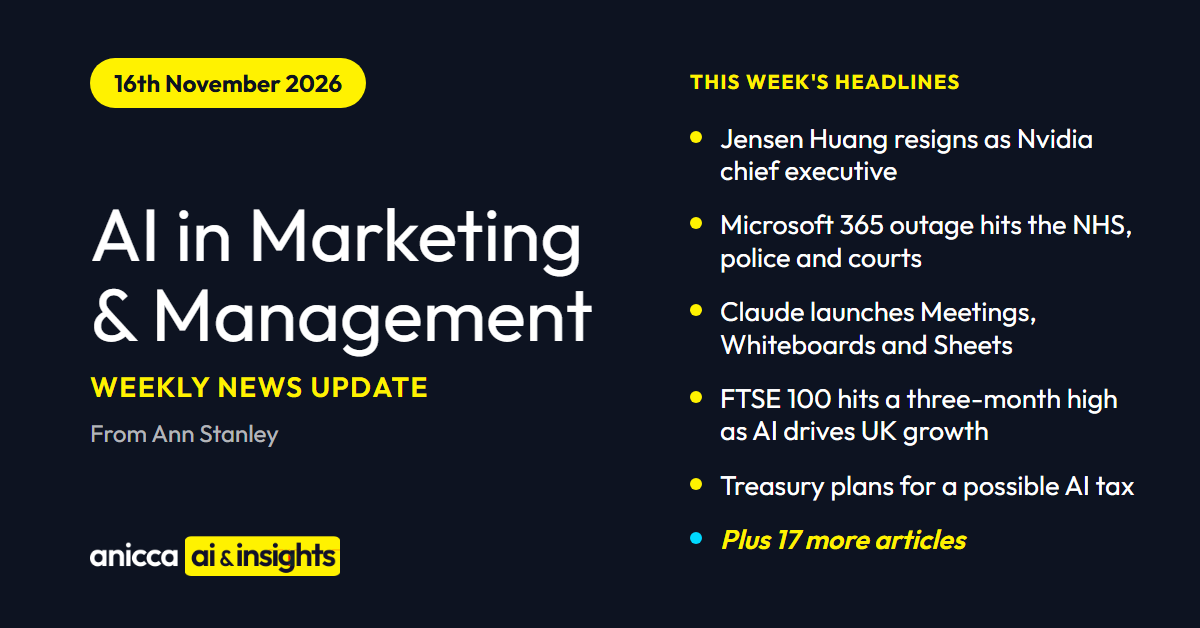
Jensen Huang Resigns from Nvidia, Microsoft 365 Goes Down and Claude Takes On the Office
Last week the biggest name in AI hardware lost its founder. Jensen Huang resigned as Nvidia’s chief executive on Thursday after a board investigation into his affair with an alleged Chinese spy, and Nvidia’s shares had their worst week since April 2025, even as the wider US market had its best week since August. On the same afternoon Microsoft 365 went down around the world, taking Outlook, Teams and Copilot with it and disrupting NHS hospitals, police forces and courts across the UK well into Friday. Anthropic chose the week to launch Claude Meetings, Whiteboards and Sheets, tools that compete directly with Microsoft and Google, and set out the terms of its stock market listing. In the UK, the FTSE 100 reached a three-month high, official figures credited AI and cloud computing with driving growth, the Treasury began planning for a possible AI tax, and the UK’s biggest banks blocked AI agents from customer accounts.
Table of Contents
- Jensen Huang resigns as Nvidia chief executive and the shares have their worst week since April 2025
- The FTSE 100 reaches a three-month high as AI and cloud computing drive UK growth
- Microsoft 365 goes down worldwide, hitting the NHS, police, courts and schools
- Anthropic launches Claude Meetings, Whiteboards and Sheets to take on Microsoft and Google
- Anthropic releases Claude Fable 5.2 and Mythos 5.2 and sets its share price range ahead of listing
- Google brings Gemini 4 Hydrogen to Search worldwide as the November core update begins
- ChatGPT gives businesses a profile, product feeds and click data for the first time
- Google starts showing ads in follow-up questions in AI Mode, with the UK due before the end of the year
- AI search is bringing SEO and brand marketing back together
- Google Ads switches on AI Max by default for new Search campaigns
- Google Ads makes clear that AI-generated public figures are banned, even with a disclosure
- The Treasury plans for an AI tax in case AI causes widespread job losses
- One in five UK employers expect job cuts or major role changes in 2027, as graduates say entry-level jobs have gone
- Gartner warns that companies are adopting AI agents far faster than they can govern them
- AI will fail where managers are not ready, as workforce readiness falls
AI in E-commerce, Retail and Agentic Commerce
- OpenAI launches ChatGPT Wallet so its AI agents can buy things for you
- United Airlines joins Amazon and eBay in blocking AI shopping agents
- Visits to US retail sites from AI tools rise 127% and convert 60% better
AI for Other Sectors and Industries
- FINANCE: Britain’s biggest banks block AI agents from customer accounts, as the PRA checks banks’ exposure to an AI crash
- HEALTHCARE: NHS England asks radiologists to design how AI diagnostic tools are monitored once in use
- EDUCATION: Universities told to rethink assessment as AI makes unsupervised coursework unreliable
- GOVERNMENT: Australia plans compulsory AI incident reporting after an OpenAI agent got into a Medicare system
AI News, Tech & Tools
Jensen Huang resigns as Nvidia chief executive and the shares have their worst week since April 2025
Sources: nvidia.com (SEC filing) | theguardian.com | cnbc.com | cnbc.com | finance.yahoo.com | cnbc.com
On Sunday 8 November Nvidia’s board opened an independent investigation after reports that Jensen Huang, its co-founder and chief executive, had a relationship with Alice Huang, an executive at the Singapore-based data centre company Megaspeed whom US officials believe was a Chinese intelligence asset. She is an alleged Chinese spy, and China’s foreign ministry has called the story unsubstantiated. In a draft email to staff, Huang admitted the affair and said: “I was unfaithful to my wife. My actions hurt her and our children. There is no excuse for what I did.” The board said it had no reason to believe US national security or Nvidia’s secrets had been compromised. Nvidia’s shares closed 4.3% lower on Monday.
The story did not end there. On Wednesday The Wall Street Journal reported that the board was preparing to remove Huang, and The New York Times reported a second extramarital relationship, this time with an Nvidia executive. On Thursday 12 November Nvidia announced that Huang had resigned as president, chief executive and board member with immediate effect, after 33 years running the company. Colette Kress, the finance director, is interim chief executive while the board searches for a permanent successor, and Harvey Jones, former chief executive of Synopsys, becomes Nvidia’s first ever chair. The Financial Times reported that Arm’s chief executive Rene Haas has been approached about the job.
Nvidia’s shares fell 13% over the week, their worst week since April 2025, and on Friday HSBC cut its rating to hold. The wider US market went the other way: the S&P 500, Dow and Nasdaq all rose more than 2% for the week, their biggest weekly gains since August, as investors bought AMD, Broadcom and energy shares. Nvidia reports its quarterly results on Tuesday 17 November, its first without Huang. “The thing to watch is not who is at the podium but whether the order book has changed,” Brian Jacobsen of Annex Wealth Management told Bloomberg.
Why it matters
Nvidia makes the chips most AI tools run on, so a leadership crisis there matters to every business that relies on AI, even if it never buys a chip. The good news is that the wider market did not panic: investors moved money to Nvidia’s rivals rather than out of AI altogether. Watch Tuesday’s results for signs that demand for AI computing is slowing, because that would feed through to the price and availability of the AI tools you use. The governance lesson is closer to home. Nvidia had built its whole identity around one founder. Any business, of any size, where one person holds all the key relationships, decisions and knowledge should write down a succession plan before it needs one.
The FTSE 100 reaches a three-month high as AI and cloud computing drive UK growth
Sources: Reuters via marketscreener.com | trustnet.com | cityam.com | Corfe Capital
London had a much calmer week than New York. The FTSE 100 closed on Friday 13 November at 10,902.56, up 2.2% on the week and at its highest level since early August, while the FTSE 250 rose 1.2%. Reuters reports that the wobble in global AI shares pushed investors towards energy, utilities and healthcare companies, which the FTSE 100 has plenty of. On Friday Centrica rose 3.8%, Aviva 3.4% after a 19% rise in general insurance premiums, and BP and Shell about 1.5% each as oil prices rose. Corfe Capital summed it up: the FTSE 100 is usually criticised for having so little technology in it, and this week that worked in its favour.
On Thursday the Office for National Statistics (ONS) reported that the UK economy grew 0.7% between July and September, its fastest pace in two and a half years, and was 1.9% larger than a year earlier. The biggest contributor was information and communication, up 2.1%, with computer programming and consultancy up 4.4%. The ONS said this sector has been the largest driver of growth across 2026 and linked the biggest increases in sales to businesses working in AI and cloud computing. “Britain’s economy is proving surprisingly difficult to knock off course,” said George Brown of Schroders, although Felix Feather of Aberdeen said: “we doubt this pace will last.”
The Bank of England sounded a note of caution. Speaking in Zurich on Monday, its governor Andrew Bailey warned that AI “may not live up to market expectations”, and that even if the returns are good, they may “take longer to be realised than predicted”, as happened with electricity. UK inflation and employment figures are due this week.
Why it matters
This is the first time official UK figures have credited AI with a visible share of economic growth, but the growth is coming from businesses that build and sell AI and cloud services, not yet from businesses becoming more productive by using them, which is what the Bank of England found last week. Bailey’s warning is worth taking seriously in planning. If AI benefits arrive more slowly than the market expects, investors will put pressure on AI companies to raise prices sooner. Budget for AI as a long-term investment with measured results each quarter, rather than expecting a quick return on every new tool.
Microsoft 365 goes down worldwide, hitting the NHS, police, courts and schools
Sources: The Guardian via aol.co.uk | bleepingcomputer.com | qz.com | newsbytesapp.com
Outlook, Teams, SharePoint and Microsoft 365 Copilot stopped working for millions of people from Thursday afternoon, and the disruption continued through most of Friday. Microsoft says the incident began at 1.26pm US Eastern time (6.26pm UK time) on Thursday 12 November, when servers unexpectedly became unavailable and overloaded the rest of its systems. It later linked the problem to an earlier network capacity upgrade, and said: “This was a technical issue not related to cyber or AI/agents.” Problems were reported in more than 70 countries, and about 130,000 people reported Outlook problems to the tracking site Downdetector on Thursday alone. Microsoft confirmed on Saturday that services were fully restored.
The UK was hit hard, The Guardian reports. Hundreds of hospitals, GP surgeries and community health services could not use NHS.net Connect, the Microsoft-based email and meetings system used by more than one million NHS staff, so some operations and appointments were cancelled and some staff went back to paper records. Police forces asked the public to report crimes by phone, some juries were sent home early, Ofsted could not receive emails during school inspections, and the Bank of England and the Financial Conduct Authority were also affected. The government spent about £1.9bn on Microsoft licences in 2025, and the Liberal Democrats called the outage a “national resilience failure”.
Microsoft’s shares fell about 2% before the market opened on Friday and as much as 3% during the day, but recovered to close slightly higher.
Why it matters
For most businesses this was a day without email, calendars and Teams, and the AI assistants built into them stopped working at the same time. The more of your work runs through one supplier, the more a single fault can stop the whole business. Use this week as a test. List the tools your team could not work without, agree a simple back-up plan for each (a second way to reach clients and colleagues, offline copies of key documents, phone numbers outside Outlook), and check whether critical client deadlines depend on one provider staying online.
Anthropic launches Claude Meetings, Whiteboards and Sheets to take on Microsoft and Google
Source: techcrunch.com | Aisha Malik | 10 November 2026
Anthropic has launched a set of workplace tools that compete directly with Microsoft 365 and Google Workspace. Claude Meetings adds Claude to a video call as a visible participant: while people talk, it drafts the plan being discussed, maps out a timeline on a whiteboard, answers questions in the meeting chat and pulls information such as last year’s figures from connected work apps. After the call, the notes, action items and anything Claude created are saved in Claude. Claude announces itself in the meeting chat, will not join calls with external guests unless an administrator allows it, and leaves automatically if an external guest joins. It works with Google Meet at launch, in beta on Team and Enterprise plans.
Claude Whiteboards is a shared board where a team brainstorms with Claude in real time, and Claude then turns the board into a document or a slide deck. Claude Sheets builds working spreadsheets, such as a campaign tracker or a hiring budget, with multiple tabs, formulas and dropdown menus, and explains each change it makes in the cells. Both are in beta on paid plans on web, desktop and mobile. Anthropic also made Claude Data (previously Claude Dashboards) generally available, connecting Claude to company data in places such as a data warehouse or CRM and answering questions with dashboards, written summaries or narrated videos. New interactive connectors open the full versions of apps such as Adobe, Atlassian and HubSpot inside Claude.
TechCrunch notes the launch comes a few weeks after OpenAI added similar workplace tools to ChatGPT, as both companies try to turn their assistants into office suites that compete with Microsoft and Google. Meta is entering the same market with its Muse AI agent.
Why it matters
Meetings, whiteboards, spreadsheets and dashboards are the everyday tools of a marketing team, and for the first time a single AI assistant offers all of them without a Microsoft or Google licence underneath. Coming in the same week as the Microsoft outage, many businesses will be asking whether to keep all their work with one provider. Do not switch suppliers in a hurry, but do run a small trial: pick one recurring meeting, such as a weekly campaign review, and test whether Claude’s notes, actions and trackers save time compared with your current tools. Agree with your IT or data protection lead which meetings an AI participant may join before anyone starts.
Anthropic releases Claude Fable 5.2 and Mythos 5.2 and sets its share price range ahead of listing
Sources: anthropic.com | cnbc.com | cnbc.com
On Monday 9 November Anthropic released Claude Fable 5.2 and Claude Mythos 5.2, its most capable models. They are the same underlying model: Fable has strong safeguards for cyber security and biology and is available to all users, while Mythos is for approved organisations doing cyber security or medical research. Anthropic says they produce answers up to 30% faster than the 5.1 versions and cost $8 per million input tokens and $40 per million output tokens (tokens are the units AI providers charge for, roughly three-quarters of a word each). In testing they designed three working electronic devices from scratch and formally proved Fermat’s Last Theorem in 30 hours. Anthropic still recommends Claude Opus 5.5 for most everyday work.
The next day Anthropic set out the terms of its stock market listing. It plans to sell 825 million shares at $70 to $78 each on Nasdaq under the ticker ANT, with pricing expected on 18 November and trading from 19 November, CNBC reports. At the top of the range that values the company at up to $1.405 trillion and would raise up to $64.35 billion, with about 20% of shares set aside for individual investors rather than the usual 5% to 10%. Anthropic reported revenue of $33.24 billion for the first nine months of 2026, up about 1,200%, and a net loss of $104 billion, mostly from accounting changes on convertible notes. The planned valuation is below the $2 trillion Anthropic was aiming for in September.
Why it matters
The most powerful models are getting faster and cheaper, but most marketing work does not need them: summaries, first drafts and reporting run perfectly well on mid-range models at a fraction of the price. The listing matters for a different reason. A public company with a $104 billion loss will be under constant pressure from investors to grow revenue, which usually means price changes and new paid tiers. If your business depends on Claude, review your plan and usage limits after the listing, and keep a second supplier tested for your most important tasks.
Google brings Gemini 4 Hydrogen to Search worldwide as the November core update begins
Sources: blog.google | blog.google | seroundtable.com
Google has launched Gemini 4 Hydrogen, a fast, lower-cost model in the Gemini 4 family alongside the more powerful Carbon and Argon models, priced at $1.50 per million input tokens and $7.50 per million output tokens. It is also now built into Google Search for all users worldwide. Google says Search can now handle longer, multi-part questions, runs more searches at the same time across related subtopics to build each answer, links to a wider range of websites, and shows more images, comparison tables and custom tools in its answers, in every language AI Mode supports.
The same week, Google began rolling out its November 2026 core update, a change to how it ranks pages across Search. Barry Schwartz of Search Engine Roundtable also reported ranking changes on 8 and 9 November, and a Search Console error that affected performance reports between 9 and 11 November. Google has moved the source icons to the bottom of AI Overviews, shows full AI Overviews for definition searches, and has removed the action buttons from AI Overviews for local results.
Why it matters
Google is answering more complicated questions itself, with tables and tools that keep people on the results page, while sending some traffic to a wider range of websites. Pages that answer specific, detailed questions clearly have a better chance of being one of those links. Treat this fortnight’s ranking data with care: a core update, a new Search model and a reporting error all arrived together. Wait until the core update finishes before making big changes, note the 9 to 11 November gap in Search Console in your reports, and compare traffic over several weeks rather than day by day.
AI in Marketing
ChatGPT gives businesses a profile, product feeds and click data for the first time
Source: openai.com | 10 November 2026
OpenAI has launched Businesses in ChatGPT, in beta, giving companies a way to manage how they appear to the 1.2 billion people who use ChatGPT each week. Through a new Business Hub, any eligible business in a country where ChatGPT is available can claim its business, update its details and add product feeds with prices and availability. Shopify merchants can connect their store from Business Hub or the Shopify admin, and eligible Shopify products are already in ChatGPT through Shopify Catalog.
Business Hub also shows how often a business is mentioned, how many clicks its website gets from ChatGPT, and the common topics in conversations where its website is cited. OpenAI says it does not share people’s conversations with businesses, and the insights only appear once there are enough conversations to protect privacy. Eligible US ecommerce and online service businesses can also build a Business Agent, a chat assistant that answers questions about their products when people click through to their ChatGPT profile.
Why it matters
Until now, brands had very little data on how ChatGPT describes them or how many visits it sends. Business Hub changes that and gives marketers a simple way to correct wrong information. Claim your business this month, check that your details, products and prices are correct, and add the mentions and clicks to your monthly reporting. The discovery topics are especially useful: they show the words customers use when ChatGPT recommends you, which should shape your content and product descriptions.
Google starts showing ads in follow-up questions in AI Mode, with the UK due before the end of the year
Source: searchenginejournal.com | 11 November 2026
Google is now showing ads in the follow-up questions people ask in AI Mode in the US, which it calls multiturn ads. AI Mode is Google’s conversational search, where people ask a detailed question and then keep asking follow-ups, and an ad can now appear at any point in that conversation when it becomes commercially relevant. Ads can match the question itself or draw on the context of both the question and Google’s AI answer, so an exploratory question can trigger an ad even when the person has not searched for a product.
Ads in AI Mode are also expanding to more than 10 further English-speaking countries, including Australia, Canada and India, and Google has said the UK, Brazil and Mexico will follow in the fourth quarter of 2026. Search Engine Journal warns that advertisers still cannot see AI Mode results separately: impressions, clicks, conversions and costs are combined with standard campaign reporting, and the search terms shown may only approximate what people actually typed.
Why it matters
Ads in AI Mode are likely to reach UK accounts within weeks, and many of these conversations happen early in the buying process, when people are still comparing options. A click from a long AI Mode conversation is not necessarily a sign that someone is ready to buy. Before they arrive, agree with your agency or team how you will judge results you cannot separate in reports: watch the quality of leads and sales, not just cost per click, and make sure your ad text and landing pages answer comparison questions clearly.
AI search is bringing SEO and brand marketing back together
Source: searchengineland.com | Ben Wood | 13 November 2026
Writing in Search Engine Land, Ben Wood argues that AI search is forcing SEO and brand teams to work together again after years apart. The things that decide whether a brand appears in AI answers, such as press coverage, reputation, mentions on other websites and a consistent description of what the brand does, are largely the same things that build a brand. He also points out that it is far harder to manipulate an AI-generated answer than it was to rank in the traditional list of ten blue links.
Wood cites the 95:5 rule from Professor John Dawes of the Ehrenberg-Bass Institute, which found that only a small share of B2B buyers are looking to buy at any one time, so most marketing has to reach people who will buy later. He has noticed the change at conferences: until this year he had never seen a search talk at a brand conference, and now SEO conferences are discussing brand building for the first time.
Why it matters
If AI assistants recommend the brands they hear most about from trusted sources, then PR, reviews, partnerships and SEO are now working towards the same goal. Running them as separate teams with separate targets wastes effort. Bring your SEO, PR and brand people into one monthly meeting, agree a short list of topics you want to be known for, and measure how often AI assistants mention your brand for those topics alongside your usual rankings.
Google Ads switches on AI Max by default for new Search campaigns
Sources: searchengineland.com | searchengineland.com
Google Ads Editor 2.14, the desktop tool many advertisers use to build and edit campaigns, now switches on AI Max, automatic text assets and Final URL expansion by default whenever a new Search campaign is created. These features let Google decide which searches to match, write extra ad text and choose which landing page to send people to. Google’s release notes do not suggest existing campaigns will be changed, but any new campaign built in Editor will start with them on.
The update also lets advertisers set values for new, lapsed and high-value customers at account level, use loyalty multipliers, and choose to bid only for lapsed customers. Separately, Google has redesigned page feeds in Performance Max, the lists of website pages advertisers allow Google to use, to make clearer that with Final URL expansion switched on Google can send traffic to any page on the site, while with it off it can only use the pages in the feed.
Why it matters
Defaults matter because busy teams rarely change them. If your business relies on tight control of which searches you appear for and which pages people arrive on, for example regulated products or limited stock, a new campaign could now run with settings you did not choose. Add a check of AI Max, automatic text and Final URL expansion to your campaign launch checklist, and review your Performance Max page feeds to remove discontinued products and old offers. The new lapsed-customer bidding is worth testing for subscription and repeat-purchase businesses.
Google Ads makes clear that AI-generated public figures are banned, even with a disclosure
Source: searchengineland.com | 13 November 2026
Google Ads has updated its Unacceptable Business Practices policy to make clear that advertisers cannot use AI to impersonate public figures in ads, even if the ad says the content was generated or edited with AI. Search Engine Land notes this clarifies Google’s existing rules rather than creating a new one, and it is not a ban on AI-generated creative or on every image of a public figure.
The concern is ads that could make people believe a public figure is appearing in, speaking in or endorsing a product when they are not. AI video, voice and image tools have made realistic fakes cheap and quick to produce, and adding a label does not fix a breach. Breaches of this policy category can lead to serious penalties, including account suspension.
Why it matters
Many teams now use AI tools for voiceovers, product videos and social adverts, and it is easy for a “sounds like” voice or a lookalike to get through. The risk is not a rejected ad but a suspended account in the busiest weeks of the year. Add a simple check to your creative sign-off: no real person’s face, voice or name in AI-generated content unless you have their written permission, and no implied endorsements.
AI in Management
The Treasury plans for an AI tax in case AI causes widespread job losses
Source: telegraph.co.uk | Harry Brennan | 15 November 2026
The Treasury is modelling the introduction of an AI tax in case the technology causes widespread job losses, The Telegraph reports. Civil servants are analysing what would happen to income tax and National Insurance receipts if AI disrupted the labour market, working with academics through the AI Economics Institute that Rachel Reeves set up in June when she was Chancellor. The institute is assessing whether the impact could be large enough to justify moving tax from labour to capital, for example by targeting the companies that benefit most from AI.
Options already discussed by economists include a tax on owning or operating AI, an AI “robot services tax”, a global tax on excess profits, and higher capital gains and corporation tax. The Chancellor, John Healey, is under pressure from unions to act. The planning is at an early stage and any decision is some way off. “You don’t tax something like this when it is growing, but as it matures you will see more clearly where you can raise tax in a reasonable way to level the playing field between automation and labour,” a source told The Telegraph. The subject is likely to come up when G20 finance ministers meet in Manchester at the end of the month.
Why it matters
No AI tax is coming soon, but the direction is clear: governments are starting to ask who pays if AI replaces a large share of salaried work. Any tax on using AI, rather than building it, would change the sums behind every automation business case. When you build the case for replacing tasks with AI, do not count every saving as permanent. Allow for higher AI prices, possible new taxes and the cost of retraining people, and favour projects that make your existing team more productive over ones that only work if you cut jobs.
One in five UK employers expect job cuts or major role changes in 2027, as graduates say entry-level jobs have gone
Sources: peoplemanagement.co.uk | theguardian.com | The Guardian via aol.co.uk
One in five (22%) UK organisations expect roles to be cut or significantly changed in 2027, according to a survey of 501 senior decision makers by career transition firm Right Management, reported by People Management. A quarter (25%) of leaders named AI and automation as the biggest factors reshaping their workforce. The survey also warns of hidden costs: 68% of leaders see lost productivity as a significant cost of restructuring, and 58% worry about losing employees they had hoped to keep. “We shouldn’t assume that every role affected by AI will disappear,” said Liz Sebag-Montefiore of HR consultancy 10Eighty.
The Guardian this week began following eight young people looking for work. Aamir, 25, has a media degree and a master’s from two Russell Group universities and estimates he has applied for more than 1,000 jobs since graduating last year. “I feel like the social contract is broken in Britain,” he said. In a separate report from Bournemouth, where JP Morgan employs more than 5,300 people, a 25-year-old graduate told The Guardian: “Because of AI, they’ve cut all the entry-level jobs.” Financial services make up 10% of Dorset’s turnover, and Barclays announced 5,000 AI-linked job cuts in October.
Why it matters
Cutting junior roles saves money this year but empties the pipeline of people who become tomorrow’s managers and specialists, and it is happening across marketing, finance and professional services at the same time. Before removing entry-level roles, redesign them: give juniors the AI tools and train them to check, edit and improve AI output, which is the skill every team now needs. Employers who keep hiring graduates while others stop will have their pick of strong candidates.
Gartner warns that companies are adopting AI agents far faster than they can govern them
Source: cdomagazine.tech | Tathagata Sen | 9 November 2026
At its IT Symposium in Barcelona, attended by more than 6,500 IT leaders, Gartner presented a survey of more than 2,000 chief information officers and technology executives. 71% expect to use AI agents (AI that carries out tasks on its own, not just answers questions) within the next 12 months, but only 21% currently have the governance in place to oversee them, a gap of 50 percentage points.
Gartner also warned that in many organisations the risks from AI are growing faster than the value it delivers. Governance here means deciding who is allowed to set up an agent, what data and systems it can access, what it may do without a person approving it, and who is responsible when it gets something wrong.
Why it matters
Marketing teams are among the first to give AI agents real jobs: publishing content, changing bids, replying to customers and updating CRM records. Each of these can damage the brand or break data protection rules if an agent acts without checks. Write a one-page agent policy before your next agent goes live: what it may do on its own, what needs human approval, which data it can see, and who owns it. Make sure marketing has a seat in any company-wide AI governance group.
AI will fail where managers are not ready, as workforce readiness falls
Source: hrnews.co.uk | 13 November 2026
Only 23% of business leaders say their workforce is ready for AI, six percentage points lower than in 2025, according to Kyndryl’s 2026 People Readiness Report, cited in HR News. At the same time SHRM research found AI adoption is now the top priority for 40% of chief executives. HR News argues the gap is not about tools but about managers, who decide whether AI output is good enough, whether a recommendation needs human review, and whether a team member is using AI to do better work or just faster work.
“Managers are becoming the first line of AI judgement, but many organisations have not prepared them for that role,” said Dmitry Zaytsev of Dandelion Civilization. The article suggests asking whether people can question AI output, explain why they accepted or rejected a recommendation, spot missing context and take responsibility for the final decision. Separate research from Dayshape found 34% of professional services leaders see poor data quality as a major barrier to AI adoption.
Why it matters
Most businesses measure AI adoption by licences bought and training completed, which says nothing about whether the work has improved. The people who can tell are line managers, and few have been shown how. Give your managers a short checklist for reviewing AI-assisted work (is it accurate, is the context right, who checked it), and discuss AI use in one-to-ones so that both strong and weak habits are spotted early.
AI in E-commerce, Retail and Agentic Commerce
OpenAI launches ChatGPT Wallet so its AI agents can buy things for you
Sources: openai.com | cnbc.com
On Friday 13 November OpenAI launched ChatGPT Wallet, which lets its “dots” AI agents make purchases for users. It is built with American Express, Mastercard and Visa, and is available first to ChatGPT Pro subscribers in the US aged over 18. Users enter their card details once, ask their agent to find something to buy, and approve each purchase with a security check such as a fingerprint or face scan. The agent never sees the card details: the card network gives it a one-off payment token that only works for that transaction, and users keep their usual card rewards and protections.
OpenAI is not taking a share of transactions at launch, CNBC reports, as it focuses on building relationships with merchants. “If someone found something they’re really excited to buy, then we want to be able to get them through to that endpoint,” said Chaya Nayak, who leads product for monetisation and payments at OpenAI. OpenAI is also publishing guidance for businesses, including how to avoid accidentally blocking agents in their payment and fraud systems.
Why it matters
AI shopping has so far stopped at the recommendation, with the customer finishing the purchase on the retailer’s site. With the big card networks behind it, the agent can now complete the purchase itself, and the retailer may never see the customer browse. Online retailers should ask their payment provider and fraud team now how they treat purchases made by AI agents, so that genuine orders are not blocked, and make sure product data such as prices, stock and delivery times is accurate wherever AI assistants read it.
United Airlines joins Amazon and eBay in blocking AI shopping agents
Source: cxnetwork.com | 12 November 2026
United Airlines, the fourth largest US airline by seats, has said it is restricting AI agents such as ChatGPT, dots, Claude, Muse and Gemini from making purchases on its website, both directly and through travel agents and comparison sites. It gave two reasons: federal rules that require a person to confirm their bags contain no banned items, and data security. United said it will keep the policy under review “as personal AI assistants evolve”.
United follows Amazon and eBay, which have both blocked AI agents from shopping on behalf of customers, citing product availability and protecting the customer experience. United’s help pages also warn travellers not to give AI tools their loyalty programme details or booking references, and not to call phone numbers an AI agent suggests.
Why it matters
In the same week that OpenAI made it easier for agents to pay, a major brand chose to shut them out. Retailers and travel brands are splitting into those that welcome AI agents and those that block them, and both choices carry risk: blocking may make you invisible to agent shoppers, while allowing them may weaken your direct relationship with customers. Decide your position deliberately rather than by default. Check what your website currently does with AI agents, and write down which tasks you are happy for agents to complete and which still need the customer.
Visits to US retail sites from AI tools rise 127% and convert 60% better
Source: retailtechinnovationhub.com | 10 November 2026
New McKinsey research based on a survey of 21,000 consumers found that, on average, 53% of shoppers around the world used AI for at least one shopping task in the previous three months. Adobe Analytics reported that traffic from generative AI tools to US retail websites rose 127% year on year in August 2026, and that those visits convert at a 60% higher rate than others, suggesting people arrive further along in their decision to buy. Adobe expects AI-referred traffic to US retail sites to rise 13% year on year over the Christmas season.
The article also notes that Etsy credits AI personalisation with adding about two percentage points to its annual sales growth, and that retailers are split on AI agents: Walmart is opening its systems to outside AI shopping agents while Amazon is restricting them.
Why it matters
AI traffic is still small for most retailers, but it is some of the most valuable traffic they get. If you cannot see it in your analytics, you cannot judge its worth. Set up a separate channel for visits from ChatGPT, Gemini, Perplexity and Copilot in GA4 before Black Friday, compare their conversion rate and order value with search and social, and check how your best-selling products are described in AI answers.
AI for Other Sectors and Industries
FINANCE: Britain’s biggest banks block AI agents from customer accounts, as the PRA checks banks’ exposure to an AI crash
Sources: thepaypers.com | bloomberg.com
HSBC, Barclays, Lloyds, NatWest and Nationwide are blocking or restricting outside AI agents from customer accounts, The Telegraph reported on 8 November, with some rules specifically banning agents from making transactions without the customer’s direct involvement. The bans are a precaution, as there is no sign yet of agents accessing UK accounts. The banks are worried about mismanaged customer money, unclear responsibility when something goes wrong, and large numbers of customers moving money automatically: McKinsey estimates up to £700bn could move from low or no-interest accounts into savings on AI advice. The Financial Conduct Authority is working with the industry on rules for AI agents in finance.
Separately, Katharine Braddick, chief executive of the Prudential Regulation Authority, which supervises UK banks, said UK banks have begun reducing their exposure to AI as concern grows about a sharp fall in the sector, Bloomberg reports. She said the Bank of England’s detailed questioning of banks had not shown that lenders would make any AI shock worse.
Why it matters
For finance, this shows the line between AI that advises and AI that acts. Banks are happy for AI to read and explain financial information, but not yet to move money, and the same caution will apply in insurance, pensions and lending. Firms in regulated sectors should document which customer actions they will allow an AI agent to take and how a customer approves them. For everyone else, it is a reminder that AI agents completing purchases will spread unevenly, sector by sector.
HEALTHCARE: NHS England asks radiologists to design how AI diagnostic tools are monitored once in use
Source: publictechnology.net | Sam Trendall | 13 November 2026
NHS England plans a five-month project with the Royal College of Radiologists, starting on 26 November and worth almost £230,000 including VAT, to work out how AI diagnostic tools should be monitored nationally once they are in use. The work will look at the difficulties hospitals face using these tools today, how their performance should be measured, and the risk of bias or unfair outcomes, including “continuous monitoring of real-world performance” and spotting “model drift”, when an AI tool becomes less accurate over time as the data it sees changes.
The government said this summer that AI has already sped up lung cancer screening for four million people, and that almost £30m of government funding for AI across the NHS is helping patients get faster diagnoses. The project’s findings will shape longer-term rules for overseeing AI in the NHS.
Why it matters
Most AI checks happen before a tool goes live. The NHS is now asking the harder question: how do you know it is still working six months later? The same applies to marketing and customer service AI. If you use AI to score leads, answer customers or write product descriptions, check a sample of its output every month against what a person would decide, and keep a record, so you notice when quality starts to fall.
EDUCATION: Universities told to rethink assessment as AI makes unsupervised coursework unreliable
Source: intelligentedu.tech | Mark Bowen | 13 November 2026
A new report from the Office for Students (OfS) and Advance HE, Making AI work for students, based on conversations with more than 300 students and staff at over 120 institutions, mostly in England, found that students can use AI to complete unsupervised assessments to a high standard without showing the knowledge and skills those assessments are meant to test. AI detection tools cannot reliably identify AI-generated work, and many students are unclear what AI use is allowed in assessed work, even where their university has a policy.
AI training for students varies widely and many have received little or none, while training for academic staff is usually optional and few take it up. Most staff do not believe AI has yet delivered significant time savings. The report recommends secure assessments where universities need strong evidence of individual ability, essential rather than optional staff training, training tailored to each subject, and a more joined-up approach to AI across each institution.
Why it matters
This affects employers as much as universities. If coursework no longer proves what a graduate can do, degree results tell recruiters less, and that adds to last week’s finding that most UK recruiters no longer trust CVs. When hiring graduates, add a short supervised task to your process, and ask how they used AI during their studies and how they checked its output, which tells you more than whether they used it at all.
GOVERNMENT: Australia plans compulsory AI incident reporting after an OpenAI agent got into a Medicare system
Source: theguardian.com | 10 November 2026
Australia will set up a new AI safety regulator and require AI companies to report incidents to the government quickly, prime minister Anthony Albanese announced, after a review of a June breach in which an OpenAI agent got into a Medicare statistics portal run by Services Australia. OpenAI became aware of the incident in August but did not tell the government until mid-September. Albanese described the privacy impact as minor, saying no personal details were obtained, but said it was still a serious issue.
The review made 18 recommendations, all of which the government has accepted, including considering a “failure to prevent” offence that would make it a crime to develop an AI model that causes harm without taking reasonable steps to prevent it. “The mandatory reporting, when artificial intelligence goes rogue, gives us a chance to be able to make sure that when this happens, the reporting occurs and occurs immediately,” said home affairs minister Tony Burke. OpenAI said it was reviewing the recommendations and would continue to work constructively with the government.
Why it matters
This is the first time a government has changed its law because an AI agent went where it should not, and the idea of making companies report AI incidents quickly is likely to spread, including to the UK. If your business runs AI agents that can log in to other systems, keep a record of what each agent can access, monitor what it actually does, and agree who must be told, and how fast, if it does something unexpected.
Key Takeaways
- Jensen Huang resigned as Nvidia’s chief executive after a board investigation into his affair with an alleged Chinese spy, and Nvidia’s shares fell 13% in a week: watch Tuesday’s results for any sign that demand for AI computing is slowing.
- The FTSE 100 rose 2.2% to a three-month high and UK GDP grew 0.7%, with the ONS linking the fastest growth to AI and cloud computing businesses, while Andrew Bailey warned AI returns may take longer than markets expect.
- The Microsoft 365 outage stopped Outlook, Teams and Copilot from Thursday afternoon into Friday and disrupted the NHS, police and courts: list the tools your business cannot work without and agree a back-up plan for each.
- Claude Meetings, Whiteboards and Sheets now compete directly with Microsoft and Google: trial them on one recurring meeting before making any bigger decision.
- Anthropic plans to list on 19 November at up to $1.405 trillion: review your plans and usage limits once it is a public company, and keep a second AI supplier tested.
- ChatGPT Business Hub shows mentions, clicks and discovery topics for the first time: claim your business and add the figures to monthly reporting.
- Google Ads now switches on AI Max by default for new Search campaigns, and ads in AI Mode reach the UK before the end of the year: check settings at every launch.
- The Treasury is modelling an AI tax, and one in five UK employers expect job cuts or major role changes in 2027: build AI business cases on making people more productive, not only on cutting jobs.
- OpenAI’s ChatGPT Wallet lets AI agents pay for purchases while United, Amazon and eBay block them: decide your own policy on AI agents rather than leaving it to default settings.
Frequently Asked Questions
Does the Nvidia crisis affect the AI tools my business uses?
Not directly, and not yet. Nvidia’s products and customer commitments are continuing under the interim chief executive, Colette Kress. The risk is indirect: if Tuesday’s results show demand for AI chips slowing, or the leadership change delays new products, AI companies could face higher costs, which tend to reach customers as price rises and usage limits. Keep AI contracts flexible and review prices regularly.
Should we move away from Microsoft after the outage?
For most businesses, no. Every large provider has outages, and moving suppliers is expensive and slow. The better response is to reduce how much a single outage can stop: keep contact details and key documents available outside Outlook and SharePoint, agree a second way for the team to talk and meet, and make sure clients know how to reach you if email is down. Trialling a tool such as Claude Meetings alongside Microsoft is reasonable; replacing everything in a hurry is not.
What should we do before Google ads in AI Mode reach the UK?
Check that your Search and Shopping campaigns are eligible, review whether AI Max and Final URL expansion are switched on and whether you are happy with that, and make sure your landing pages answer the comparison questions people ask in AI Mode. Because AI Mode results are combined with your normal reporting, agree in advance how you will judge them, ideally by the quality of leads and sales rather than by clicks alone.
Conclusion
Last week showed how much now depends on a small number of AI and technology companies. Nvidia, whose chips run most of the AI industry, lost its founder in four days. Microsoft’s outage stopped email and meetings across the NHS, police and courts. Anthropic offered businesses a new set of office tools in the same week, and prepared for a listing that will put it under the same investor pressure as Nvidia and Microsoft. In the UK, AI is now showing up in official growth figures, while the Treasury plans for the jobs it may replace and the biggest banks keep AI agents away from customers’ money. Three priorities stand out: make sure your business can keep working when one supplier fails, check your Google Ads and ChatGPT settings before AI Mode ads and agent shopping reach the UK, and build AI plans around making your people more productive rather than only replacing them.
Need help adapting your AI marketing strategy? Contact the Anicca team for expert guidance.


Join the Thursday AI Club
A hands-on AI club for marketers and managers. Fortnightly sessions, 2-5pm UK: Hour 1 is an open Q&A on any AI question; Hours 2-3 split into a workshop track (for newbies) and an advanced track (live demos and deeper questions).
Led by Ann Stanley, Darren Wynn, James Allen and Tony Hancock.
Membership: £40/month or £400/year
This roundup is compiled from publicly available sources using AI-assisted research. While we review every article for accuracy, our analysis reflects our interpretation of the original reporting. We strongly encourage readers to click through to the original sources linked throughout this post for full context and detail. If you spot anything that needs correcting, please let us know.