How We Use AI to Improve Our SEO Offering
There has been A LOT of conversation around AI and SEO over the last couple of years, a lot of which has focused on what AI is doing to search itself, from AI Overviews and AI Mode through to the rise of Generative Engine Optimisation. That is a signifcant shift, and one we have spoken about at length.
There is a second shift, however, that gets far less attention. What AI is doing to the way agencies actually deliver SEO. Over the past year, we have built a set of internal tools that handle the repetitive, data-heavy parts of our work, and the effect on what we are able to deliver within a monthly retainer has been significant.
In this blog post, we will look at some of the tools we have built, explain how each one works, and set out what this means for the clients we work with. We will also be clear about the parts of SEO that AI is not suited to, because there are several.
The problem with the traditional SEO retainer
Every SEO retainer contains a certain amount of work that has to be done but does not, in itself, improve anything.
Someone has to pull the data. Someone has to reconcile the exports, rebuild the same report, review dozens of URLs to check whether author information is in place, and cross-reference keyword lists across spreadsheets. This work is necessary, and it has always been part of the job. The problem is that it consumes hours that would be far better spent on analysis, strategy and implementation.
For most agencies, this has been an accepted cost of delivery. If you wanted a deeper audit or a more thorough content plan, you paid for more hours, because more hours were genuinely required. That equation has changed.
The tools we have built
We have not simply bought an AI platform and added our logo to it. We have built our own tools around the specific, repeatable tasks our team was losing time to each week. Four of these have made the biggest difference to our delivery.
1. The E-E-A-T Checker
Experience, Expertise, Authoritativeness and Trust has become one of the most important considerations in content quality. Auditing for it properly, however, has always been extremely time-consuming, because the assessment Google’s own Quality Raters carry out is a long, evidence-based process rather than a checklist.
Our E-E-A-T Checker works through that same process at scale. Every page is captured with a headless browser, so the rendered content, structured data and page metadata are all read exactly as a visitor and a search engine would receive them. From there, the audit runs in stages.
It screens before it scores
Google’s guidance sets out conditions that would rate a page at the lowest quality tier regardless of what else it does well, covering harmful content, deceptive identity or design, spam policy violations, missing responsible-party information and extremely negative reputation, among others. The tool tests each of these gates and records not only the result, but the closest thing on the site to a failure. Those near-misses are usually more useful than the pass itself.
It classifies YMYL at page level, not just site level
Most retailers are not Your Money or Your Life sites, and are not assessed as though they were. Individual pages within those sites, however, can still sit closer to the higher bar, typically where content touches on safe use, health relevance or financial consequence. Those pages are assessed against the higher standard without the whole site being dragged down with them. Getting this distinction right in both directions matters, because it is very commonly got wrong.
It scores the five groups separately
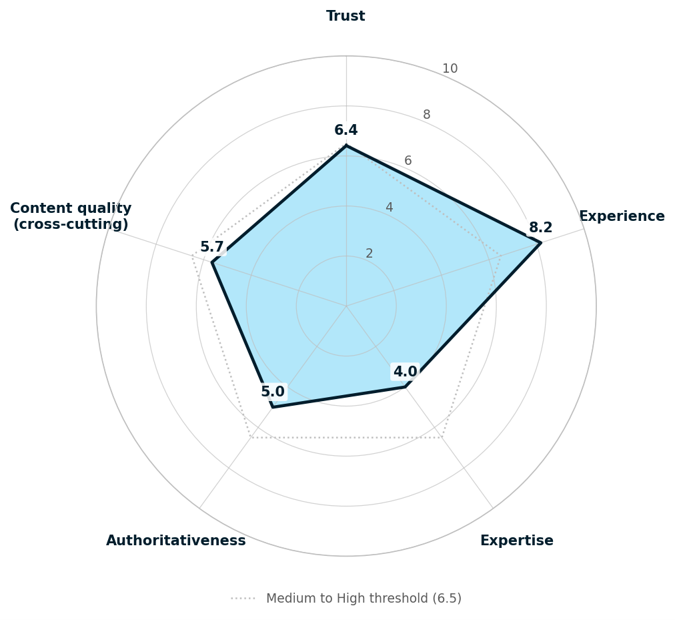
Trust, Experience, Expertise, Authoritativeness and Content Quality each receive their own score, alongside an overall grade on Google’s five-tier Page Quality scale. Crucially, the grade is derived by rule rather than by averaging, in the same way Google’s guidance works: a single failure on a heavily weighted factor holds a site down regardless of how well it performs elsewhere.
It researches reputation off-site
Following the method Google sets out for its raters, the tool searches independent sources with the site’s own pages excluded, then reads what those sources actually say. Company registration, directorships, filing status and any relevant regulatory records are confirmed against primary public sources. Review platforms are examined individually rather than averaged together, and the backlink profile is reviewed at portfolio level.
It grades every page individually
Each URL receives its own grade with the reason stated rather than implied, so you can see exactly why one page has been marked down against its neighbours. The audit then produces a prioritised action list, ordered by improvement per unit of effort, with each action mapped to the specific factors it would lift — alongside a risks section, because several of the changes an E-E-A-T audit recommends carry commercial or reputational consequences that need thinking about before anyone acts on them.
The most common finding is not that a business lacks expertise. It is that the expertise is real and the site does not evidence it anywhere a search engine, or a customer, would look for it. That is a very different problem to solve, and a considerably cheaper one, because it rarely calls for new content. It calls for evidence.
2. The Cluster Generator
Topic clusters remain one of the most effective ways to build topical authority. A well-built cluster combines an authoritative hub page with supporting content that covers the subject properly, connected by a sensible internal linking structure.
Our Cluster Generator produces two documents for each topic, because a cluster can fail in two quite different ways.
The content hub map
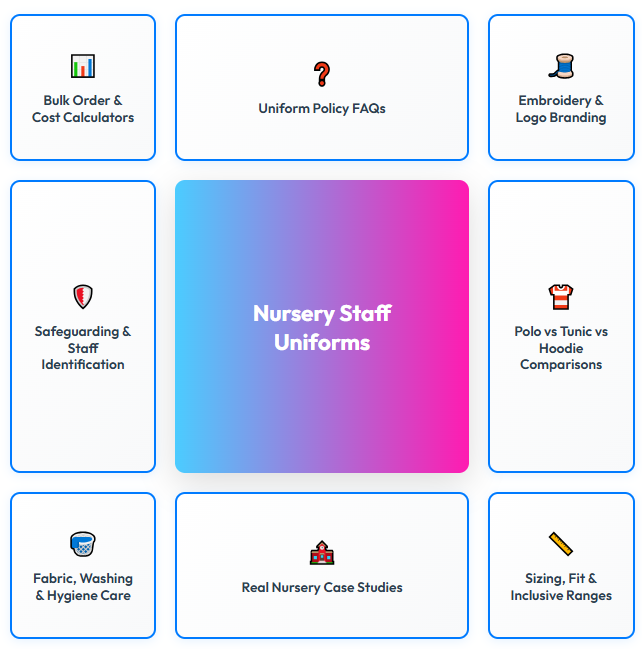
This sets out the pillar page and the supporting content that needs to sit around it. The tool identifies the specific questions a potential customer wants answered on that topic — the guides, the FAQs, the comparisons, the sizing and specification content, the case studies, the calculators — and maps them against what already exists on the site.
The content funnel map
The second document places each of those pieces at the right stage of the buying journey, with target keywords and a search intent classification for each stage.
This exists because clusters commonly fail in one direction or the other. Sites either produce a great deal of top-of-funnel awareness content that never leads anywhere commercially, or they jump straight to product and category pages and never capture anyone who is still researching. Mapping the cluster across the funnel makes those gaps visible before anything is written.
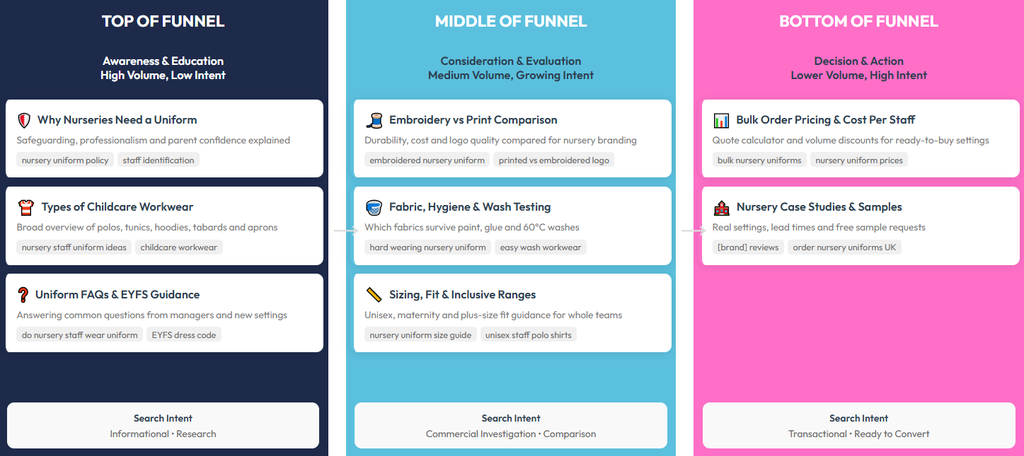
Both documents are client-ready, which matters more than it sounds. A content plan that has to be translated out of a spreadsheet before anyone can discuss it tends not to get discussed.
Our strategists then apply the commercial judgement the tool cannot. A content plan is only useful if it reflects your margins, your sales cycle, the products you actually want to sell, and what your team is realistically able to produce. The end result is a website that hosts genuinely helpful content for your users.
Not only does this help with achieving better results in traditional search, but also helps get you cited within AI search results too.
3. Search Console Analysis
Google Search Console is the most valuable free dataset available in SEO, and for most businesses it is also the most underused. The volume is simply too great. Thousands of queries, hundreds of pages and sixteen months of history make anything beyond surface-level analysis very time consuming.
We have built analysis on top of the Search Console API that surfaces the insights a human would find given unlimited time:
- Pages sitting in striking distance, where a modest improvement would deliver a disproportionate increase in traffic
- Queries where impressions are growing but click-through rate is not keeping pace, which usually points to a title or meta description issue
- Content that is gradually decaying and needs refreshing
- Cannibalisation between pages competing for the same intent
- Emerging queries that you are picking up incidentally and could target deliberately
None of this is new in principle. What has changed is that these insights now surface every month as a matter of course, rather than whenever somebody has a spare afternoon.
4. Ranking Analysis Reports
Rank tracking has been a solved problem for many years. Rank reporting has not.
Most ranking reports tell you what happened. Positions moved up, positions moved down, and here is a chart showing it. What they rarely tell you is why it matters, or what should happen next.
Our ranking analysis reports connect movement to meaning:
- Which changes are commercially significant and which are simply volatility
- Where competitors have gained ground, and what appears to have driven it
- Which movements correlate with work we have delivered
- What the overall pattern suggests should be prioritised in the coming month
The analysis is produced automatically. The recommendation is written by your account team. You receive both every month, rather than a lengthy PDF that takes an hour to interpret.
What this means for your retainer
This is the part that matters most if you are the one paying the invoice.
You get more delivered for the same investment. The hours that previously went into data preparation now go into analysis and implementation. The fee has not changed, but the amount of meaningful work within it has.
You get depth that was not previously affordable. A full E-E-A-T audit of the kind described above, researched against primary public records and independent review sources, used to be a separately scoped project with its own price. For many of our clients, that work now sits within the standard monthly retainer.
Your monthly calls become more useful. We spend less time walking through figures you could read yourself, and more time on the questions that genuinely require both parties in the room. Where should you compete? What are you deliberately choosing not to do? How does the SEO strategy connect with paid media, email and the wider business?
We can react more quickly. When analysis takes hours rather than weeks, we are able to respond to a ranking drop, an algorithm update or a competitor’s activity while it is still relevant.
You get results. See our case study on how we helped GB DIY with their SEO and content, getting them a bigger share of clicks and bringing them in line with category leaders.
What AI does not do
It is worth being clear about the limits, because a great deal of marketing at the moment is not.
AI is extremely effective at work that is large in volume, repetitive and pattern-based. It is not a strategist. It does not know that your strongest margins sit in one product line while your highest traffic sits in another. It does not know that your sales team cannot yet service a particular region, that a competitor is about to be acquired, or that your managing director has strong views about a specific market.
The E-E-A-T Checker is a good illustration. It can establish that an article is credited to one person while the section it sits in is credited to another, and it can recommend resolving that contradiction. It cannot tell you which of the two versions is actually true, or whether the person concerned is willing to publish the credentials that would make the claim checkable. Those are conversations, not outputs, and getting them wrong carries a reputational cost that no tool is in a position to weigh.
Every output from every tool described in this post is reviewed by someone who understands your business before it reaches you. The tools determine what is worth looking at. Our team determines what is worth doing.
The same applies to the content itself. AI is a useful tool for research, structuring and analysis, but the experience and expertise Google is increasingly looking for cannot be generated. It has to come from people who genuinely know the subject.
Conclusion
AI has not replaced anyone in our SEO delivery team. What it has done is remove a substantial amount of the administrative work that used to sit between our team and the work that actually improves performance.
For our clients, the practical result is a retainer that delivers more analysis, more implementation and more strategic input for the same investment, along with a depth of auditing and planning that would previously have required a separate project.
It is also worth saying that this work carries forward. The signals these tools assess — evidenced expertise, named authors, substantiated claims, content that answers real questions at every stage of the journey — are the same signals Google’s AI-driven search surfaces are drawing on. Work done here is not spent solely on the current interface.
At Anicca, we’re constantly evolving our SEO service and finding ways to bring clients better value for money, and our team will continue to develop new AI tools to make our work more valuable to you.
Talk to our SEO team
If your current SEO retainer feels as though it produces a good deal of reporting but limited progress, we would be happy to talk through what this approach would look like for your business.
About the author
Brad Longman – View Bio
Head of Owned & Earned Media, Anicca Digital
I have worked in SEO for over 15 years, the last 11 of them at Anicca. I have seen a great deal change across that time, from the algorithm updates that reshaped how content was written, through to the arrival of AI Overviews and AI Mode and the questions those raise about where search traffic goes next. The tools described in this post are our response to the most recent of those changes, and I am always happy to talk through how they would apply to a particular site.